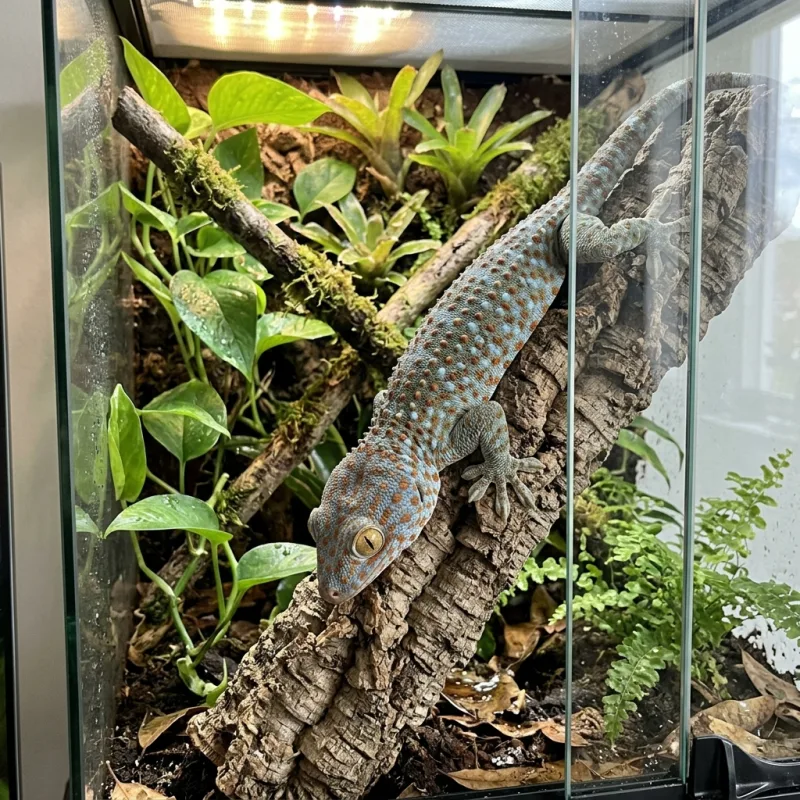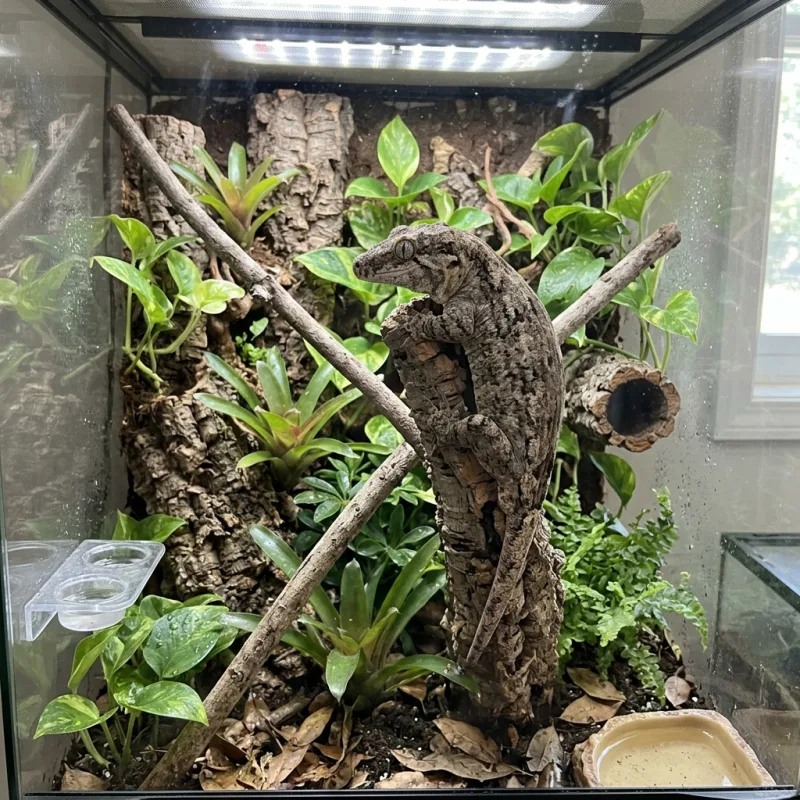
Gargoyle Gecko
Rhacodactylus auriculatus
Bumpy-headed gecko that regrows its tailBeginner
- Lifespan
- 15-20 years
- Size
- 8-10 in20-25 cm (incl. tail)
- Social needs
- Solitary; house singly
- Time
- Low; evening feed, regular mist
- Cost
- Low-Medium
- Diet
- Omnivore (complete diet + insects)
Overview
What is this animal?
- The gargoyle gecko, from southern New Caledonia, is named for the cranial bumps above its eyes that resemble small horns.
- It is a hardy, arboreal, nocturnal species with care almost identical to the crested gecko, which makes it a good and slightly less common beginner gecko.
- Unlike crested geckos, gargoyles can regrow a dropped tail, and they are noted for a bolder, more predatory streak.
- They tolerate normal room temperatures well, so they are inexpensive to run, but they still need height, cover and steady moderate humidity to do well.
Temperament
- Gargoyle geckos are generally calm and become tame with gentle, regular handling, though they can be quick and are capable jumpers, so handle low over a soft surface.
- They are nocturnal, so expect them to be most active and confident in the evening.
Show 3 more
- They must be housed singly.
- Adults, particularly males, are territorial and will bite and fight, and their predatory nature means they may injure smaller cage mates.
- Solo housing is the responsible standard and avoids stress and injury.
A good fit for
- Beginners wanting an easy arboreal gecko
- Keepers without room for heat lamps
- People who like a complete powdered diet
- Those wanting a slightly less common gecko
Common mistakes to avoid
- Overheating above 82-84°F28-29°C
- Housing two together (territorial bites)
- Skipping calcium and UVB
- Feeding only fruit or baby food
Enclosure
Minimum 2.2 sq ft0.2 m² of floor · 18 x 18 x 35 in45 x 45 x 90 cm
Must be housed alone. Solitary; house singly
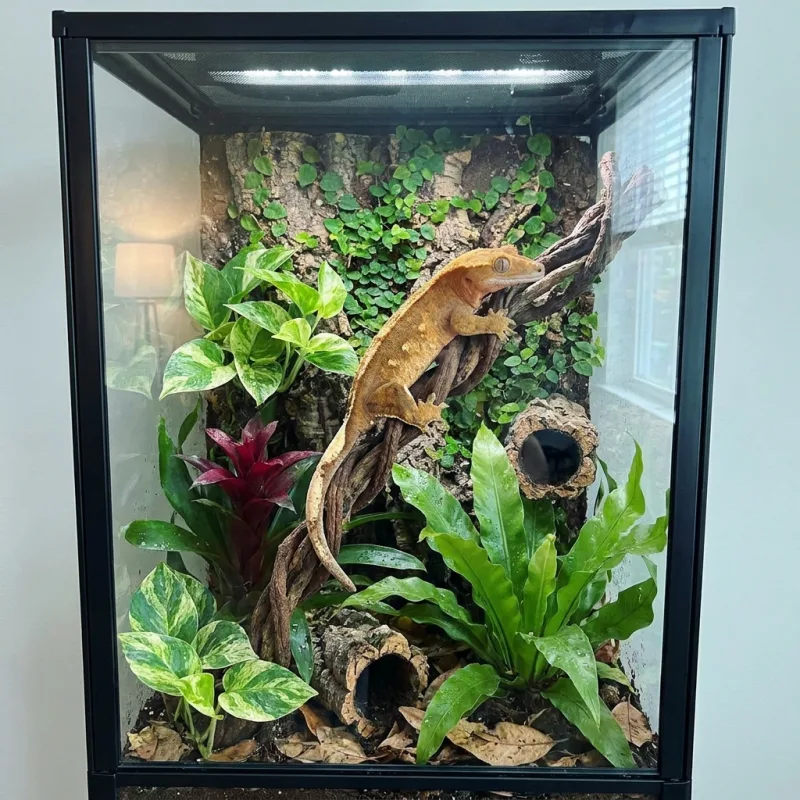
- Provide a tall, well-ventilated vivarium of at least 18 x 18 x 36 in45 x 45 x 90 cm for one adult, well planted with branches, cork bark and foliage for climbing and security.
- It climbs, but not always ably, so it needs floor space as well as height, and a bioactive setup helps maintain humidity naturally.
- Keep temperatures around 72-79°F22-26°C, avoiding sustained heat above 82-84°F28-29°C, which is stressful, so a strong basking lamp is rarely needed indoors.
Show 2 more
- A low-output UVB tube is beneficial.
- Mist once or twice daily to hold humidity around 50-70%, letting the enclosure dry partly between mistings to prevent mould and respiratory disease.
Supplies
Setup
- Enclosure, 18 x 18 x 36 in45 x 45 x 90 cm or larger
- Thermostat, and a low-wattage heat source only if the room falls below about 72°F22°C
- Low-output UVB fixture and bulb
- Thermometers and hygrometer
- Substrate, hides, plants and decor
Ongoing
- Complete powdered fruit-gecko or day-gecko nectar diet (for cresteds, gargoyles, chahouas, mourning and day geckos; not for leopard, fat-tailed or tokay geckos)
- Live crickets, dubia roaches or black soldier fly larvae
- Plain calcium powder without D3
- Calcium with D3 plus a reptile multivitamin
- Feeder gut-load and a ventilated feeder tub
Show 3 more
- Shallow ledge-mounted feeding cups (fruit-eating geckos)
- Blunt-tipped feeding tongs
- Shallow water dish
Safe substrate: Topsoil and play sand mix for arid geckos · Coco fibre and orchid bark for tropical geckos · Paper towel
Care routine
Daily
- Check temperatures and humidity
- Fresh water bowl
- Look the animal over
- Mist the enclosure
- Spot-clean waste and uneaten food
Show 8 more
Every few days
- Feed insects or prepared dietevery 2 days
- Check toes, tail tip and eyes after a shedevery 3 days
- Short handling session, species permittingevery 3 days
Every few weeks
- Weigh-inevery 2 weeks
Monthly
- Deep-clean decor, glass and bowls
- Test thermostats, lamps and guards
Less often
- Refresh the substrateevery 3 months
- Check the UVB lamp's age and replace it if due (if one is fitted)every 6 months
Vet: Annual exam and faecal check, every 12 months (every 6 months from 10 years old)
Tools
Care in depth
Diet
Omnivore (complete diet + insects)
- Gargoyle geckos do well on a commercial complete crested/gargoyle gecko diet, a powdered fruit-and-insect mix prepared with water and offered in a shallow dish several times a week.
- This balanced food can form the bulk of their nutrition and simplifies feeding considerably.
- They are more carnivorous than crested geckos and readily take gut-loaded, calcium-dusted live insects such as crickets and dubia roaches once or twice weekly.
- Avoid relying on plain fruit or baby food, which is unbalanced.
- Provide fresh water in a dish, though they also lap droplets from misted surfaces.
Health
Signs of good health, and the common problems
- Healthy gargoyles have clear eyes, full toe pads, a good appetite and steady weight.
- The main risks are metabolic bone disease from inadequate calcium or UVB, retained shed on the toes that can constrict them, and overheating, which can be rapidly fatal in this cool-tolerant species.
- A dropped tail will regenerate, though imperfectly, and is not an emergency.
- Any sudden change in weight, appetite or activity warrants attention from a vet experienced with exotics.
- Correct humidity and ventilation prevent most skin and respiratory problems.
Is this urgent?
4 warning signs and how fast to act, 1 of them right away
Small geckos dehydrate and lose condition quickly. Weight is the fuel gauge, and in leopard and African fat-tailed geckos so is the tail.
Go now
Today
This is general guidance for a healthy adult, not a diagnosis. An exotics vet who knows your animal always overrides it, and the time to find one is before you need one.
Bedding and substrate
3 safe, 1 with a caveat, 3 to avoid
Match the substrate to the species' humidity, and never let a small gecko stand on anything it can swallow whole.
Safe
With a caveat
Never
Ground-dwelling geckos such as leopard and fat-tailed geckos need a humid hide whatever the main substrate is, and most of their stuck sheds trace back to its absence. Arboreal geckos get their shedding humidity from misting the whole enclosure, so stuck shed in them usually means the enclosure is too dry.
Top resources for more info
Independent creators and organisations we would send a friend to. We have no affiliation with any of them, and nothing here is sponsored. Links checked 2026-10-22.
YouTubers
Sites
Geckos, side by side
Same axes, same care guides: the honest way to choose between types.