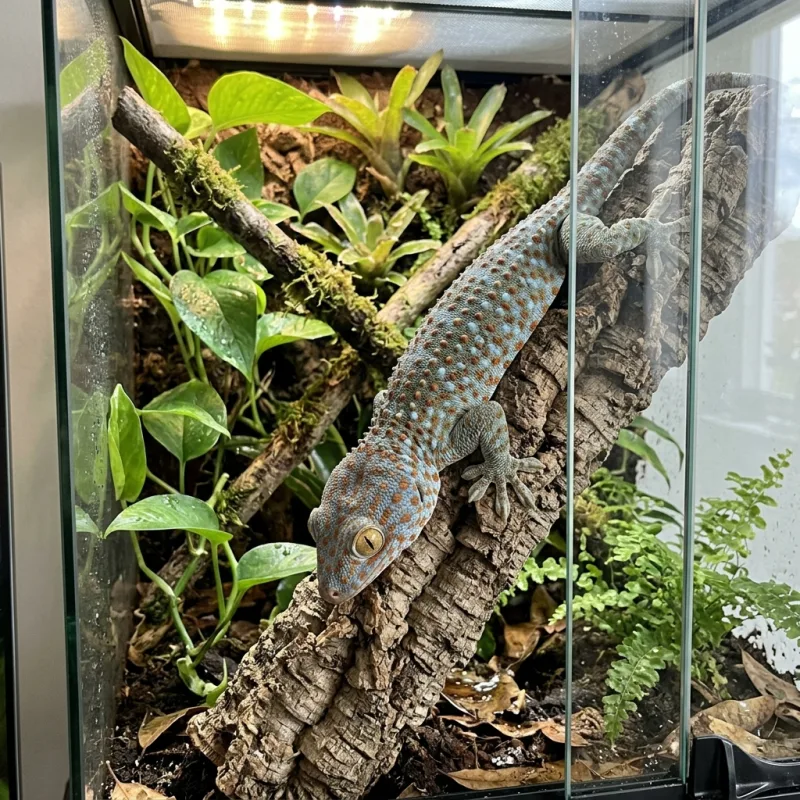
Tokay Gecko
Gekko gecko
Large, vocal, defensive display geckoAdvanced
- Lifespan
- 10-20 years
- Size
- 12-14 in30-35 cm
- Social needs
- Solitary; house singly
- Time
- Medium; feed, mist, minimal handling
- Cost
- Medium-High
- Diet
- Insectivore (live insects, occasional pinky)
Overview
What is this animal?
- The Tokay gecko, from the forests of South and Southeast Asia, is one of the largest and most striking geckos, blue-grey with orange and white spots and named for its loud 'to-kay' call.
- It is bold, fast and famously defensive, delivering a powerful, tenacious bite, so it is firmly an advanced, hands-off species.
- Despite their difficult temperament, Tokays are hardy and long-lived when their humidity and space needs are met.
Show 2 more
- Many sold are still wild-caught and arrive stressed or parasitised, so captive-bred animals and a quarantine plan matter.
- They suit experienced keepers who want an impressive vivarium occupant to observe, not to handle.
Temperament
- Tokay geckos are bold, territorial and highly defensive, gaping, lunging and biting hard when approached, and they will hold on.
- They are not a handling pet; interaction is largely limited to maintenance, and even calm individuals rarely become truly tame.
Show 4 more
- They are also loud, calling at night, which suits some keepers and not others.
- They are strictly solitary outside supervised breeding.
- Two will fight, often seriously.
- A single Tokay in a tall, well-planted vivarium, observed rather than handled, is the appropriate and humane way to keep this species.
A good fit for
- Experienced keepers wanting a bold display gecko
- Those happy with a hands-off, observe-only reptile
- Keepers who can source captive-bred animals
- People untroubled by loud nighttime calls
Common mistakes to avoid
- Expecting a handleable, tame gecko
- Wild-caught stress, parasites and mites
- Housing two together (serious fights)
- Low or stagnant humidity causing shed and respiratory issues
Enclosure
Minimum 4 sq ft0.36 m² of floor · 24 x 24 x 47 in60 x 60 x 120 cm
Must be housed alone. Solitary; house singly
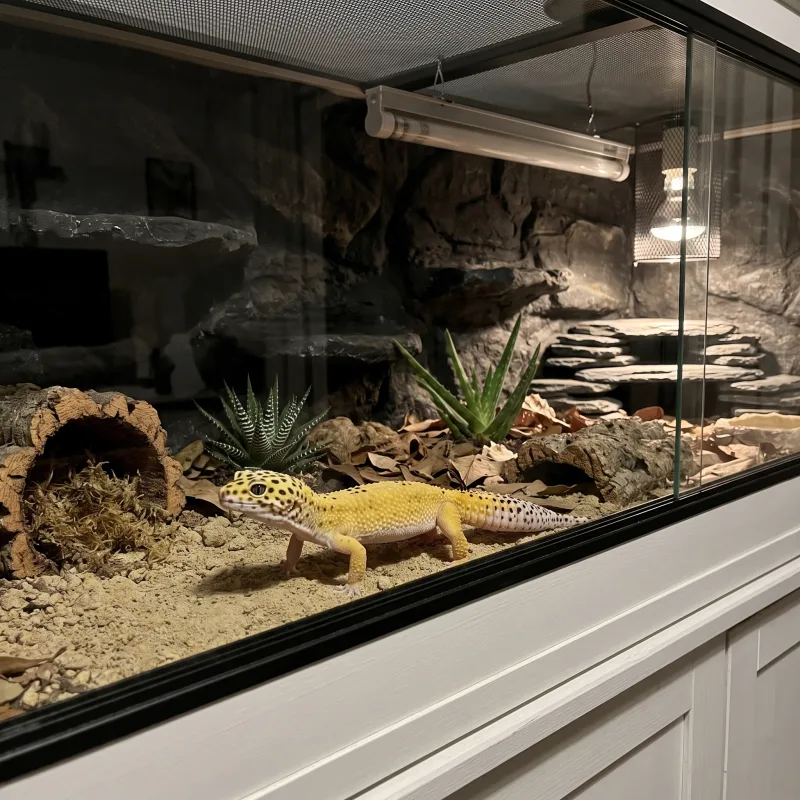
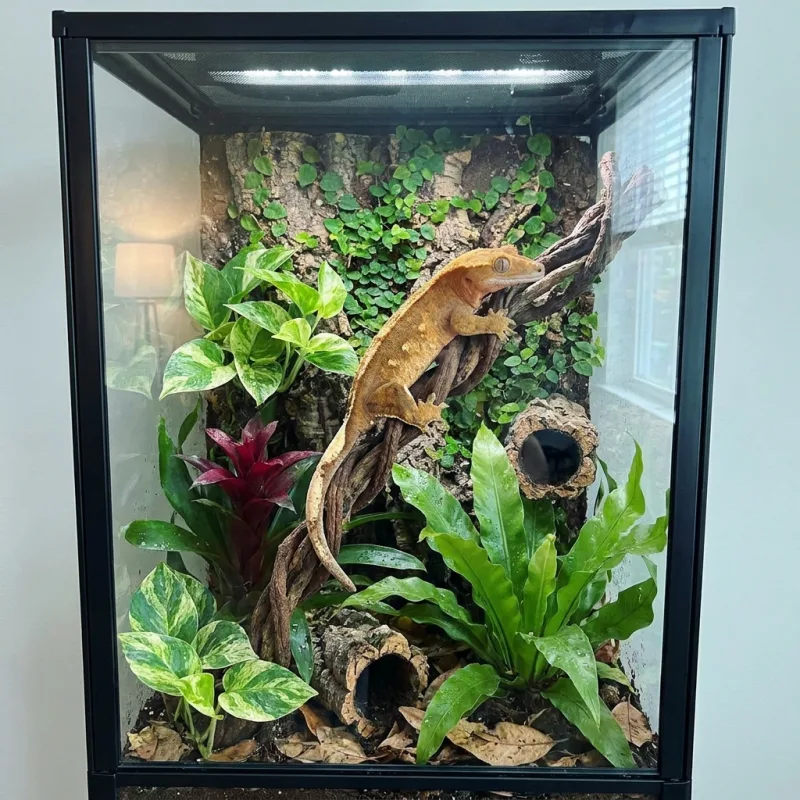
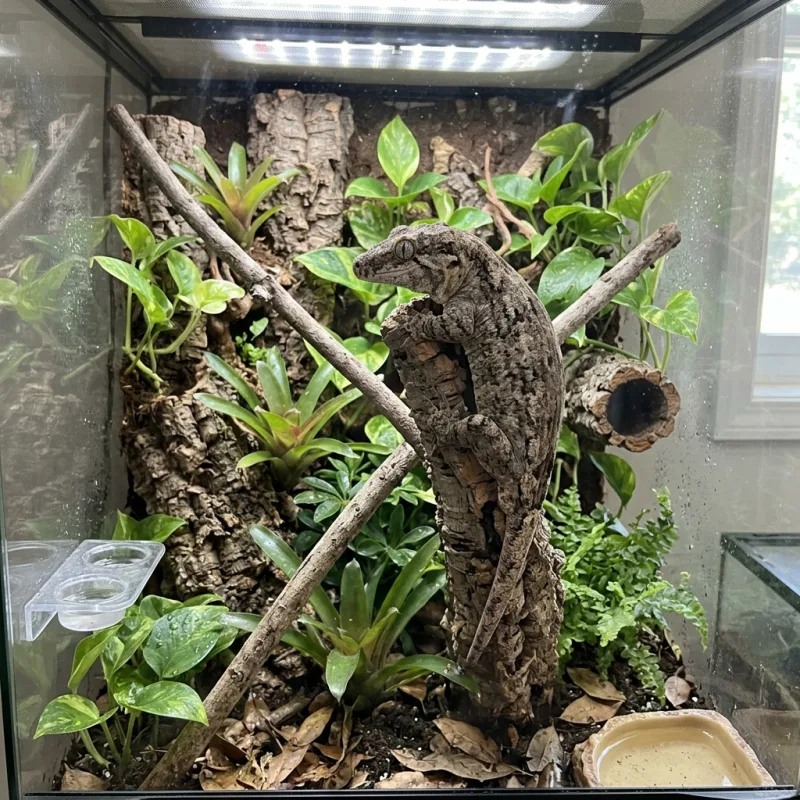
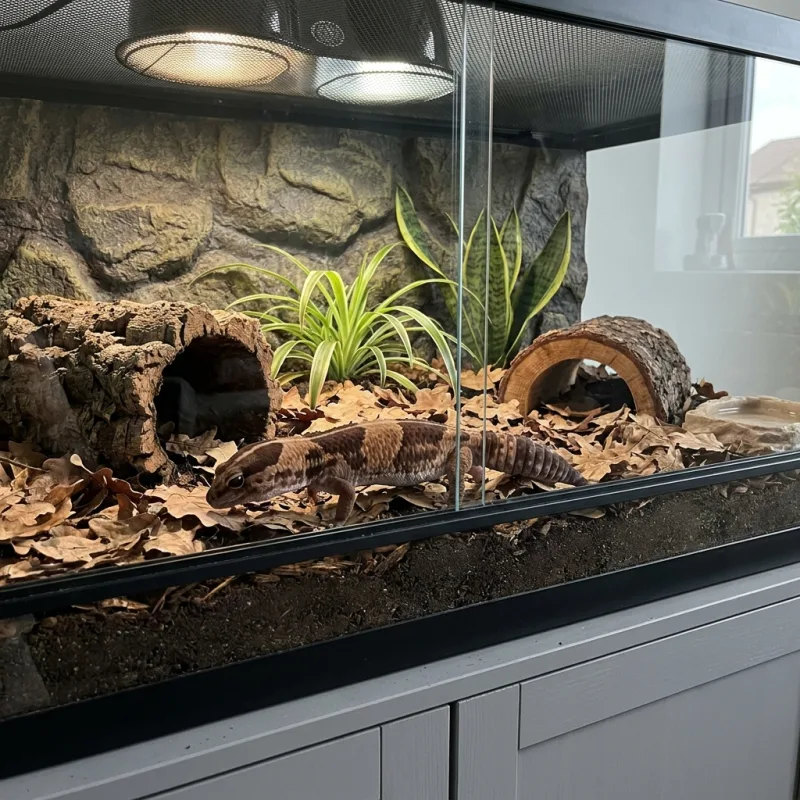
- House one adult in a tall, well-ventilated, securely latched vivarium of at least 24 x 24 x 48 in (60 x 60 x 120 cm (35 x 24 x 47 in90 x 60 x 120 cm for a particularly large adult), well furnished with cork bark, branches and live plants for climbing and dense cover.
- As a strong arboreal climber it needs vertical space and many hiding spots to feel secure and reduce defensive displays.
- Maintain a warm gradient of around 82-86°F28-30°C with a basking area near 90°F32°C and cooler shaded zones, plus a nighttime drop.
Show 2 more
- A low-output UVB tube is beneficial.
- Keep humidity high, around 60-80%, by misting daily, while ensuring good ventilation so the enclosure dries partly between mistings and avoids stagnant, mouldy conditions.
Supplies
Setup
- Enclosure, adult size
- Heating and thermostat
- UVB fixture and bulb (low output for nocturnal geckos, T5 high output for day geckos)
- Thermometers and hygrometer
- Substrate, hides including a humid hide, decor
Ongoing
- Complete powdered fruit-gecko or day-gecko nectar diet (for cresteds, gargoyles, chahouas, mourning and day geckos; not for leopard, fat-tailed or tokay geckos)
- Live crickets, dubia roaches or black soldier fly larvae
- Plain calcium powder without D3
- Calcium with D3 plus a reptile multivitamin
- Feeder gut-load and a ventilated feeder tub
Show 3 more
- Shallow ledge-mounted feeding cups (fruit-eating geckos)
- Blunt-tipped feeding tongs
- Shallow water dish
Safe substrate: Topsoil and play sand mix for arid geckos · Coco fibre and orchid bark for tropical geckos · Paper towel
Care routine
Daily
- Check temperatures and humidity
- Fresh water bowl
- Look the animal over
- Mist the enclosure
- Spot-clean waste and uneaten food
Show 8 more
Every few days
- Feed insects or prepared dietevery 2 days
- Check toes, tail tip and eyes after a shedevery 3 days
- Quiet observation session (no handling)every 3 days
Every few weeks
- Weigh-inevery 2 weeks
Monthly
- Deep-clean decor, glass and bowls
- Test thermostats, lamps and guards
Less often
- Refresh the substrateevery 3 months
- Check the UVB lamp's age and replace it if due (if one is fitted)every 6 months
Vet: Annual exam and faecal check, every 12 months (every 6 months from 10 years old)
Tools
Care in depth
Diet
Insectivore (live insects, occasional pinky)
- Tokay geckos are voracious insectivores.
- Feed a varied diet of gut-loaded, calcium-dusted live insects such as large crickets, dubia roaches and locusts, with the occasional appropriately sized pinky mouse for large adults.
- Their size means they take substantial prey, so match insect size to the gecko.
- Dust feeders with calcium and a vitamin/D3 supplement on a regular schedule to prevent metabolic bone disease.
- Feed juveniles daily and adults every other day, offering as many insects as the gecko will eat in about five minutes, none larger than its head; a pinky or a little complete gecko diet is a treat, no more than twice a month.
- Provide fresh water in a dish, though they drink mostly from misted droplets on leaves and glass.
Health
Signs of good health, and the common problems
- A healthy Tokay is muscular and alert with clear eyes, full toe pads and a strong appetite.
- Wild-caught animals commonly carry internal parasites and mites and arrive dehydrated, so a vet faecal check and quarantine are wise.
- Retained shed, metabolic bone disease and respiratory infections from cold or stagnant humidity are the main husbandry concerns.
- Because they are easily stressed, signs of illness such as lethargy, weight loss or laboured breathing can be subtle against their normally defensive behaviour.
- Use a vet experienced with exotics, and favour captive-bred stock to reduce disease and welfare problems.
Is this urgent?
4 warning signs and how fast to act, 1 of them right away
Small geckos dehydrate and lose condition quickly. Weight is the fuel gauge, and in leopard and African fat-tailed geckos so is the tail.
Go now
Today
This is general guidance for a healthy adult, not a diagnosis. An exotics vet who knows your animal always overrides it, and the time to find one is before you need one.
Bedding and substrate
3 safe, 1 with a caveat, 3 to avoid
Match the substrate to the species' humidity, and never let a small gecko stand on anything it can swallow whole.
Safe
With a caveat
Never
Ground-dwelling geckos such as leopard and fat-tailed geckos need a humid hide whatever the main substrate is, and most of their stuck sheds trace back to its absence. Arboreal geckos get their shedding humidity from misting the whole enclosure, so stuck shed in them usually means the enclosure is too dry.
Top resources for more info
Independent creators and organisations we would send a friend to. We have no affiliation with any of them, and nothing here is sponsored. Links checked 2026-10-22.
YouTubers
Sites
Geckos, side by side
Same axes, same care guides: the honest way to choose between types.