Roborovski Dwarf Hamster
Small Pets · Hamsters

Roborovski Dwarf Hamster

Phodopus roborovskii

Tiny, fast, better watched than handledIntermediate

Lifespan
2-3 years
Size
2-3 in
Social needs
Strictly solitary
Time
Low-Medium (daily)
Cost
Low-Medium
Diet
Granivore hamster mix

Overview

What is this animal?

  • The Roborovski is the smallest and fastest pet hamster, an energetic desert species better suited to watching than handling.
  • Its speed and skittishness make it a poor fit for young children but a good choice for observant keepers.
  • Robos are best kept one per enclosure.
Show 2 more
  • Some welfare bodies, the RSPCA among them, say dwarf hamsters can share, but pairs and groups sold as compatible often fall out as adults, sometimes overnight and without warning, and the injuries can be serious.
  • One hamster, one enclosure is the safe choice.

Temperament

  • Robos rarely tame for handling, being fast, jumpy, and disliking being held.
  • They reward keepers who enjoy watching natural burrowing, foraging, and wheel-running.
Show 2 more
  • They are curious and rarely bite, but their darting movements mean drops and escapes are the real danger.
  • Treat them as a display pet to observe rather than a hands-on companion.

A good fit for

  • Keepers who prefer watching to handling
  • Hands-off observers and hobbyists
  • People wanting a hardy, active hamster
  • Adults rather than very young children

Common mistakes to avoid

  • Expecting a cuddly, handleable pet
  • Tiny cages that frustrate this active species
  • Escapes through small gaps or open hands
  • Housing two together, which ends in fights

Enclosure

Minimum 5.5 sq ft of floor · 39 x 20 in

Must be housed alone. Strictly solitary

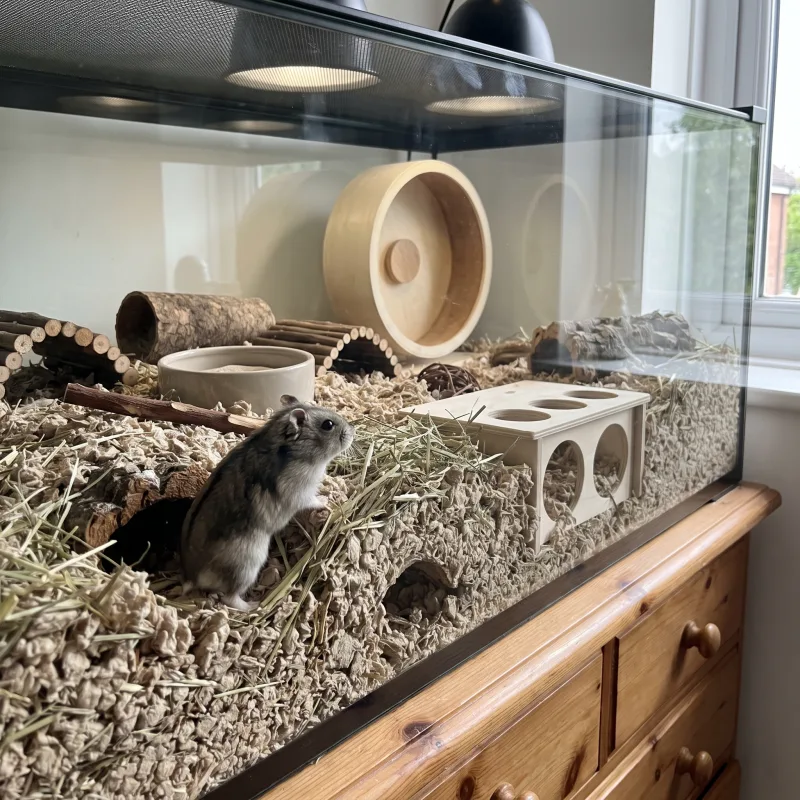
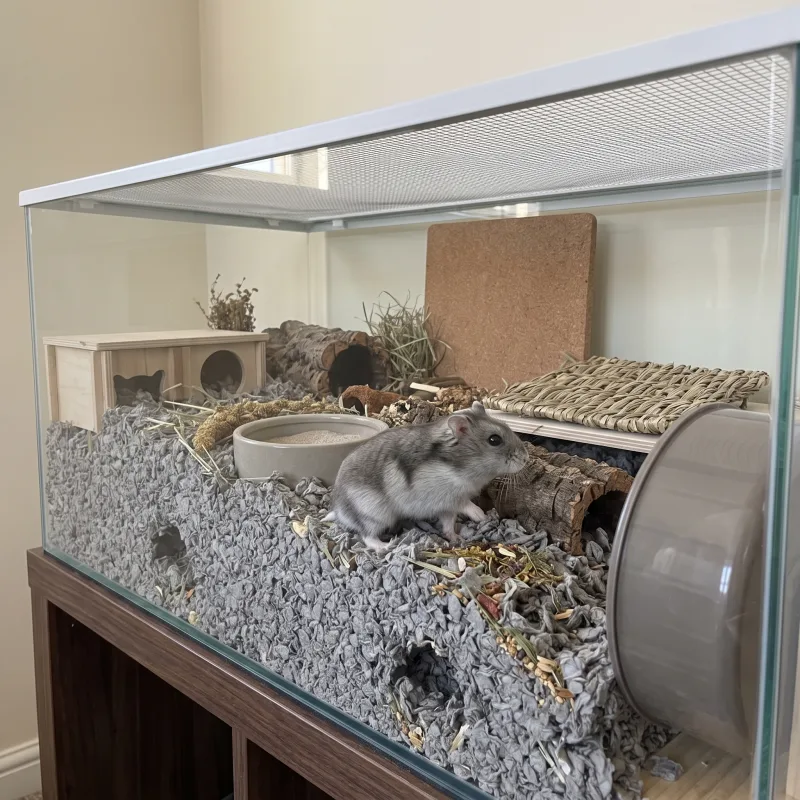
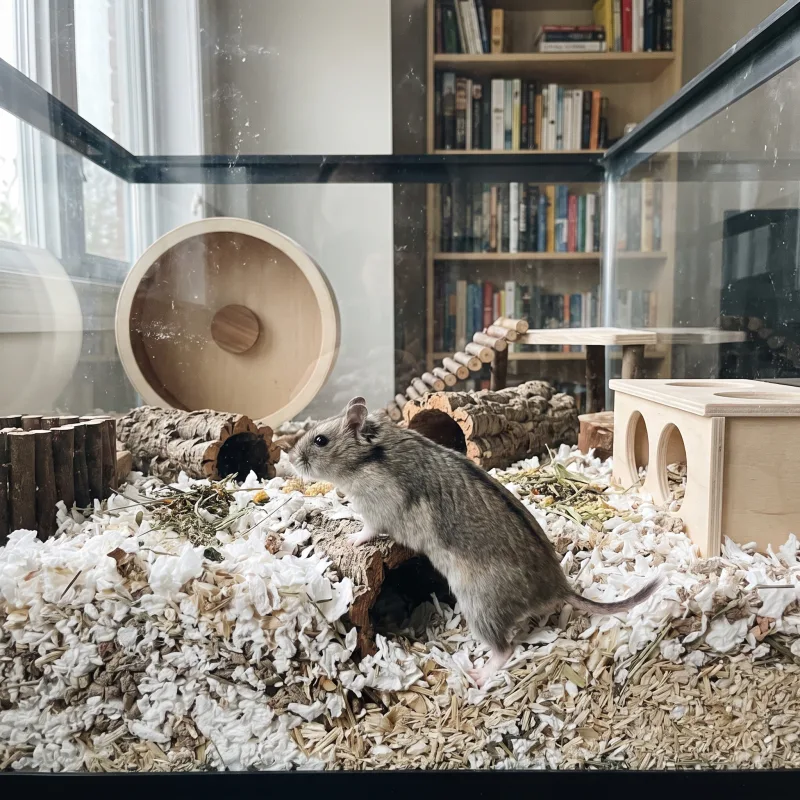
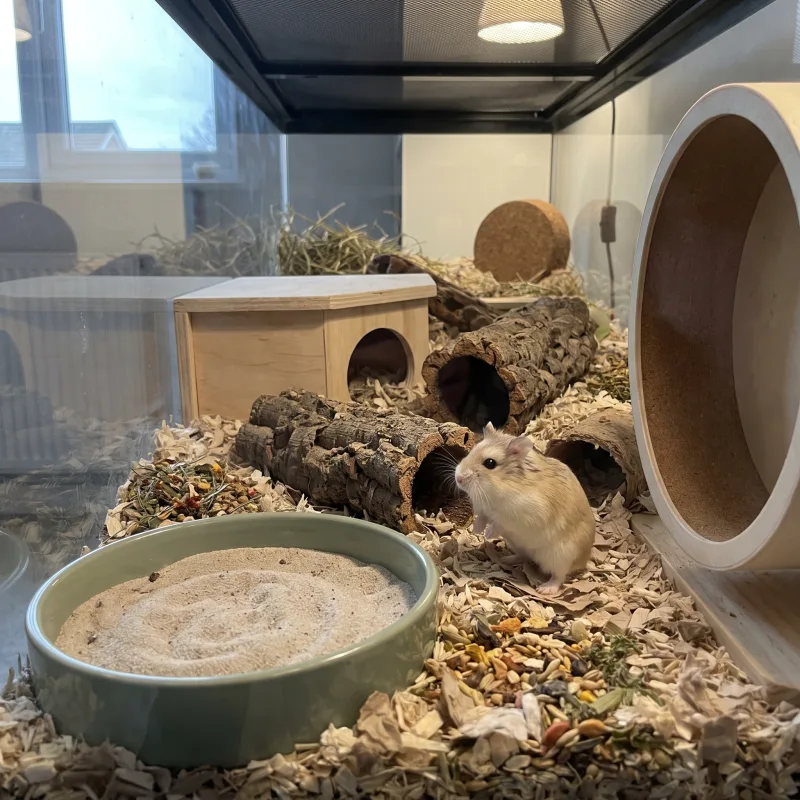
  • Give at least 39 x 20 in of unbroken floor, the minimum for every hamster, and more if you can, because robos are intensely active.
  • Provide deep bedding of 16 in or more for burrowing, the depth TVT, the German veterinary association for animal welfare, says dwarf hamsters use readily (never less than 8 in), held by solid sides about 20 in high, and a solid wheel of at least 10 in, TVT's minimum for every dwarf hamster.
  • As a desert animal, a deep sand bath is essential for coat and behaviour.
Show 2 more
  • Keep at 64-75°F.
  • Use a tank or low-barred enclosure they cannot squeeze through, as these tiny animals fit through surprisingly small gaps.

Check your enclosure

Supplies

Setup

  • Enclosure with 5.5 square feet or more of unbroken floor, and 11 square feet for a Syrian
  • Deep bedding, first fill
  • Solid-surface wheel sized to the species
  • Sand bath, hides, chews, bowls

Ongoing

  • Quality seed-and-grain hamster mix (low sugar, no added fruit for dwarfs)
  • Dried mealworms or a small live culture
  • Cuttlebone
  • Untreated apple or willow chew sticks
  • Water bottle with a bottle brush
Show 3 more
  • Small ceramic dish for fresh food
  • Kitchen scale for weekly weigh-ins
  • Airtight food storage tub

Safe substrate: Dust-extracted paper bedding, 16 in deep or more · Kiln-dried aspen · Plain chinchilla bathing sand in a heavy dish

Work out the cost

Care routine

Daily

  • Company and time out
  • Fresh water
  • Scatter-feed the mix
  • Spot-clean the enclosure
  • Watch them while they are awake
Show 9 more

Weekly

  • Change the sand bath
  • Check the wheel
  • Hands-on health check
  • Rotate enrichment
  • Weigh-in

Every few weeks

  • Top the bedding back upevery 2 weeks

Monthly

  • Check nails and teeth
  • Check supplies and dates
  • Partial clean, keeping the burrow

Vet: Six-monthly exam, every 6 months (every 3 months from 1.5 years old)

Tools

Care in depth

Diet

Granivore hamster mix
  • Offer a varied granivore mix of small seeds, grains, and millet, scatter-fed for natural foraging.
  • Robos have fast metabolisms and benefit from plenty of opportunity to forage and stay active.
  • Add occasional protein such as a mealworm and tiny amounts of fresh vegetables.
  • Avoid sugary treats and citrus.
  • Provide constant fresh water and gnawing materials to wear down the continuously growing teeth.

Health

Signs of good health, and the common problems
  • Generally hardy and among the longer-lived hamsters, but prone to obesity if under-exercised and to stress in cramped housing.
  • Diabetes risk is lower than in Campbell's, but a low-sugar diet is still sensible.
  • Watch for overgrown teeth and skin issues.
  • Their speed makes escape and injury the main practical risks.
  • Handle low over a contained surface.
  • Any limping, weight loss, lethargy, or wet rear needs an exotic vet.

Is this urgent?

4 warning signs and how fast to act, 2 of them right away

A hamster is small enough that a day of illness is a large fraction of its reserves. Do not wait a weekend out.

Go now

Watery diarrhoea, a wet or soiled tail area, lethargyGo now. Keep the hamster warm in transit. Severe infectious diarrhoea, most common in young hamsters, and often fatal within 48 hours untreated.
Now
Cold and unresponsive but not stiffWarm the hamster slowly with body heat and call. Do not assume it has died. Dwarf and Syrian hamsters can enter a torpor that looks like death when the room gets cold.
Now

Today

Not eating, or a full food store left untouchedCall today. A hoarding animal that stops hoarding has usually stopped eating too.
Today

Soon

A lump that is growing, or an open soreBook an appointment. Common in older hamsters and easier to address while small.
This week

Bar-biting, pacing and repetitive route-running are not personality. They are the signs of an enclosure that is too small.

This is general guidance for a healthy adult, not a diagnosis. An exotics vet who knows your animal always overrides it, and the time to find one is before you need one.

Bedding and substrate

4 safe, 1 with a caveat, 4 to avoid

Depth is the whole point. A hamster with 16 in of paper bedding behaves like a different animal to one with 1.2 in.

Safe

Dust-extracted paper bedding, 16 in deep or moreDeep enough to hold a tunnel that does not collapse: TVT and Swiss Animal Protection give 16 in, and never less than 8-10 in. This is the single biggest enrichment change you can make.
safe
Kiln-dried aspenMixes well with paper to give the burrow structure.
safe
Plain chinchilla bathing sand in a heavy dishFor coat condition. Sand, never dust.
safe
Hay and plain toilet paper for nestingSafe nesting material a hamster can shred itself.
safe

With a caveat

HempGood absorbency, but on its own it does not hold a burrow. Mix with paper.
with a caveat

Never

Fluffy cotton-wool nesting materialWraps around limbs and is swallowed. Repeatedly implicated in limb injuries and blockages in hamsters.
never
Pine and cedar shavingsAromatic oils; airway irritation and liver effects.
never
Raw corncobBlockage risk, and it moulds.
never
Scented beddingThe hamster's nose lives in it.
never

Top resources for more info

Independent creators and organisations we would send a friend to. We have no affiliation with any of them, and nothing here is sponsored. Links checked 2026-10-22.

YouTubers

Sites

Keep going

Hamsters, side by side

Same axes, same care guides: the honest way to choose between types.
More Small Pets guides

Is your enclosure big enough?

These are the smallest sizes that give good conditions, not legal minimums. More room is always better.

Minimum 5.5 sq ft of floor · 39 x 20 in

Every figure, and where it comes from

Height is not checked, because the bedding, not climbing, is what needs it: 16 in of bedding takes solid sides about 20 in high and an enclosure at least 24 in tall.

Minimum floor area5.5 sq ft of continuous, unbroken floor
As dimensions39 x 20 in
CompanyMust be housed alone. Strictly solitary
The recognised standards do not agree on this one
TVT, the German veterinary association for animal welfare; PDSA; Wood Green, The Animals Charity; Blue Cross (UK): 5.5 sq ft, for example 39 x 20 in, as a minimum. The figure this site uses. TVT's dwarf hamster leaflet (2025) says it should not be undercut, PDSA and Blue Cross that bigger is better, and Wood Green gives it for Chinese and dwarf hamsters alike. Checked 2026-10-23.
Swiss Animal Protection STS, for dwarf hamsters: At least 8 sq ft, better 11 sq ft, and at least 24 in high. A larger standard. The leaflet gives the Chinese hamster no separate figure. Checked 2026-10-23.
Austria, 2. Tierhaltungsverordnung (legal minimum, every hamster): 24 x 12 x 16 in, with at least 2 in of diggable bedding. A legal minimum, recorded for context. Checked 2026-10-23.
US Animal Welfare Act regulations, 9 CFR 3.28 (licensed dealers, exhibitors and research facilities only; there is no legal minimum for a pet cage): 10-19 sq in per hamster, by body weight. Recorded for context, not endorsed. The 121 sq in often quoted from it is the rule's figure for a nursing female with her litter. PetMD, by contrast, advises at least 6.5 sq ft of floor for a Syrian and 5 sq ft for dwarf and Chinese hamsters. Checked 2026-10-22.

What it really costs

Setup, monthly, first year and across a whole life, itemised and with the electricity worked out from the actual wattage. Published figures for the same animal disagree by a factor of four, so the calculator shows ranges rather than picking one.

Can a Roborovski Dwarf Hamster eat that?

Dwarf and Chinese hamsters are granivores with an omnivorous streak, and most of them are prone to diabetes. Scatter-feed a varied, low-sugar seed mix, and leave fruit and sweet vegetables out.

The full list: 26 foods

Never (20)

AlcoholNo safe amount at any body weight on this site.
never
AlmondsHigh in fat for an animal this size, and hard pieces can lodge in the cheek pouches.
never
AppleSugar, and most of these hamsters are prone to diabetes. Only a Syrian should have fruit, and then rarely.
never
AvocadoPersin, concentrated in the leaves, skin and stone. It damages the heart in birds and in many mammals, rabbits and rodents among them; it has not been studied in reptiles, so treat it as unsafe for them too.
never
BananaVery sugary, and it goes sticky in the cheek pouches.
never
CaffeineCoffee, tea and energy drinks. Cardiac and neurological toxicity at tiny doses for an animal this size.
never
CarrotA sugary root. Campbell's, winter white and Chinese hamsters are prone to diabetes; the Roborovski is less so, but a low-sugar diet is still the safe course.
never
ChocolateTheobromine and caffeine. Small mammals and reptiles cannot clear either.
never
CitrusToo acidic for a hamster's digestive tract.
never
FruitAll fruit is sugar, and most of these hamsters are prone to diabetes.
never
GarlicSame allium toxicity as onion, and more concentrated by weight.
never
Iceberg lettuceWater, no nutrition, and it causes diarrhoea in an animal that cannot afford to lose fluid.
never
LeekAllium family. Same mechanism as onion and garlic.
never
OnionOrganosulphur compounds damage red blood cells. The whole allium family is out.
never
PotatoSolanine in the raw skin and any green part.
never
Raw beansLectins.
never
RhubarbOxalates.
never
Salty or seasoned human foodSalt, oil and seasoning. Crisps, chips, seasoned leftovers and processed meat are all out.
never
Sticky foodsPeanut butter, dried fruit, anything gluey. It packs into the cheek pouches and causes impaction, which needs a vet to clear.
never
SweetcornSweet and starchy, which none of these hamsters needs.
never

Occasional (5)

BroccoliWell tolerated in small amounts. A piece the size of the hamster's ear, twice a week.
occasional
Cooked plain chickenUnseasoned, no skin. A pea-sized piece, weekly.
occasional
CucumberMostly water. Useful in hot weather, not as food. A thin slice.
occasional
MealwormsReal animal protein, and hamsters love them. One or two, a few times a week.
occasional
Plain cooked eggGood protein with nothing added. No salt, no oil, no butter. A pea-sized piece, weekly.
occasional

Everyday foods (1)

Grain-based hamster mixA varied mix of seeds, grains and dried vegetables, scattered through the bedding so the hamster has to forage for it. About a tablespoon a day for a Syrian, less for a dwarf.
everyday food

That food is not on our list. A hamster is small enough that a wrong food is a large dose. Leave it out.

Campbell's, winter white and Chinese hamsters are prone to diabetes; the Roborovski is less so, but a low-sugar diet is still the safe course. Heavy drinking, more urine or a change in weight are reasons to ask a vet for a urine test.