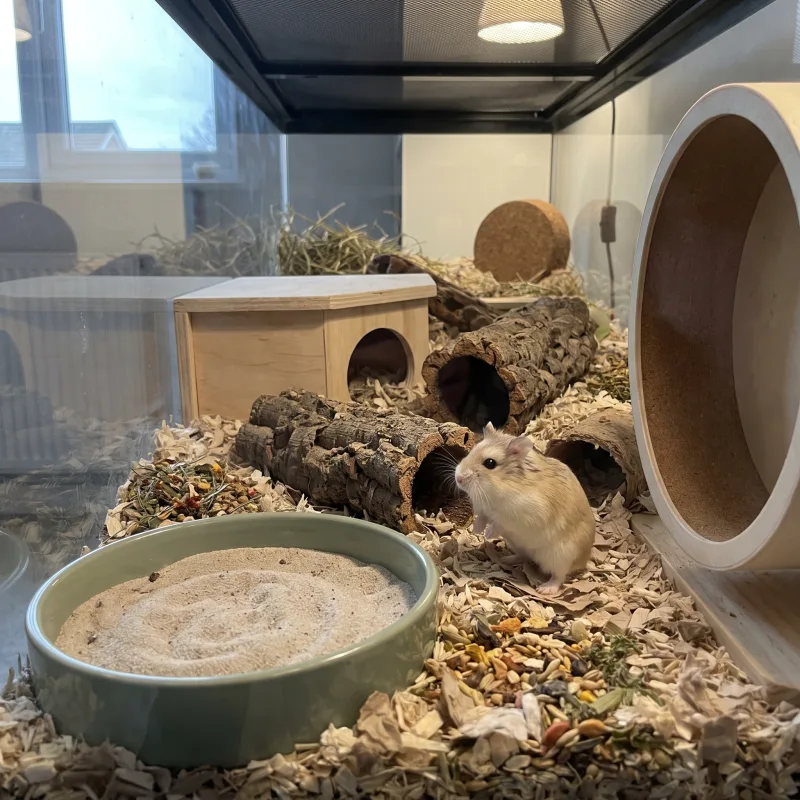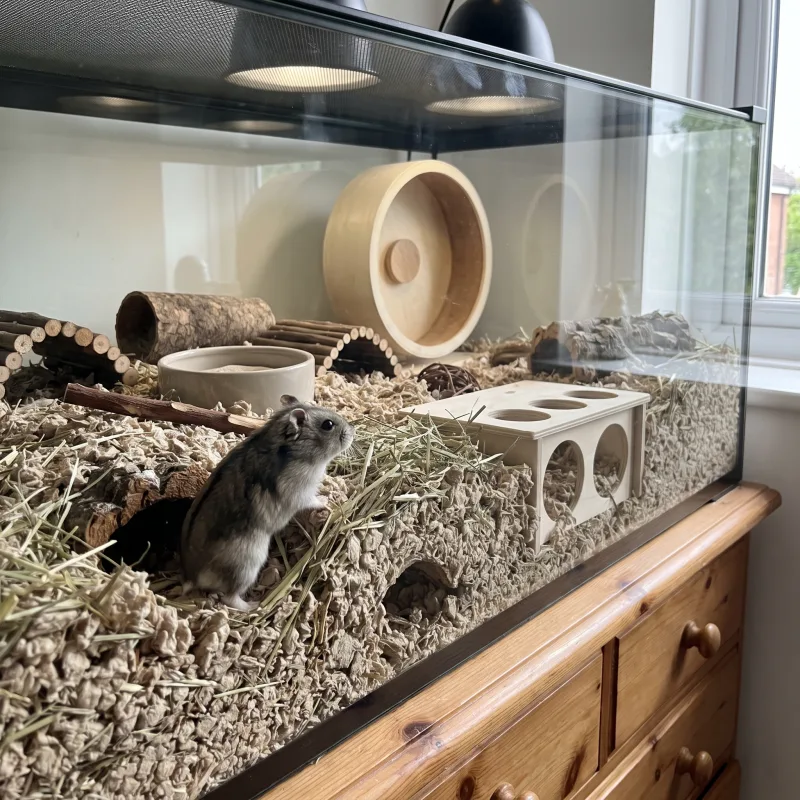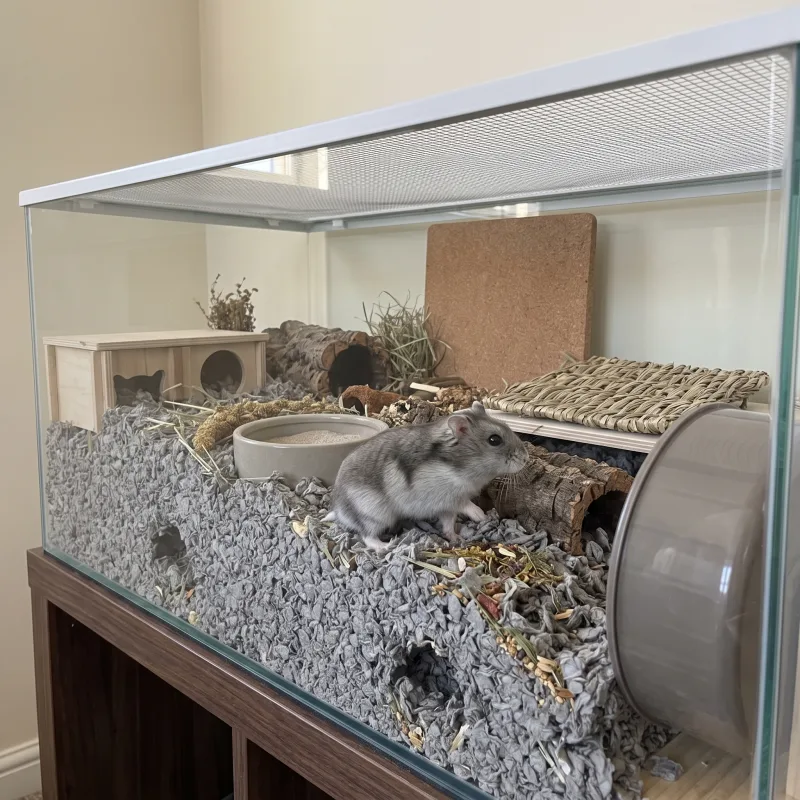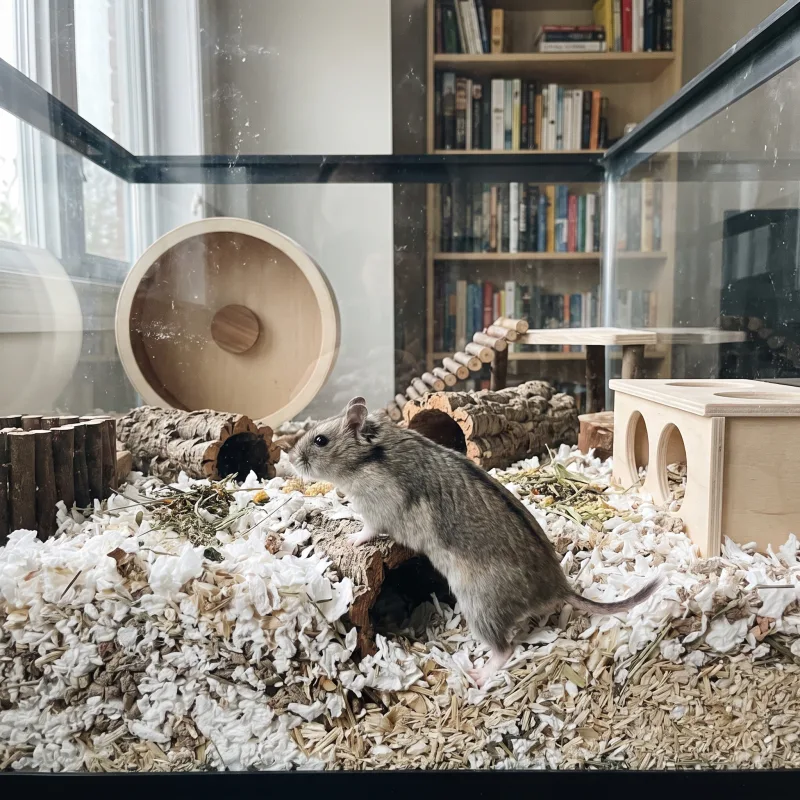
Syrian Hamster
Mesocricetus auratus
Solitary, easy-to-tame first hamsterBeginner
- Lifespan
- 2-3 years
- Size
- 5-7 in13-18 cm
- Social needs
- Strictly solitary
- Time
- Low-Medium (daily)
- Cost
- Low-Medium
- Diet
- Granivore/omnivore hamster mix
Overview
What is this animal?
- The Syrian, also called the golden or teddy bear hamster, is the largest and most commonly kept pet hamster.
- It is calm and easy to tame, which makes it a popular first small pet, but it is routinely housed in cages far too small for its needs.
- Syrians are nocturnal and territorial.
Show 2 more
- Adults must live alone, as pairing them leads to severe fighting and death.
- With patient, regular handling they become docile and tolerant of gentle interaction.
Temperament
- Syrians are generally placid, slow-moving, and among the easiest hamsters to hold once tamed.
- They are best handled in the evening when naturally awake, as waking a sleeping hamster can provoke a defensive nip.
Show 2 more
- They bond through routine and food-based trust rather than cuddling.
- Each animal has its own personality, but most settle into calm, predictable companions for gentle older children and adults.
A good fit for
- First-time small-pet keepers
- People wanting one solo pet with low running costs
- Gentle older children with supervision
- Evening and night-active households
Common mistakes to avoid
- Housing two together, which causes fatal fights
- Cages under 11 square feet1 square metre of unbroken floor
- Wheels under 12 in30 cm, risking spinal curving
- Ignoring wet tail, a fast-killing illness
Enclosure
Minimum 11 sq ft1 m² of floor · 49 x 31 in125 x 80 cm
Must be housed alone. Strictly solitary
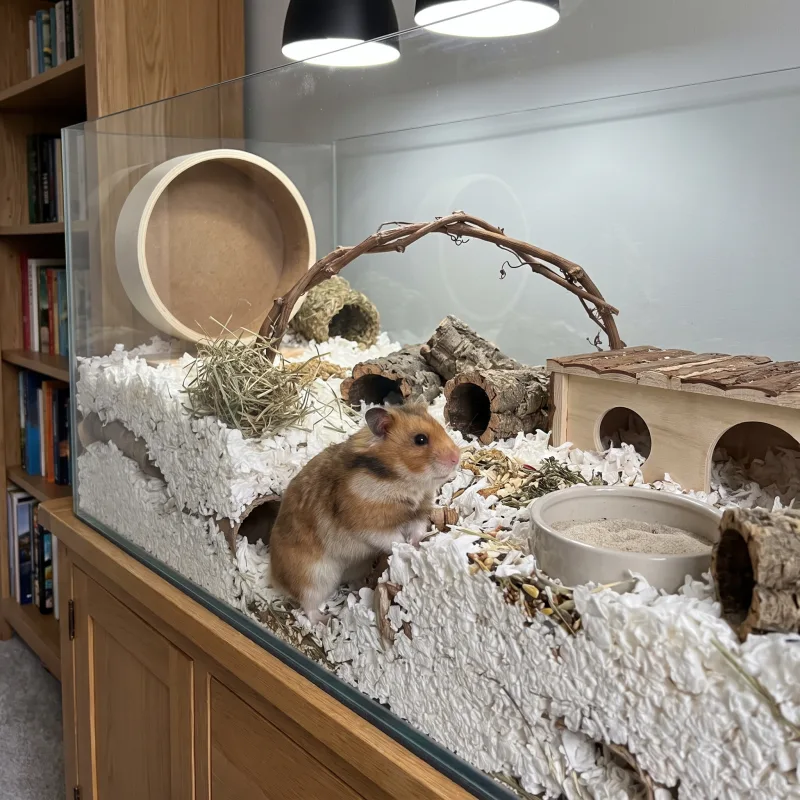
- Provide at least 10.8 sq ft1 square metre of continuous, unbroken floor, for example 49 x 31 in125 x 80 cm, with larger being better.
- That is the size TVT, the German veterinary association for animal welfare, and Swiss Animal Protection recommend for a Syrian, because studies show golden hamsters do better from 11 square feetone square metre; the 39 x 20 in100 x 50 cm many guides print is the floor no hamster should go below.
- Fill it with deep bedding of 16 in40 cm or more so the hamster can build natural burrows: TVT prefers 16 in40 cm and never less than 10 in25 cm, and Swiss Animal Protection asks for at least 16 in40 cm.
Show 5 more
- Holding that depth takes solid sides about 20 in50 cm high, in an enclosure at least 24 in60 cm tall.
- A solid (not wire) running wheel of at least 12 in30 cm diameter is essential to prevent spinal curvature.
- Keep the enclosure at 64-75°F18-24°C, away from drafts and direct sun.
- Avoid poorly ventilated tube systems.
- Include a sand bath, hides, and plenty of chews and forage to discourage bar-biting and stress.
Supplies
Setup
- Enclosure with 5.5 square feet0.5 square metres or more of unbroken floor, and 11 square feet1 square metre for a Syrian
- Deep bedding, first fill
- Solid-surface wheel sized to the species
- Sand bath, hides, chews, bowls
Ongoing
- Quality seed-and-grain hamster mix (low sugar, no added fruit for dwarfs)
- Dried mealworms or a small live culture
- Cuttlebone
- Untreated apple or willow chew sticks
- Water bottle with a bottle brush
Show 3 more
- Small ceramic dish for fresh food
- Kitchen scale for weekly weigh-ins
- Airtight food storage tub
Safe substrate: Dust-extracted paper bedding, 16 in40 cm deep or more · Kiln-dried aspen · Plain chinchilla bathing sand in a heavy dish
Care routine
Daily
- Company and time out
- Fresh water
- Scatter-feed the mix
- Spot-clean the enclosure
- Watch them while they are awake
Show 9 more
Weekly
- Change the sand bath
- Check the wheel
- Hands-on health check
- Rotate enrichment
- Weigh-in
Every few weeks
- Top the bedding back upevery 2 weeks
Monthly
- Check nails and teeth
- Check supplies and dates
- Partial clean, keeping the burrow
Vet: Six-monthly exam, every 6 months (every 3 months from 1.5 years old)
Tools
Care in depth
Diet
Granivore/omnivore hamster mix
- Feed a quality grain-based hamster mix of varied seeds, grains, and dried vegetables rather than a monotonous pellet.
- Scatter-feed across the bedding to encourage natural foraging and slow eating.
- Supplement with small amounts of fresh vegetables and occasional animal protein such as a mealworm or plain cooked egg.
- Avoid sugary or citrus foods.
- Provide unlimited fresh water from a bottle or bowl, plus cuttlebone or wood for gnawing.
Health
Signs of good health, and the common problems
- Common issues include wet tail (a serious infectious diarrhoea, especially in young animals), overgrown teeth, obesity, and skin mites.
- Older hamsters are prone to tumours and amyloidosis.
- Sudden lethargy, wetness around the tail, or weight loss warrants urgent exotic-vet care.
- Weigh your hamster regularly and check the teeth and rear.
- Cheek-pouch impaction can occur from sticky or sharp foods.
- Provide chews to keep the continuously growing incisors worn down.
Is this urgent?
4 warning signs and how fast to act, 2 of them right away
A hamster is small enough that a day of illness is a large fraction of its reserves. Do not wait a weekend out.
Go now
Today
Soon
Bar-biting, pacing and repetitive route-running are not personality. They are the signs of an enclosure that is too small.
This is general guidance for a healthy adult, not a diagnosis. An exotics vet who knows your animal always overrides it, and the time to find one is before you need one.
Bedding and substrate
4 safe, 1 with a caveat, 4 to avoid
Depth is the whole point. A hamster with 16 in40 cm of paper bedding behaves like a different animal to one with 1.2 in3 cm.
Safe
With a caveat
Never
Top resources for more info
Independent creators and organisations we would send a friend to. We have no affiliation with any of them, and nothing here is sponsored. Links checked 2026-10-22.
YouTubers
Sites
Hamsters, side by side
Same axes, same care guides: the honest way to choose between types.