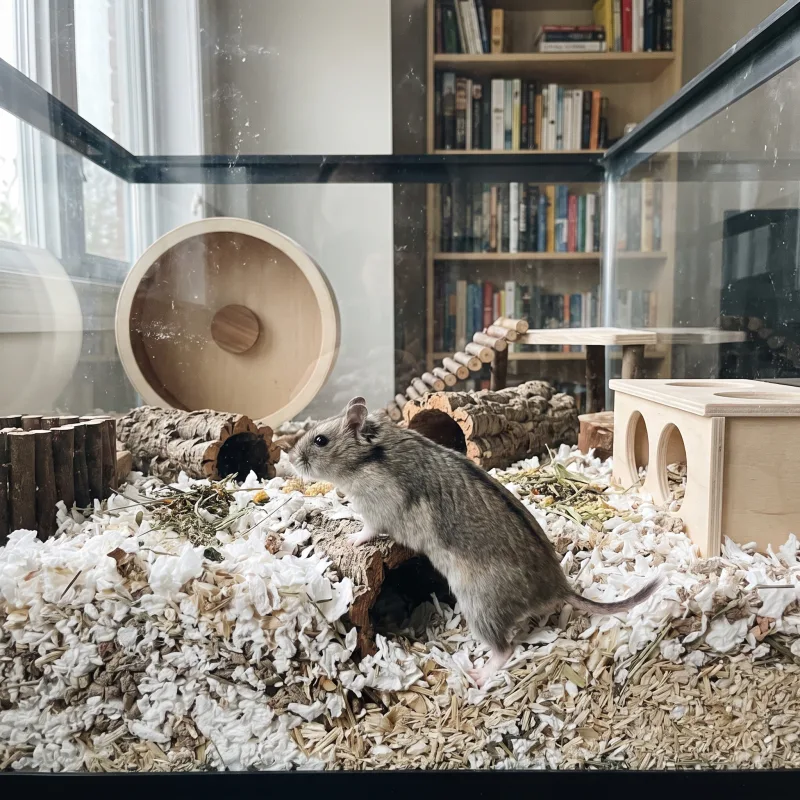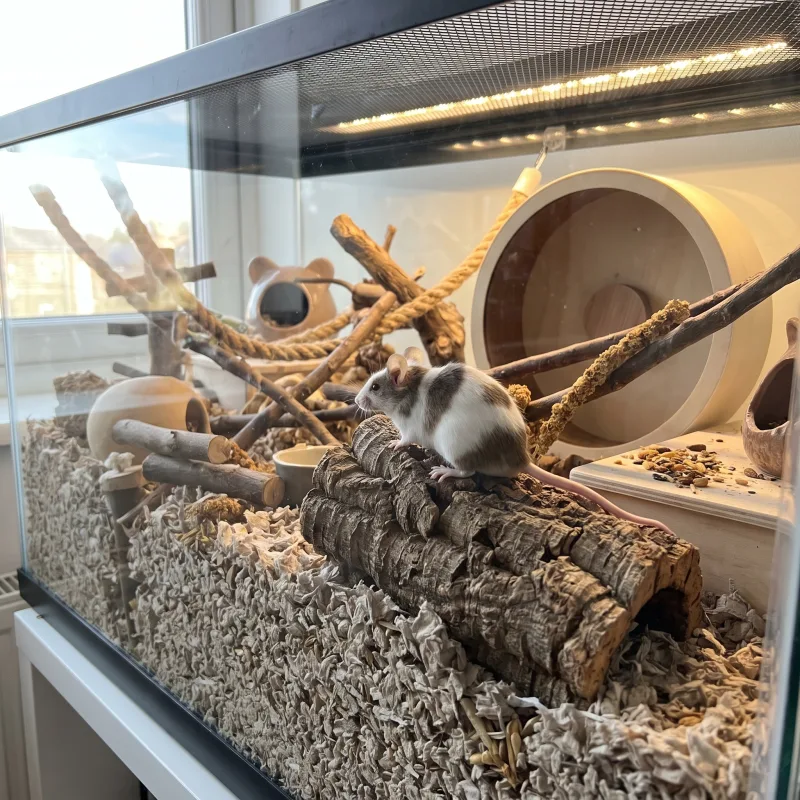
Fancy Mouse
Small Pets

Fancy Mouse

Mus musculus

A small, agile climber best kept for observationBeginner

Lifespan
1.5-3 years
Size
2.8-3.9 in body, plus tail
Social needs
Social; never alone. Does in same-sex groups; bucks as brothers raised together, or neutered with does
Time
Daily feeding and checks; regular cleaning
Cost
Low
Diet
Rodent nuggets, a scatter of seed mix, occasional fresh food

Overview

What is this animal?

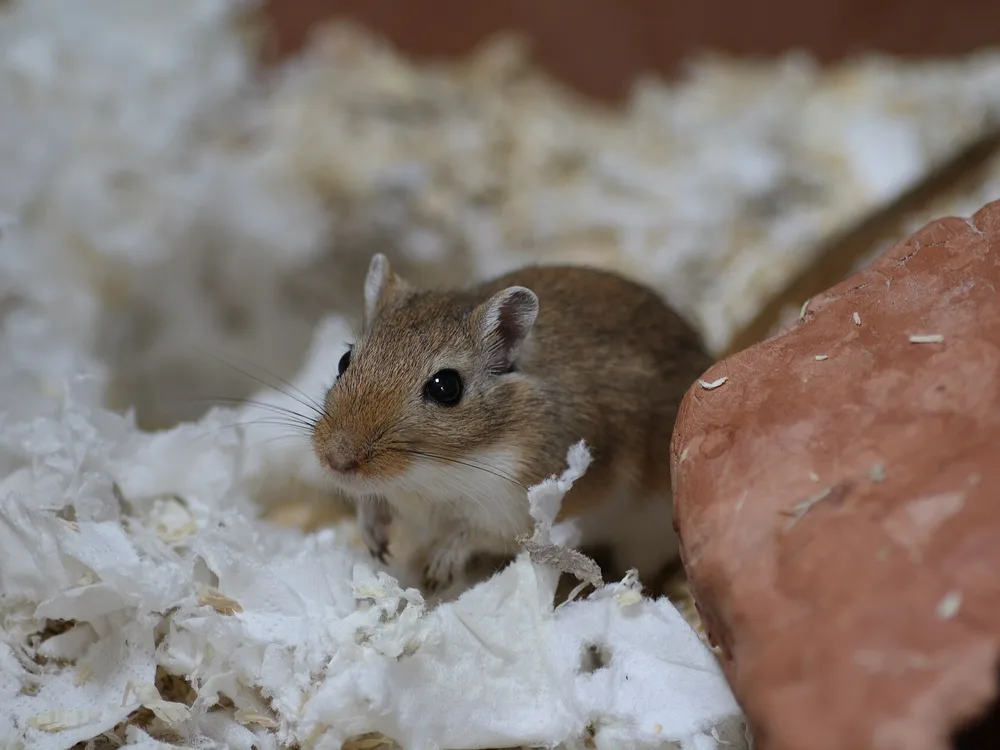
  • The fancy mouse is a small, agile and inquisitive rodent bred in many colours and coat types.
  • Mice are mainly nocturnal but active enough by day to make engaging, low-cost pets.
  • Their small size and short lifespan suit keepers who enjoy observation more than handling.
  • They are social and need careful group management: females live happily in same-sex groups, while males need planning, because unfamiliar adult males fight.

Temperament

  • Fancy mice are lively, curious and quick, often more interested in exploring than being held, though calm, regular handling can tame them.
  • Watching them climb, burrow and forage is the main appeal of keeping them.
Show 4 more
  • Females are social and content in groups.
  • Unfamiliar adult males usually fight, so keep bucks as littermate brothers, or have a buck neutered by a vet experienced with mice and, once the vet says he is no longer fertile, house him with does.
  • A buck should live alone only on a vet's advice, and then where he can still see, hear and smell other male mice.
  • Provide ample space and enrichment to reduce squabbles, and introduce new females carefully on neutral ground.

A good fit for

  • Beginners and observation-focused keepers
  • Those wanting a low-cost small pet
  • Keepers happy with a female group or a neutered buck with does
  • People who enjoy climbing-focused setups

Common mistakes to avoid

  • Mixing unfamiliar adult males, or adding a newcomer to a male group (fighting)
  • Pine or cedar bedding harming airways
  • Cages with escapable bar gaps
  • Ignoring early respiratory signs

Enclosure

Minimum 4.5 sq ft of floor, for the pair · 31 x 20 x 31 in

Cannot be kept alone. The minimum is 2, and the space above is for that group.

  • House mice in a gnaw-proof, well-ventilated cage with at least 31 x 20 in of floor and 31 in of height for a pair or a group of up to four: that is the minimum set by the TVT, Germany's veterinary animal-welfare association, and the floor Wood Green gives for three or four mice, with 39 x 20 in for up to six.
  • Swiss Animal Protection asks for more floor, at least 5.5 square feet with 24 in of height, and ideally 8 square feet and 39 in of height, while the Merck Veterinary Manual's 18 x 18 in for two or three is a bare minimum.
  • Keep bar spacing to 0.28 in or less, as mice squeeze through tiny gaps, and avoid glass tanks, which ventilate poorly.
Show 5 more
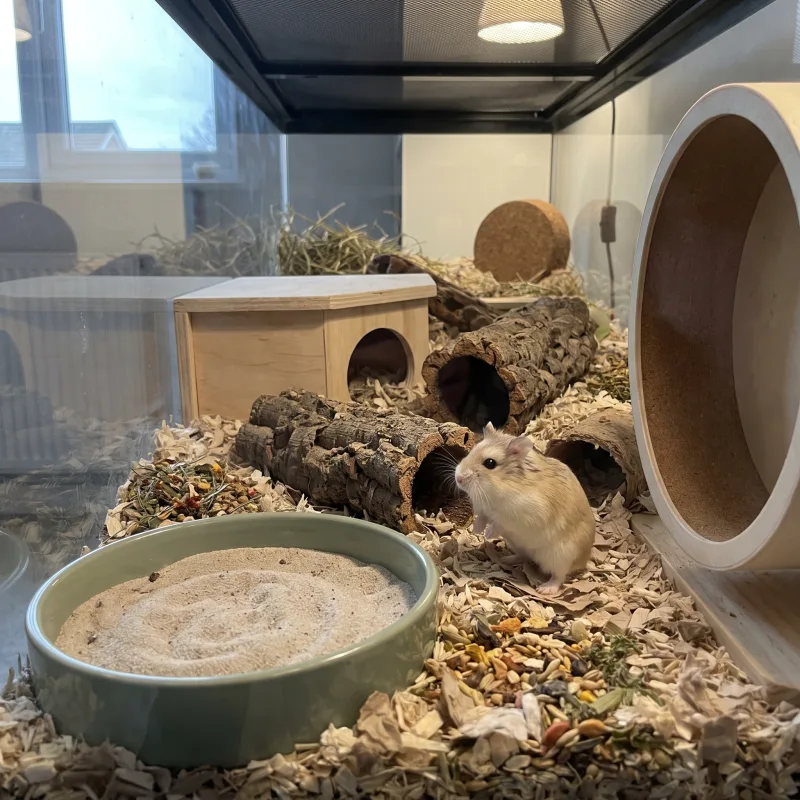
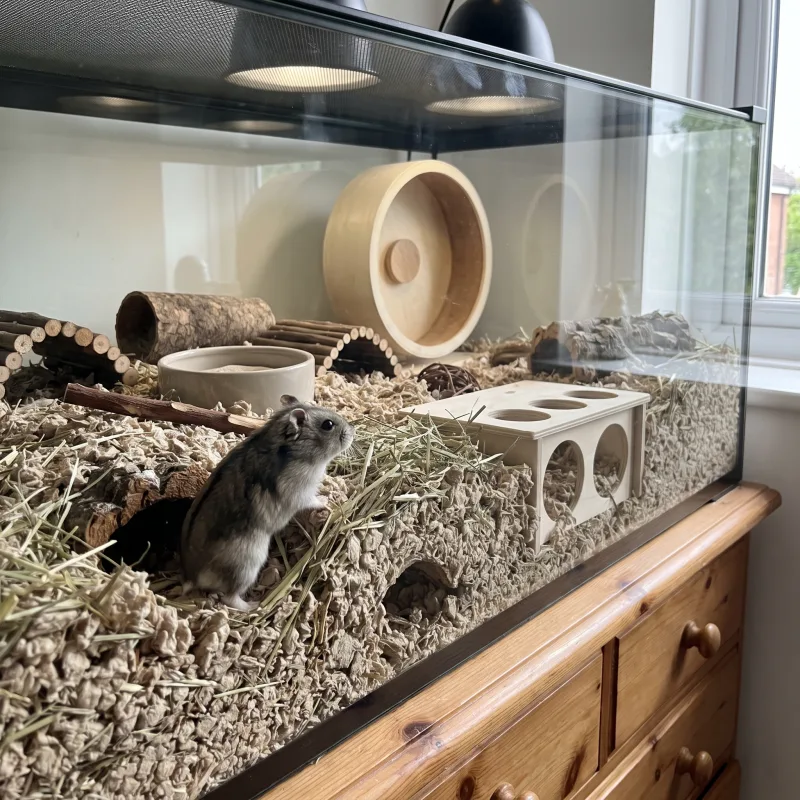
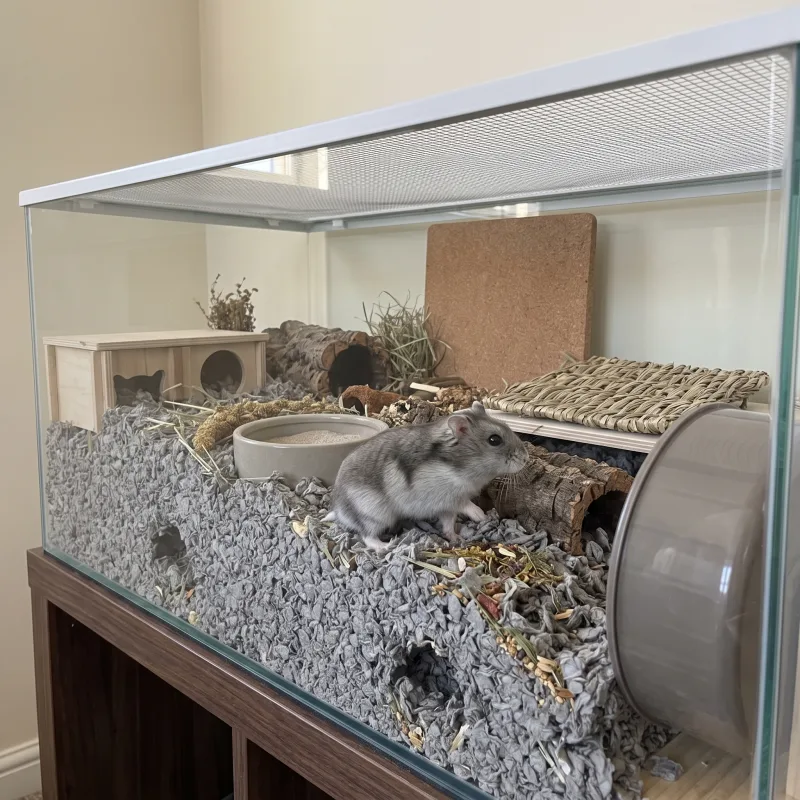
  • Provide deep substrate for burrowing plus vertical climbing structures.
  • Add ropes, branches, tunnels, a small solid-surface wheel and nesting material.
  • Females live well in same-sex groups.
  • Males fight with unfamiliar males, so keep them as brothers grouped before weaning and never split up or added to, or have a buck neutered and house him with does.
  • Keep enclosures clean, as mice can produce a noticeable odour.

Check your enclosure

Supplies

Setup

  • Enclosure of an adequate size
  • Water bottles, bowls, hides and enrichment
  • Carrier and travel box
  • Digital kitchen scale

Ongoing

  • Complete rodent nuggets or lab block, plus a small bag of quality seed-and-grain mix
  • Small dried mealworms
  • Fresh vegetables for tiny daily portions
  • Water bottle plus brush
  • Shallow ceramic dish
Show 2 more
  • Untreated apple or willow chews
  • Airtight food storage tub

Safe substrate: Dust-extracted paper bedding · Hemp bedding · Plain paper, tissue or hay for nesting

Work out the cost

Care routine

Daily

  • Feed and clear yesterday's leftovers
  • Fresh water
  • Quiet time at the cage
  • Spot-clean the enclosure
  • Watch them while they are awake

Every few days

  • Partial bedding changeevery 5 days
Show 5 more

Weekly

  • Hands-on health check
  • Rotate enrichment
  • Weigh-in

Monthly

  • Check nails and teeth
  • Check supplies and dates

Vet: Six-monthly exam, every 6 months (every 3 months from 1 year old)

Tools

Care in depth

Diet

Rodent nuggets, a scatter of seed mix, occasional fresh food
  • Offer a complete rodent nugget or lab block as the base, with a small scatter of a quality seed-and-grain mix for foraging, supplemented with occasional small amounts of fresh vegetables, fruit and protein such as a mealworm.
  • Scatter feeding encourages natural foraging.
  • Provide constant fresh water from a bottle.
  • Limit fatty seeds and sugary treats to prevent obesity.
  • A varied but controlled diet keeps these small, fast-metabolism animals healthy.

Health

Signs of good health, and the common problems
  • Mice are prone to respiratory infections, so good ventilation and dust-free, ammonia-free bedding are important; avoid pine and cedar shavings.
  • Mammary and other tumours are common in older mice, especially females.
  • Watch for sneezing, weight loss, lumps and overgrown teeth.
  • Their short lifespan means health changes progress quickly, so seek an exotics vet early.
  • Regular gentle handling helps you spot problems sooner.

Is this urgent?

11 warning signs and how fast to act, 7 of them right away

Small mammals are prey animals. They mask pain and illness by instinct, so by the time something is obvious it is usually already advanced.

Go now

Not eating, or eating far less than normalCall an exotics vet. Bring a recent weight if you have one. Loss of appetite is serious in every small mammal. In hindgut fermenters such as chinchillas and degus the gut slows and then stops when food stops moving through it, which makes this one of the most common emergencies in those species. In a hedgehog, appetite loss is often the first visible sign of illness, and a hedgehog that stops eating can quickly develop fatty liver.
8 hours
No droppings, or droppings suddenly tiny, misshapen or scarceCall an exotics vet now. Take a photo of the litter tray. Output is the most reliable read on gut movement there is, and it fails before the animal looks unwell.
8-12 hours
Sitting hunched, pressed to the floor, unwilling to moveGo now. A hunched, still posture in a prey animal is a pain posture.
Now
Audible teeth grinding or crunchingGo now. Loud, slow grinding is a pain signal.
Now
Hard, bloated or drum-tight abdomenGo now. Do not offer food or attempt to massage the abdomen. Gas or an obstruction can become fatal within hours and needs imaging, not home care.
Now
Laboured breathing, open-mouth breathing, or clickingGo now. Keep the animal quiet and undisturbed in transit, at its usual temperature: never chilled, never overheated. Most small mammals are obligate nose breathers; open-mouth breathing means they are already struggling.
Now
Maggots or fly eggs anywhere on the animal, especially the rearGo now. Do not attempt to wash them off first. Flystrike can kill within a day. Risk rises sharply in warm weather and in any animal with a dirty or damp rear.
Now

Today

Head tilted persistently to one side, or circlingBook today. Several causes, most of which respond far better to early treatment.
Today
Weight down 5 percent or more since the last weighingCall today, and bring the weight history. Weight falls before appetite visibly changes. This is why weekly weighing is worth the two minutes.
Today
Drooling, wet chin, or dropping food while trying to eatBook a dental check today. Dropping food means eating less. In rodents, continuously growing teeth can overgrow into the tongue or cheek long before the animal stops trying to eat; chinchillas and degus have this in every tooth, mice and gerbils in the incisors. In hedgehogs, whose teeth do not keep growing, the usual cause is gum disease, tartar, an abscess or a growth in the mouth.
Today

Soon

Scratching hard enough to break skin, or bald patches spreadingBook an appointment. Mites and fungal infections spread, and some transfer to other animals in the household.
A few days

Have the number of an exotics-competent practice saved before you need it. Most general small-animal clinics do not treat rabbits or rodents out of hours, and finding one at 11pm is not realistic.

This is general guidance for a healthy adult, not a diagnosis. An exotics vet who knows your animal always overrides it, and the time to find one is before you need one.

Bedding and substrate

3 safe, 2 with a caveat, 5 to avoid

Mice dig and nest, and their airways are as sensitive as a rat's: dust-free, unscented bedding deep enough to burrow in, plus soft material to build a nest from.

Safe

Dust-extracted paper beddingThe default. Look for 'dust extracted' on the label rather than 'natural'.
safe
Hemp beddingVery absorbent and low dust.
safe
Plain paper, tissue or hay for nestingMice build elaborate nests from material they shred themselves. Unprinted paper only.
safe

With a caveat

Kiln-dried aspen shavingsLow in the aromatic oils that make pine and cedar a problem, but the RSPCA advises against aspen bedding and wood shavings for mice. Dust-extracted paper or hemp is the safer default.
with a caveat
Cardboard-based beddingFine, but it goes soggy quickly and needs changing more often than paper.
with a caveat

Never

Pine and cedar shavingsTheir aromatic oils irritate the airway and affect the liver: laboratory work found liver enzyme changes in mice after about a day on cedar, and enlarged livers in mice kept on pine for months.
never
SawdustDust plus, usually, softwood. Both problems at once.
never
Scented or coloured beddingThe RSPCA advises against fragrant or coloured material; added fragrance is an airway irritant.
never
Cotton wool and fluffy nesting materialIt wraps around limbs and is swallowed.
never
Clumping cat litterSwallowed during grooming, and it clumps inside the animal.
never

Give them enough depth to dig: the RSPCA asks for at least 0.8 in of bedding and the TVT, Germany's veterinary animal-welfare association, about 4 in.

Top resources for more info

Independent creators and organisations we would send a friend to. We have no affiliation with any of them, and nothing here is sponsored. Links checked 2026-10-22.

YouTubers

Sites

Keep going

Other Small Pets worth knowing

Same axes, same care guides: the honest way to compare them.
More Small Pets guides

Is your enclosure big enough?

These are the smallest sizes that give good conditions, not legal minimums. More room is always better.

Minimum 4.5 sq ft of floor, for the pair · 31 x 20 x 31 in

Every figure, and where it comes from

Mice climb, so height is checked as well as floor. The floor is for a pair or up to four mice; Wood Green gives 39 x 20 in for up to six. Swiss Animal Protection asks for more floor: at least 5.5 sq ft with 24 in of height, better 8 sq ft and 39 in.

Minimum floor area4.5 sq ft of continuous, unbroken floor
As dimensions31 x 20 x 31 in
Height31 in minimum. This species climbs, so height is not optional.
CompanyCannot be kept alone. The minimum is 2, and the space above is for that group.
The recognised standards do not agree on this one
TVT, the German veterinary association for animal welfare: 31 x 20 x 31 in minimum, in a cage as large as possible. The figure this site uses, height included. Checked 2026-10-23.
Swiss Animal Protection STS: At least 5.5 sq ft of floor and 24 in high; better 8 sq ft and 39 in. A larger floor, with a lower minimum height. Checked 2026-10-23.
Wood Green, The Animals Charity (UK): 31 x 20 x 14 in for three or four mice; 39 x 20 x 14 in for up to six. The same floor for up to four mice, with less height. Checked 2026-10-23.
Austria, 2. Tierhaltungsverordnung (legal minimum): 31 x 12 x 12 in per pair, plus 20 percent more floor for each extra adult. A legal minimum, recorded for context. With 20 percent more for each mouse beyond a pair, six or more mice need more floor than the figure used here. Checked 2026-10-23.
Switzerland, Tierschutzverordnung (legal minimum): 2 sq ft for two mice, plus 78 sq in for each extra mouse. A legal minimum, recorded for context. Checked 2026-10-23.
Merck Veterinary Manual: 18 x 18 x 10 in for two or three mice. A bare minimum, below every welfare figure here. Checked 2026-10-22.

What it really costs

Setup, monthly, first year and across a whole life, itemised and with the electricity worked out from the actual wattage. Published figures for the same animal disagree by a factor of four, so the calculator shows ranges rather than picking one.

Can a Fancy Mouse eat that?

Mice are seed-eating omnivores with fast metabolisms: a complete nugget as the base, small fresh extras taken out of the day's ration, and a little animal protein.

The full list: 25 foods

Never (15)

AlcoholNo safe amount at any body weight on this site.
never
AvocadoPersin, concentrated in the leaves, skin and stone. It damages the heart in birds and in many mammals, rabbits and rodents among them; it has not been studied in reptiles, so treat it as unsafe for them too.
never
CaffeineCoffee, tea and energy drinks. Cardiac and neurological toxicity at tiny doses for an animal this size.
never
ChocolateTheobromine and caffeine. Small mammals and reptiles cannot clear either.
never
DairyRich and fatty, and nothing in it a mouse needs; cheese is not a mouse food, whatever the cartoons say.
never
GarlicSame allium toxicity as onion, and more concentrated by weight.
never
Grapes and raisinsThe RSPCA lists grapes and raisins as poisonous to mice.
never
LeekAllium family. Same mechanism as onion and garlic.
never
LettuceThe RSPCA advises against lettuce for mice because it can cause diarrhoea.
never
OnionOrganosulphur compounds damage red blood cells. The whole allium family is out.
never
Raw or dried beansLectins, which are toxic raw.
never
Raw or green potatoSolanine in the raw skin and any green part.
never
RhubarbVery high in soluble oxalate, high enough to cause acute kidney injury. The leaves are worse than the stalks.
never
Salty or seasoned human foodSalt, oil and seasoning. Crisps, chips, seasoned leftovers and processed meat are all out.
never
Sugary treatsYoghurt drops, honey-coated seed sticks and sweets add nothing a mouse needs and make obesity more likely.
never

Rare treats (4)

Bread and baked goodsA crumb of plain wholemeal bread, plain cooked pasta or a low-sugar cereal is harmless. Sweetened or seasoned baked goods are out. A crumb, rarely.
rare treat
FruitSugary, and part of the day's allowance rather than extra. Remove seeds and stones. A thumbnail-sized piece of apple, pear or melon, once or twice a week.
rare treat
NutsVery fatty; plain, unsalted slivers only. A sliver, rarely.
rare treat
Sunflower and pumpkin seedsWell loved and very fatty. Use them for hand-taming, not as food. One seed, a few times a week.
rare treat

Occasional (4)

Fresh vegetablesSmall amounts add variety, but they come out of the day's ration rather than on top of it, as the RSPCA puts it. Remove anything uneaten the same day. A thumbnail-sized piece, a few times a week.
occasional
Grass hayFibre, gnawing and nesting material, but not the staple: that is the measured nugget ration. A handful in the enclosure, refreshed regularly.
occasional
Mealworms, egg and cooked chickenMice are omnivores that need some animal protein: a mealworm, a crumb of plain cooked egg, or a pea-sized piece of plain cooked chicken. Never raw, cured, salted or seasoned meat. One small piece, two or three times a week.
occasional
SweetcornFlaked maize is a normal part of rodent mixes, and a kernel of fresh corn is fine. A kernel or two, occasionally.
occasional

Everyday foods (2)

Rodent nuggets or lab blockA complete nugget gives every mouthful the same balance, so a mouse cannot pick out the fatty seeds and leave the rest. The RSPCA recommends nuggets as the main diet. A measured daily ration, scatter-fed, adjusted to the weigh-in.
everyday food
Seed-and-grain mixGood for foraging, but mice pick out the fatty seeds first, so it works as a small scatter beside the nuggets rather than the whole ration. A small scatter alongside the nuggets.
everyday food

That food is not on our list. A mouse is small enough that a wrong food is a large dose. Leave it out and check with an exotics vet.

Fresh food is part of the day's ration, not an addition to it. A mouse that is getting heavier needs a smaller ration, not a different treat.