Rosy Boa
Reptiles · Snakes

Rosy Boa

Lichanura trivirgata

Slow, docile, desert-dwelling small boaBeginner

Lifespan
20-30+ years
Size
2-3.5 ft
Social needs
Solitary
Time
Low - feed every 1-2 weeks
Cost
Low to Medium
Diet
Carnivore - frozen/thawed rodents

Overview

What is this animal?

  • Rosy boas are small, slow-moving North American boas from arid regions, valued for their calm temperament and longitudinal stripes.
  • They are among the most docile snakes in the hobby and rarely bite.
  • Many authorities now split rosy boas into two species: the northern rosy boa of California and western Arizona (Lichanura orcutti; some recent authors call it L. roseofusca), which takes in the coastal and desert rosy boas of California, and the Mexican rosy boa of Baja California and Sonora (Lichanura trivirgata).
Show 3 more
  • Not every authority accepts the split, so this guide, which covers both, uses Lichanura trivirgata in its older, broad sense.
  • Their modest size, long lifespan, and easygoing nature make them good beginner boas.
  • As true boas they give live birth rather than laying eggs, and captive-bred animals are readily available.

Temperament

  • Rosy boas are among the gentlest snakes available, moving slowly and almost never striking defensively.
  • They tolerate handling well and suit nervous or first-time keepers.
Show 3 more
  • They may musk when first picked up but usually settle quickly.
  • Their relaxed pace makes them easy to handle, including for supervised children.
  • Avoid handling for a day or two after feeding.

A good fit for

  • First-time and nervous keepers
  • Those wanting a small, long-lived boa
  • Keepers with room for a 4 ft enclosure
  • People seeking a very docile snake

Common mistakes to avoid

  • High humidity causes respiratory illness
  • Easily overfed - prone to obesity
  • Needs a dry, desert-style setup
  • Slow metabolism means infrequent feeding

Enclosure

Minimum 8 sq ft of floor · 47 x 24 x 35 in

Must be housed alone. Solitary

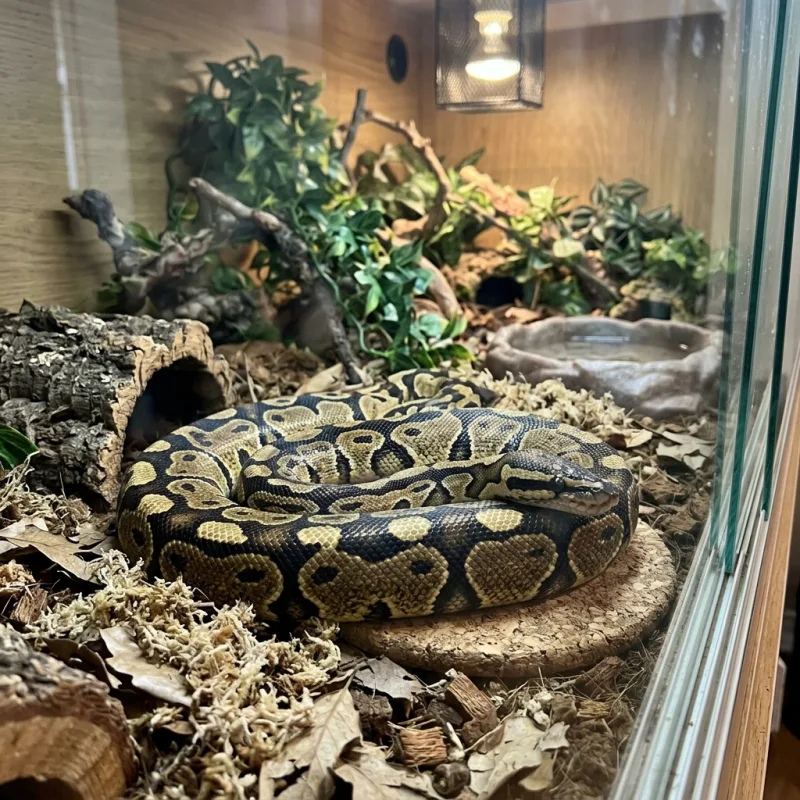
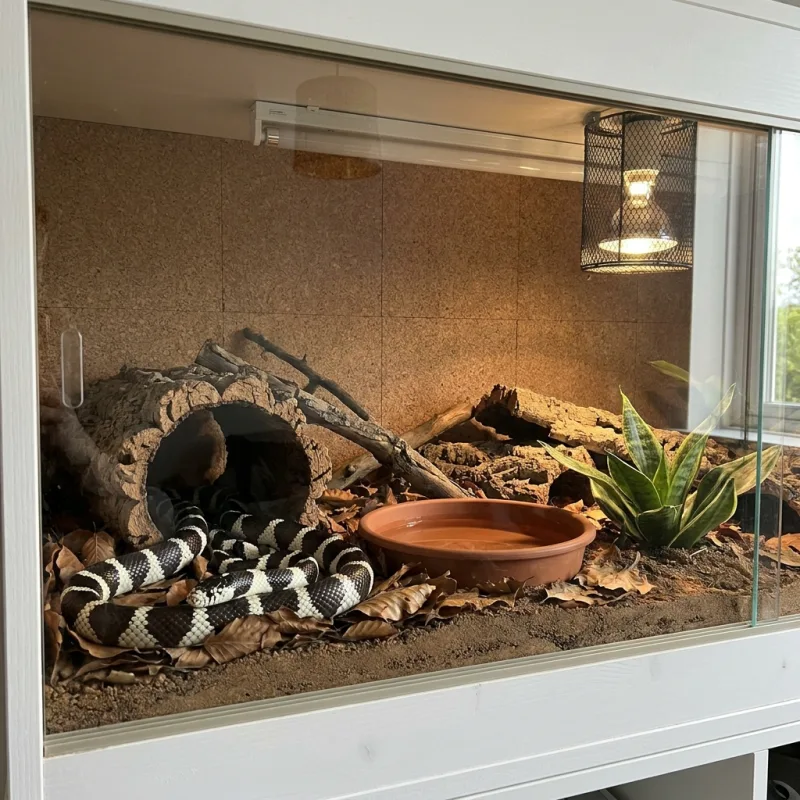
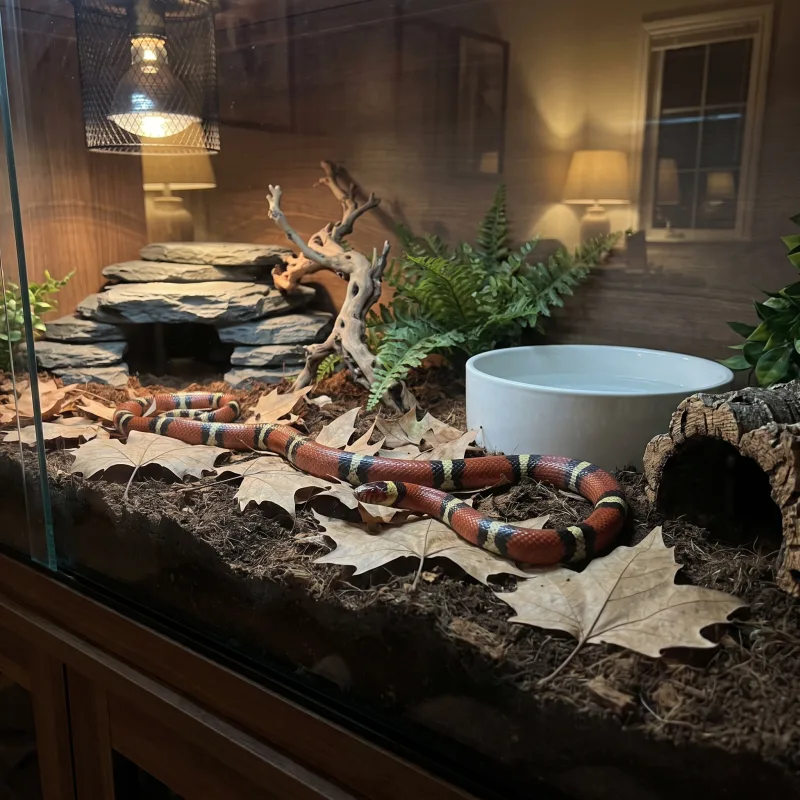
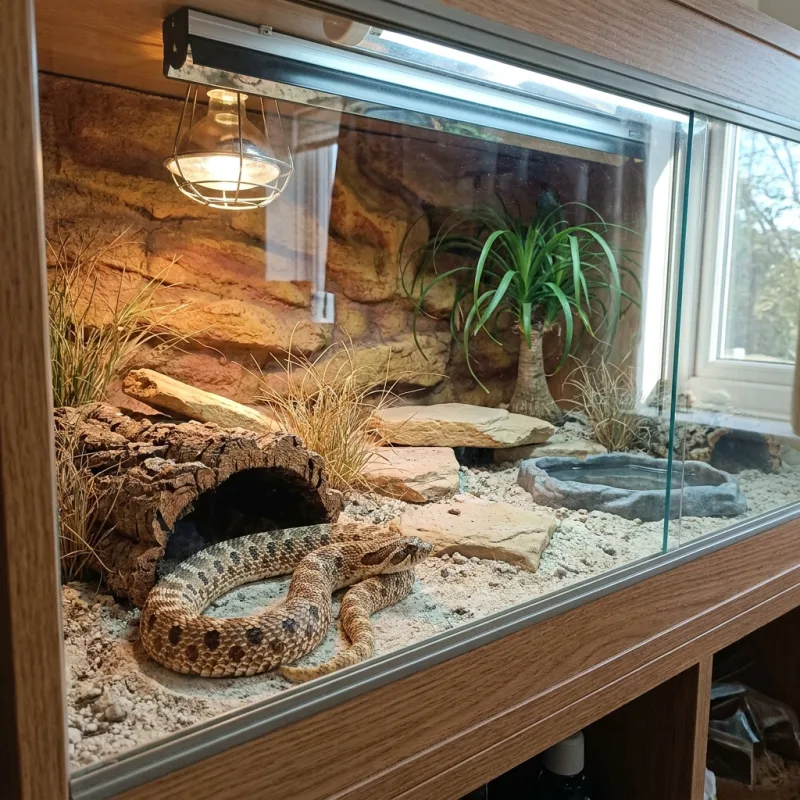
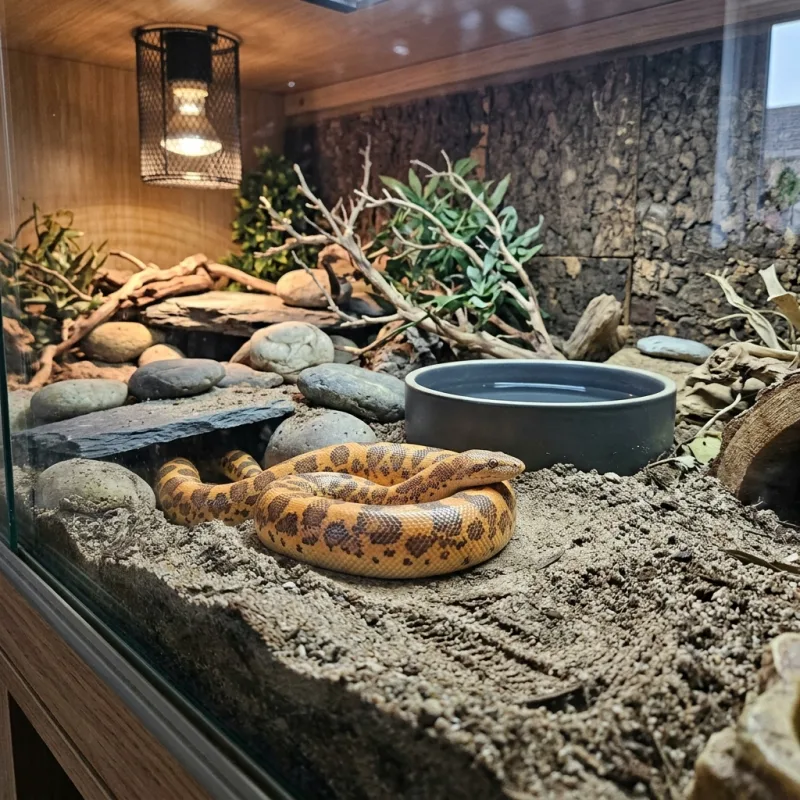
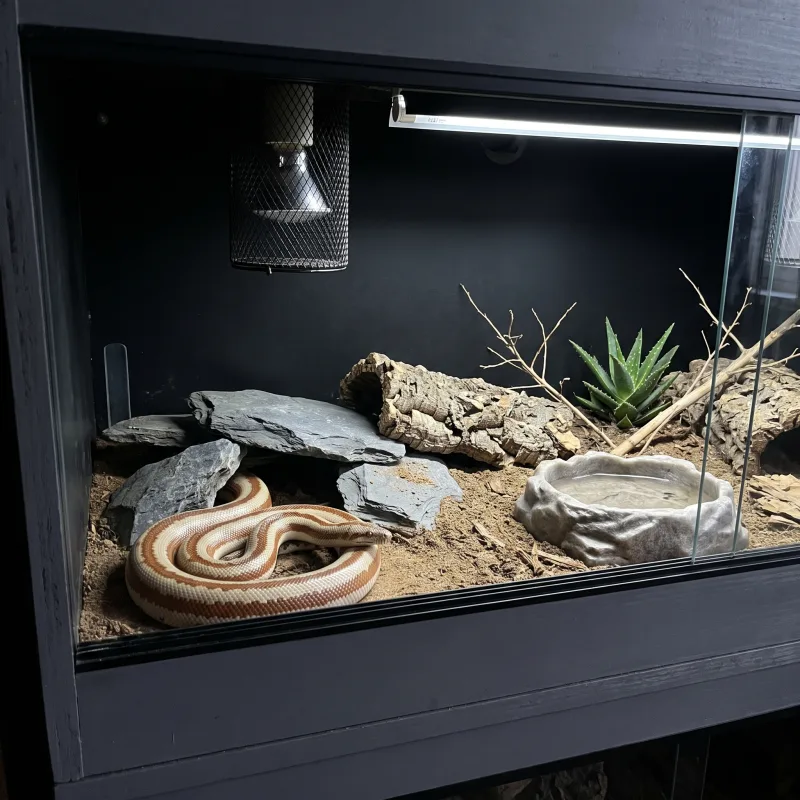
  • An adult needs a vivarium of at least 4 x 2 x 3 ft, which lets even the largest rosy boas, at about 43 in, stretch out fully, with height for a few sturdy branches.
  • Give it a dry substrate it can burrow into, such as aspen or a sand-soil mix.
  • Provide hides on both the warm and cool ends and some low climbing decor, though they are mostly terrestrial.
Show 2 more
  • Provide a basking area of 86-90°F and a cool side around 72-75°F using a thermostat.
  • Keep humidity low, around 30-40%, as these arid-adapted snakes are prone to respiratory and skin problems in damp setups.

Check your enclosure

Supplies

Setup

  • Enclosure, sized for the adult snake
  • Heating and thermostat
  • Thermometers and hygrometer
  • Substrate, hides at both ends, water bowl

Ongoing

  • Frozen rodents in the right size for your snake
  • Freezer container or bin dedicated to feeder storage
  • Long blunt-tipped feeding tongs
  • Sealable bags or a thawing tub for warming prey
  • Heavy, tip-proof water bowl (big enough to soak in for most species; a small bowl on the cool side for rosy and sand boas, which are kept dry)
Show 2 more
  • Digital kitchen scale for tracking weight
  • Digital thermometer for checking prey temperature

Safe substrate: Sand-topsoil mix · Aspen shavings, kept dry · Paper towel or newspaper

Work out the cost

Care routine

Daily

  • Check temperatures and humidity
  • Look the animal over
  • Spot-clean waste and uneaten food

Every few days

  • Fresh water bowlevery 3 days
  • Short handling sessionevery 3 days

Weekly

  • Check every latch and vent
  • Watch for a shed cycle
Show 7 more

Every few weeks

  • Check for mitesevery 2 weeks
  • Feed an adult a thawed prey item (hatchlings and juveniles about weekly)every 2 weeks
  • Weigh-inevery 2 weeks

Monthly

  • Deep-clean decor, glass and bowls
  • Test thermostats, lamps and guards

Less often

  • Refresh the substrateevery 3 months
  • Check the UVB lamp's age and replace it if due (if one is fitted)every 6 months

Vet: Annual exam and faecal check, every 12 months

Tools

Care in depth

Diet

Carnivore - frozen/thawed rodents
  • Rosy boas are carnivores that eat frozen-thawed rodents sized to their girth.
  • They have slow metabolisms and modest appetites, so feed adults every 10-14 days and juveniles every 5-7 days.
  • They are prone to obesity if fed too often, so avoid overfeeding.
  • Most are good feeders; offer prey in a quiet setting.
  • Provide clean water at all times, though they drink relatively little.

Health

Signs of good health, and the common problems
  • Rosy boas are hardy when kept dry and warm, but excess humidity can lead to respiratory infections and scale rot.
  • Obesity from overfeeding is the most common health issue in captivity.
  • Keep the enclosure dry, with a humid hide offered only during sheds.
  • Watch for retained eye caps and incomplete sheds.
  • Quarantine new arrivals and check for mites, and have a reptile-savvy vet review any wheezing or skin changes.

Is this urgent?

5 warning signs and how fast to act, 2 of them right away

Most snake worry is about feeding, and most feeding worry is misplaced. Check the guide for this species' normal fast before treating a refusal as illness.

Go now

Open-mouth breathing, bubbles at the nostrils, or an audible whistleGo now. Respiratory infection. Most snakes have only one working lung, and even boas and pythons, whose second lung is much smaller, have little reserve.
Now
Cannot right itself, or holds the head and neck in an unnatural twist (a western hognose that rolls over and plays dead when disturbed, then recovers once left alone, is showing normal defensive behaviour)Go now. Neurological signs are always urgent in a snake.
Now

Today

Retained eyecaps after a shed, or a ring of stuck shed on the tail tipRaise humidity and provide a damp hide. Call if it is not resolved within a day. Almost always humidity that was too low during the blue phase. A constricting ring costs the tail tip.
Today

Soon

A regurgitated mealDo not offer food again for at least a fortnight. Check the warm-end temperature today, then call if it happens twice. Usually too cold, handled too soon, or a meal too large. Repeated regurgitation is a different and more serious problem.
Check today
Refusing food for longer than is normal for this speciesLog the refusal and check the species guide. For an adult ball python, a fast of about a month is not in itself a cause for concern, and much longer voluntary fasts are documented. Weigh weekly through it. The weight trend, not the calendar, is what tells you whether a fast matters.
Log it first

This is general guidance for a healthy adult, not a diagnosis. An exotics vet who knows your animal always overrides it, and the time to find one is before you need one.

Bedding and substrate

3 safe, 2 with a caveat, 3 to avoid

A dry-country burrower: the substrate has to stay dry and be deep and loose enough for the snake to bury itself.

Safe

Sand-topsoil mixTopsoil, play sand and a little clay (ReptiFiles gives 40% topsoil, 40% sand and 20% clay by weight), at least 3-4 in deep and kept dry.
safe
Aspen shavings, kept dryLoose and easy to burrow in. Replace any patch that gets wet, because aspen moulds when damp.
safe
Paper towel or newspaperQuarantine, feeding response problems, and post-surgery.
safe

With a caveat

Cypress mulch and coco fibreThey hold humidity, which is wrong for a dry-substrate burrower and invites respiratory and scale problems.
with a caveat
Damp mossInside a humid hide on the cool side only, never over the floor.
with a caveat

Never

Pine and cedarThe same aromatic oils that make them unsafe in small-mammal bedding.
never
Calcium or vitamin sandSold as digestible, which encourages eating it. Implicated in impaction.
never
Uncovered heat mats and unguarded ceramic emittersNot a substrate, but the most common cause of contact burns. Every heat source needs a thermostat, and every emitter needs a guard.
never

Keep the enclosure dry. ReptiFiles keeps a humid hide of lightly damp substrate or moss on the cool side all the time, while some keepers offer one only during a shed. Feeding on a tile or in a separate container keeps substrate out of the meal.

Top resources for more info

Independent creators and organisations we would send a friend to. We have no affiliation with any of them, and nothing here is sponsored. Links checked 2026-10-22.

YouTubers

Sites

Keep going

Snakes, side by side

Same axes, same care guides: the honest way to choose between types.
More Reptiles guides

Is your enclosure big enough?

These are the smallest sizes that give good conditions, not legal minimums. More room is always better.

Minimum 8 sq ft of floor · 47 x 24 x 35 in

Every figure, and where it comes from

Sized for the largest rosy boas, about 43 in: as long as the snake, half as wide, and three quarters of its length in height, rounded up to a standard 3 ft, as Swiss law and the German expert report ask.

Minimum floor area8 sq ft of continuous, unbroken floor
As dimensions47 x 24 x 35 in
Height35 in minimum. This species climbs, so height is not optional.
CompanyMust be housed alone. Solitary
The recognised standards do not agree on this one
ReptiFiles: The snake's length by half its length by half its length: 47 x 24 x 24 in for a 44-inch rosy boa. The floor area this site uses, sized for the largest rosy boas. ReptiFiles strongly recommends going larger than the minimum. Checked 2026-10-23.
German expert report on minimum requirements for keeping reptiles (BMEL, 1997): Three quarters of the snake's length by half its length by three quarters of its length, for one or two: 33 x 22 x 33 in for a 44-inch rosy boa. A minimum standard. The height this site uses follows its height rule, rounded up to a standard 3 ft. Checked 2026-10-23.
Swiss legal minimum (Tierschutzverordnung, Anhang 2, Tabelle 5, row 43a: small and medium-sized pythons and boas): As long as the snake, half its length wide and three quarters of its length high, for one or two: 44 x 22 x 33 in for a 44-inch rosy boa. A legal minimum, recorded for context. The figure used here meets it for every rosy boa. Checked 2026-10-23.
Austrian legal minimum for ground-dwelling snakes (2. Tierhaltungsverordnung, Anlage 3): 5.5 sq ft of floor and 16 in of height for one or two snakes of 20-39 in; 9.5 sq ft and 24 in at 39-59 in. A legal minimum, recorded for context. The figure used here is above it for a rosy boa of up to 39 in, which most adults are. The law's next band, for snakes of 39-59 in, which only the largest rosy boas reach, asks 9.5 sq ft of floor, more than the 8 sq ft here. Checked 2026-10-23.

What it really costs

Setup, monthly, first year and across a whole life, itemised and with the electricity worked out from the actual wattage. Published figures for the same animal disagree by a factor of four, so the calculator shows ranges rather than picking one.

Can a Rosy Boa eat that?

Whole prey only: frozen-thawed rodents sized to the snake, never live.

The full list: 15 foods

Never (14)

AlcoholNo safe amount at any body weight on this site.
never
AvocadoPersin, concentrated in the leaves, skin and stone. It damages the heart in birds and in many mammals, rabbits and rodents among them; it has not been studied in reptiles, so treat it as unsafe for them too.
never
CaffeineCoffee, tea and energy drinks. Cardiac and neurological toxicity at tiny doses for an animal this size.
never
ChocolateTheobromine and caffeine. Small mammals and reptiles cannot clear either.
never
Cooked, seasoned or processed meatNot whole prey: muscle meat lacks the bone and organs that make a rodent a complete food, and salt and seasoning do harm.
never
GarlicSame allium toxicity as onion, and more concentrated by weight.
never
Greens, vegetables and fruitSnakes are obligate carnivores.
never
Insect feedersNot part of a snake's diet, and loose crickets chew on resting or shedding snakes.
never
LeekAllium family. Same mechanism as onion and garlic.
never
Live rodentsA live rodent can bite and seriously injure a snake. Frozen-thawed only.
never
OnionOrganosulphur compounds damage red blood cells. The whole allium family is out.
never
RhubarbVery high in soluble oxalate, high enough to cause acute kidney injury. The leaves are worse than the stalks.
never
Salty or seasoned human foodSalt, oil and seasoning. Crisps, chips, seasoned leftovers and processed meat are all out.
never
Wild-caught preyParasites and rodenticide.
never

Everyday foods (1)

Frozen-thawed rodentsThe whole diet for these snakes. Choose prey no wider than the snake at its thickest point. Thaw fully in the fridge, then warm in a sealed bag to about 100°F and offer with tongs. One prey item per feed, at the interval in the species guide.
everyday food

That food is not on our list. A snake eats whole prey and nothing else, so if it is not a correctly sized prey item from the species guide, leave it out.

Whole prey is a complete food: snakes fed whole rodents need no supplement dusting.