Silkie Guinea Pig
Cavia porcellus
Backswept silken coat on the mellowest cavyIntermediate
- Lifespan
- 5-7 years
- Size
- 8-12 in20-30 cm
- Weight
- 1.5-2.6 lb0.7-1.2 kg
- Social needs
- Highly social, keep 2 or more
- Time
- High; daily grooming on top of daily care
- Cost
- Medium
- Diet
- Herbivore: unlimited hay + vitamin C
Overview
What is this animal?
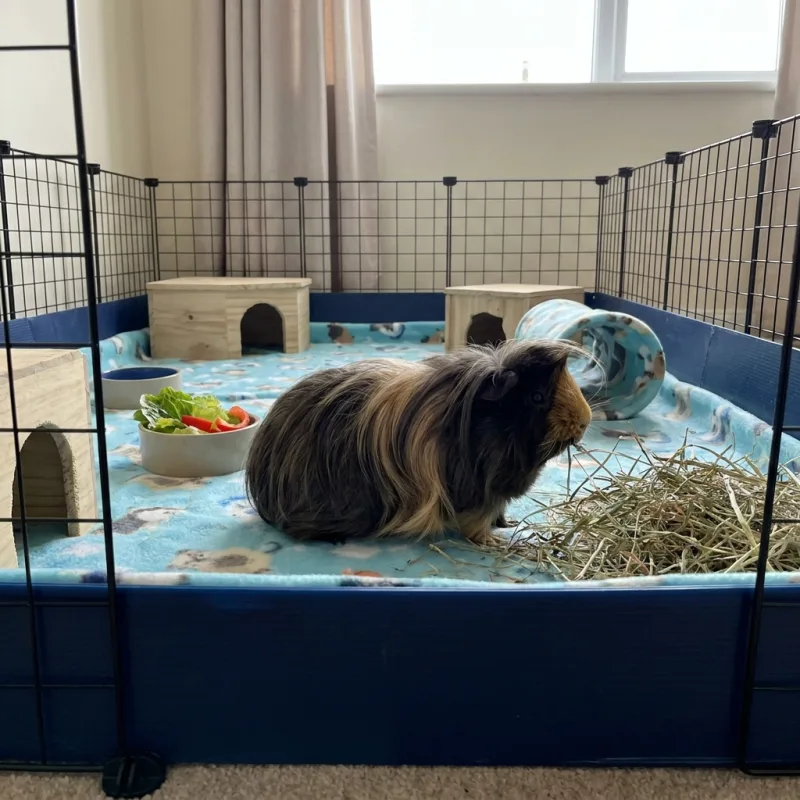
- The Silkie, called the Sheltie in the UK, is a long-haired guinea pig breed whose coat sweeps back from the face like a mane, giving a teardrop silhouette seen from above.
- Unlike the Peruvian there is no centre parting and no fringe falling forward over the eyes, and the coat is noticeably softer and glossier to the touch.
- The breed was developed in Britain in the early 1970s from crosses between Peruvians and Self Black shorthairs.
Show 2 more
- The coat grows about 1 inch2.5 cm a month for life and can pass 20 inches50 cm in show animals, so daily grooming and regular trims are a lifelong commitment, not a phase.
- Of the long-haired breeds it is generally the most manageable, but underneath the hair it is still an intensely social cavy that must live with at least one other guinea pig.
Temperament
- Silkies have a reputation as the calmest and most laid-back of the guinea pig breeds, though they start out as shy as any cavy and need patient, gentle handling to settle.
- They wheek at feeding time, popcorn when content, and recognise their keepers.
Show 2 more
- Daily brushing started young, kept short and calm, becomes a bonding ritual rather than a struggle, and this breed tends to tolerate it better than most.
- They must live with the company of their own kind in quiet, predictable surroundings, because a solitary guinea pig becomes stressed and unwell.
A good fit for
- Committed keepers ready for daily coat care
- Homes wanting a long-hair with a mellow, tolerant nature
- Keepers housing a bonded pair or trio indoors
- People who enjoy grooming as a quiet daily ritual
- Adults or older teens who handle pets calmly
Common mistakes to avoid
- Skipping grooming for even a few days; mats form fast
- Loose shavings tangling into the backswept coat
- Overheating above 79°F26°C under the heavy coat
- Keeping a single guinea pig alone
- Forgetting daily vitamin C, causing scurvy
- Choosing the breed on looks without planning lifelong trims
Enclosure
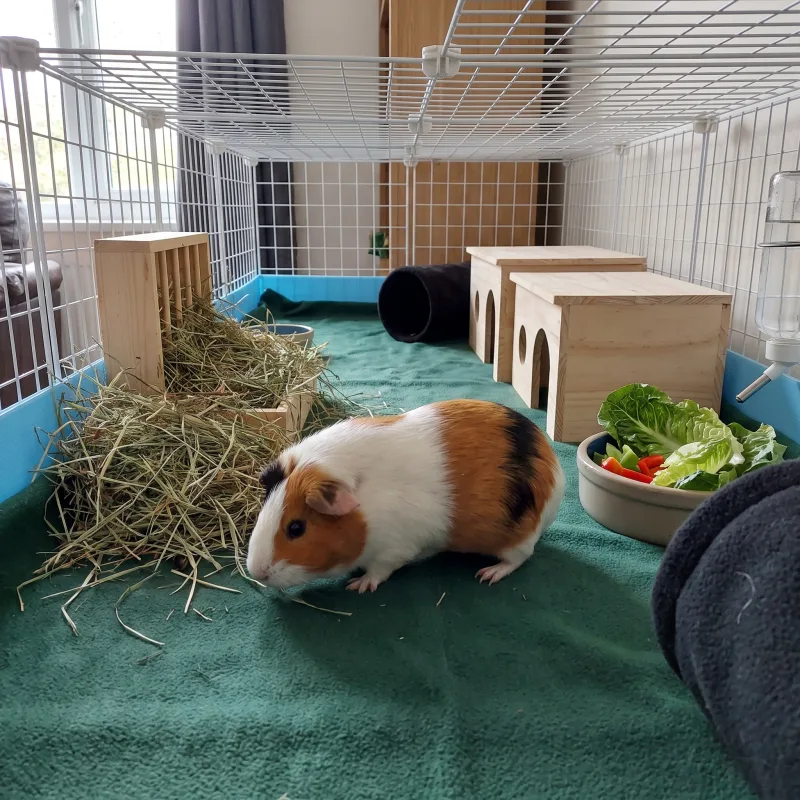
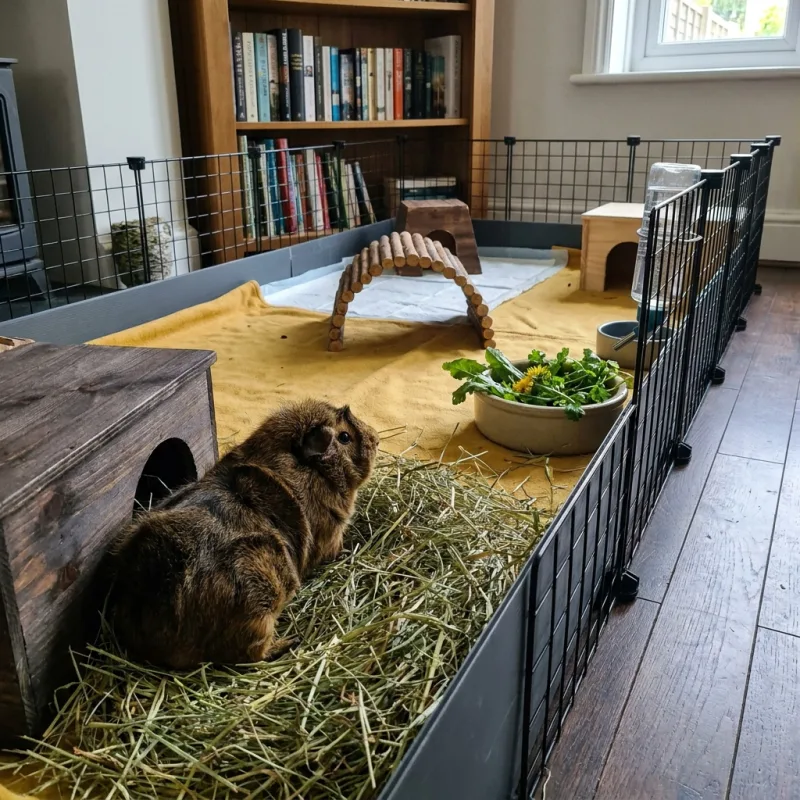
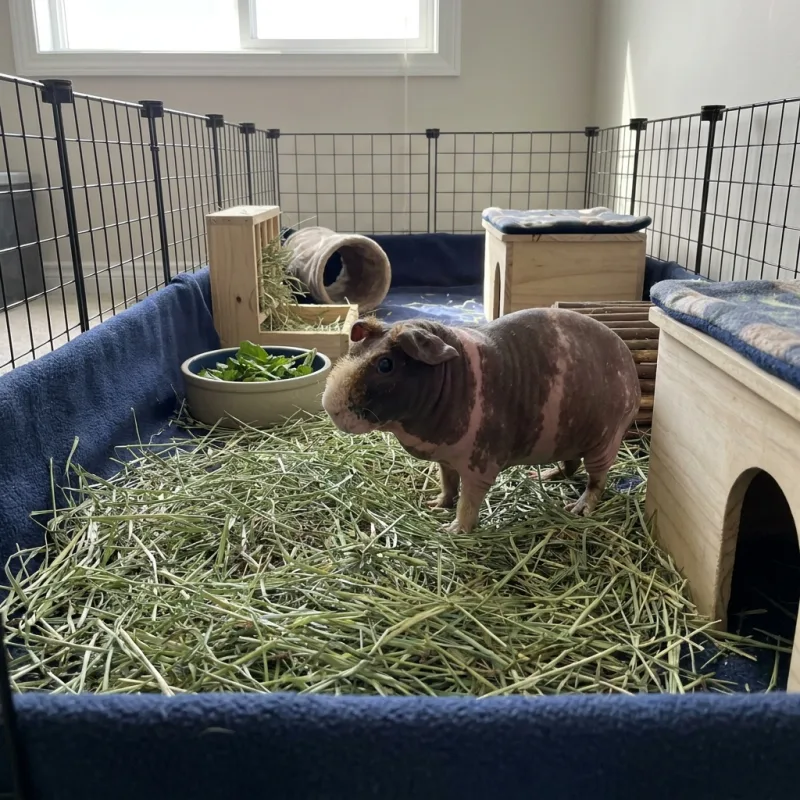
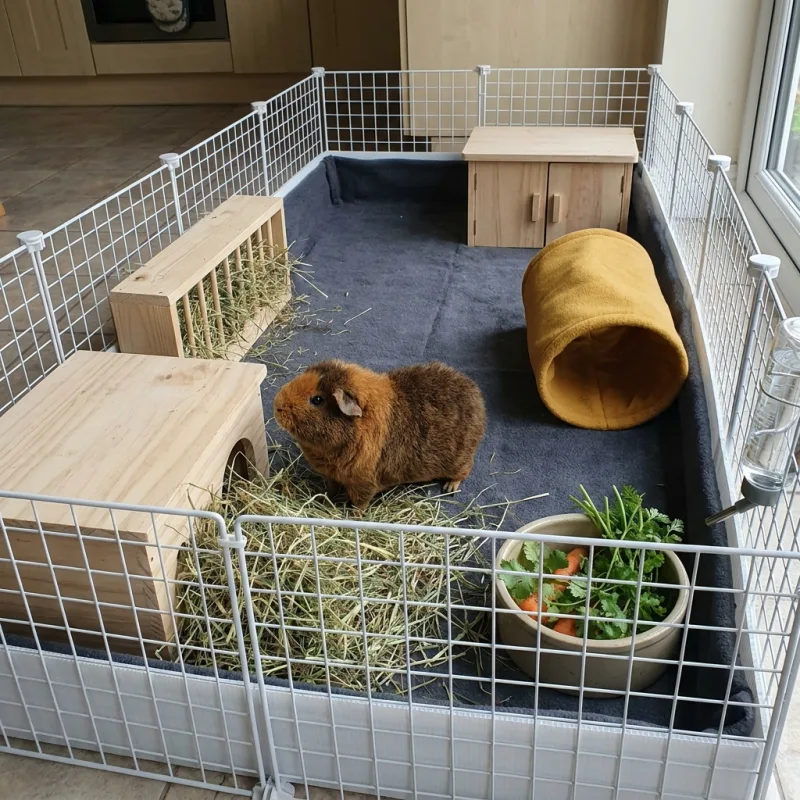
Minimum 22 sq ft2 m² of floor, for the pair · 6.5 x 3.3 ft2 x 1 m
Cannot be kept alone. The minimum is 2, and the space above is for that group.
- House at least two together on a solid floor.
- This guide's minimum for a pair is 21.5 sq ft2 square metres of floor, for example 6.5 x 3.3 ft2 x 1 m, the figure TVT, the German veterinary association for animal welfare, and Swiss Animal Protection give, and more is better.
- PDSA asks for more again in total, a hutch of at least 59 x 39 in1.5 x 1 m with a 6.5 x 3.3 ft2 x 1 m run attached, while RSPCA Australia's 11 square feet1 square metre and Humane World for Animals' 7.5 sq ft0.7 square metres are smaller figures.
Show 5 more
- Long-haired breeds belong on clean fleece liners rather than loose shavings, which work into the backswept coat within hours.
- Provide a hide for each pig to prevent squabbling, and never use wire floors, which injure feet.
- Keep them indoors at 64-73°F18-23°C, away from drafts and damp, and treat anything above 79°F26°C as dangerous, because the heavy coat makes Silkies overheat faster than short-haired breeds.
- They need ground-level floor space rather than height, plus daily supervised floor time.
- Spot-clean every day, since a soiled floor becomes a soiled coat and skin trouble underneath it.
Supplies
Setup
- Enclosure, 22 square feet2 square metres or larger for a pair
- Hides, tunnels, bowls, hay rack
- Carrier
- Digital kitchen scale
Ongoing
- Grass hay in the largest fresh box you can store
- Plain vitamin-C-stabilised guinea pig pellets
- Bell peppers (fed daily; a staple, not a treat)
- Mixed leafy greens for daily rotation
- Chewable or liquid vitamin C supplement, for a pig that eats few vegetables or on a vet's advice
Show 3 more
- Hay rack that keeps hay off the floor
- Heavy ceramic bowl plus a water bottle and brush
- Measuring spoon for the pellet ration
Safe substrate: Fleece liners over an absorbent layer · Dust-extracted paper bedding
Care routine
Daily
- Check the rear end, coat and skin; brush long coats
- Company and time out
- Feed and clear yesterday's leftovers
- Fresh vitamin C
- Fresh water
- Spot-clean and shake out fleece
- Top up unlimited hay
- Watch them while they are awake
Show 6 more
Weekly
- Deep-clean and change bedding
- Hands-on health check
- Rotate enrichment
- Weigh-in
Every few weeks
- Trim nailsevery 3 weeks
Monthly
- Check supplies and dates
Vet: Annual exam and dental check, every 12 months (every 6 months from 4 years old)
Tools
Care in depth
Diet
Herbivore: unlimited hay + vitamin C
- Unlimited grass hay is the foundation of the diet, wearing down continuously growing teeth and keeping the gut moving.
- Add a measured portion of plain, vitamin-C-stabilised guinea-pig pellets and a daily variety of fresh vegetables such as bell pepper.
- Offer hay from a low rack positioned so the trailing coat drags through it as little as possible.
- Like all guinea pigs, Silkies cannot make their own vitamin C and need roughly 10-30mg a day from fresh vegetables and stabilised pellets, or they develop scurvy.
- Provide constant fresh water and avoid sudden diet changes, muesli mixes, and rabbit food.
Health
Signs of good health, and the common problems
- The coat is the main clinical risk: mats pull at the skin, trap moisture and droppings, hide mites and fungal disease, and invite flystrike around the rear in warm weather.
- Most pet keepers trim the coat to floor length or shorter, and the rear end needs checking daily whatever the trim.
- Because the Silkie's hair sweeps back rather than over the face, eye checks are easier than in a Peruvian, but the rump coat still soils fastest.
- Otherwise the breed shares the standard cavy problems: scurvy, dental malocclusion, respiratory infections, bladder stones, ovarian cysts, and bumblefoot on poor flooring.
- Any guinea pig that stops eating is a medical emergency, because gut stasis kills quickly.
- Weigh weekly and keep an exotics-savvy vet on hand.
Is this urgent?
5 warning signs and how fast to act, 2 of them right away
Weigh weekly. It is the highest-value two minutes in guinea pig keeping, and it is the only way to see trouble coming.
Go now
Today
Soon
A guinea pig must not live alone. Switzerland treats keeping a single guinea pig as a welfare offence, and the practical consequence there is a rent-a-companion service for a bereaved survivor.
This is general guidance for a healthy adult, not a diagnosis. An exotics vet who knows your animal always overrides it, and the time to find one is before you need one.
Bedding and substrate
2 safe, 2 with a caveat, 3 to avoid
Guinea pigs do not burrow, so the priorities are absorbency, dryness and grip, and for a long coat like the Silkie's, nothing loose that works its way into the coat.
Safe
With a caveat
Never
Spot-clean every day: on a long-coated pig a soiled floor soon becomes a soiled coat, and in warm weather that invites flystrike.
Top resources for more info
Independent creators and organisations we would send a friend to. We have no affiliation with any of them, and nothing here is sponsored. Links checked 2026-10-22.
YouTubers
Sites
Guinea Pigs, side by side
Same axes, same care guides: the honest way to choose between types.