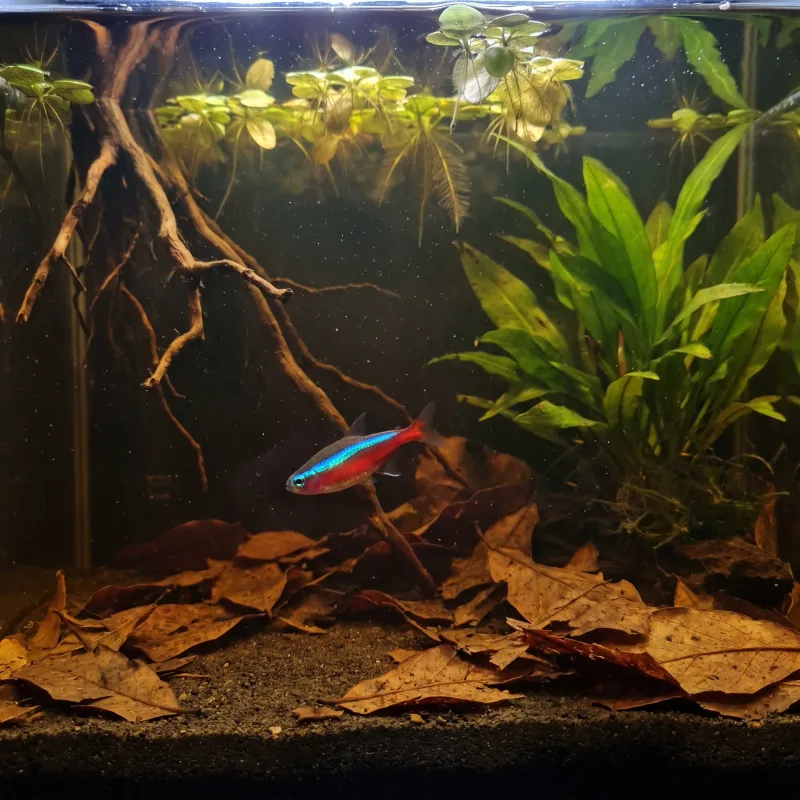
Cardinal Tetra
Paracheirodon axelrodi
Blue-and-red shoaler from soft blackwaterIntermediate
- Lifespan
- 4-6 years
- Size
- 1.4-1.8 in3.5-4.5 cm
- Social needs
- Shoaler; keep 10+ together
- Time
- Low-moderate; daily feeding, weekly water change
- Cost
- Low-Medium
- Diet
- Omnivore; micro pellets, flakes, frozen foods
Overview
What is this animal?
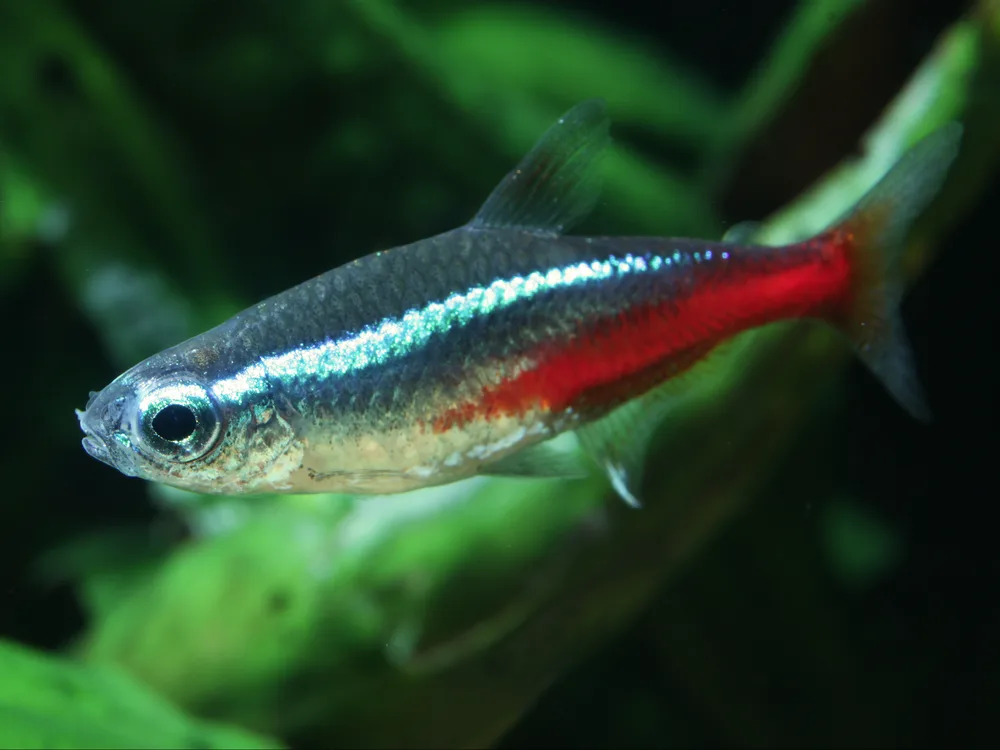
- The cardinal tetra is a small shoaling characin from the soft, acidic blackwaters of the Rio Negro and upper Orinoco basins in Brazil, Colombia and Venezuela.
- Its red stripe runs the full length of the body, distinguishing it from the similar neon tetra and giving a dense shoal a strong visual effect under subdued light.
- Many cardinals are still wild-caught, so they arrive sensitive to shipping stress and need stable, mature water.
- In a settled, well-cycled tank they are hardy and long-lived, but they are not as forgiving as a true beginner fish.
Temperament
- Peaceful, social and active, cardinals shoal tightly when secure and scatter when kept in too-small groups.
- A large shoal settles faster, colours up and swims more openly.
Show 2 more
- They make good community fish alongside other peaceful soft-water species such as dwarf cichlids, corydoras and small rasboras.
- Avoid large, boisterous or predatory tankmates that will eat them or keep them hiding.
A good fit for
- Planted soft-water community aquariums
- Keepers wanting a colourful display shoal
- Those with a mature, stable cycled tank
- Blackwater and biotope-style setups
Common mistakes to avoid
- Adding fragile wild imports to immature tanks
- Keeping too few, causing chronic stress
- Hard, alkaline water dulling colour and health
- Neon tetra disease spreading through the shoal
Enclosure
Minimum 20 gallons75 litres, for a group of 10
Cannot be kept alone. The minimum is 10, and the space above is for that group.
- Keep a shoal of at least ten in a tank at least 24 in60 cm long holding 20 US gallons75 litres or more, filtered and heated to 75-82°F24-28°C.
- They show best in a dim, heavily planted tank with dark substrate, driftwood and tannin-stained water that mimics their native habitat.
- They prefer soft, slightly acidic water and dislike high mineral content.
Show 2 more
- A fully cycled, stable system matters more than decor.
- Provide gentle flow and floating cover so these timid fish feel secure.
Supplies
Setup
- Tank and stand
- Filter
- Heater and thermometer
- Substrate, plants and decor
- Liquid test kit
- Dechlorinator and starter supplies
Ongoing
- Micro-pellet or finely crushed tropical flake
- Frozen daphnia and cyclops
- Frozen or live baby brine shrimp
- Microworm culture (optional, for fry and conditioning)
- Spirulina-based flake
Show 2 more
- Fine net for removing leftovers
- Small feeding spoon for accurate pinches
Safe substrate: Fine, smooth sand · Smooth, rounded fine gravel (not for loaches or sand-sifting cichlids; sand is better for corydoras) · Bare bottom (quarantine and grow-out only)
Care routine
Daily
- Check temperature and equipment
- Feed
- Head-count and look everyone over
Every few days
- Top up evaporationevery 3 days
Show 8 more
Weekly
- Count the school
- Test the water
- Water change and gravel vacuum
- Wipe the front glass only
Every few weeks
- Trim and thin the plantsevery 2 weeks
Monthly
- Check supplies and reagent dates
- Replace or recharge chemical media, if you use any (skip it in a blackwater tank)
- Rinse the filter media
Health review: Quarterly school and stability review, every 3 months
Tools
Care in depth
Diet
Omnivore; micro pellets, flakes, frozen foods
- Cardinals are micro-predators that eat small invertebrates and zooplankton in the wild.
- Offer a quality micro-pellet or crushed flake as the staple, rotated with frozen or live daphnia, baby brine shrimp, cyclops and finely chopped bloodworm.
- Feed small amounts once or twice daily, only what is taken within a minute.
- Their small mouths need appropriately sized food, and varied feeding supports colour and overall condition.
Health
Signs of good health, and the common problems
- The main concern is neon tetra disease, an untreatable Pleistophora infection that causes fading colour, lumps and spinal curving; affected fish should be removed promptly.
- Ich and fin rot appear when fish are chilled or stressed during acclimation.
- Stable warmth, soft water and slow, careful acclimatisation prevent most losses.
- Quarantine new stock, as wild imports can carry parasites, and avoid adding cardinals to an immature tank where swinging parameters weaken them.
Is this urgent?
6 warning signs and how fast to act, 3 of them right away
In a fish tank the patient is usually the water. Test before you treat: dosing a healthy tank for a disease it does not have makes things worse.
Go now
Today
Soon
Never add a new fish to a tank that is not fully cycled, and never treat blind. A test kit is cheaper than the fish.
This is general guidance for a healthy adult, not a diagnosis. An exotics vet who knows your animal always overrides it, and the time to find one is before you need one.
Bedding and substrate
3 safe, 4 with a caveat, 2 to avoid
Substrate in an aquarium is a filter as much as a floor. Most of the biology lives in and on it.
Safe
With a caveat
Never
This is our general list for freshwater fish. We have not built one specific to Tetras yet.
Top resources for more info
Independent creators and organisations we would send a friend to. We have no affiliation with any of them, and nothing here is sponsored. Links checked 2026-10-22.
YouTubers
Sites
Tetras, side by side
Same axes, same care guides: the honest way to choose between types.