Rummy-nose Tetra
Petitella rhodostoma
One of the tightest schoolers in the hobby, with a built-in stress gaugeIntermediate
- Lifespan
- 5-6 years
- Size
- 2 in5 cm
- Social needs
- Tight schooler; keep 10+ together
- Time
- 10-15 min daily; weekly water change
- Cost
- Low-Medium
- Diet
- Omnivore (micro-pellet, flake, frozen foods)
Overview
What is this animal?
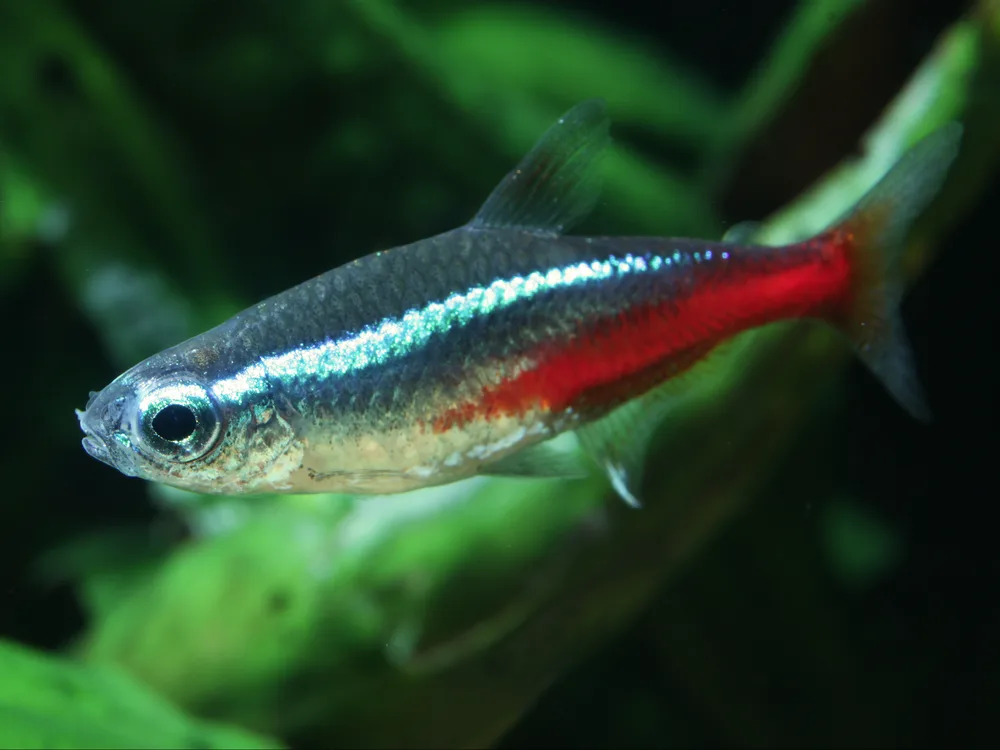
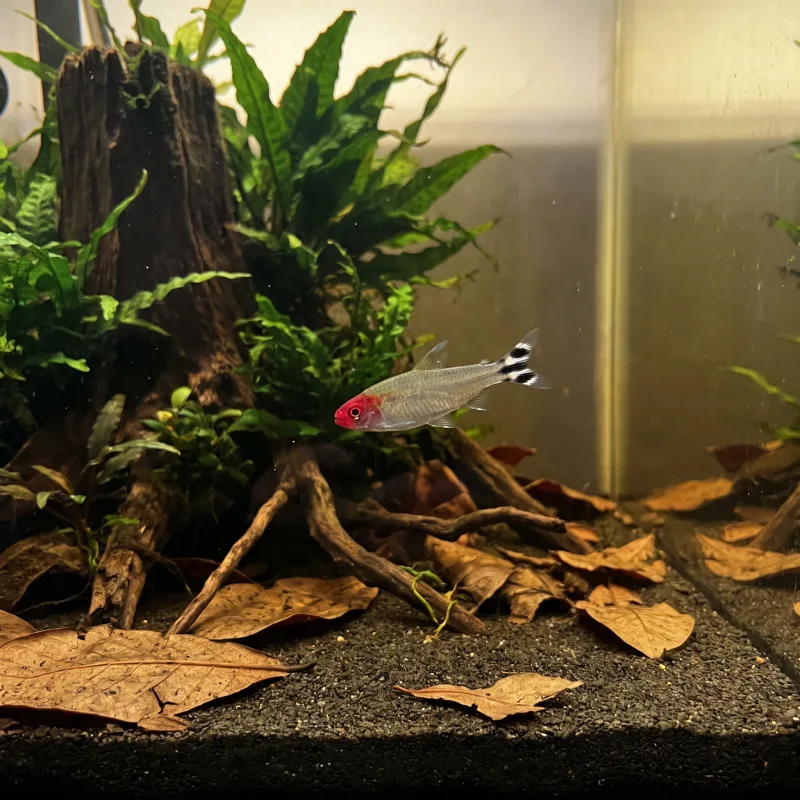
- Rummy-nose tetras are silver torpedoes with a glowing red face and a boldly striped tail, famous for schooling more tightly than almost any other aquarium fish.
- A group moving as one is a genuine spectacle.
- Long known as Hemigrammus rhodostomus, it was moved to the genus Petitella in 2020, and many fish sold as rummy-noses are in fact the near-identical firehead tetra, Petitella bleheri, which needs the same care.
- They carry a built-in diagnostic: the red nose drains to washed-out pink when the fish are stressed or the water deteriorates, making the school a live water-quality gauge.
Temperament
- Completely peaceful, rummy-noses spend the day cruising in formation through the lower midwater.
- The tighter the school, the more secure the fish; small groups huddle and hide instead.
Show 2 more
- They are ideal companions for other gentle blackwater species: cardinal tetras, corydoras, dwarf cichlids, and pencilfish.
- Nothing about them threatens shrimp colonies beyond the odd newborn.
A good fit for
- Keepers who want true, dramatic schooling behaviour
- Mature planted aquariums with stable parameters
- Communities with dwarf cichlids and corydoras
- Aquarists who like visible feedback on water quality
Common mistakes to avoid
- Adding them to brand-new, unstable tanks
- Groups under 10 that huddle rather than school
- Temperature and parameter swings: noses fade fast
- Buying freshly imported, unrested stock
Enclosure
Minimum 30 gallons113 litres, for a group of 10
Cannot be kept alone. The minimum is 10, and the space above is for that group.
- Keep a school of ten or more in a mature, cycled aquarium of at least 30 US gallons113 litres and 3 ft90 cm long, such as a standard 30-gallon115-litre (36 x 12 x 16 in90 x 30 x 41 cm); 35 in90 cm is the minimum length Seriously Fish gives, and bigger groups in longer tanks school more impressively.
- Provide open swimming length with planted flanks.
- Hold the temperature at 75-82°F24-28°C.
- They come from soft, acidic blackwater, and while tank-bred stock adapts to moderately hard water, what they cannot forgive is instability: drift and spikes show in the noses immediately.
Supplies
Setup
- Tank and stand
- Filter
- Heater and thermometer
- Substrate, plants and decor
- Liquid test kit
- Dechlorinator and starter supplies
Ongoing
- Micro-pellet or finely crushed tropical flake
- Frozen daphnia and cyclops
- Frozen or live baby brine shrimp
- Microworm culture (optional, for fry and conditioning)
- Spirulina-based flake
Show 2 more
- Fine net for removing leftovers
- Small feeding spoon for accurate pinches
Safe substrate: Fine, smooth sand · Smooth, rounded fine gravel (not for loaches or sand-sifting cichlids; sand is better for corydoras) · Bare bottom (quarantine and grow-out only)
Care routine
Daily
- Check temperature and equipment
- Feed
- Head-count and look everyone over
Every few days
- Top up evaporationevery 3 days
Show 8 more
Weekly
- Count the school
- Test the water
- Water change and gravel vacuum
- Wipe the front glass only
Every few weeks
- Trim and thin the plantsevery 2 weeks
Monthly
- Check supplies and reagent dates
- Replace or recharge chemical media, if you use any (skip it in a blackwater tank)
- Rinse the filter media
Health review: Quarterly school and stability review, every 3 months
Tools
Care in depth
Diet
Omnivore (micro-pellet, flake, frozen foods)
- Offer fine flake or micro-pellets as the staple, with regular frozen or live treats such as daphnia, cyclops, baby brine shrimp, and chopped bloodworm.
- Their mouths are small, so size food accordingly.
- Feed once or twice daily in small amounts.
- A well-fed, settled school shows saturated red noses at every feed.
Health
Signs of good health, and the common problems
- Rummy-noses are not delicate once settled, but they ship poorly and resent new, unstable tanks; add them to mature aquariums only and quarantine first.
- Losses in the first fortnight usually mean the tank, not the fish, was not ready.
- After that, standard tetra care applies: watch for ich after temperature dips and keep nitrate low with steady weekly water changes.
- Faded noses are the early-warning sign: investigate before anything else goes wrong.
Is this urgent?
6 warning signs and how fast to act, 3 of them right away
In a fish tank the patient is usually the water. Test before you treat: dosing a healthy tank for a disease it does not have makes things worse.
Go now
Today
Soon
Never add a new fish to a tank that is not fully cycled, and never treat blind. A test kit is cheaper than the fish.
This is general guidance for a healthy adult, not a diagnosis. An exotics vet who knows your animal always overrides it, and the time to find one is before you need one.
Bedding and substrate
3 safe, 4 with a caveat, 2 to avoid
Substrate in an aquarium is a filter as much as a floor. Most of the biology lives in and on it.
Safe
With a caveat
Never
This is our general list for freshwater fish. We have not built one specific to Tetras yet.
Top resources for more info
Independent creators and organisations we would send a friend to. We have no affiliation with any of them, and nothing here is sponsored. Links checked 2026-10-22.
YouTubers
Sites
Tetras, side by side
Same axes, same care guides: the honest way to choose between types.