Neon Tetra
Paracheirodon innesi
Schooling characin for mature, planted tanksIntermediate
- Lifespan
- 5-8 years
- Size
- 1.2-1.5 in3-4 cm
- Social needs
- Schooling; keep 10+ together
- Time
- 10-15 min daily; weekly water change
- Cost
- Low
- Diet
- Omnivore (micro-flake, small pellet, live foods)
Overview
What is this animal?
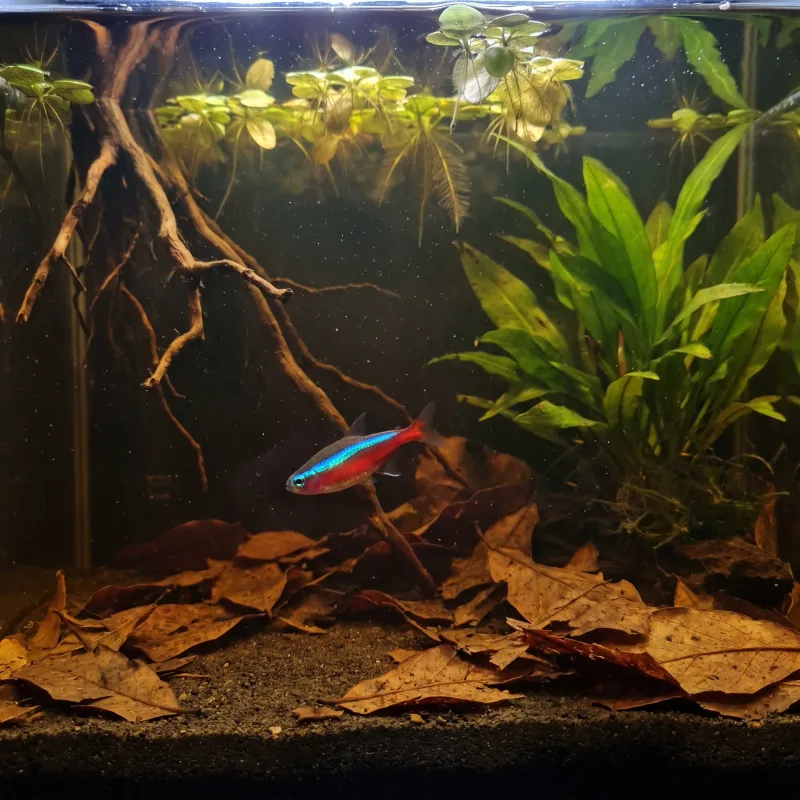
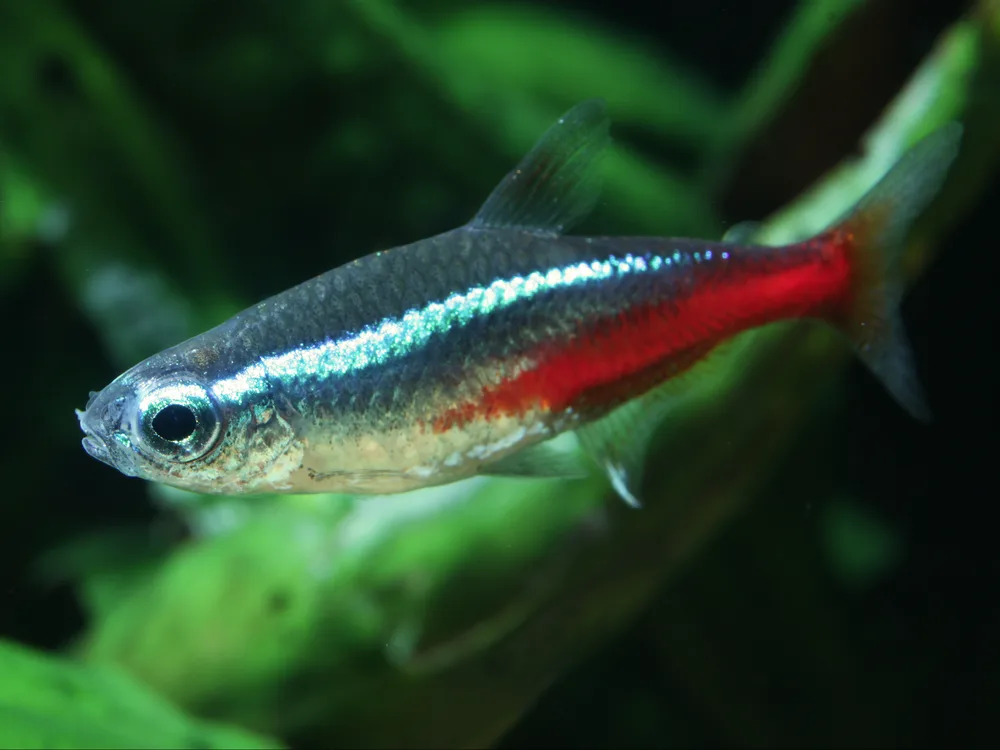
- Neon tetras are small characins from the soft, shaded blackwater streams of the upper Amazon, known for the blue and red stripe along their flanks.
- In a tight school under good conditions they show their colour best.
- Though cheap and widely available, they are more demanding than their price suggests.
- They need a mature, stable aquarium and the security of a large group, and they are often lost early in newly set-up or under-stocked tanks.
Temperament
- Neons are peaceful, timid schooling fish that should be kept in groups of ten or more.
- In a study of group size in common aquarium fish, neons kept in groups of ten shoaled most and darted least.
Show 3 more
- In small numbers they become stressed, pale, and reclusive, while a large school is more confident and coordinated.
- They suit calm community tanks with other small, gentle species and should never be mixed with large or aggressive fish that may eat them.
- Their nervous nature means sudden movements and bright bare tanks leave them hiding rather than displaying.
A good fit for
- Established, mature planted aquariums
- Peaceful community tanks of small species
- Keepers wanting a schooling display
- Soft, slightly acidic water setups
Common mistakes to avoid
- Adding to brand-new, uncycled tanks
- Keeping too few and stressing the school
- Neon tetra disease spreading without quarantine
- Housing with large or aggressive tankmates
Enclosure
Minimum 15 gallons57 litres, for a group of 10
Cannot be kept alone. The minimum is 10, and the space above is for that group.
- Keep a school of ten or more in a cycled, planted tank of at least 15 US gallons57 litres and 24 in60 cm long, held at 70-79°F21-26°C in soft, slightly acidic water.
- Neons colour up and feel safe in dim, well-planted surroundings with darker substrate and gentle filtration.
- Stability is essential; they do poorly in newly cycled tanks or fluctuating parameters.
- Add them only to a mature aquarium, keep nitrate low with weekly water changes, and avoid bright, bare setups that leave these shy fish stressed and washed-out.
Supplies
Setup
- Tank and stand
- Filter
- Heater and thermometer
- Substrate, plants and decor
- Liquid test kit
- Dechlorinator and starter supplies
Ongoing
- Micro-pellet or finely crushed tropical flake
- Frozen daphnia and cyclops
- Frozen or live baby brine shrimp
- Microworm culture (optional, for fry and conditioning)
- Spirulina-based flake
Show 2 more
- Fine net for removing leftovers
- Small feeding spoon for accurate pinches
Safe substrate: Fine, smooth sand · Smooth, rounded fine gravel (not for loaches or sand-sifting cichlids; sand is better for corydoras) · Bare bottom (quarantine and grow-out only)
Care routine
Daily
- Check temperature and equipment
- Feed
- Head-count and look everyone over
Every few days
- Top up evaporationevery 3 days
Show 8 more
Weekly
- Count the school
- Test the water
- Water change and gravel vacuum
- Wipe the front glass only
Every few weeks
- Trim and thin the plantsevery 2 weeks
Monthly
- Check supplies and reagent dates
- Replace or recharge chemical media, if you use any (skip it in a blackwater tank)
- Rinse the filter media
Health review: Quarterly school and stability review, every 3 months
Tools
Care in depth
Diet
Omnivore (micro-flake, small pellet, live foods)
- Neons are micro-predators and omnivores with small mouths.
- Feed a finely crushed flake or micro-pellet staple and supplement frequently with small frozen or live foods such as daphnia, cyclops, microworm, and baby brine shrimp to maintain colour and condition.
- Offer tiny pinches once or twice daily, only what is eaten quickly.
- Their small size makes overfeeding easy and quickly fouls the soft, lightly buffered water they prefer, so feed sparingly and remove any uneaten food.
Health
Signs of good health, and the common problems
- Neon tetra disease, an incurable parasitic wasting illness causing fading colour, curved spine, and lumps, is the species' notorious affliction.
- There is no cure, so prevention through quarantine, low stress, and removing affected fish is essential to protect the school.
- Mass production has weakened many farmed lines, so neons are best added to mature tanks and acclimatised slowly.
- Common stress-related issues include ich and fin rot; stable, soft water and an established aquarium give the best resistance.
Is this urgent?
6 warning signs and how fast to act, 3 of them right away
In a fish tank the patient is usually the water. Test before you treat: dosing a healthy tank for a disease it does not have makes things worse.
Go now
Today
Soon
Never add a new fish to a tank that is not fully cycled, and never treat blind. A test kit is cheaper than the fish.
This is general guidance for a healthy adult, not a diagnosis. An exotics vet who knows your animal always overrides it, and the time to find one is before you need one.
Bedding and substrate
3 safe, 4 with a caveat, 2 to avoid
Substrate in an aquarium is a filter as much as a floor. Most of the biology lives in and on it.
Safe
With a caveat
Never
This is our general list for freshwater fish. We have not built one specific to Tetras yet.
Top resources for more info
Independent creators and organisations we would send a friend to. We have no affiliation with any of them, and nothing here is sponsored. Links checked 2026-10-22.
YouTubers
Sites
Tetras, side by side
Same axes, same care guides: the honest way to choose between types.