Common Boa
Boa imperator
A calm heavyweight for committed keepersIntermediate
- Lifespan
- 20-30 years, some 40+
- Size
- Males 4-6 ft1.2-1.8 m; females 6-8 ft1.8-2.5 m
- Social needs
- Solitary; house singly
- Time
- Medium; feeds every 1-4 weeks by age, plus routine large-enclosure cleaning
- Cost
- High
- Diet
- Carnivore (frozen-thawed rats)
Overview
What is this animal?
- The common boa is the 'boa constrictor' of the pet trade, a heavy-bodied livebearer ranging from northern Mexico through Central America into north-western South America (Colombia and Ecuador).
- It was long treated as a subspecies of the true red-tailed boa but is now recognised as its own species, Boa imperator, and it is by far the more commonly kept of the two.
- Unlike the small rosy and Kenyan sand boas, this is a genuinely large snake: males reach 4-6 ft1.2-1.8 m, while females commonly hit 6-8 ft1.8-2.5 m and 15-30 lb7-14 kg.
Show 4 more
- Dwarf island localities such as Hog Island and Corn Island boas stay closer to 4-5 ft1.2-1.5 m, which is worth seeking out if space is tight.
- Whatever the locality, expect a 20-30 year commitment, with some individuals passing 40.
- Common boas are widely recommended as a first large snake rather than a first snake.
- If you have not yet kept a corn snake or similar to adulthood, the honest advice is not yet; the cute 20 in50 cm baby in the shop becomes an animal you may struggle to lift.
Temperament
- Well-started common boas are famously calm, and a settled adult is typically a slow, deliberate animal that grips steadily with its body rather than darting or thrashing.
- Babies can be nippy and defensive, but consistent, brief, gentle handling usually produces a tractable adult within the first year.
Show 6 more
- This steadiness, rather than any need for affection, is what makes them rewarding to handle.
- Respect the size all the same.
- Follow the standard rule of having a second person present whenever you handle any snake over 6 ft1.8 m, support the body at multiple points, and never drape a large boa around your neck.
- Confuse feeding response with aggression and you will misread this snake; a hungry boa striking at movement near the door is doing exactly what tap-training prevents.
- House them strictly alone, as they are solitary and cohabitation causes stress and disease transmission.
- A boa left unhandled in a spacious, well-furnished enclosure is perfectly content; handling is for the keeper's benefit, so keep sessions short and predictable.
A good fit for
- Experienced keepers ready for a first large snake
- Homes with room for an 8 fta 2.4 m-long, 6 ft1.8 m-tall enclosure
- People wanting a calm, slow-moving heavyweight
- Those prepared for a 20-30 year commitment
- Keepers drawn to dwarf localities like Hog Island
Common mistakes to avoid
- Overfeeding; obesity is the top killer of pet boas
- Buying the baby without planning for an 8 fta 2.4 m, 25 lb11.3 kg female
- Inclusion body disease; quarantine and buy screened captive-bred
- Handling a 6 ft+1.8 m+ snake without a second person present
- Keeping the adult permanently in the juvenile's 4 ft120 cm vivarium
- Cold, damp enclosures causing respiratory infection
Enclosure
Minimum 31 sq ft2.88 m² of floor · 8 x 4 x 6 ft2.4 x 1.2 x 1.8 m
Must be housed alone. Solitary; house singly
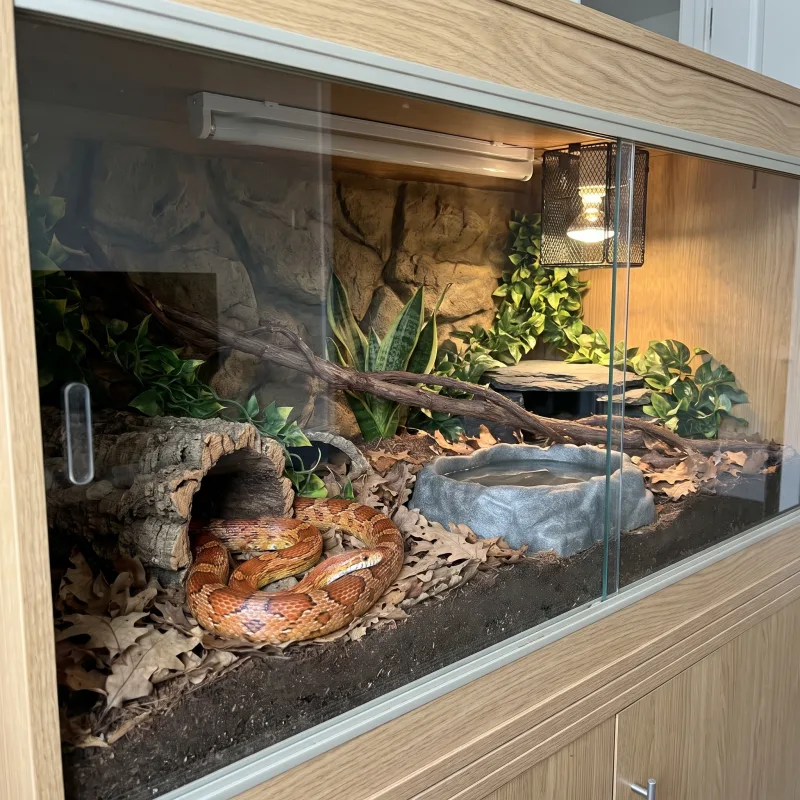
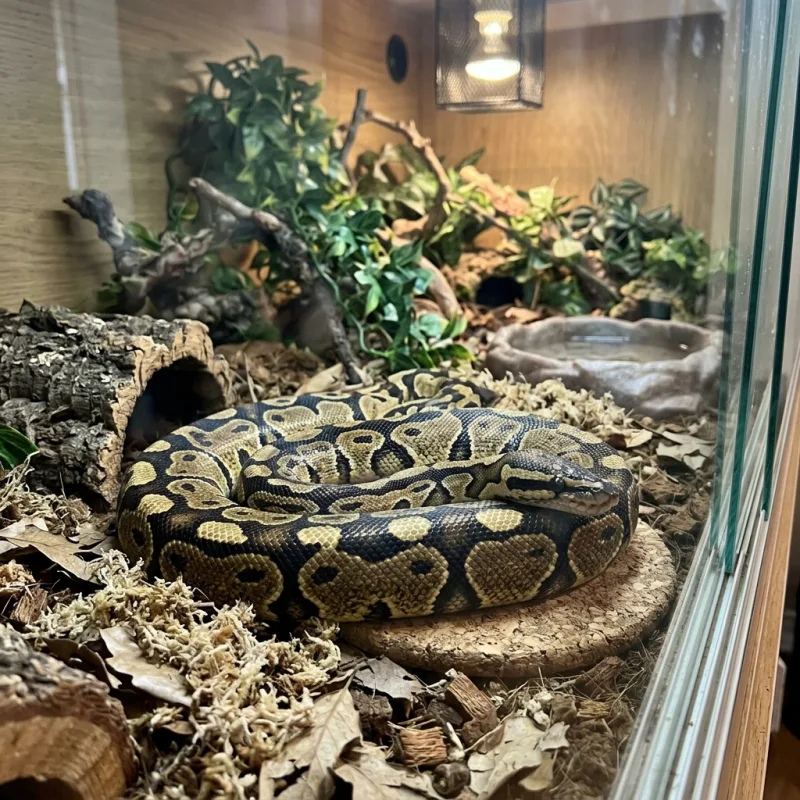
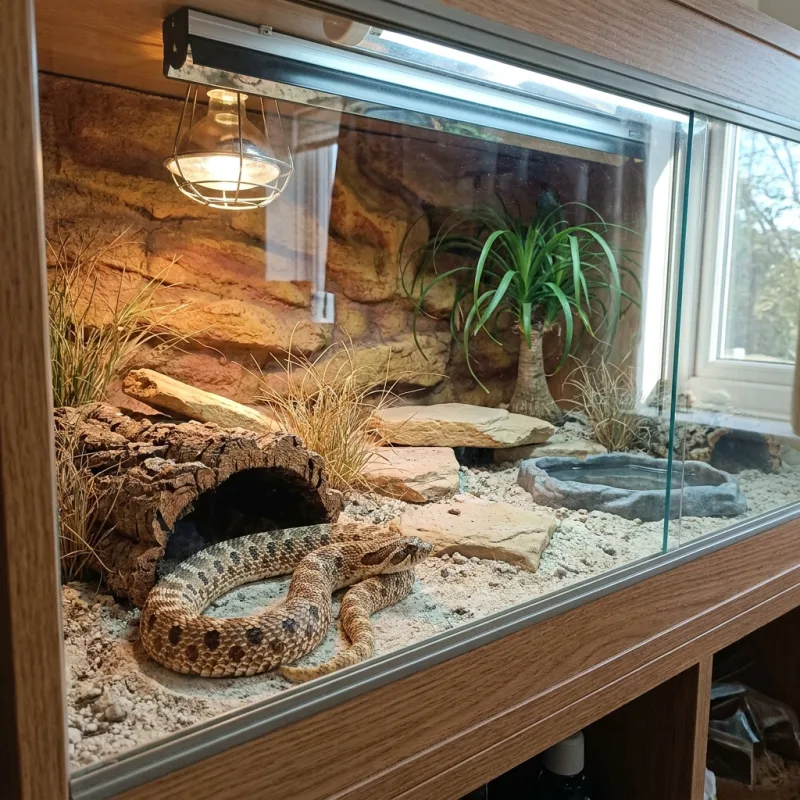
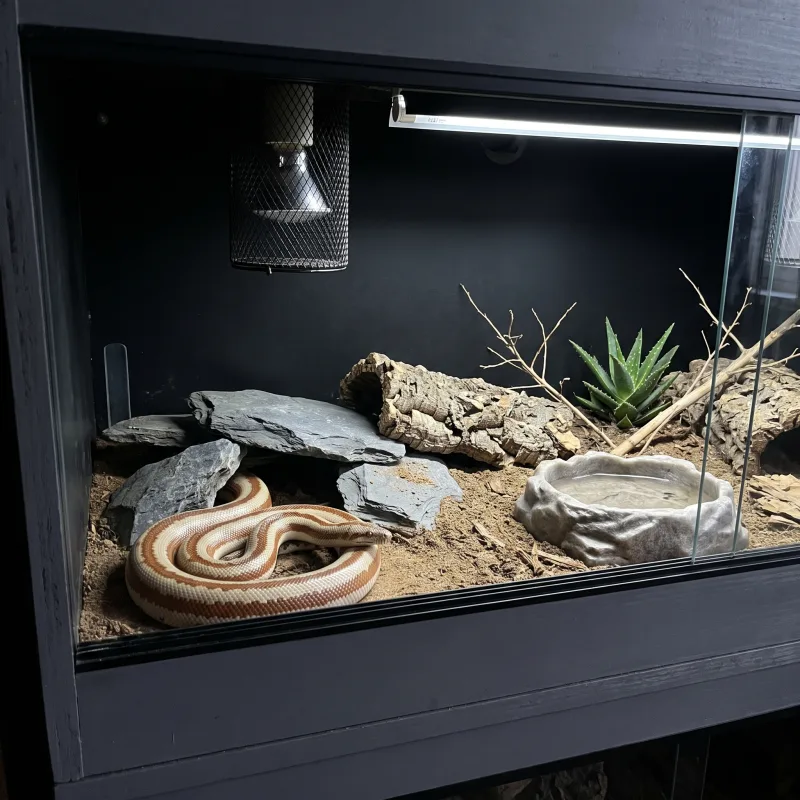
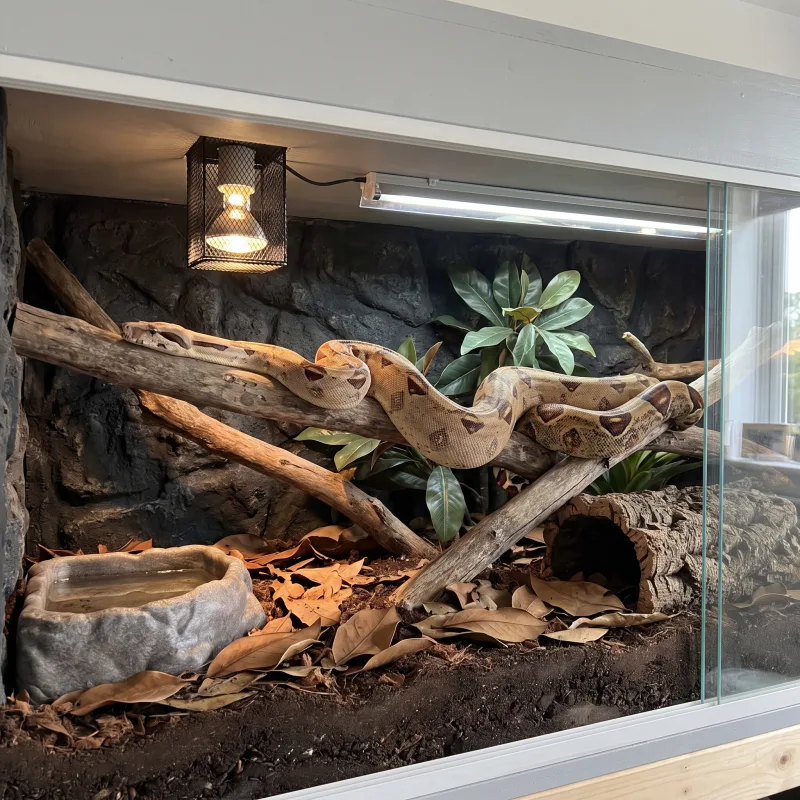
- An adult needs an enclosure of at least 8 x 4 x 6 ft2.4 x 1.2 x 1.8 m, which gives even a big female of about 8 ft2.4 m room to stretch out fully and to climb; as a rule the enclosure should be at least as long as the snake, so a boa over 8 ft2.4 m needs more, and the height is used, because boas are semi-arboreal.
- The build must be sturdy, with locking doors, because an adult boa can force weak seams and flip loose lids.
- Juveniles climb readily, so include strong, well-anchored branches that will still hold weight as the snake grows.
Show 5 more
- Provide a basking surface of 88-92°F31-33°C on a thermostat, a cool end of 78-82°F26-28°C, and no nighttime drop below about 75°F24°C.
- Keep humidity at 60-70%, rising during sheds, with a water bowl large enough for the whole snake to soak in.
- Low-output UVB over the basking area is increasingly considered best practice.
- The classic mistake is parking an adult boa permanently in a 4 ft120 cm vivarium bought for the juvenile.
- Budget for the adult enclosure, its heating costs, and the room it occupies before buying the baby.
Supplies
Setup
- Enclosure, 8 x 4 x 6 ft2.4 x 1.2 x 1.8 m
- Heating and thermostat
- Thermometers and hygrometer
- Substrate, hides at both ends, water bowl
Ongoing
- Frozen rodents in the right size for your snake
- Freezer container or bin dedicated to feeder storage
- Long blunt-tipped feeding tongs
- Sealable bags or a thawing tub for warming prey
- Heavy, tip-proof water bowl (big enough to soak in for most species; a small bowl on the cool side for rosy and sand boas, which are kept dry)
Show 2 more
- Digital kitchen scale for tracking weight
- Digital thermometer for checking prey temperature
Safe substrate: Cypress mulch · Aspen shavings · Topsoil and coco fibre mix
Care routine
Daily
- Check temperatures and humidity
- Look the animal over
- Spot-clean waste and uneaten food
Every few days
- Fresh water bowlevery 3 days
- Short handling sessionevery 3 days
Weekly
- Check every latch and vent
- Watch for a shed cycle
Show 7 more
Every few weeks
- Check for mitesevery 2 weeks
- Weigh-inevery 2 weeks
Monthly
- Feed a thawed rodent (adults every 3-4 weeks, large females every 4-6; juveniles every 7-10 days)
- Deep-clean decor, glass and bowls
- Test thermostats, lamps and guards
Less often
- Refresh the substrateevery 3 months
- Check the UVB lamp's age and replace it if due (if one is fitted)every 6 months
Vet: Annual exam and faecal check, every 12 months
Tools
Care in depth
Diet
Carnivore (frozen-thawed rats)
- Common boas are carnivores fed frozen-thawed rodents no wider than the snake's body at its thickest point, moving from mice to rats as they grow.
- Juveniles eat every 7-10 days, subadults every 10-14 days, and adults only every three to four weeks, with large females often stretched to four to six.
- Always thaw prey fully, warm it, and offer it with long tongs; never feed live.
- Overfeeding is the single most common way keepers harm this species.
- Boas have a slow metabolism, and weekly adult feeding produces obesity and fatal fatty liver disease, so a healthy boa should feel firmly muscular, not soft and segmented.
- Skip handling for 48 hours after a meal to avoid regurgitation, which is a serious event in boas.
- They have a strong, accurate feeding response, so tap-training with a hook or paper towel roll before opening the enclosure teaches the snake to distinguish feeding time from handling time.
Health
Signs of good health, and the common problems
- A healthy common boa is firmly muscled with clear eyes, clean nostrils and a clean, pink mouth, and sheds in one piece.
- Cold or damp enclosures cause respiratory infections, seen as wheezing, mucus, or open-mouth breathing, while wet substrate causes scale rot on the belly.
- Both need an exotics vet, ideally one used to handling large snakes.
- Inclusion body disease, caused by reptarenavirus, is the disease every boa keeper must know: it is incurable, ultimately fatal, and spreads through collections, possibly carried by snake mites.
- Buy captive-bred from a breeder who screens their animals, quarantine any new reptile away from your boa for at least three months and ideally six, and treat any mite outbreak aggressively.
- Monitor weight over the years, since obesity shortens lives quietly, and remember you are budgeting for decades of vet access for an animal many general practices will not see.
Is this urgent?
5 warning signs and how fast to act, 2 of them right away
Most snake worry is about feeding, and most feeding worry is misplaced. Check the guide for this species' normal fast before treating a refusal as illness.
Go now
Today
Soon
This is general guidance for a healthy adult, not a diagnosis. An exotics vet who knows your animal always overrides it, and the time to find one is before you need one.
Bedding and substrate
5 safe, 1 with a caveat, 2 to avoid
For snakes the substrate has to hold the right humidity for the shed, and let the animal get fully under it.
Safe
With a caveat
Never
Stuck shed and retained eyecaps are usually a humidity failure during the blue phase, not a substrate failure afterwards.
Top resources for more info
Independent creators and organisations we would send a friend to. We have no affiliation with any of them, and nothing here is sponsored. Links checked 2026-10-22.
YouTubers
Sites
Snakes, side by side
Same axes, same care guides: the honest way to choose between types.