Dumbo Fancy Rat
Rattus norvegicus
Low-set ears, same brilliant rat underneathIntermediate
- Lifespan
- 2-3 years, occasionally longer
- Size
- Body 8-11 in20-28 cm plus a tail nearly as long
- Weight
- 0.55-1.45 lb250-650 g, males the heavier
- Social needs
- Highly social; keep a same-sex group of 3 or more, never alone
- Time
- 1+ hour daily; handling, free-roam time, spot cleaning
- Cost
- Medium; vet bills routinely exceed the purchase price
- Diet
- Omnivore; balanced rat nuggets plus fresh veg and lean protein
Overview
What is this animal?
- The dumbo is not a separate breed but an ear type of the fancy rat, produced by a single recessive gene that sets large, round ears low on the sides of the head instead of on top.
- It first appeared in a US litter in the early 1990s and now shows up across every coat variety, from standard to rex to hairless.
- Apart from the ears it is essentially the same animal as the top-eared fancy rat, with the same size, lifespan, and care needs.
Show 4 more
- The persistent claim that dumbos are calmer, friendlier, or healthier than top-eared rats is a myth with no genetic basis.
- Temperament comes from the breeding line and early socialisation, not ear placement, so choose a breeder or rescue by how the animals are handled, not by how the ears sit.
- Like all rats, dumbos are intelligent, strongly social, and genuinely interactive, but they are a short, vet-heavy commitment of two to three years.
- They must live in same-sex groups, three or more rather than a pair, and a lone rat is a welfare failure regardless of how much human attention it gets.
Temperament
- A well-socialised dumbo is gentle, curious, and genuinely bonded to its people, learning its name, riding shoulders, and picking up simple tricks for treats.
- Rats rarely bite when handled respectfully, which makes them one of the best hands-on rodents for calm, supervised older children.
Show 4 more
- Expect the same range of personalities as in any rat line, because the low-set ears change the silhouette, not the character.
- A skittish dumbo from a poorly handled litter will need the same slow, food-based trust-building as any other rat.
- Rats are group animals that groom, play, and sleep in a pile, so keep a same-sex group of at least three, the number Swiss Animal Protection and Wood Green give as better than a pair, and introduce newcomers gradually on neutral ground.
- If you cannot commit to three, the honest answer is not yet.
A good fit for
- Keepers wanting a clever, trainable, hands-on pet
- Households able to commit an hour or more daily
- People prepared to keep three or more rats
- Families with gentle, supervised older children
- Owners who accept a short, vet-heavy lifespan
Common mistakes to avoid
- Believing dumbo ears mean a calmer or healthier rat
- Keeping a single rat alone
- Aquariums or tubs trapping ammonia and wrecking airways
- Impulse-buying from stores that mass-breed for the ear type
- Ignoring sneezing, red staining, or new lumps
- Skipping the exotics vet fund
Enclosure
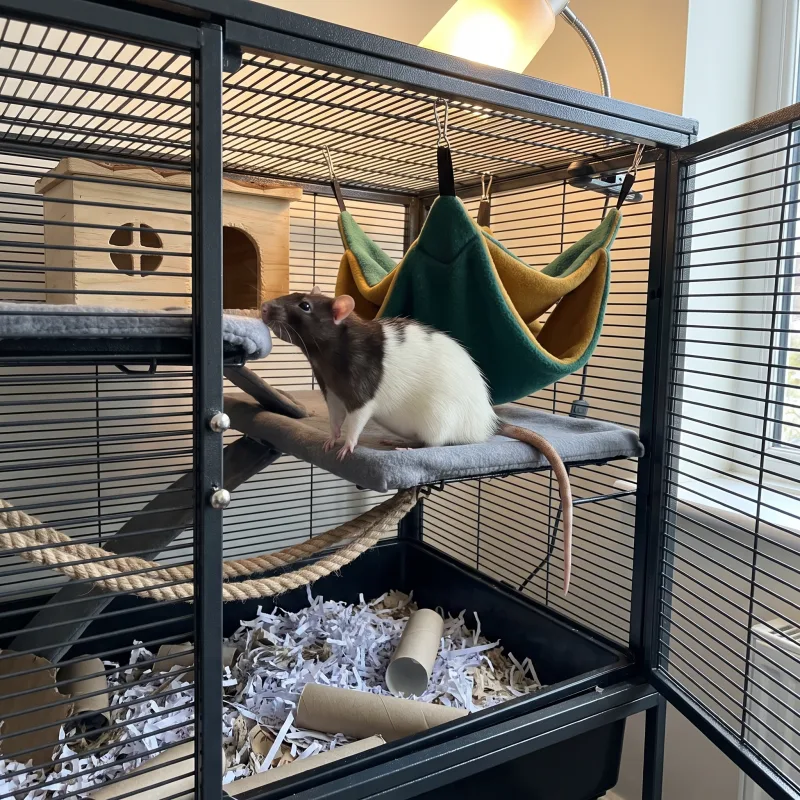
Minimum 5.5 sq ft0.5 m² of floor, for a group of 3 · 39 x 20 x 39 in100 x 50 x 99 cm
Cannot be kept alone. The minimum is 3, and the space above is for that group.
- House a trio in a wire cage of at least 39 x 20 x 39 inches100 x 50 x 100 cm with several solid levels, the size TVT, the German veterinary association for animal welfare, sets for up to three rats, and go larger for every rat you add, because floor space and climbing height both matter.
- Bar spacing must be no more than about half an inch1.2 cm for adults, and closer to 0.4 in1 cm for young rats, which will otherwise squeeze straight through.
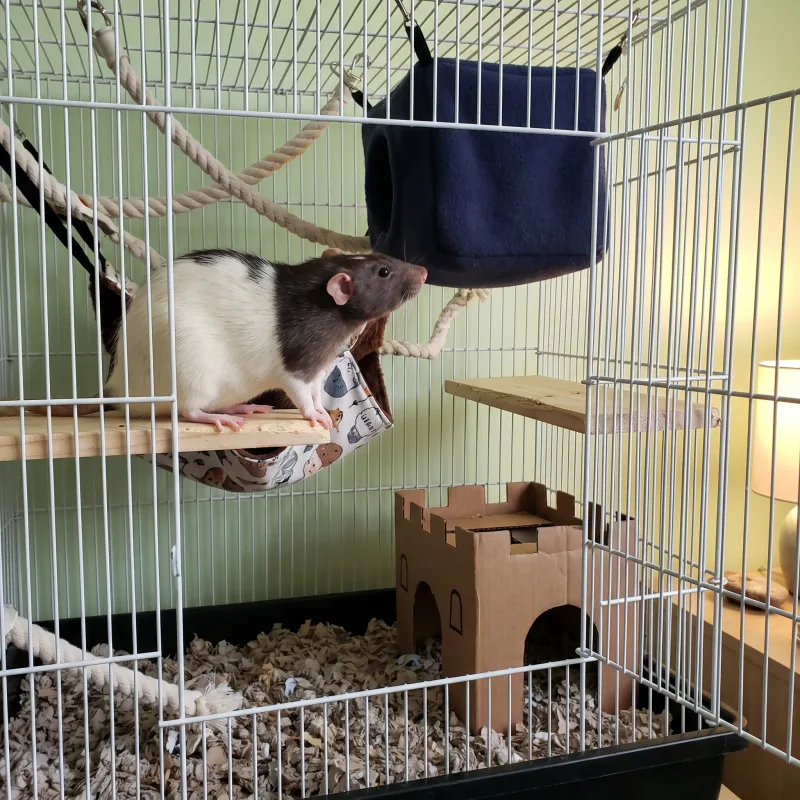
- Furnish generously with hammocks, ropes, platforms, hides, tunnels, and a litter tray, since rats readily litter-train.
Show 4 more
- Never house rats in an aquarium or plastic tub, because trapped ammonia off dirty bedding is a direct route to the respiratory disease that already kills many rats.
- Use dust-free paper-based bedding, and avoid pine and cedar shavings, whose aromatic oils irritate the airway.
- Keep the room at 64-75°F18-24°C and treat anything above 79°F26°C as dangerous, because rats cannot sweat and shed heat poorly through their tails.
- Rats also need at least an hour of supervised free-roam time daily in a rat-proofed space, and the cage alone is not enough exercise or enrichment.
Supplies
Setup
- Enclosure of an adequate size
- Water bottles, bowls, hides and enrichment
- Carrier and travel box
- Digital kitchen scale
Ongoing
- Balanced rat nuggets or lab blocks (12-16% protein, low fat)
- Fresh vegetables for daily portions
- Dried mealworms
- Foraging toys or a puzzle feeder
- Heavy ceramic bowl
Show 3 more
- Water bottle plus brush
- Kitchen scale for weekly weigh-ins
- Airtight storage bin
Safe substrate: Dust-extracted paper bedding · Hemp · Fleece hammocks and liners
Care routine
Daily
- Feed and clear yesterday's leftovers
- Free-roam time with you
- Fresh water
- Spot-clean the enclosure
- Watch them while they are awake
Every few days
- Training or a foraging puzzleevery 3 days
- Full bedding changeevery 4 days
Show 5 more
Weekly
- Hands-on lump and breathing check
- Rotate enrichment
- Weigh-in
Monthly
- Check nails and teeth
- Check supplies and dates
Vet: Six-monthly exam, every 6 months (every 3 months from 1.5 years old)
Tools
Care in depth
Diet
Omnivore; balanced rat nuggets plus fresh veg and lean protein
- Feed a balanced commercial rat nugget or lab block as roughly 80 percent of the diet, choosing a formula around 12-16 percent protein and low in fat (about 4-5 percent), because muesli-style mixes let rats pick out the fatty bits and unbalance themselves.
- Scatter-feed part of the ration or use foraging toys, since working for food is real enrichment for an animal this clever.
- Add a small daily portion of fresh vegetables such as broccoli, peas, cucumber, or leafy greens, with fruit only as an occasional treat.
- Tiny amounts of cooked egg, plain chicken, or a mealworm suit their omnivorous nature once or twice a week.
- Skip citrus for male rats, as a compound in the peel is linked to kidney damage in males specifically, and never offer sticky globs of peanut butter, which are a genuine choking hazard.
- Obesity is common in pet rats and shortens an already short life, so weigh weekly and portion rather than free-feed.
Health
Signs of good health, and the common problems
- The dumbo mutation mainly changes how the outer ear forms and sits; the study that identified it also found slightly smaller eyes in newborn dumbo rats, with no documented effect on health.
- There is no evidence that dumbos are healthier, calmer or hear any differently than top-eared rats, and no ethical seller should claim otherwise.
- Budget for an exotics vet from day one, because most rats will need one at some point in their short lives.
- Chronic respiratory disease driven by Mycoplasma pulmonis is the signature rat illness, so treat sneezing, clicking or laboured breathing, and red porphyrin staining around the eyes and nose as reasons to book a vet, not to wait.
- Clean, well-ventilated housing on dust-free bedding is the single best prevention.
- Mammary tumours affect a large share of unspayed females, and spaying young dramatically cuts the risk, while pituitary tumours and hind-leg weakness are common endings for elderly rats.
- Check for lumps during weekly handling, because early removal of a mammary tumour is routine surgery while a late one is often inoperable.
Is this urgent?
3 warning signs and how fast to act, 1 of them right away
Rats are the most respiratory-fragile common small pet. Listen to them in a quiet room once a week.
Go now
Today
Soon
Rats must live in same-sex groups, three or more rather than a pair. A solitary rat becomes withdrawn and stops thriving.
This is general guidance for a healthy adult, not a diagnosis. An exotics vet who knows your animal always overrides it, and the time to find one is before you need one.
Bedding and substrate
3 safe, 2 with a caveat, 3 to avoid
For rats, dust is the whole conversation. Their respiratory tract is the weak point of the species.
Safe
With a caveat
Never
If you can smell ammonia at the cage, the rats have been breathing it for a while. That is a cleaning-frequency problem, not a bedding problem.
Top resources for more info
Independent creators and organisations we would send a friend to. We have no affiliation with any of them, and nothing here is sponsored. Links checked 2026-10-22.
YouTubers
Sites
Rats, side by side
Same axes, same care guides: the honest way to choose between types.