Fancy Rat
Rattus norvegicus
An intelligent, interactive rodent that bonds with keepersIntermediate
- Lifespan
- 2-3 years
- Size
- Body 8-11 in20-28 cm plus a tail nearly as long
- Weight
- 0.55-1.45 lb250-650 g, males the heavier
- Social needs
- Social; keep a same-sex group of 3 or more
- Time
- Daily interaction and out-of-cage time
- Cost
- Medium
- Diet
- Balanced rat nuggets or lab block plus fresh veg and protein
Overview
What is this animal?
- The fancy rat is an intelligent, sociable domesticated rodent often regarded as one of the more interactive small pets.
- Rats can bond with their keepers, learn simple tasks and enjoy genuine interaction.
- They are social and should not be kept alone: keep a same-sex group of three or more.
- Their main drawbacks are a short lifespan and a high rate of tumours and respiratory disease.
Temperament
- Fancy rats are generally gentle and clever, often seeking out their owners, riding on shoulders and learning to respond to their names.
- With regular handling they become interactive companions.
Show 2 more
- They are highly social and do best in same-sex groups, grooming and sleeping in a pile together.
- A lone rat suffers and a pair is the bare minimum, so keep three or more, introducing newcomers carefully to maintain a harmonious group.
A good fit for
- Keepers wanting an interactive, trainable pet
- Those able to provide daily handling
- Owners committed to keeping groups
- People prepared for a short lifespan
Common mistakes to avoid
- Keeping a single rat alone
- Respiratory disease from poor ventilation/bedding
- Small cages with no climbing height
- Ignoring lumps and breathing changes
Enclosure
Minimum 5.5 sq ft0.5 m² of floor, for a group of 3 · 39 x 20 x 39 in100 x 50 x 99 cm
Cannot be kept alone. The minimum is 3, and the space above is for that group.
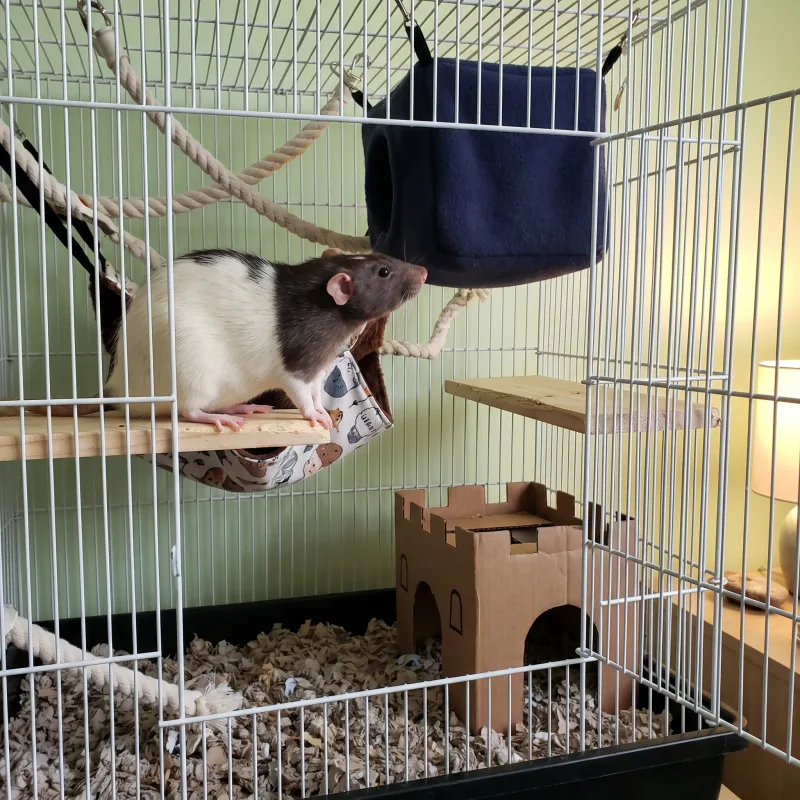
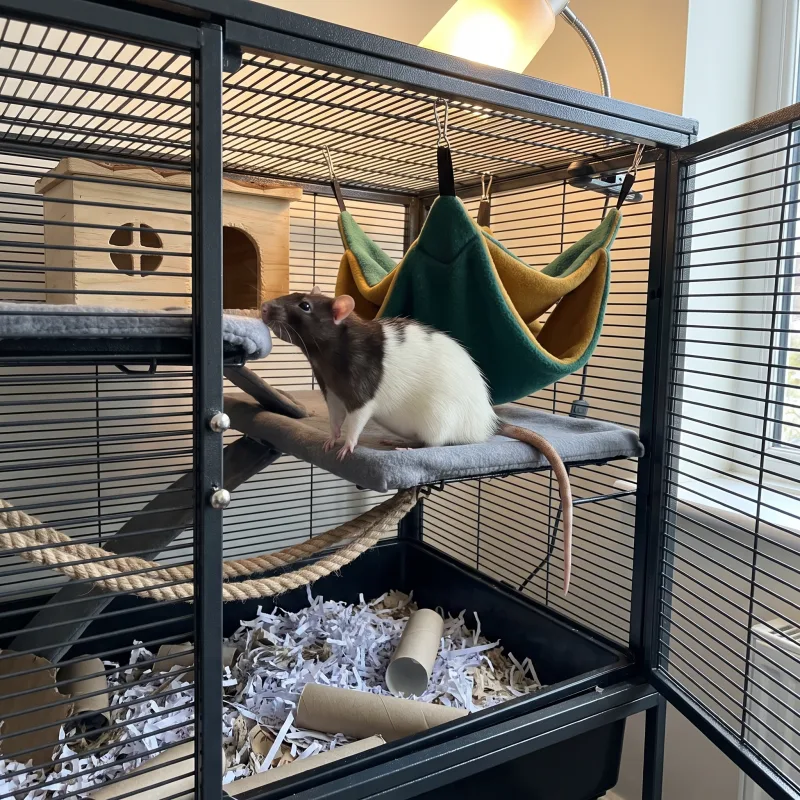
- Provide a tall, multi-level wire cage with bars suitable for climbing, at least 39 x 20 x 39 in100 x 50 x 100 cm for three rats, the TVT figure for up to three, with bar spacing close enough to prevent escape.
- Fill it with hammocks, ropes, platforms, hides and tunnels.
- Use dust-free, low-ammonia bedding and avoid pine and cedar.
Show 2 more
- Daily out-of-cage time in a safe, supervised space is essential for exercise and bonding.
- Keep the cage clean, well-ventilated and out of draughts and direct sun.
Supplies
Setup
- Enclosure of an adequate size
- Water bottles, bowls, hides and enrichment
- Carrier and travel box
- Digital kitchen scale
Ongoing
- Balanced rat nuggets or lab blocks (12-16% protein, low fat)
- Fresh vegetables for daily portions
- Dried mealworms
- Foraging toys or a puzzle feeder
- Heavy ceramic bowl
Show 3 more
- Water bottle plus brush
- Kitchen scale for weekly weigh-ins
- Airtight storage bin
Safe substrate: Dust-extracted paper bedding · Hemp · Fleece hammocks and liners
Care routine
Daily
- Feed and clear yesterday's leftovers
- Free-roam time with you
- Fresh water
- Spot-clean the enclosure
- Watch them while they are awake
Every few days
- Training or a foraging puzzleevery 3 days
- Full bedding changeevery 4 days
Show 5 more
Weekly
- Hands-on lump and breathing check
- Rotate enrichment
- Weigh-in
Monthly
- Check nails and teeth
- Check supplies and dates
Vet: Six-monthly exam, every 6 months (every 3 months from 1.5 years old)
Tools
Care in depth
Diet
Balanced rat nuggets or lab block plus fresh veg and protein
- Feed a balanced commercial rat nugget or lab block as the staple, roughly 80 percent of the diet, rather than a mix, which rats pick through for the fatty bits; supplement it with daily fresh vegetables, occasional fruit and small amounts of cooked protein.
- Variety supports their omnivorous nature.
- Provide constant fresh water from a bottle.
- Limit fatty, sugary and salty human foods to prevent obesity.
- Foraging toys and scatter feeding give useful mental stimulation for these intelligent animals.
Health
Signs of good health, and the common problems
- Rats are very prone to respiratory infections, particularly mycoplasma, so clean, dust-free, well-ventilated housing is crucial; watch for sneezing, porphyrin (red) staining and laboured breathing.
- Mammary and pituitary tumours are common, especially in females.
- Their short lifespan means health can decline quickly.
- Neutering can reduce some tumours and hormonal aggression.
- Find a rat-experienced exotics vet early, as prompt treatment greatly improves outcomes.
Is this urgent?
3 warning signs and how fast to act, 1 of them right away
Rats are the most respiratory-fragile common small pet. Listen to them in a quiet room once a week.
Go now
Today
Soon
Rats must live in same-sex groups, three or more rather than a pair. A solitary rat becomes withdrawn and stops thriving.
This is general guidance for a healthy adult, not a diagnosis. An exotics vet who knows your animal always overrides it, and the time to find one is before you need one.
Bedding and substrate
3 safe, 2 with a caveat, 3 to avoid
For rats, dust is the whole conversation. Their respiratory tract is the weak point of the species.
Safe
With a caveat
Never
If you can smell ammonia at the cage, the rats have been breathing it for a while. That is a cleaning-frequency problem, not a bedding problem.
Top resources for more info
Independent creators and organisations we would send a friend to. We have no affiliation with any of them, and nothing here is sponsored. Links checked 2026-10-22.
YouTubers
Sites
Rats, side by side
Same axes, same care guides: the honest way to choose between types.