Bamboo Shrimp
Atyopsis moluccensis
Fan-handed filter feeder that fishes the currentIntermediate
- Lifespan
- 1-2 years is typical; up to 5 when well fed, but many starve sooner
- Size
- 2.5-3.5 in6-9 cm; males larger, with a thickened, elongated front pair of legs
- Social needs
- Fine alone; peaceful in groups of 3+
- Time
- Normal tank care plus targeted feeding several times a week
- Cost
- Low-medium
- Diet
- Filter feeder: fine particle foods dosed into the current
Overview
What is this animal?
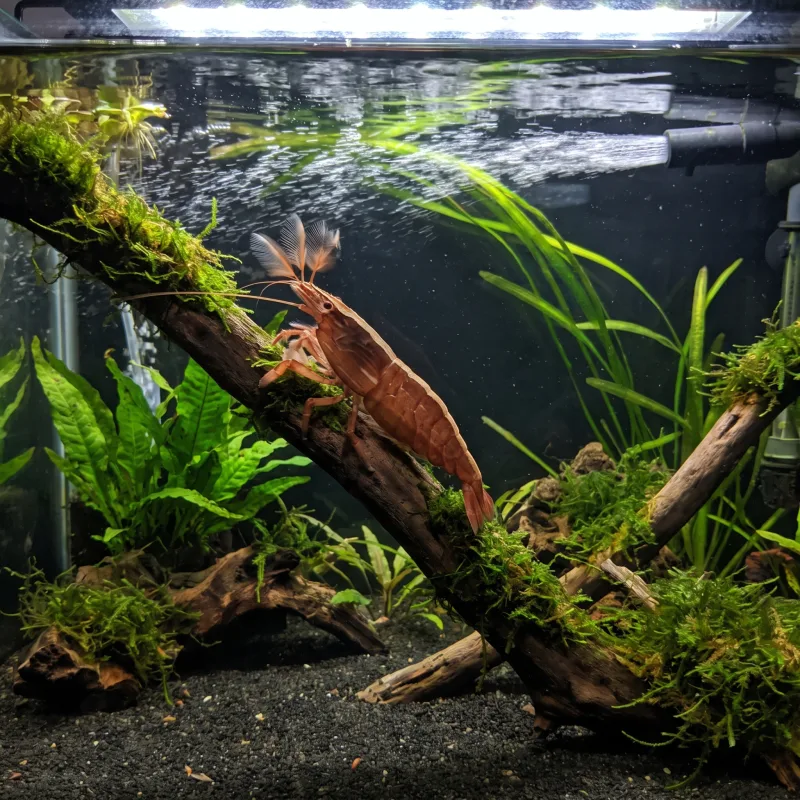
- The bamboo shrimp is the freshwater hobby's specialist filter feeder: instead of claws, its front limbs end in four feathery fans that it spreads into the current to net passing food particles.
- At up to 3.5 inches6-9 cm it dwarfs the cherry and Amano shrimp elsewhere on this site, wearing warm amber-brown with a pale cream racing stripe down its back.
- That fan-feeding lifestyle is the entire care puzzle.
Show 3 more
- It cannot graze algae the way other shrimp do, so it thrives only in a mature tank with genuine water movement and enough suspended food, which is why an animal routinely sold as easy earns an Intermediate rating here.
- Almost every bamboo shrimp in the trade is wild-caught in Southeast Asia, because its larvae need brackish water to develop and it has never been bred at scale in home tanks.
- That makes careful sourcing and gentle acclimation part of keeping this species responsibly.
Temperament
- The bamboo shrimp is entirely peaceful and physically incapable of harming a tankmate, because its fans cannot pinch anything.
- It is safe with plants, snails, dwarf shrimp, and any small, gentle community fish.
Show 4 more
- It is content kept alone, and a group of three or more will simply line up along the same flow line without any squabbling.
- The danger runs the other way: large cichlids, goldfish, crayfish, and nippy barbs treat a slow, defenceless shrimp of this size as a target.
- Expect a mostly sedentary animal that claims one high-flow perch and occupies it for weeks, becoming more active toward dusk.
- The reward is not antics but the quiet spectacle of a living net fishing the current every day.
A good fit for
- Mature, well-established planted community tanks
- Keepers fascinated by unusual feeding behaviour
- Peaceful communities of small, gentle fish
- Aquarists willing to target-feed powdered foods
- Tanks with steady flow from a filter or powerhead
Common mistakes to avoid
- Spotless, over-filtered tanks: filter feeders starve in them
- Fan-sweeping the substrate, the classic starvation sign
- Soft, mineral-poor water causing stuck or failed moults
- Copper in any medication or fertiliser: lethal
- Rushed acclimation of already-stressed wild-caught stock
- Housing with large fish, crayfish, or nippy barbs
Enclosure
Minimum 20 gallons75 litres
Fine alone or with company. Fine alone; peaceful in groups of 3+
- Plan on a 20-gallon long tank75-litre tank as a working minimum, and only a tank that has been running for several months; a freshly cycled aquarium is too clean to feed a filter feeder.
- Place wood or rock perches directly in the outflow of the filter or a small powerhead, because the shrimp will climb to the fastest water it can find and face into the stream.
- Keep the water at 72-82°F22-28°C, pH 6.5-7.5, with moderate to firm hardness and ammonia and nitrite at zero.
Show 5 more
- It needs enough dissolved minerals (GH and KH) to build each new shell, so do not run it in soft, near-RO water.
- Like all invertebrates it has no tolerance for copper in medications or fertilisers.
- Fit a tight lid, since a hungry or stressed bamboo shrimp is a determined climber.
- Provide dense plants or caves for moulting, because it hides for several days after each moult while its new shell hardens.
- If there is no strong flow anywhere in the tank, this is the wrong species for that tank.
Supplies
Setup
- Tank and stand
- Filter
- Heater and thermometer
- Substrate, plants and decor
- Liquid test kit
- Dechlorinator and starter supplies
Ongoing
- Powdered spirulina or fine particle food
- A fine larval or reef micro-diet
- Baby brine shrimp, frozen or hatched at home
- Pipette or turkey baster for target-feeding into the current
- Mineral or GH supplement for shell health
- Small powerhead, if the filter outflow gives no strong current
Safe substrate: Fine, smooth sand · Smooth, rounded fine gravel (not for loaches or sand-sifting cichlids; sand is better for corydoras) · Bare bottom (quarantine and grow-out only)
Care routine
Daily
- Check temperature and equipment
- Head-count and look everyone over
Every few days
- Feed small amounts (target-feed bamboo shrimp into the current)every 2 days
- Top up evaporationevery 3 days
Weekly
- Small, matched water change
- Test hardness as well as nitrogen
- Wipe the front glass only
Show 5 more
Every few weeks
- Trim and thin the plantsevery 2 weeks
Monthly
- Check labels for copper
- Check supplies and reagent dates
- Replace or recharge chemical media, if you use any (skip it in a blackwater tank)
- Rinse the filter media
Health review: Quarterly colony and mineral review, every 3 months
Tools
Care in depth
Diet
Filter feeder: fine particle foods dosed into the current
- A bamboo shrimp eats by holding its fans open in the current and combing off whatever they trap, so its food must be suspended in the water column, not sitting on the glass.
- In most home aquariums the natural supply of micro-particles is not enough, so target-feed several times a week: powdered spirulina, finely crushed flake, a fine larval micro-diet, or baby brine shrimp released upstream so the cloud drifts through the fans.
- Read the behaviour like a gauge.
- A shrimp perched high with fans spread is feeding well, while one crouched low and sweeping the substrate with its fans is starving, and slow starvation is the single most common way keepers lose this species.
- A spotless, heavily over-filtered tank works against it, so aim for a mature system with some biofilm and mulm rather than surgical cleanliness.
- Never move it to a bare quarantine-style tank long term, because there is nothing there for it to eat.
Health
Signs of good health, and the common problems
- Most losses happen in the first few weeks, because wild-caught stock arrives stressed and half-starved from the supply chain.
- Drip acclimate over at least an hour, and in the shop choose an animal that is actively fanning rather than one crouched low and picking listlessly at the gravel.
- It moults every month or two and then disappears into cover for days, which is normal, not illness.
- Leave the shed shell in the tank, since the shrimp eats it to recover minerals, and trace failed or stuck moults to unstable parameters or mineral-poor water.
- Colour shifts from deep brick red to muddy brown are normal and track mood, moulting, and background, so do not read them as disease on their own.
- Check every medication and plant fertiliser for copper before it goes anywhere near the tank, and with steady feeding expect 1-2 years at least, and up to 5 from a well-kept adult.
Is this urgent?
7 warning signs and how fast to act, 4 of them right away
In a shrimp tank the patient is usually the water. Test before you treat: many fish medications harm shrimp, and dosing a healthy tank for a disease it does not have makes things worse.
Go now
Today
Soon
Never add new animals to a tank that is not fully cycled, and never treat blind. Read every medication, algaecide and plant treatment for copper before it goes in. A test kit is cheaper than the colony.
This is general guidance for a healthy adult, not a diagnosis. An exotics vet who knows your animal always overrides it, and the time to find one is before you need one.
Bedding and substrate
3 safe, 4 with a caveat, 2 to avoid
Substrate in an aquarium is a filter as much as a floor. Most of the biology lives in and on it.
Safe
With a caveat
Never
This is our general list for freshwater fish. We have not built one specific to Shrimp yet.
Top resources for more info
Independent creators and organisations we would send a friend to. We have no affiliation with any of them, and nothing here is sponsored. Links checked 2026-10-22.
YouTubers
Sites
Shrimp, side by side
Same axes, same care guides: the honest way to choose between types.