Long-finned Betta
Betta splendens
Flowing-finned labyrinth fish that lives aloneBeginner
- Lifespan
- 3-5 years
- Size
- 2.5 in6-7 cm
- Social needs
- Solitary (males); kept without tankmates
- Time
- 10-15 min daily; weekly water change
- Cost
- Low
- Diet
- Carnivore (high-protein pellets, frozen foods)
Overview
What is this animal?
- Bettas are labyrinth fish from the slow, warm waters of Southeast Asia, able to gulp air from the surface.
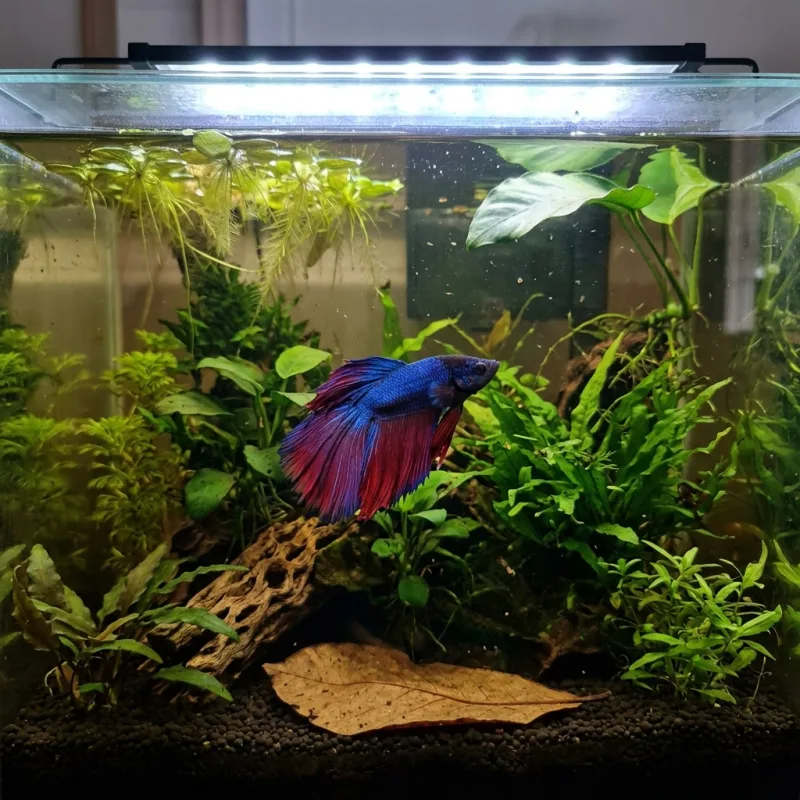
- Selective breeding, mostly in the last hundred years, produced the long finnage and bright colours sold today, but the fish beneath is hardy and learns to recognise its keeper.
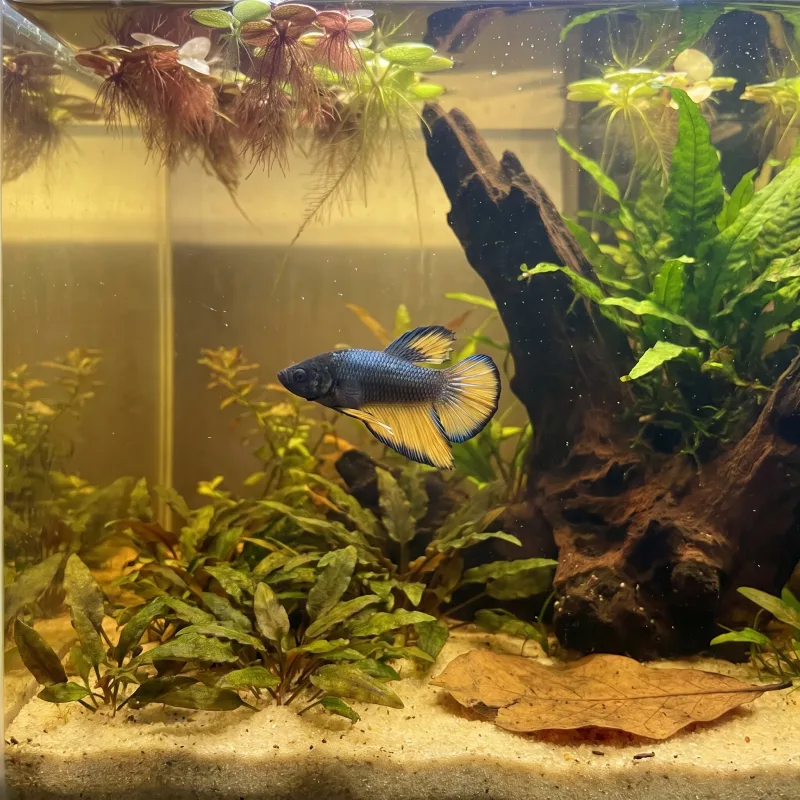
- This guide covers the long-finned forms most shops sell, such as the veiltail, halfmoon, crowntail and double tail; the short-finned plakat is the same species and has its own guide.
Show 3 more
- Despite their reputation as desk ornaments, bettas do well only in a heated, filtered, cycled tank.
- Their tolerance of poor water is a survival trait, not a reason to skip proper care.
- Given a stable setup they are interactive and long-lived.
Temperament
- Males are territorial and must be housed alone, as two males will fight and even a mirror can stress them.
- The name Siamese fighting fish reflects this instinct.
Show 3 more
- They do not need company and are content as the sole occupant.
- They become curious and bold once settled, flaring, following fingers, and learning feeding routines.
- Females can sometimes share a heavily planted larger tank as a sorority, but this is advanced and not recommended for beginners.
A good fit for
- First-time keepers wanting an interactive fish
- A heated 24 in60 cm tank on a sturdy stand
- People who like a single characterful pet
- Keepers who can commit to weekly water changes
Common mistakes to avoid
- Housing in unheated bowls or vases
- Keeping two males together
- Overfeeding causing bloat and swim-bladder issues
- Assuming they tolerate uncycled water long-term
- Strong flow or sharp decor that tears long fins
Enclosure
Minimum 15 gallons57 litres
Must be housed alone. Solitary (males); kept without tankmates
- Provide at least 15 US gallons57 litres in a tank at least 24 in60 cm long, such as a standard 15-gallon57-litre, with a gentle filter and a reliable heater holding 77-82°F25-28°C.
- A tight lid is essential, as bettas jump and need an undisturbed warm air layer to breathe.
- Silk or live plants and a cave give security and resting spots near the surface.
Show 3 more
- Keep flow low, since long fins tire in strong currents.
- Cycle the tank before adding the fish and aim for ammonia and nitrite at zero and nitrate under 20ppm.
- Bowls, vases, and unheated nano cubes are inadequate and shorten lifespan, and the 5 gallons19 litres often quoted is a floor rather than a good home.
Supplies
Setup
- Tank and stand
- Filter
- Heater and thermometer
- Substrate, plants and decor
- Liquid test kit
- Dechlorinator and starter supplies
Ongoing
- Quality betta pellets (fish or shrimp meal listed first)
- Frozen bloodworm blister pack
- Frozen daphnia
- Frozen brine shrimp
- Feeding tweezers or a pipette
Show 2 more
- Small thawing cup
- Fine net for removing uneaten food
Safe substrate: Fine, smooth sand · Smooth, rounded fine gravel (not for loaches or sand-sifting cichlids; sand is better for corydoras) · Bare bottom (quarantine and grow-out only)
Care routine
Daily
- Check temperature and equipment
- Feed a few pellets
- Head-count and look everyone over
Every few days
- Check the finsevery 3 days
- Top up evaporationevery 3 days
Show 8 more
Weekly
- Check the lid and air gap
- Test the water
- Water change and gravel vacuum
- Wipe the front glass only
Every few weeks
- Trim and thin the plantsevery 2 weeks
Monthly
- Check supplies and reagent dates
- Replace or recharge chemical media, if you use any (skip it in a blackwater tank)
- Rinse the filter media
Health review: Quarterly tank and fin review, every 3 months
Tools
Care in depth
Diet
Carnivore (high-protein pellets, frozen foods)
- Bettas are carnivores and need a meat-based diet.
- Feed a quality betta-specific pellet as the staple, supplemented several times weekly with frozen or live bloodworms, daphnia, and brine shrimp.
- Variety supports colour, finnage, and digestion.
- Feed only what is eaten in two minutes, once or twice daily, and include a weekly fasting day to reduce constipation and bloating.
- Overfeeding is a leading cause of swim-bladder problems and fouled water in betta tanks.
Health
Signs of good health, and the common problems
- Common ailments are fin rot, fungal infections, and swim-bladder disorder, most traceable to cold water, poor filtration, or overfeeding.
- Stable warmth and clean parameters prevent most disease.
- Watch for clamped fins, lethargy, and loss of appetite as early warning signs.
- Long-finned and double-tail forms can suffer fin-weighting and spinal issues, and some long-finned males bite their own tails, which usually points to stress, so look at the tank before blaming the fish.
- Quarantine new plants and decor, avoid sharp ornaments that tear fins, and treat illness promptly with the correct medication rather than salt alone.
Is this urgent?
6 warning signs and how fast to act, 3 of them right away
In a fish tank the patient is usually the water. Test before you treat: dosing a healthy tank for a disease it does not have makes things worse.
Go now
Today
Soon
Never add a new fish to a tank that is not fully cycled, and never treat blind. A test kit is cheaper than the fish.
This is general guidance for a healthy adult, not a diagnosis. An exotics vet who knows your animal always overrides it, and the time to find one is before you need one.
Bedding and substrate
3 safe, 4 with a caveat, 2 to avoid
Substrate in an aquarium is a filter as much as a floor. Most of the biology lives in and on it.
Safe
With a caveat
Never
This is our general list for freshwater fish. We have not built one specific to Bettas yet.
Top resources for more info
Independent creators and organisations we would send a friend to. We have no affiliation with any of them, and nothing here is sponsored. Links checked 2026-10-22.
YouTubers
Sites
Bettas, side by side
Same axes, same care guides: the honest way to choose between types.