Swordtail
Xiphophorus hellerii
Active livebearer with a bladed tailBeginner
- Lifespan
- 3-5 years
- Size
- 4-5.5 in10-14 cm
- Social needs
- Social; keep 6+ together
- Time
- 15 min daily; weekly water change
- Cost
- Medium
- Diet
- Omnivore (flake, pellet, veg, live foods)
Overview
What is this animal?
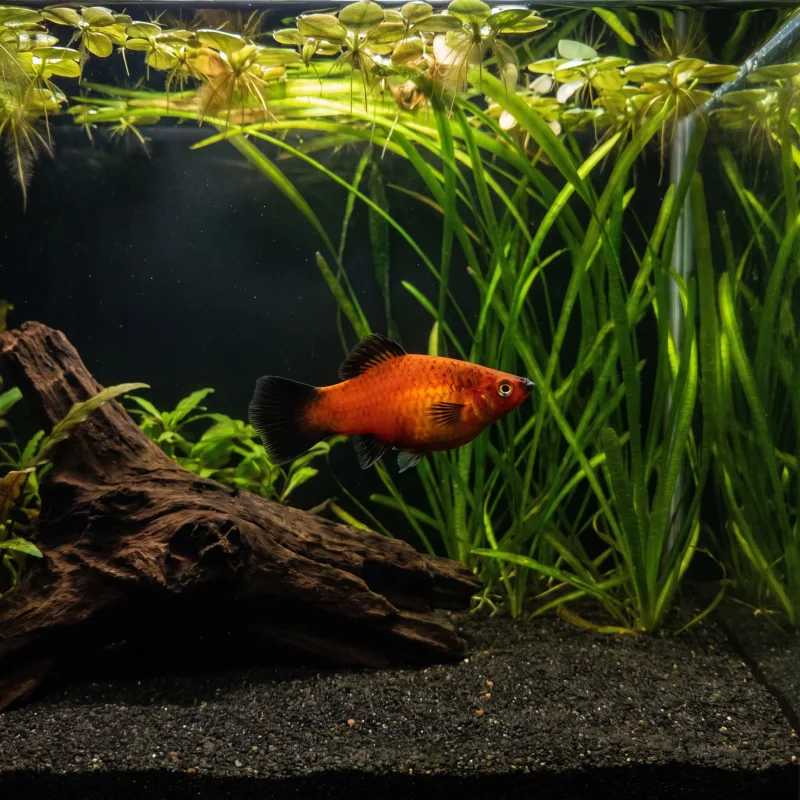
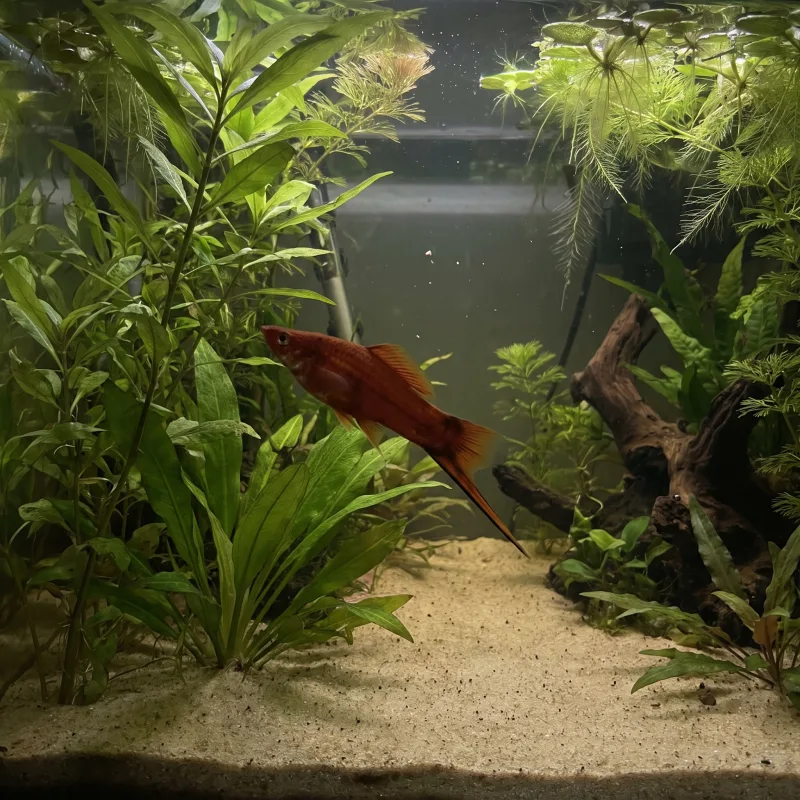
- Swordtails are lively livebearers from Central America, named for the long blade extending from the lower tail of mature males.
- Closely related to platies, they are larger, more active, and need more swimming room than their compact cousins.
- Hardy and adaptable, they come in red, green, pineapple, and tuxedo varieties.
- They are strong swimmers and accomplished jumpers, so they suit keepers who provide length, a secure lid, and stable, slightly hard water.
Temperament
- Swordtails are active and largely peaceful, but mature males can be territorial toward each other, sparring over space and females.
- Six is a good starting group, ideally one male with five females; keeping a single male, or several with plenty of room and a female-biased group, reduces conflict and stress.
Show 2 more
- They are confident, outgoing community fish that occupy open water and rarely hide.
- As ready breeders, mixed groups produce frequent fry, which adults will eat unless dense planting offers the young somewhere to shelter.
A good fit for
- Larger community aquariums with swimming space
- Beginners wanting an active, hardy fish
- Hard-water planted setups
- Keepers who can provide a secure lid
Common mistakes to avoid
- Undersized tanks restricting active swimmers
- Multiple males fighting in tight quarters
- Open tanks letting these jumpers escape
- Low-fibre diets causing constipation
Enclosure
Minimum 30 gallons113 litres, for a group of 6
Cannot be kept alone. The minimum is 6, and the space above is for that group.
- Their size and energy call for a tank with a footprint of at least 48 x 12 in120 x 30 cm and at least 30 US gallons113 litres of water, kept at 72-82°F22-28°C in hard, alkaline water and filtered to keep nitrate low.
- A standard 29- or 30-gallon110- or 115-litre tank is only 30-36 in76-91 cm long, so shop for length: open swimming space matters more than height for these powerful swimmers.
- A tight-fitting lid is essential, as swordtails are notorious jumpers.
- Provide planting at the sides and back for cover and fry refuge while leaving the central water column clear for their constant activity.
Supplies
Setup
- Tank and stand
- Filter
- Heater and thermometer
- Substrate, plants and decor
- Liquid test kit
- Dechlorinator and starter supplies
Ongoing
- Quality tropical flake or micro-pellet
- Spirulina or vegetable flake
- Frozen brine shrimp and daphnia
- Frozen or freeze-dried bloodworm
- Veg clip for courgette and spinach
Show 2 more
- Baby brine shrimp hatchery or frozen equivalent for fry
- Fine net for removing leftovers
Safe substrate: Fine, smooth sand · Smooth, rounded fine gravel (not for loaches or sand-sifting cichlids; sand is better for corydoras) · Bare bottom (quarantine and grow-out only)
Care routine
Daily
- Check temperature and equipment
- Feed
- Head-count and look everyone over
Every few days
- Top up evaporationevery 3 days
Weekly
- Test the water
- Water change and gravel vacuum
- Wipe the front glass only
Show 5 more
Every few weeks
- Trim and thin the plantsevery 2 weeks
Monthly
- Check supplies and reagent dates
- Replace or recharge chemical media, if you use any (skip it in a blackwater tank)
- Review the fry plan
- Rinse the filter media
Health review: Quarterly stocking and health review, every 3 months
Tools
Care in depth
Diet
Omnivore (flake, pellet, veg, live foods)
- Swordtails are omnivores that do best on a varied, vegetable-inclusive diet.
- Use a quality flake or pellet base, add spirulina, algae, and blanched greens, and offer frozen or live foods such as bloodworms, daphnia, and brine shrimp several times a week.
- Feed modest amounts once or twice daily, only what is consumed quickly.
- Like other livebearers they tend to overeat and can become constipated on a low-fibre diet, so keep vegetable matter a regular part of the menu.
Health
Signs of good health, and the common problems
- Swordtails are robust given clean, hard, stable water, but suffer ich, fin rot, and constipation under neglect or poor diet.
- Steady warmth, strong filtration, and weekly water changes prevent most disease in this hardy species.
- Mass-bred stock can be genetically weaker, so source carefully and quarantine new fish.
- Watch for clamped fins, white spots, or a swollen belly with stringy faeces: white spot (ich) and internal parasites need prompt treatment, while constipation from a low-fibre diet usually responds to corrected feeding.
Is this urgent?
6 warning signs and how fast to act, 3 of them right away
In a fish tank the patient is usually the water. Test before you treat: dosing a healthy tank for a disease it does not have makes things worse.
Go now
Today
Soon
Never add a new fish to a tank that is not fully cycled, and never treat blind. A test kit is cheaper than the fish.
This is general guidance for a healthy adult, not a diagnosis. An exotics vet who knows your animal always overrides it, and the time to find one is before you need one.
Bedding and substrate
3 safe, 4 with a caveat, 2 to avoid
Substrate in an aquarium is a filter as much as a floor. Most of the biology lives in and on it.
Safe
With a caveat
Never
This is our general list for freshwater fish. We have not built one specific to Swordtail yet.
Top resources for more info
Independent creators and organisations we would send a friend to. We have no affiliation with any of them, and nothing here is sponsored. Links checked 2026-10-22.
YouTubers
Sites
Other Freshwater Fish worth knowing
Same axes, same care guides: the honest way to compare them.