Boeseman's Rainbowfish
Melanotaenia boesemani
Half blue, half orange, all motionIntermediate
- Lifespan
- 5-8 years
- Size
- Males 4-4.5 in10-11 cm; females to 3 in8 cm
- Social needs
- Shoaler; keep 8+ with both sexes, more is better
- Time
- Low-moderate (daily feed, weekly water changes)
- Cost
- Medium (large tank; quality stock costs more)
- Diet
- Omnivore; small foods for a small throat
Overview
What is this animal?
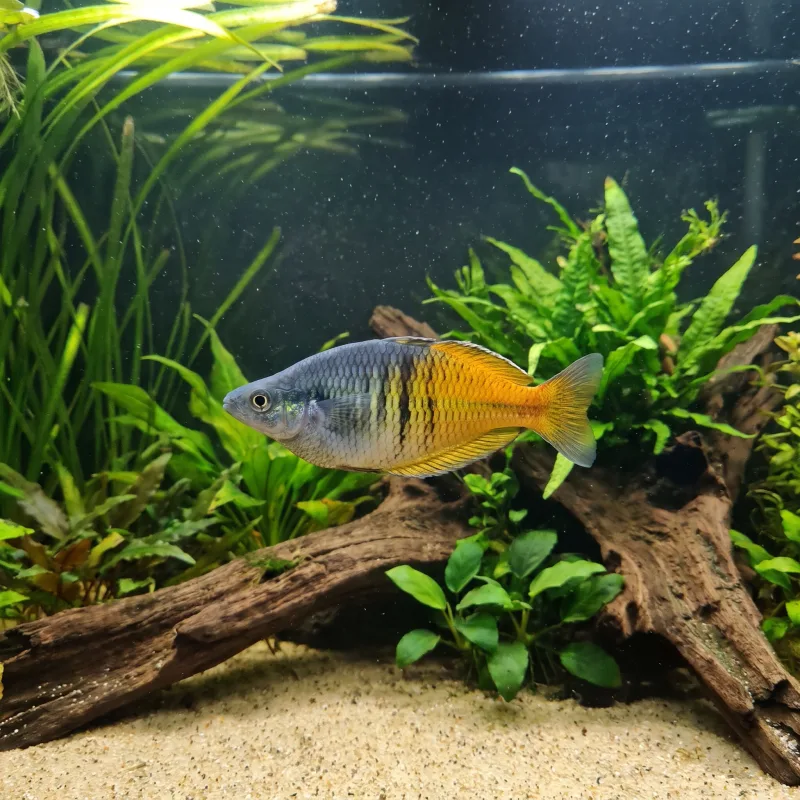
- Boeseman's rainbowfish is instantly recognisable among aquarium fish for its split colouration, with a smoky blue-grey head and forebody giving way to a saturated orange-red rear half.
- Adult males are deep-bodied, fast and constantly on display, and a shoal of them in morning light is one of the most striking sights in freshwater keeping.
- It is the only rainbowfish in this guide, and unlike the soft-water tetras and rasboras it prefers harder, slightly alkaline water.
Show 4 more
- The species is endemic to the Ayamaru Lakes region of West Papua, Indonesia, and is classed as Endangered in the wild after decades of over-collection and habitat change.
- Virtually every fish in the trade is farm-bred, and it should stay that way, so buy captive-bred stock from a reputable source without exception.
- The classic mistake happens in the shop, because juveniles are drab silver and only develop full colour over one to two years as they mature.
- Keepers who buy on adult photographs often give up on their 'grey' young fish long before the transformation, so patience is part of the care requirement here.
Temperament
- Boeseman's are peaceful but decidedly boisterous, spending the day in fast cruising runs and flashy male sparring matches of flared fins and intensified colour that almost never cause real injury.
- Keep both sexes, ideally with females equalling or outnumbering males, because males show their best colour when they have rivals and an audience.
Show 4 more
- In too small a group or a cramped tank the sparring turns into genuine bullying of the weakest male, which is a husbandry failure rather than a character flaw.
- Eight is the working minimum, the top of the six to eight Seriously Fish gives as its least, and more spreads the energy further.
- Good tankmates are other medium, robust, hard-water-tolerant fish: other rainbowfish species first of all, then larger tetras such as Congo tetras, peaceful barbs, Corydoras and other sturdy bottom dwellers.
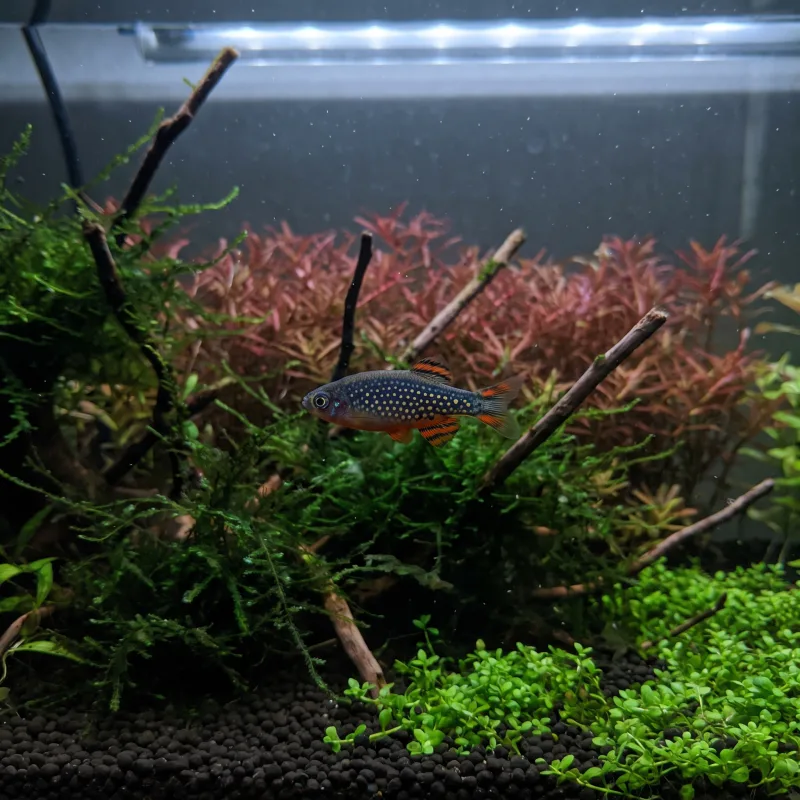
- Avoid tiny or timid species like ember tetras and celestial pearl danios, which are outcompeted at every feeding, and slow long-finned fish such as pearl gouramis or fancy guppies that find the constant motion stressful.
A good fit for
- Keepers with a 4 ft120 cm tank to fill with colour
- Active, hard or alkaline water communities
- Patient keepers who can wait 1-2 years for adult colour
- A long-lived centrepiece shoal (5-8 years)
- Homes wanting constant daytime activity
Common mistakes to avoid
- Judging drab juveniles - full colour takes 1-2 years
- Tanks under 4 ft120 cm cramping this fast swimmer
- Soft, acidic or cool water dulling colour and health
- Farm stock with bent spines or washed-out colour
- Overfeeding greedy fish that easily run fat
- An open top - startled rainbowfish jump
Enclosure
Minimum 53 gallons200 litres, for a group of 8
Cannot be kept alone. The minimum is 8, and the space above is for that group.
- Keep a group of eight or more in a tank at least 4 ft120 cm long and 53 US gallons (200 litres (a standard 55-gallon210-litre tank qualifies), because these are fast, powerful open-water swimmers and tank length matters more than volume.
- A 24-35 in60-90 cm tank that suits the tetras and barbs elsewhere in this guide is genuinely too small for adult Boeseman's.
- Fit a tight lid, as startled rainbowfish are confident jumpers.
Show 4 more
- Aim for 77-86°F25-30°C, pH 7.0-8.0 and moderately hard to hard water, echoing their warm alkaline lake habitat rather than the tannin-stained blackwater many community fish prefer.
- Plant the back and sides densely but leave a clear swimming lane along the full length of the tank.
- Dark substrate, a dark background and some early-day light bring out the two-tone colour dramatically.
- Keep nitrate low with weekly partial water changes, because rainbowfish fade and sicken quickly in old, acidic, poorly maintained water.
Supplies
Setup
- Tank and stand
- Filter
- Heater and thermometer
- Substrate, plants and decor
- Liquid test kit
- Dechlorinator and starter supplies
Ongoing
- Small floating or slow-sinking pellets (sized for smaller fish)
- Quality tropical flake
- Spirulina or vegetable-based food
- Frozen brine shrimp and daphnia
- Frozen bloodworm (to be chopped)
Show 2 more
- Small scissors for chopping frozen food
- Fine net for removing leftovers
Safe substrate: Fine, smooth sand · Smooth, rounded fine gravel (not for loaches or sand-sifting cichlids; sand is better for corydoras) · Bare bottom (quarantine and grow-out only)
Care routine
Daily
- Check temperature and equipment
- Feed
- Head-count and look everyone over
Every few days
- Top up evaporationevery 3 days
Show 9 more
Weekly
- Check for a thinning fish
- Test the water
- Water change and gravel vacuum
- Wipe the front glass only
Every few weeks
- Trim and thin the plantsevery 2 weeks
Monthly
- Check hardness as well as nitrate
- Check supplies and reagent dates
- Replace or recharge chemical media, if you use any (skip it in a blackwater tank)
- Rinse the filter media
Health review: Quarterly condition and water-hardness review, every 3 months
Tools
Care in depth
Diet
Omnivore; small foods for a small throat
- Boeseman's rainbowfish are enthusiastic omnivores with a catch, because despite their size their mouth and throat are small, so large pellets are ignored or spat out.
- Feed small floating or slow-sinking pellets and flakes sized for much smaller fish, and note that their upturned mouths mean food on the bottom mostly goes to waste.
- Rotate the staple with frozen or live brine shrimp, daphnia and chopped bloodworm for conditioning, and include a spirulina or vegetable-based food regularly, since plant matter is a real part of their natural diet and the carotenoids in it support the orange colour.
- Feed once or twice daily, only what is cleared within a minute or two.
- These are greedy, fast feeders that run fat easily in captivity, so keep portions small and consider one fast day a week for adults.
Health
Signs of good health, and the common problems
- This is a robust species when its water is right, and most problems trace back to keeping it long-term in soft, acidic or nitrate-heavy water, which shows as faded colour, clamped fins and susceptibility to skin and fungal infections.
- Columnaris and ich are the usual acute complaints and both respond best to early treatment and corrected conditions.
- Stock quality is the other big issue, because decades of mass farm breeding have produced lines with weak colour, stunted size and bent spines.
- Inspect fish before buying, reject any batch with deformed individuals, and expect to pay more for well-bred stock, which is money well spent over a 5-8 year lifespan.
- Quarantine new arrivals for two to four weeks, as mycobacteriosis (fish tuberculosis, a chronic wasting infection) persists in some commercial rainbowfish lines and has no practical cure.
- A wasting, hollow-bellied fish that eats but thins should be isolated promptly.
Is this urgent?
6 warning signs and how fast to act, 3 of them right away
In a fish tank the patient is usually the water. Test before you treat: dosing a healthy tank for a disease it does not have makes things worse.
Go now
Today
Soon
Never add a new fish to a tank that is not fully cycled, and never treat blind. A test kit is cheaper than the fish.
This is general guidance for a healthy adult, not a diagnosis. An exotics vet who knows your animal always overrides it, and the time to find one is before you need one.
Bedding and substrate
3 safe, 4 with a caveat, 2 to avoid
Substrate in an aquarium is a filter as much as a floor. Most of the biology lives in and on it.
Safe
With a caveat
Never
This is our general list for freshwater fish. We have not built one specific to Rainbowfish yet.
Top resources for more info
Independent creators and organisations we would send a friend to. We have no affiliation with any of them, and nothing here is sponsored. Links checked 2026-10-22.
YouTubers
Sites
Other Freshwater Fish worth knowing
Same axes, same care guides: the honest way to compare them.