Kuhli Loach
Pangio semicincta
Eel-like burrower that does best in groupsIntermediate
- Lifespan
- 7-10 years
- Size
- 3-4 in8-10 cm
- Social needs
- Social - keep 10+ together, more is better
- Time
- Moderate (daily feed, weekly water changes)
- Cost
- Low-Medium
- Diet
- Omnivore (bottom-feeder)
Overview
What is this animal?
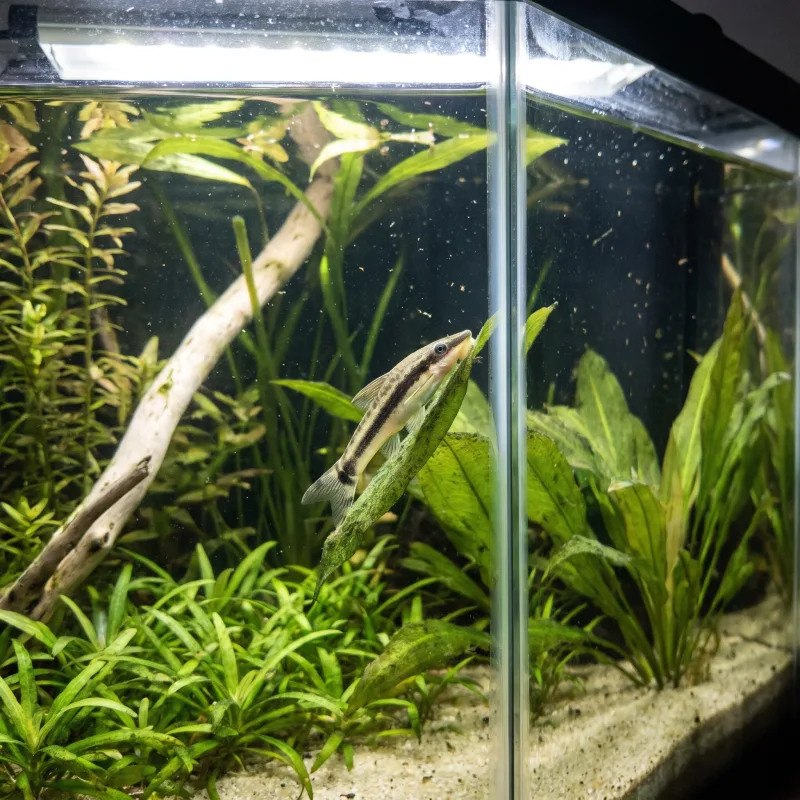
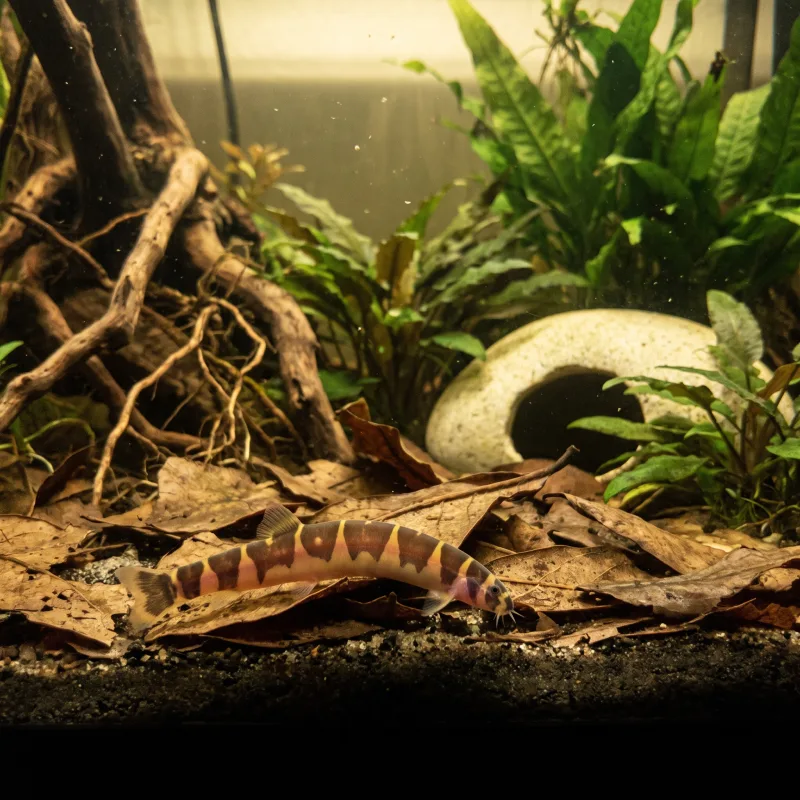
- The Kuhli Loach is a slender, eel-like Southeast Asian loach with tiger-banded colouration.
- Secretive and nocturnal, it spends the day hidden in sand or among decor, emerging to wriggle across the bottom in search of food.
- It was long sold as Pangio kuhlii, but the true P. kuhlii has possibly never reached the hobby: most aquarium kuhlis are P. semicincta or a close relative, and the care is the same.
Show 2 more
- Its intermediate rating comes from its sensitivity to water quality and its escape-artist tendencies, not from complex needs.
- Patient keepers who provide the right substrate and a group are rewarded with a quirky, long-lived fish.
Temperament
- Kuhli Loaches are peaceful and timid, and are social animals that show natural behaviour only in a group: Practical Fishkeeping calls ten the absolute minimum, and the larger the group, the more often they come out.
- Kept singly they hide constantly and are rarely seen, which keepers often mistake for the species simply being shy.
Show 2 more
- They ignore other fish and suit calm communities with small, non-aggressive tankmates such as rasboras, tetras, and corydoras.
- Avoid large or predatory fish that might harass or eat these slender, defenceless loaches.
A good fit for
- Patient keepers wanting an unusual species
- Mature, stable community tanks
- Sand-substrate aquariums
- Peaceful mid-size community tanks of 20 gallons75 litres or more
Common mistakes to avoid
- Keeping fewer than 10 (they hide constantly)
- Unsealed gaps and filter intakes (escapees)
- Adding to a new or unstable tank
- Copper/salt medications on their near-scaleless skin
Enclosure
Minimum 20 gallons75 litres, for a group of 10
Cannot be kept alone. The minimum is 10, and the space above is for that group.
- Provide a tank of at least 20 gallons75 litres and 24 in60 cm long for a group of ten, with a soft sand substrate they can burrow into safely.
- Maintain about 72-79°F22-26°C and pH 5.5-7.0 in a fully cycled, mature setup; Seriously Fish gives 70-79°F21-26°C for the trade kuhli, though some care sheets run as high as 82-86°F28-30°C.
- With only tiny scales buried in the skin, these loaches react badly to ammonia, nitrite, and unstable water.
Show 2 more
- Dense plants, driftwood, and caves give the security they need to come out more often.
- Every gap, filter intake, and lid opening must be sealed, as kuhlis are determined escapees that squeeze through surprisingly small openings.
Supplies
Setup
- Tank and stand
- Filter
- Heater and thermometer
- Substrate, plants and decor
- Liquid test kit
- Dechlorinator and starter supplies
Ongoing
- Sinking wafers and tablets
- Frozen bloodworm, daphnia and brine shrimp
- Live blackworms (optional, from a clean source)
- Fine sand substrate
- Turkey baster or pipette for target-feeding the bottom
Show 2 more
- Feeding tongs
- Fine net for removing leftovers
Safe substrate: Fine, smooth sand · Smooth, rounded fine gravel (not for loaches or sand-sifting cichlids; sand is better for corydoras) · Bare bottom (quarantine and grow-out only)
Care routine
Daily
- Check temperature and equipment
- Feed
- Head-count and look everyone over
Every few days
- Top up evaporationevery 3 days
Show 10 more
Weekly
- Head-count with a torch
- Test the water
- Water change and gravel vacuum
- Wipe the front glass only
Every few weeks
- Check the substrate stays softevery 2 weeks
- Trim and thin the plantsevery 2 weeks
Monthly
- Check supplies and reagent dates
- Replace or recharge chemical media, if you use any (skip it in a blackwater tank)
- Review medication doses
- Rinse the filter media
Health review: Quarterly head-count and substrate review, every 3 months
Tools
Care in depth
Diet
Omnivore (bottom-feeder)
- Kuhli Loaches are bottom-feeding omnivores that forage in soft substrate.
- Feed sinking pellets, wafers, and tablets, plus frozen or live bloodworm, daphnia, and brine shrimp, all delivered to the bottom where they can reach it.
- Because they are shy and often feed at night, offer some food after lights-out so faster fish do not take everything.
- They sift sand for morsels, so a fine substrate aids natural foraging and keeps these slim fish well fed.
Health
Signs of good health, and the common problems
- With only minute scales embedded in the skin, Kuhli Loaches are unusually sensitive to medications, salt, and copper, and to poor water quality and ammonia spikes.
- They should only go into a fully matured, stable tank, and any treatment must be dosed cautiously, often at reduced strength.
- Watch for skin irritation, faded banding, and lethargy as early warning signs.
- Quarantine new fish, keep nitrate low, and avoid sharp substrate.
- Given clean, stable water they are surprisingly long-lived, often reaching seven years or more.
Is this urgent?
6 warning signs and how fast to act, 3 of them right away
In a fish tank the patient is usually the water. Test before you treat: dosing a healthy tank for a disease it does not have makes things worse.
Go now
Today
Soon
Never add a new fish to a tank that is not fully cycled, and never treat blind. A test kit is cheaper than the fish.
This is general guidance for a healthy adult, not a diagnosis. An exotics vet who knows your animal always overrides it, and the time to find one is before you need one.
Bedding and substrate
3 safe, 4 with a caveat, 2 to avoid
Substrate in an aquarium is a filter as much as a floor. Most of the biology lives in and on it.
Safe
With a caveat
Never
This is our general list for freshwater fish. We have not built one specific to Loaches yet.
Top resources for more info
Independent creators and organisations we would send a friend to. We have no affiliation with any of them, and nothing here is sponsored. Links checked 2026-10-22.
YouTubers
Sites
Other Freshwater Fish worth knowing
Same axes, same care guides: the honest way to compare them.