Otocinclus
Otocinclus vittatus
Small algae-grazer for mature planted tanksIntermediate
- Lifespan
- 3-5 years
- Size
- 1.2-2 in3-5 cm
- Social needs
- Social shoaler - keep 6+ together
- Time
- Moderate (daily feed, stable mature tank)
- Cost
- Low-Medium
- Diet
- Herbivore (algae/biofilm grazer)
Overview
What is this animal?
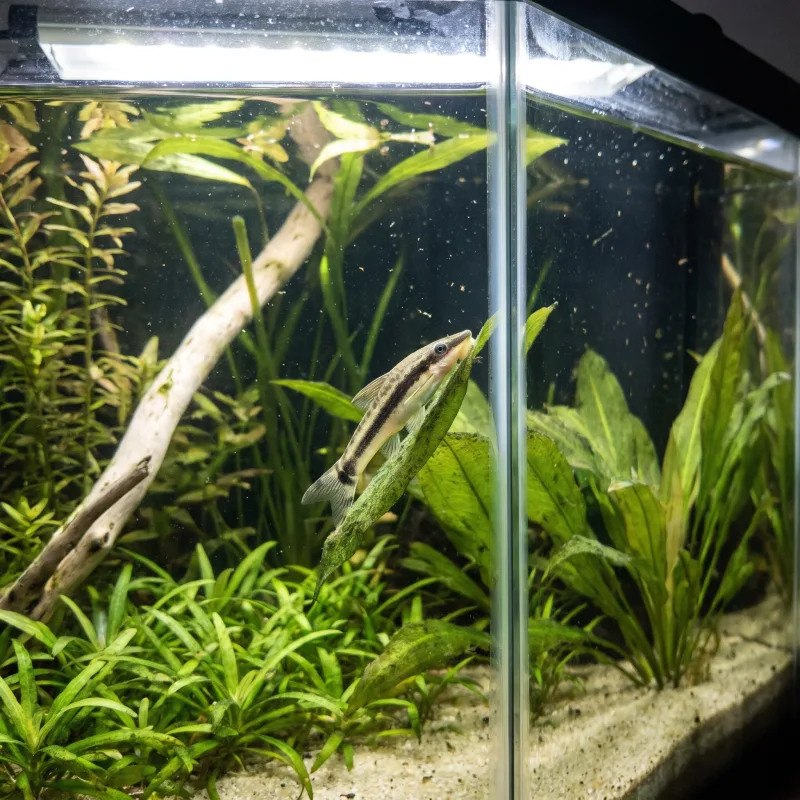
- The Otocinclus, or oto, is a small suckermouth catfish from South America and one of the better genuine algae-grazers for the planted community tank.
- It works over leaves and glass, removing soft algae and biofilm too delicate for larger plecos.
- Several look-alike species are sold simply as otos, commonly O. vittatus, O. macrospilus and O. vestitus, and they need the same care.
- Its intermediate rating is well earned: most otos die not because they are hard to keep but because they are sold half-starved, often wild-caught, and rushed into immature tanks before there is enough biofilm to sustain them.
Temperament
- Otocinclus are peaceful, gentle shoaling fish that feel secure and graze openly only in groups of six or more.
- Singly or in small numbers they hide and stress, so a true shoal is essential for natural behaviour.
Show 2 more
- They are harmless to tankmates and well suited to planted communities of 24 gallons90 litres or more alongside small tetras, rasboras, shrimp, and corydoras.
- Keep them away from boisterous or large fish, which intimidate these small grazers.
A good fit for
- Mature, algae-rich planted tanks
- Peaceful planted community tanks of 24 gallons90 litres or more
- Keepers wanting safe algae control on plants
- Aquarists who select round-bellied stock
Common mistakes to avoid
- Adding to a new tank with no algae/biofilm
- Buying thin, starved, hollow-bellied stock
- Keeping fewer than 6 (they shoal)
- Salt/copper medications they tolerate poorly
Enclosure
Minimum 24 gallons90 litres, for a group of 6
Cannot be kept alone. The minimum is 6, and the space above is for that group.
- Keep a shoal of six or more in a well-established, fully cycled tank of at least 24 US gallons90 litres and 24 in60 cm long, with a stable, mature growth of algae; a 29-gallon110-litre tank qualifies, and a 20-gallon long76-litre long tank falls short on volume.
- Maintain 72-81°F22-27°C, pH 6.0-7.5, and clean, well-oxygenated water with low nitrate.
- Never add otos to a brand-new tank; they need an aged setup with soft green algae already growing.
Show 2 more
- Provide plants, driftwood, and gentle flow.
- They are highly sensitive to ammonia and nitrite, so the cycle must be solid before they arrive.
Supplies
Setup
- Tank and stand
- Filter
- Heater and thermometer
- Substrate, plants and decor
- Liquid test kit
- Dechlorinator and starter supplies
Ongoing
- Sinking pellets, wafers or tablets (corydoras)
- Algae or spirulina wafers (bristlenose and otocinclus)
- Frozen bloodworm, daphnia and brine shrimp (corydoras)
- Untreated aquarium driftwood (for bristlenose plecos to rasp)
- Courgette, cucumber and spinach for blanching (bristlenose and otocinclus)
Show 3 more
- Veg clip or a stainless veg skewer (bristlenose and otocinclus)
- Feeding tongs or a pipette for target-feeding
- Fine sand substrate for corydoras foraging
Safe substrate: Fine, smooth sand · Smooth, rounded fine gravel (not for loaches or sand-sifting cichlids; sand is better for corydoras) · Bare bottom (quarantine and grow-out only)
Care routine
Daily
- Check temperature and equipment
- Head-count and look everyone over
- Sinking food at lights-out
Every few days
- Top up evaporationevery 3 days
Show 9 more
Weekly
- Check belly profiles
- Test the water
- Water change and gravel vacuum
- Wipe the front glass only
Every few weeks
- Trim and thin the plantsevery 2 weeks
Monthly
- Check supplies and reagent dates
- Check the driftwood
- Replace or recharge chemical media, if you use any (skip it in a blackwater tank)
- Rinse the filter media
Health review: Quarterly bottom-dweller review, every 3 months
Tools
Care in depth
Diet
Herbivore (algae/biofilm grazer)
- Otocinclus are dedicated herbivores that graze soft green algae and biofilm.
- In tanks with insufficient algae they will starve, so always supplement with blanched vegetables such as courgette, cucumber, and spinach, plus quality algae wafers.
- Many new otos arrive emaciated and need immediate, reliable feeding to recover; a sunken belly is a danger sign.
- Keep a steady supply of grazing food and vegetables.
- They cannot subsist on commercial flake intended for other fish.
Health
Signs of good health, and the common problems
- The biggest killer of otos is starvation, both before purchase and in algae-poor tanks.
- Combined with their sensitivity to poor water and shipping stress, this makes the first few weeks critical.
- Choose round-bellied, active individuals and acclimatise them slowly.
- They tolerate medications, salt, and copper poorly, so treat with care.
- Check belly shape at least weekly, and daily for newly bought fish: flat or sunken means underfeeding.
- In a mature, stable, algae-rich tank with clean water they settle well and live several years.
Is this urgent?
6 warning signs and how fast to act, 3 of them right away
In a fish tank the patient is usually the water. Test before you treat: dosing a healthy tank for a disease it does not have makes things worse.
Go now
Today
Soon
Never add a new fish to a tank that is not fully cycled, and never treat blind. A test kit is cheaper than the fish.
This is general guidance for a healthy adult, not a diagnosis. An exotics vet who knows your animal always overrides it, and the time to find one is before you need one.
Bedding and substrate
3 safe, 4 with a caveat, 2 to avoid
Substrate in an aquarium is a filter as much as a floor. Most of the biology lives in and on it.
Safe
With a caveat
Never
This is our general list for freshwater fish. We have not built one specific to Catfish yet.
Top resources for more info
Independent creators and organisations we would send a friend to. We have no affiliation with any of them, and nothing here is sponsored. Links checked 2026-10-22.
YouTubers
Sites
Catfish, side by side
Same axes, same care guides: the honest way to choose between types.