Panda Corydoras
Hoplisoma panda
Panda-masked shoaler from cool foothill streamsIntermediate
- Lifespan
- 5-10 years (shorter if kept too warm)
- Size
- Up to about 2 in5 cm; females largest
- Social needs
- Highly social - keep 6+, ideally 10+
- Time
- Low-moderate (daily feed, weekly water changes)
- Cost
- Low-moderate
- Diet
- Omnivore (bottom-feeder)
Overview
What is this animal?
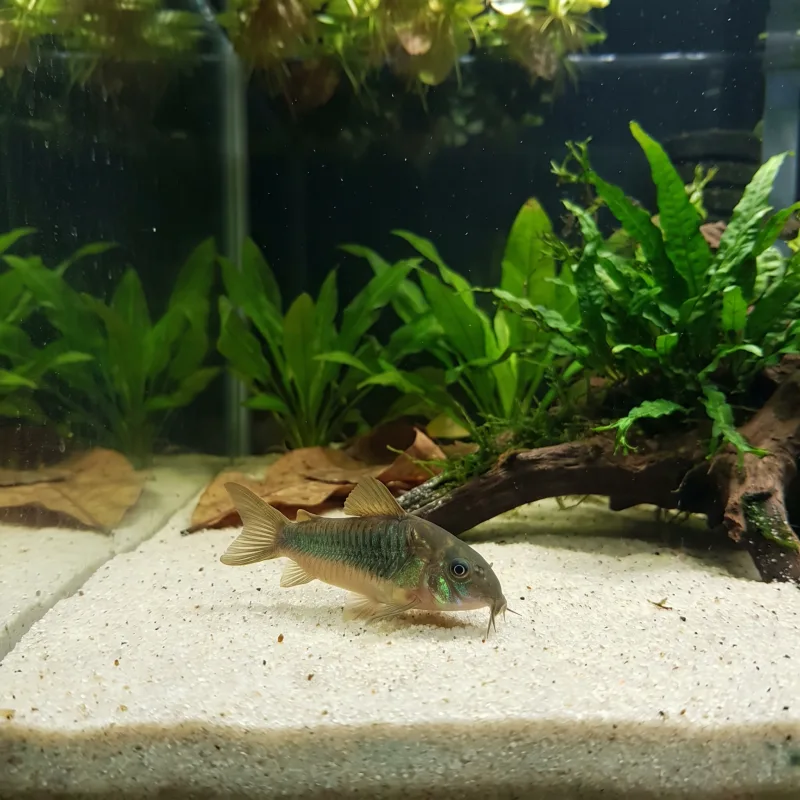
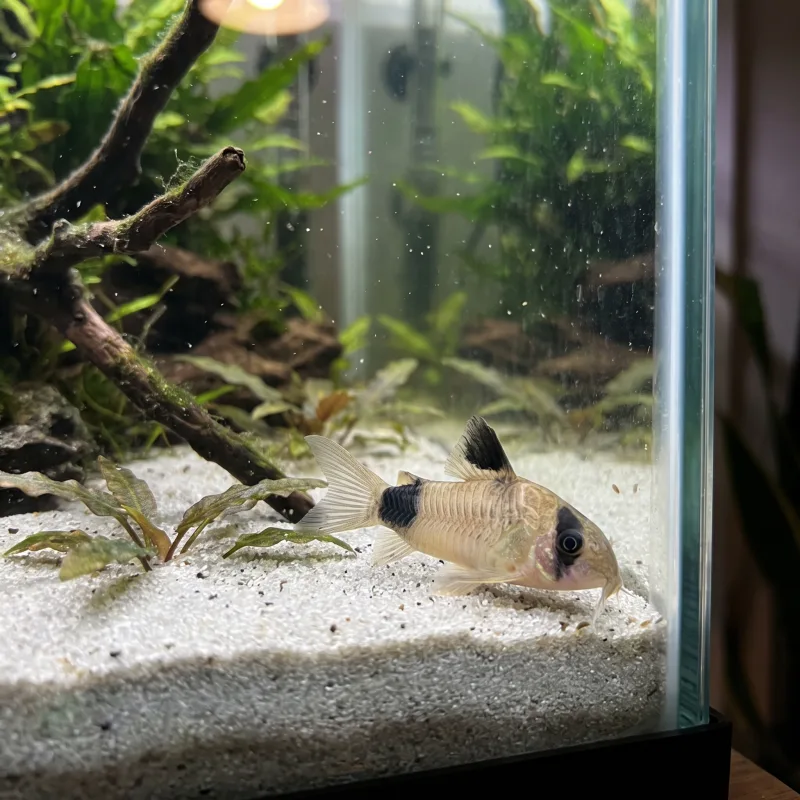
- The Panda Corydoras is a small armoured catfish from cool, clear foothill streams of the Peruvian upper Amazon, named for the black eye patches, dorsal blotch and tail spot that mark its pale, pinkish-cream body.
- At around 2 in5 cm, with females the largest, it stays noticeably smaller than the Bronze Corydoras and shoals even more tightly.
- Since a 2024 revision of the corydoras group it is classed as Hoplisoma panda, though it is still sold as Corydoras panda.
Show 3 more
- It is also the more delicate of the two.
- Tank-bred pandas fade fast in new, unstable or overly warm aquariums, so this is a fish for a mature setup rather than a first stocking choice.
- If your aquarium has been running for less than three months, the honest answer is not yet.
Temperament
- Panda Corydoras are completely peaceful and among the most tightly shoaling of all cories, often moving as a single coordinated group and sometimes rising to school with midwater fish.
- Keep at least six, and ideally ten or more, because small groups sit hidden and inactive.
Show 2 more
- Choose calm tankmates that are happy at the cooler end of tropical, such as small rasboras, peaceful tetras, dwarf danios and Kuhli Loaches.
- Skip warmth-loving species like Discus and German Blue Rams, whose preferred temperatures are too high for pandas, and avoid anything boisterous enough to outcompete them at feeding time.
A good fit for
- Mature, established community tanks
- Keepers who run their tanks on the cool side
- Fans of tight, active shoaling behaviour
- Sand-bottomed, planted aquariums
- Hobbyists stepping up from Bronze Corydoras
Common mistakes to avoid
- Adding them to a tank under 3 months old
- Sustained temperatures above 79°F26°C
- Groups smaller than 6
- Sharp gravel eroding their barbels
- Expecting them to live on leftovers
- Salt and copper-based medications
Enclosure
Minimum 20 gallons75 litres, for a group of 6
Cannot be kept alone. The minimum is 6, and the space above is for that group.
- House a shoal in at least 20 gallons75 L, with as much open floor as you can give them; a 30 in76 cm long footprint suits a group of six, and ten or more want more than that.
- Cover the base with soft sand or very smooth, rounded fine gravel to protect their delicate barbels, and keep the water soft to moderately hard (about 2-15 dGH) at pH 6.0-7.5, well oxygenated with a gentle current.
- Temperature matters more here than for most cories.
Show 4 more
- Aim for 68-77°F20-25°C: the species comes from cool, fast foothill streams that run several degrees below a typical tropical tank, and sustained temperatures above about 79°F26°C stress it, lower dissolved oxygen and shorten its life.
- Do not pair pandas with heat-loving species and then split the difference on the thermostat.
- The tank must be fully cycled and mature, with zero ammonia and nitrite and nitrate held under 20 ppm.
- Provide shade, plants and driftwood for security, and leave an air gap under the lid, because they dart to the surface to gulp air through the gut.
Supplies
Setup
- Tank and stand
- Filter
- Heater and thermometer
- Substrate, plants and decor
- Liquid test kit
- Dechlorinator and starter supplies
Ongoing
- Sinking pellets, wafers or tablets (corydoras)
- Algae or spirulina wafers (bristlenose and otocinclus)
- Frozen bloodworm, daphnia and brine shrimp (corydoras)
- Untreated aquarium driftwood (for bristlenose plecos to rasp)
- Courgette, cucumber and spinach for blanching (bristlenose and otocinclus)
Show 3 more
- Veg clip or a stainless veg skewer (bristlenose and otocinclus)
- Feeding tongs or a pipette for target-feeding
- Fine sand substrate for corydoras foraging
Safe substrate: Fine, smooth sand · Smooth, rounded fine gravel (not for loaches or sand-sifting cichlids; sand is better for corydoras) · Bare bottom (quarantine and grow-out only)
Care routine
Daily
- Check temperature and equipment
- Head-count and look everyone over
- Sinking food at lights-out
Every few days
- Top up evaporationevery 3 days
Show 9 more
Weekly
- Check belly profiles
- Test the water
- Water change and gravel vacuum
- Wipe the front glass only
Every few weeks
- Trim and thin the plantsevery 2 weeks
Monthly
- Check supplies and reagent dates
- Check the driftwood
- Replace or recharge chemical media, if you use any (skip it in a blackwater tank)
- Rinse the filter media
Health review: Quarterly bottom-dweller review, every 3 months
Tools
Care in depth
Diet
Omnivore (bottom-feeder)
- Panda Corydoras are omnivores that must be fed deliberately with sinking foods, not left to scavenge leftovers.
- Offer small sinking granules, pellets and wafers sized for their small mouths, plus frozen or live bloodworm, daphnia and brine shrimp several times a week.
- Make sure the food actually reaches the bottom past faster midwater fish, or add a portion after lights-out, when the pandas forage most confidently.
- Gradual starvation of the supposed clean-up crew is one of the most common ways this species is lost.
- They eat almost no algae, so they are not a substitute for tank maintenance.
Health
Signs of good health, and the common problems
- The two biggest killers of Panda Corydoras are immature tanks and chronic heat.
- New-tank instability causes rapid losses in the first weeks, while sustained warmth above about 79°F26°C lowers oxygen and slowly wears them down; fast gill movement and constant trips to the surface are warning signs.
- Watch for barbel erosion from sharp or dirty substrate, and for red blotch disease, which shows as reddish sores on the belly and flanks and is linked to stress and poor substrate hygiene.
- Like all cories they tolerate salt and copper-based medications poorly, so dose cautiously at reduced strength and quarantine every new fish.
Is this urgent?
6 warning signs and how fast to act, 3 of them right away
In a fish tank the patient is usually the water. Test before you treat: dosing a healthy tank for a disease it does not have makes things worse.
Go now
Today
Soon
Never add a new fish to a tank that is not fully cycled, and never treat blind. A test kit is cheaper than the fish.
This is general guidance for a healthy adult, not a diagnosis. An exotics vet who knows your animal always overrides it, and the time to find one is before you need one.
Bedding and substrate
3 safe, 4 with a caveat, 2 to avoid
Substrate in an aquarium is a filter as much as a floor. Most of the biology lives in and on it.
Safe
With a caveat
Never
This is our general list for freshwater fish. We have not built one specific to Catfish yet.
Top resources for more info
Independent creators and organisations we would send a friend to. We have no affiliation with any of them, and nothing here is sponsored. Links checked 2026-10-22.
YouTubers
Sites
Catfish, side by side
Same axes, same care guides: the honest way to choose between types.