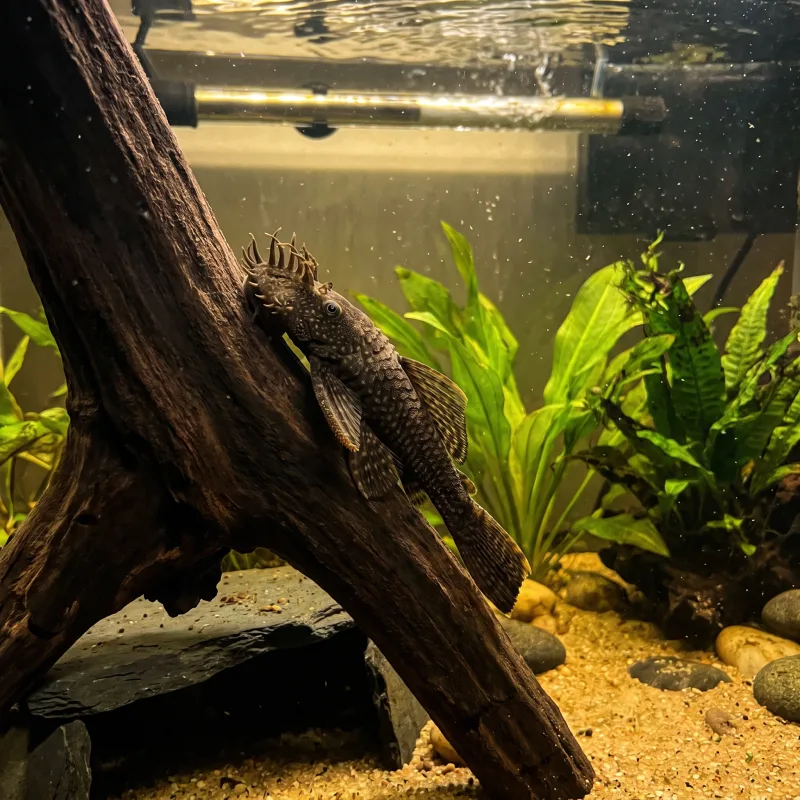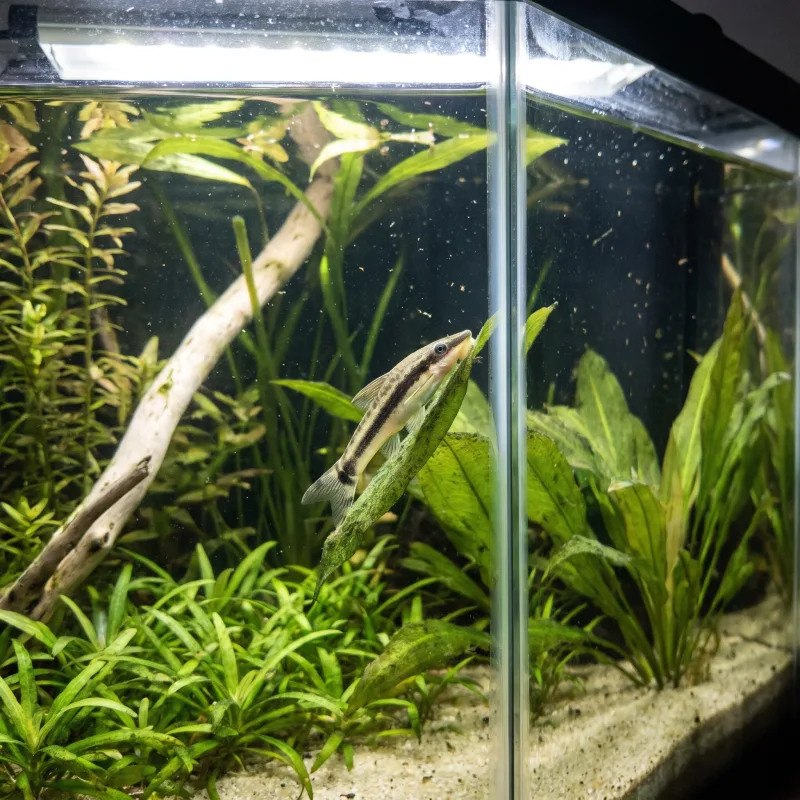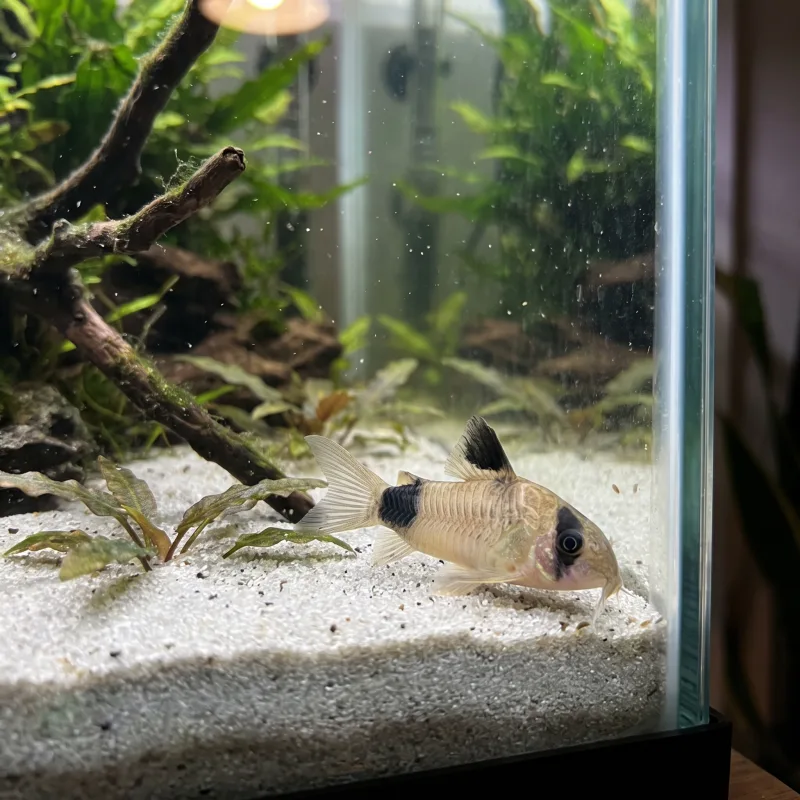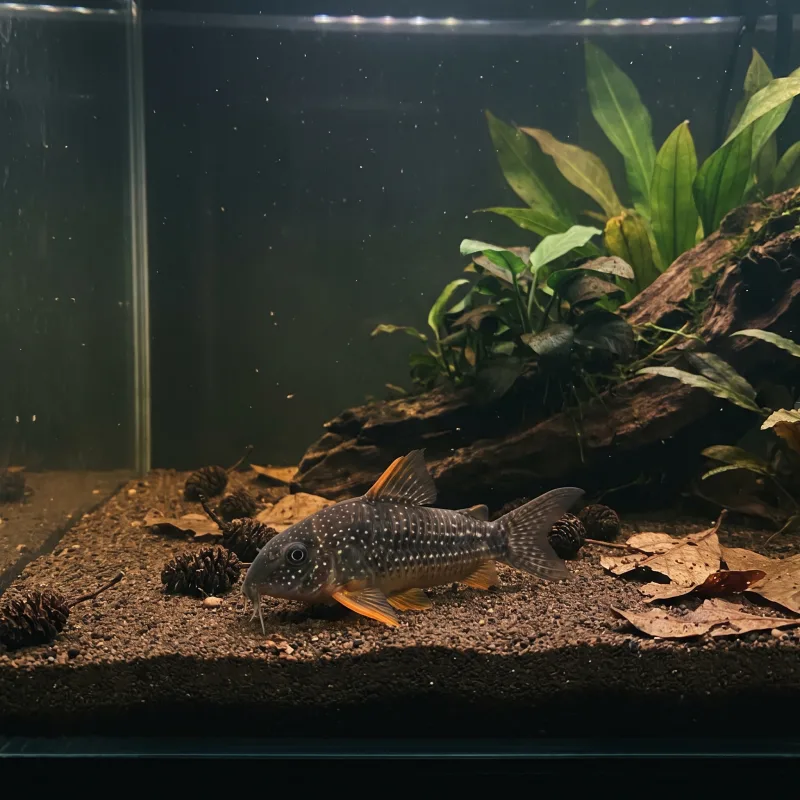
Bronze Corydoras
Osteogaster aenea
Social bottom-dweller for peaceful community tanksBeginner
- Lifespan
- 5-10 years
- Size
- 2.4-3 in6-7.5 cm
- Social needs
- Highly social - keep 6+ together
- Time
- Low-moderate (daily feed, weekly water changes)
- Cost
- Low
- Diet
- Omnivore (bottom-feeder)
Overview
What is this animal?
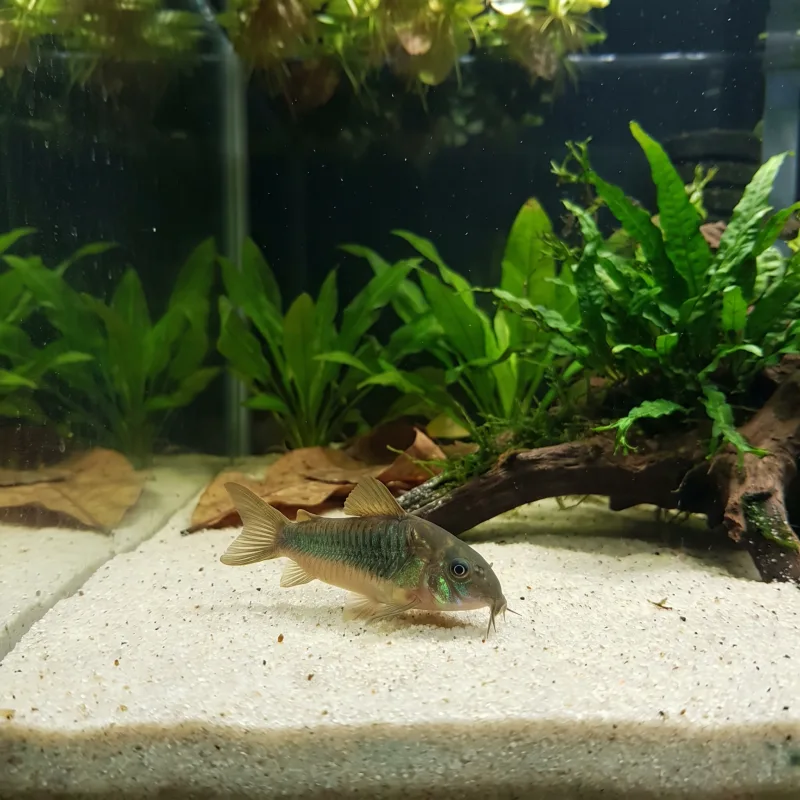
- The Bronze Corydoras is a peaceful, armoured catfish from South America and one of the most popular bottom-dwellers in the hobby.
- Hardy and long-lived, it scours the substrate and brings constant gentle activity to the lower tank.
- It was long known as Corydoras aeneus, until a 2024 revision of the corydoras group moved it to the genus Osteogaster; shops still sell it under the old name.
Show 2 more
- Despite a reputation as a clean-up crew, this is not a fish that survives on leftovers.
- It is a genuine community species with real social and dietary needs that keepers must meet.
Temperament
- Bronze Corydoras are sociable and peaceful, and are happiest and most active in a shoal of six or more of their own kind.
- Kept singly or in pairs they become withdrawn, whereas a proper group displays its characteristic collective foraging and resting.
Show 2 more
- They coexist well with most calm community fish, including tetras, rasboras, dwarf cichlids, and peaceful barbs.
- Their gentle nature means they should not be mixed with aggressive or large predatory tankmates.
A good fit for
- Beginners wanting an active bottom-dweller
- Peaceful community aquariums
- Keepers using sand substrate
- Long-term hobbyists (often 5-10 years)
Common mistakes to avoid
- Keeping fewer than 6 (they are social)
- Sharp gravel eroding their barbels
- Assuming they survive on leftovers
- Copper/salt medications they tolerate poorly
Enclosure
Minimum 20 gallons75 litres, for a group of 6
Cannot be kept alone. The minimum is 6, and the space above is for that group.
- Keep a group in a tank of at least 20 gallons75 litres that is also at least 31.5 in80 cm long, the base Seriously Fish recommends for long-term care: a standard 30-gallon115-litre tank, at 36 in91 cm, qualifies, and a 20-gallon long76-litre long tank, at 30 in76 cm, falls just short.
- Use a soft sand or smooth, rounded fine-gravel substrate to protect their delicate barbels.
- Target 72-79°F22-26°C, pH 6.0-7.5, in a fully cycled, well-oxygenated setup.
Show 3 more
- Provide shaded spots, plants, and driftwood for security.
- They periodically dash to the surface to gulp air, so leave an air gap beneath a tight lid.
- Sharp or coarse gravel erodes barbels and invites infection.
Supplies
Setup
- Tank and stand
- Filter
- Heater and thermometer
- Substrate, plants and decor
- Liquid test kit
- Dechlorinator and starter supplies
Ongoing
- Sinking pellets, wafers or tablets (corydoras)
- Algae or spirulina wafers (bristlenose and otocinclus)
- Frozen bloodworm, daphnia and brine shrimp (corydoras)
- Untreated aquarium driftwood (for bristlenose plecos to rasp)
- Courgette, cucumber and spinach for blanching (bristlenose and otocinclus)
Show 3 more
- Veg clip or a stainless veg skewer (bristlenose and otocinclus)
- Feeding tongs or a pipette for target-feeding
- Fine sand substrate for corydoras foraging
Safe substrate: Fine, smooth sand · Smooth, rounded fine gravel (not for loaches or sand-sifting cichlids; sand is better for corydoras) · Bare bottom (quarantine and grow-out only)
Care routine
Daily
- Check temperature and equipment
- Head-count and look everyone over
- Sinking food at lights-out
Every few days
- Top up evaporationevery 3 days
Show 9 more
Weekly
- Check belly profiles
- Test the water
- Water change and gravel vacuum
- Wipe the front glass only
Every few weeks
- Trim and thin the plantsevery 2 weeks
Monthly
- Check supplies and reagent dates
- Check the driftwood
- Replace or recharge chemical media, if you use any (skip it in a blackwater tank)
- Rinse the filter media
Health review: Quarterly bottom-dweller review, every 3 months
Tools
Care in depth
Diet
Omnivore (bottom-feeder)
- Bronze Corydoras are omnivores that should be fed directly, not left to scavenge.
- Use sinking pellets, wafers, and tablets that reach the bottom, supplemented with frozen or live bloodworm, daphnia, and brine shrimp.
- Feed once or twice daily, making sure enough food sinks past faster mid-water fish so the cories actually eat.
- Slow starvation from relying on scraps is a common cause of decline; a proper sinking diet keeps them well-rounded and healthy.
Health
Signs of good health, and the common problems
- These catfish are robust but vulnerable to two husbandry faults: barbel erosion from sharp or dirty substrate, and red blotch or fin infections in poor water.
- Keeping the substrate clean and parameters stable prevents most problems.
- They are also sensitive to high nitrate and to salt and copper-based medications, so dose carefully.
- Watch barbel length, breathing rate, and skin condition, and quarantine new fish.
- With good care, individuals routinely live well beyond five years.
Is this urgent?
6 warning signs and how fast to act, 3 of them right away
In a fish tank the patient is usually the water. Test before you treat: dosing a healthy tank for a disease it does not have makes things worse.
Go now
Today
Soon
Never add a new fish to a tank that is not fully cycled, and never treat blind. A test kit is cheaper than the fish.
This is general guidance for a healthy adult, not a diagnosis. An exotics vet who knows your animal always overrides it, and the time to find one is before you need one.
Bedding and substrate
3 safe, 4 with a caveat, 2 to avoid
Substrate in an aquarium is a filter as much as a floor. Most of the biology lives in and on it.
Safe
With a caveat
Never
This is our general list for freshwater fish. We have not built one specific to Catfish yet.
Top resources for more info
Independent creators and organisations we would send a friend to. We have no affiliation with any of them, and nothing here is sponsored. Links checked 2026-10-22.
YouTubers
Sites
Catfish, side by side
Same axes, same care guides: the honest way to choose between types.