Chili Rasbora
Boraras brigittae
Chilli-red speck from Borneo's peat swampsIntermediate
- Lifespan
- 4-8 years
- Size
- 0.6-0.8 in1.5-2 cm
- Social needs
- Shoaler; keep 10+ together
- Time
- Low-moderate; daily feeding, weekly water change
- Cost
- Low-Medium
- Diet
- Micro-predator; micro pellets, live and frozen micro-foods
Overview
What is this animal?
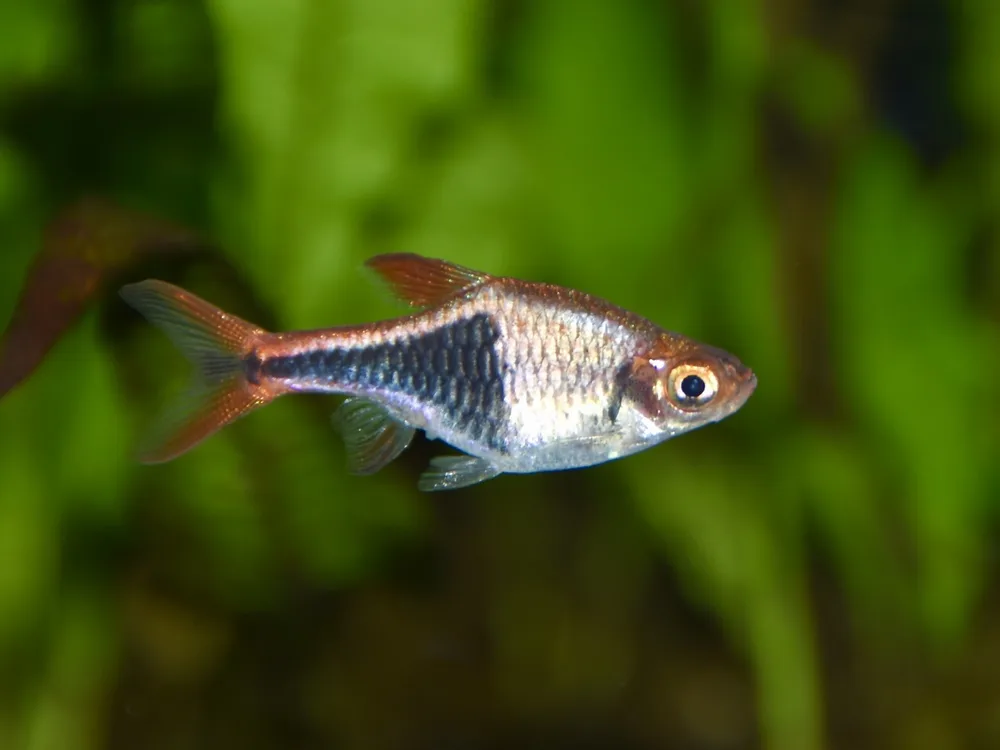
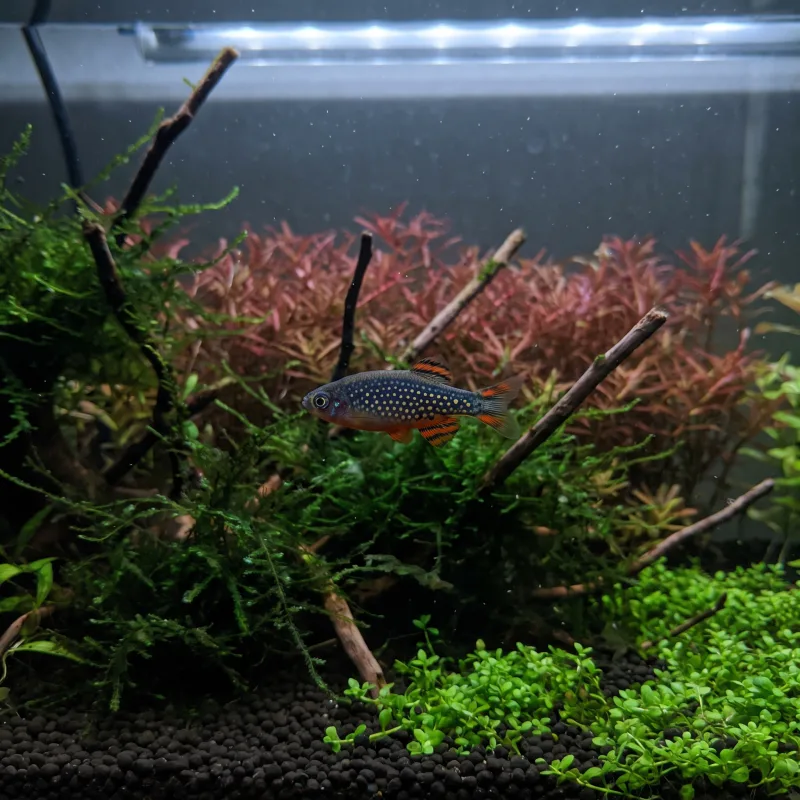
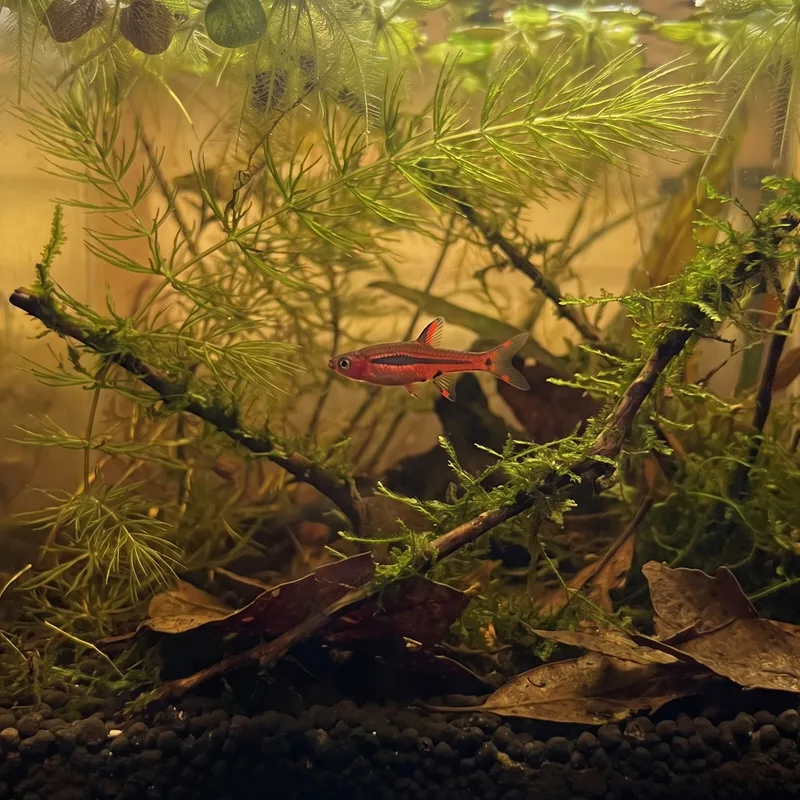
- The chili rasbora is a miniature danionid (a small carp relative long classed as a cyprinid) from the tannin-stained peat swamps and blackwater streams of southwestern Borneo, where males glow deep chilli red along a dark lateral stripe.
- At 0.6 to 0.8 inches1.5 to 2 centimetres fully grown it is among the smallest fish in this guide, about the size of an ember tetra and a fraction the size of a harlequin rasbora.
- Despite the common name it is not a true Rasbora but a Boraras, a genus of dwarfed species built for still, acidic water.
Show 3 more
- Much stock is still wild-caught from habitat under pressure from peatland drainage, and those imports arrive small, thin and easily stressed, though captive-bred chilis are increasingly available and settle in far more readily.
- It is an intermediate fish for a mature, planned tank, not a first fish for a new aquarium, and if your tank is younger than a few months the honest advice is not yet.
- Ask your store whether stock is captive-bred, and favour it when offered.
Temperament
- Chilis are peaceful and completely harmless, forming a loose shoal in which males claim tiny display territories and spar with flared fins, all bluff and no damage.
- A group of ten or more spreads the sparring, builds confidence and produces the constant midwater activity and colour that a nervous group of six never shows.
Show 3 more
- Tankmate choice is the hard part, because almost everything in the hobby can swallow or outcompete them, including peaceful staples like harlequin rasboras and bettas.
- Adult dwarf shrimp are safe with them, so the best setups are a species-only shoal or a pairing with dwarf shrimp and at most one other Boraras-sized species, though the tiniest newborn shrimplets may occasionally be picked at.
- If a planned community includes anything over about 1.2 inches3 centimetres, the chilis belong in a different tank.
A good fit for
- Mature, planted blackwater aquariums
- Species-only shoals with real presence
- Dwarf-shrimp tanks needing a genuinely shrimp-safe fish
- Aquascapers wanting a tiny, vivid centrepiece
- Keepers ready to step beyond beginner fish
Common mistakes to avoid
- Adding them to a new or immature tank
- Hard, alkaline water dulling colour and shortening lives
- Skipping slow drip acclimation for wild-caught arrivals
- Tankmates big enough to swallow them, which is most fish
- New fish refusing dry food without live micro-foods
- Open-topped tanks, as they jump
Enclosure
Minimum 15 gallons57 litres, for a group of 10
Cannot be kept alone. The minimum is 10, and the space above is for that group.
- Keep a shoal of ten or more in a mature, densely planted aquarium of at least 15 US gallons57 litres and 18 in45 cm long; a bigger tank holds steadier water and a larger shoal.
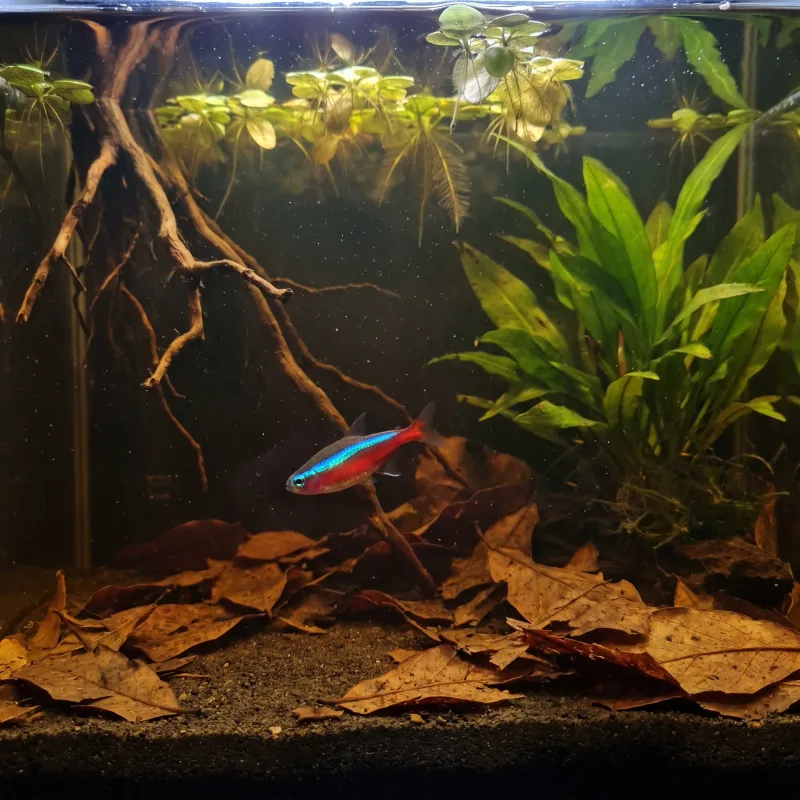
- Heat the tank to 75-82°F24-28°C and aim for blackwater styling: dark substrate, driftwood, leaf litter and tannins that echo the peat swamps and make the red glow.
- Flow should be very gentle, and an air-driven sponge filter suits them better than a powerful internal filter.
Show 3 more
- They want soft, acidic water, ideally pH 5.0-6.5 and low hardness, though stable slightly-acidic conditions are workable.
- Stability matters more than chasing exact numbers, because a small volume of water buffers swings poorly and these tiny bodies absorb every mistake.
- Never add them to a freshly cycled tank, and fit a tight lid, as they can jump through surprisingly small gaps.
Supplies
Setup
- Tank and stand
- Filter
- Heater and thermometer
- Substrate, plants and decor
- Liquid test kit
- Dechlorinator and starter supplies
Ongoing
- Quality micro-pellet or fine flake
- Frozen daphnia and cyclops
- Frozen or live baby brine shrimp
- Frozen bloodworm (to be chopped fine)
- Small scissors or blade for chopping frozen food
Show 2 more
- Fine net for removing leftovers
- Small feeding spoon
Safe substrate: Fine, smooth sand · Smooth, rounded fine gravel (not for loaches or sand-sifting cichlids; sand is better for corydoras) · Bare bottom (quarantine and grow-out only)
Care routine
Daily
- Check temperature and equipment
- Feed a fine-grained food
- Head-count and look everyone over
Every few days
- Top up evaporationevery 3 days
Show 8 more
Weekly
- Count the school
- Test the water
- Water change and gravel vacuum
- Wipe the front glass only
Every few weeks
- Trim and thin the plantsevery 2 weeks
Monthly
- Check supplies and reagent dates
- Replace or recharge chemical media, if you use any (skip it in a blackwater tank)
- Rinse the filter media
Health review: Quarterly review with a new-stock check, every 3 months
Tools
Care in depth
Diet
Micro-predator; micro pellets, live and frozen micro-foods
- Chilis are micro-predators that pick zooplankton and tiny invertebrates from the water column, and their mouths are minute even by nano-fish standards.
- Powdered food, finely crushed flake and the smallest micro-pellets form the dry staple, but freshly imported wild fish often refuse dry food entirely at first.
- Live or frozen baby brine shrimp, microworms, cyclops and small daphnia are the reliable way to get new arrivals feeding and coloured up.
- Feed small amounts once or twice a day, offering only what disappears within a minute or two.
- Anything sized for ordinary community fish is too large, so check that every fish in the shoal is actually eating rather than mouthing and spitting food.
Health
Signs of good health, and the common problems
- The risky period is the first month, because wild-caught chilis arrive stressed and may carry internal parasites that show as wasting despite eager feeding.
- Drip-acclimatise them slowly over an hour or more, quarantine new arrivals, and expect washed-out brown fish to need weeks of quiet, tannin-stained water before the red returns.
- Ich and fin rot follow chilling or unstable water, as with any small fish.
- Once settled in a stable, soft, mature tank they are surprisingly durable and largely trouble-free.
- Do gentle weekly partial changes with temperature-matched water rather than infrequent large ones, since big parameter swings shock a fish this size.
- Daily observation is your early-warning system, because a 0.8-inchtwo-centimetre body leaves no margin once illness takes hold.
Is this urgent?
6 warning signs and how fast to act, 3 of them right away
In a fish tank the patient is usually the water. Test before you treat: dosing a healthy tank for a disease it does not have makes things worse.
Go now
Today
Soon
Never add a new fish to a tank that is not fully cycled, and never treat blind. A test kit is cheaper than the fish.
This is general guidance for a healthy adult, not a diagnosis. An exotics vet who knows your animal always overrides it, and the time to find one is before you need one.
Bedding and substrate
3 safe, 4 with a caveat, 2 to avoid
Substrate in an aquarium is a filter as much as a floor. Most of the biology lives in and on it.
Safe
With a caveat
Never
This is our general list for freshwater fish. We have not built one specific to Rasboras yet.
Top resources for more info
Independent creators and organisations we would send a friend to. We have no affiliation with any of them, and nothing here is sponsored. Links checked 2026-10-22.
YouTubers
Sites
Rasboras, side by side
Same axes, same care guides: the honest way to choose between types.