Dwarf Gourami
Trichogaster lalius
Colourful labyrinth fish prone to farmed-stock diseaseIntermediate
- Lifespan
- 3-5 years
- Size
- 2.8-3.5 in7-9 cm
- Social needs
- Best singly or as a true pair; males clash
- Time
- Low-moderate
- Cost
- Low
- Diet
- Omnivore (flakes, pellets, frozen foods, some veg)
Overview
What is this animal?
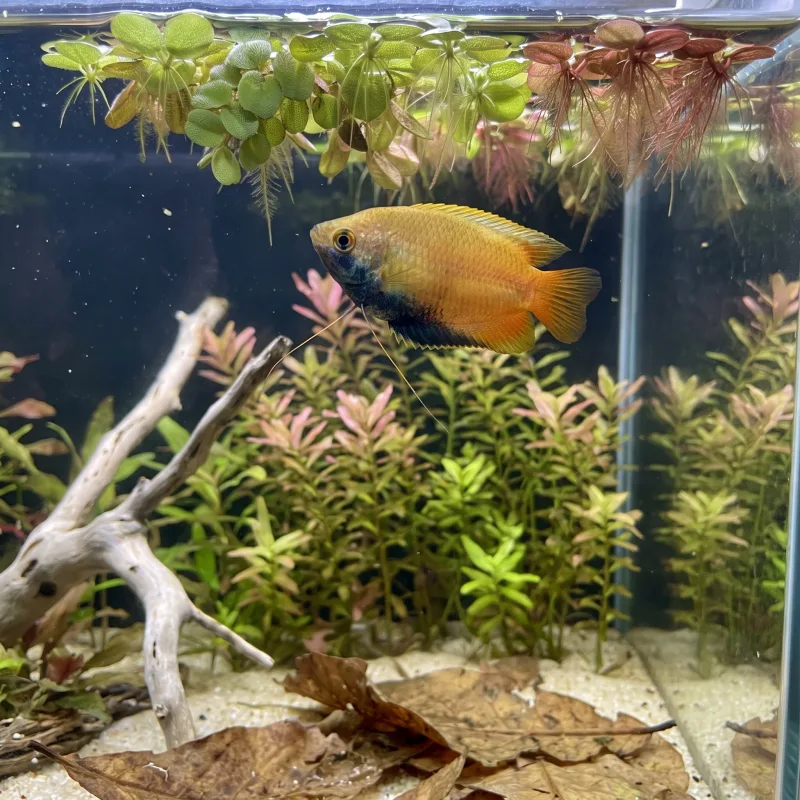
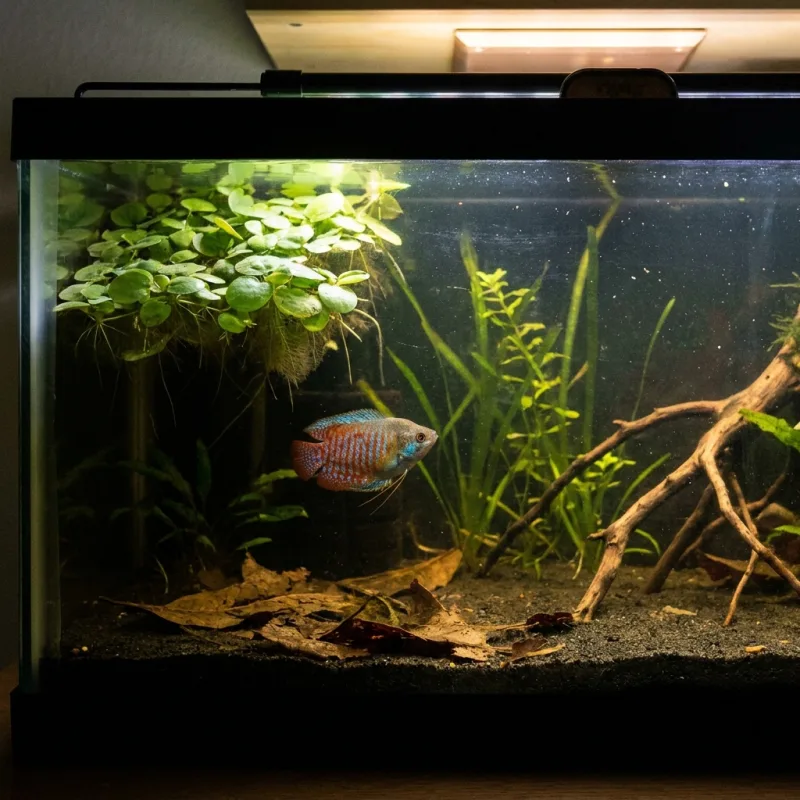
- The dwarf gourami is a small, brightly coloured labyrinth fish from the slow waters of South Asia, able to breathe air at the surface through a labyrinth organ.
- Males are especially colourful in shades of blue and red.
- Its scientific name is in flux: since Knight et al.
Show 3 more
- (2022), Eschmeyer's Catalog of Fishes and FishBase have listed it as Trichogaster fasciata, a name the hobby still uses for the banded gourami, so most keepers and dealers still call it Trichogaster lalius.
- Widely sold and inexpensive, they are nonetheless affected by farmed-stock health problems that catch out beginners, which places them at the intermediate level.
- Calm and personable, they make good centrepieces for peaceful, planted community tanks when sourced carefully.
Temperament
- Dwarf gouramis are generally peaceful and somewhat shy, but males can be territorial toward each other and toward similar-looking fish, so keep a single male or a genuine male-female pair rather than rival males.
- They appreciate planted cover to retreat into.
Show 3 more
- Suitable tankmates include peaceful tetras, rasboras and corydoras; avoid fin-nippers and boisterous species that stress them.
- Males may court and build bubble-nests.
- Their calm disposition makes them a good community fish provided rival males and aggressive companions are avoided.
A good fit for
- Peaceful planted community tanks
- Keepers wanting a colourful surface-dweller
- Those who research and source healthy stock
- Aquarists with calm, low-flow setups
Common mistakes to avoid
- Buying virus-prone mass-farmed stock
- Keeping multiple rival males together
- Strong flow stressing this calm-water fish
- No lid, risking chilled labyrinth organ and jumping
Enclosure
Minimum 15 gallons57 litres
Fine alone or with company. Best singly or as a true pair; males clash
- Provide a planted tank of at least 15 US gallons60 L and 24 in60 cm long with a calm water surface, warm at 75-82°F24-28°C and soft to moderately hard around neutral pH.
- That is room for one male: Seriously Fish calls a 24 x 12 x 12 in60 x 30 x 30 cm tank just about big enough for a pair, so give a male-female pair more.
- As air-breathers they need access to the surface, so avoid strong flow and keep a warm, humid air gap above the water.
Show 3 more
- Floating plants, gentle filtration and plenty of cover suit their shy nature.
- Keep water well cycled with zero ammonia and nitrite.
- A tight-fitting lid preserves the warm surface air their labyrinth organ relies on and prevents jumping.
Supplies
Setup
- Tank and stand
- Filter
- Heater and thermometer
- Substrate, plants and decor
- Liquid test kit
- Dechlorinator and starter supplies
Ongoing
- Quality tropical flake (crushed fine for sparkling and honey gouramis)
- Floating and slow-sinking micro-pellets
- Frozen bloodworm, brine shrimp and daphnia
- Frozen or live baby brine shrimp, cyclops or microworms (for sparkling gouramis)
- Spirulina or vegetable flake
- Fine net for removing leftovers
Safe substrate: Fine, smooth sand · Smooth, rounded fine gravel (not for loaches or sand-sifting cichlids; sand is better for corydoras) · Bare bottom (quarantine and grow-out only)
Care routine
Daily
- Check temperature and equipment
- Feed
- Head-count and look everyone over
Every few days
- Check the air layer above the waterevery 3 days
- Top up evaporationevery 3 days
Show 7 more
Weekly
- Test the water
- Water change and gravel vacuum
- Wipe the front glass only
Every few weeks
- Trim and thin the plantsevery 2 weeks
Monthly
- Check supplies and reagent dates
- Replace or recharge chemical media, if you use any (skip it in a blackwater tank)
- Rinse the filter media
Health review: Quarterly review with a surface-air check, every 3 months
Tools
Care in depth
Diet
Omnivore (flakes, pellets, frozen foods, some veg)
- Dwarf gouramis are omnivores that accept quality flakes and micro-pellets as a staple, enriched with frozen and live foods such as bloodworm, brine shrimp and daphnia, plus occasional vegetable matter.
- In the wild they also pick small insects from the surface.
- Feed modest amounts once or twice daily.
- A varied diet supports colour and immune health, which matters given their disease susceptibility.
- Avoid overfeeding, and offer a mix of floating and sinking foods to suit their mid-to-upper feeding habits.
Health
Signs of good health, and the common problems
- Dwarf gouramis are notably affected by Dwarf Gourami Iridovirus and a bacterial dwarf gourami disease, both common in mass-farmed stock and largely untreatable, causing wasting, sores and death.
- Many fish carry these without obvious early symptoms.
- The best protection is sourcing from reputable breeders, quarantining, and keeping warm, stable, clean water with low stress.
- Watch for loss of colour, lesions and emaciation.
- Because so much farmed stock is compromised, careful purchasing matters more here than for almost any other community fish.
Is this urgent?
6 warning signs and how fast to act, 3 of them right away
In a fish tank the patient is usually the water. Test before you treat: dosing a healthy tank for a disease it does not have makes things worse.
Go now
Today
Soon
Never add a new fish to a tank that is not fully cycled, and never treat blind. A test kit is cheaper than the fish.
This is general guidance for a healthy adult, not a diagnosis. An exotics vet who knows your animal always overrides it, and the time to find one is before you need one.
Bedding and substrate
3 safe, 4 with a caveat, 2 to avoid
Substrate in an aquarium is a filter as much as a floor. Most of the biology lives in and on it.
Safe
With a caveat
Never
This is our general list for freshwater fish. We have not built one specific to Gouramis yet.
Top resources for more info
Independent creators and organisations we would send a friend to. We have no affiliation with any of them, and nothing here is sponsored. Links checked 2026-10-22.
YouTubers
Sites
Gouramis, side by side
Same axes, same care guides: the honest way to choose between types.