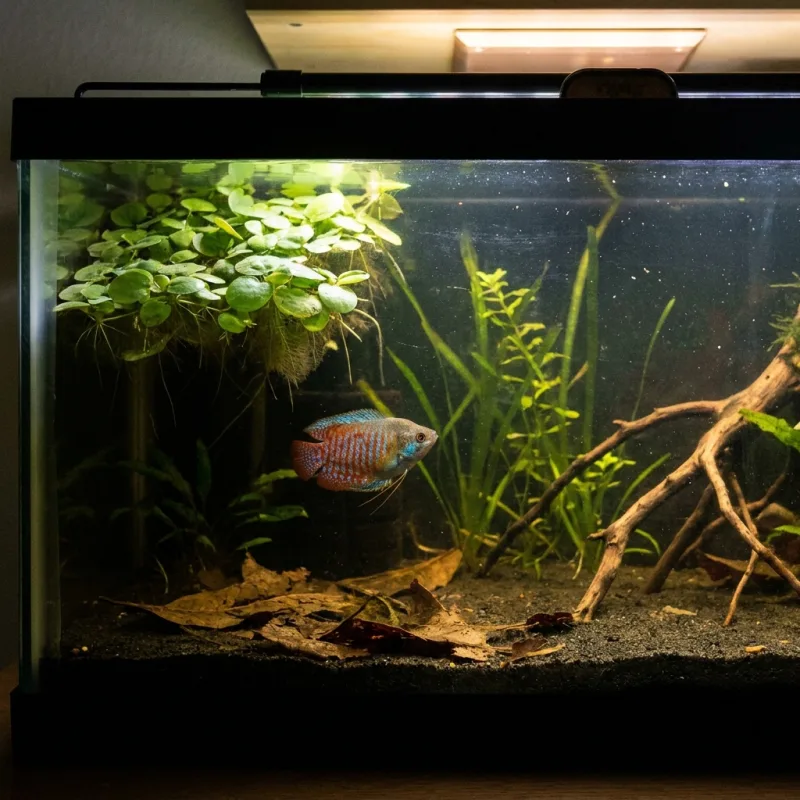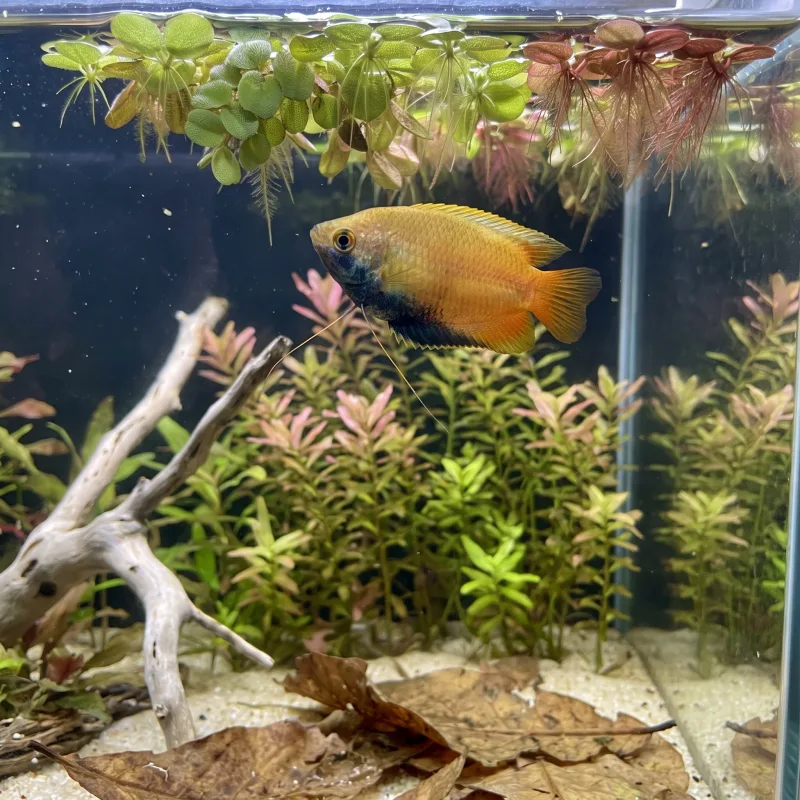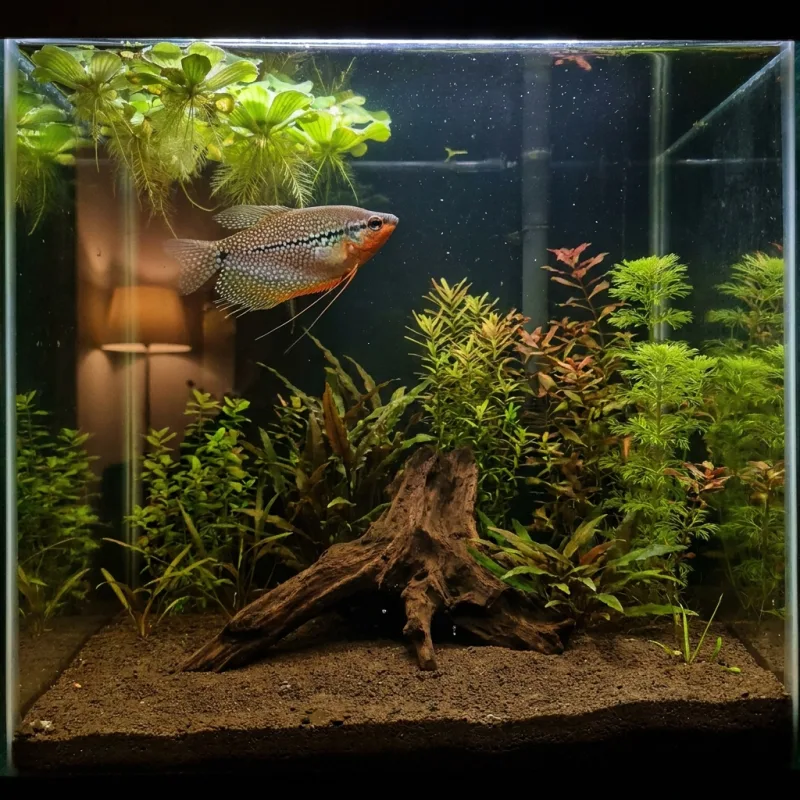
Sparkling Gourami
Trichopsis pumila
The thumb-sized gourami you can actually hearIntermediate
- Lifespan
- 3-5 years
- Size
- Up to about 1.6 in4 cm
- Social needs
- Social; keep a group of five or six or more; quiet nano tankmates only
- Time
- 10-15 min daily; weekly water change
- Cost
- Low
- Diet
- Micropredator (micro-pellets, live/frozen daphnia, baby brine shrimp)
Overview
What is this animal?
- The sparkling gourami is one of the smallest gouramis in the hobby, a labyrinth fish barely 1.4-1.6 in3.5-4 cm long from the still ditches, marshes, and rice paddies of Southeast Asia: the Mekong and Chao Phraya basins and the Malay Peninsula.
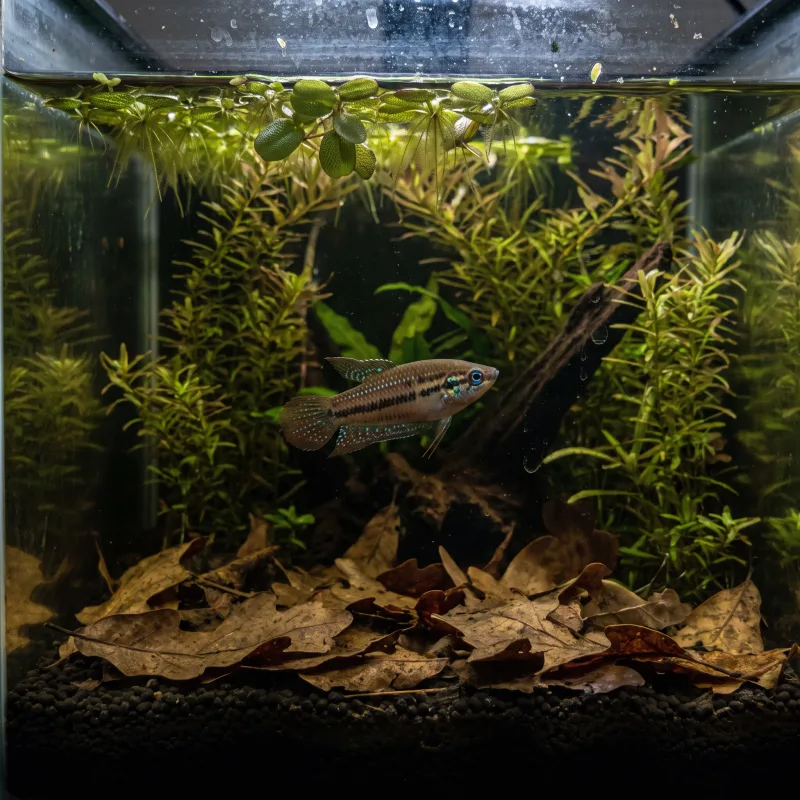
- A brownish body spangled with rows of iridescent blue-green spots, red-and-blue-edged fins, and brilliant turquoise eyes give it its name.
- Its party trick is real sound: displaying fish produce an audible croaking or clicking by snapping enhanced tendons in the pectoral fins, and a settled group will chatter at each other across the tank.
Show 3 more
- Do not confuse it with the closely related croaking gourami, Trichopsis vittata, which grows to nearly twice the length, or with the honey and dwarf gouramis already familiar to community keepers, both of which are bigger, bolder fish.
- This is a true nano species for a quiet, planted, dedicated setup.
- The intermediate rating is not about fragile health, because they are reasonably hardy; it reflects that they starve, hide, and fade in the average busy community tank, and only show their colour, confidence, and voice when the whole aquarium is designed around them.
Temperament
- Sparkling gouramis are peaceful, inquisitive, and endearingly interactive with each other, but they are timid with anything larger or faster than themselves.
- Keep them in a group of five or six or more, because lone fish tend to stay hidden while a settled group spreads confidence and triggers the croaking displays the species is known for.
Show 4 more
- Males spar with spread fins and audible clicks, circling each other in brief, theatrical contests that almost never cause damage in a planted tank.
- Males also build small bubble nests, often tucked under a broad leaf rather than in open water.
- The safest stocking is a species tank, or company on their own scale: chili rasboras, ember tetras, pygmy corydoras, and otocinclus work well, while barbs, bettas, larger gouramis, and anything boisterous will bully or simply out-eat them.
- They may pick off shrimplets but generally coexist with adult cherry shrimp.
A good fit for
- Keepers who want a characterful centrepiece for a small planted tank
- Anyone charmed by the idea of a fish that audibly croaks
- Quiet species tanks or small communities of equally small fish
- Keepers ready to feed live and frozen micro-foods
- Fans of natural, tannin-stained, leaf-litter aquascapes
Common mistakes to avoid
- Adding them to a busy community where they hide and slowly starve
- Standard flake and pellets being too large for their tiny mouths
- Strong filter flow pinning them into corners
- Cold room air over the surface harming the labyrinth organ
- Keeping them alone or in too small a group, which leaves them shy and colourless
- Escaping through small gaps in the lid
Enclosure
Minimum 15 gallons57 litres, for a group of 5
Cannot be kept alone. The minimum is 5, and the space above is for that group.
- House a small group of five or six in a tank of at least 15 US gallons57 L that is at least 18 in45 cm long, prioritising floor area and planted cover over height; a standard 24 x 12 x 12 in60 x 30 x 30 cm 15-gallon57-litre tank qualifies, and a 10-gallon38-litre does not.
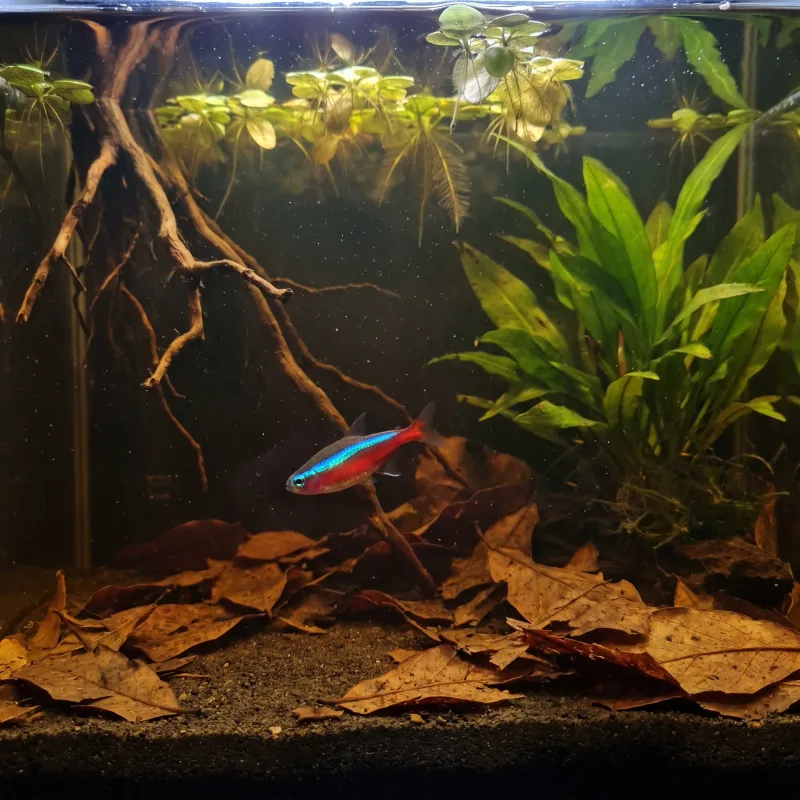
- Dense stem plants, leaf litter, and a layer of floating plants recreate the shaded, tannin-stained still water they come from and transform their behaviour.
- Keep the water at 75-82°F24-28°C, soft and slightly acidic to neutral with a pH around 6.0-7.5, and use gentle filtration such as a sponge filter, because flow that barely registers for other fish will pin these into the corners.
Show 3 more
- Like all gouramis they gulp air at the surface with a labyrinth organ, so fit a tight lid that traps a layer of warm, humid air; cold room air over warm water is a classic way keepers damage them.
- Cycle the tank fully before they arrive and keep ammonia and nitrite at zero, with a weekly partial water change.
- Labyrinth fish will jump through equipment gaps, so close off cable cutouts in the lid.
Supplies
Setup
- Tank and stand
- Filter
- Heater and thermometer
- Substrate, plants and decor
- Liquid test kit
- Dechlorinator and starter supplies
Ongoing
- Quality tropical flake (crushed fine for sparkling and honey gouramis)
- Floating and slow-sinking micro-pellets
- Frozen bloodworm, brine shrimp and daphnia
- Frozen or live baby brine shrimp, cyclops or microworms (for sparkling gouramis)
- Spirulina or vegetable flake
- Fine net for removing leftovers
Safe substrate: Fine, smooth sand · Smooth, rounded fine gravel (not for loaches or sand-sifting cichlids; sand is better for corydoras) · Bare bottom (quarantine and grow-out only)
Care routine
Daily
- Check temperature and equipment
- Feed
- Head-count and look everyone over
Every few days
- Check the air layer above the waterevery 3 days
- Top up evaporationevery 3 days
Show 7 more
Weekly
- Test the water
- Water change and gravel vacuum
- Wipe the front glass only
Every few weeks
- Trim and thin the plantsevery 2 weeks
Monthly
- Check supplies and reagent dates
- Replace or recharge chemical media, if you use any (skip it in a blackwater tank)
- Rinse the filter media
Health review: Quarterly review with a surface-air check, every 3 months
Tools
Care in depth
Diet
Micropredator (micro-pellets, live/frozen daphnia, baby brine shrimp)
- Sparkling gouramis are micropredators that hunt tiny invertebrates in the wild, and their mouths are genuinely small, so standard flake and community pellets are often literally too big.
- Use crushed flake or true micro-pellets as the staple and expect some individuals to refuse dry food entirely at first.
- Condition and colour come from small live and frozen foods: daphnia, baby brine shrimp, microworms, cyclops, and finely chopped bloodworm.
- A tank with leaf litter and mature plants also grows the microfauna they graze between meals.
- Feed small amounts once or twice daily and watch that every fish actually eats, because they are slow, deliberate feeders that lose out to anything quicker.
- Slow starvation next to faster tankmates is one of the most common ways this species fails.
Health
Signs of good health, and the common problems
- This is a fairly robust little fish with no strong link to the iridovirus that plagues farmed dwarf gouramis, which makes sourcing less fraught than for that species.
- Most losses trace back to husbandry: chilled surface air, strong flow, poor water quality, or simply being outcompeted for food.
- Quarantine new arrivals for a few weeks, since wild-caught and farm imports can carry parasites, and internal worms show as a hollow belly despite eating.
- Watch for clamped fins, faded spangling, and constant hiding as early stress signals in a fish that should be out patrolling the plants.
- At this size a healthy lifespan is around 3-5 years, and stable temperature, clean water, and a low-stress tank are what get them there.
- There is little margin for error in medicating a fish this small, so prevention beats treatment.
Is this urgent?
6 warning signs and how fast to act, 3 of them right away
In a fish tank the patient is usually the water. Test before you treat: dosing a healthy tank for a disease it does not have makes things worse.
Go now
Today
Soon
Never add a new fish to a tank that is not fully cycled, and never treat blind. A test kit is cheaper than the fish.
This is general guidance for a healthy adult, not a diagnosis. An exotics vet who knows your animal always overrides it, and the time to find one is before you need one.
Bedding and substrate
3 safe, 4 with a caveat, 2 to avoid
Substrate in an aquarium is a filter as much as a floor. Most of the biology lives in and on it.
Safe
With a caveat
Never
This is our general list for freshwater fish. We have not built one specific to Gouramis yet.
Top resources for more info
Independent creators and organisations we would send a friend to. We have no affiliation with any of them, and nothing here is sponsored. Links checked 2026-10-22.
YouTubers
Sites
Gouramis, side by side
Same axes, same care guides: the honest way to choose between types.