Panther Chameleon
Furcifer pardalis
Madagascar's painted showpiece for meticulous keepersAdvanced
- Lifespan
- Males 5-7 years (up to 8); females often only 2-4 with repeated egg-laying
- Size
- Males 16-21 in40-53 cm total length; females 10-14 in25-35 cm
- Social needs
- Strictly solitary; no cohabitation and no visual contact with other chameleons
- Time
- High; daily misting, feeding and close monitoring
- Cost
- Very high; $250-600+ animal, $600-1,200+ setup
- Diet
- Strict insectivore (gut-loaded live insects)
Overview
What is this animal?
- The panther chameleon comes from the humid coastal lowlands of northern Madagascar, and adult males are among the most vividly coloured reptiles on earth.
- Colour is locale-specific rather than random, so an Ambilobe, Nosy Be, Ambanja or Sambava male each wears a recognisably different palette, and serious breeders sell animals with the locale named.
- Reputable captive-bred stock with a named locale is the only ethical purchase, as wild-caught imports still enter the trade and travel poorly.
Show 3 more
- Panthers have a reputation as the mellowest of the commonly kept chameleons, and that is true only in a relative sense.
- The infrastructure demands are identical to a veiled chameleon's, the margin for error in heat, UVB, hydration and ventilation is just as thin, and the price of the animal is several times higher.
- This is an advanced-keeper display animal, and if the budget or the daily routine is not certain yet, the honest answer is not yet.
Temperament
- A panther chameleon's colour is a language before it is decoration, and dark bars, fired-up patterns, flattening or gaping all say stressed or threatened.
- Reading those signals and backing off is most of the relationship.
Show 6 more
- They are ambush hunters and slow, deliberate climbers who spend their day patrolling branches and watching everything.
- Their reputation as the calmer chameleon is real but relative, and some individuals will voluntarily walk onto a hand for a hand-fed insect.
- Even so, this is a display animal rather than a pet to hold, and handling should stay rare, brief and always on the animal's initiative.
- Forced handling produces chronic stress that shortens lives.
- Panthers must live strictly alone, with no cohabitation and no line of sight to another chameleon, because males display and stress themselves even through a screen.
- Reflections in glass or mirrors can trigger the same territorial response, so cage placement matters as much as cage size.
A good fit for
- Experienced keepers ready for chameleon-level precision
- People who want a spectacular living display in a planted cage
- Keepers who will automate misting and nighttime fogging and still check in daily
- Those content to observe rather than handle
- Buyers willing to pay properly for captive-bred, named-locale stock
Common mistakes to avoid
- Treating it as an 'easier veiled': the infrastructure demands are identical
- Cheap wild-caught or unnamed-locale animals
- A too-hot basking spot or a constantly wet cage: overheating and respiratory infection both kill
- Skipping the nighttime humidity spike; chronic dehydration is a leading killer
- Weak or expired UVB quietly causing metabolic bone disease
- Any visual contact with another chameleon, including reflections
Enclosure
Minimum 8 sq ft0.72 m² of floor · 47 x 24 x 47 in120 x 60 x 120 cm
Must be housed alone. Strictly solitary; no cohabitation and no visual contact with other chameleons
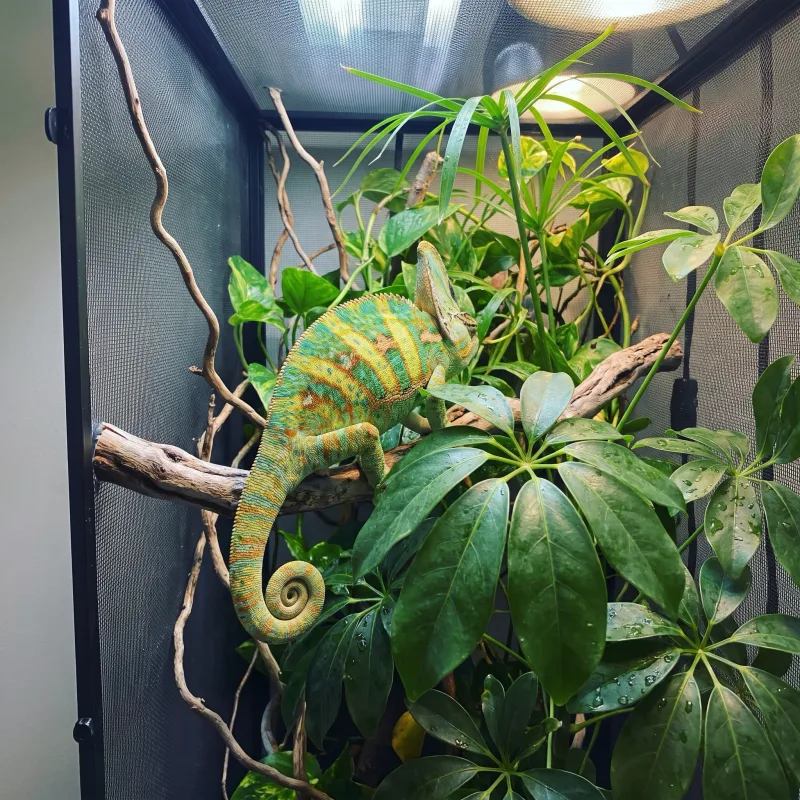
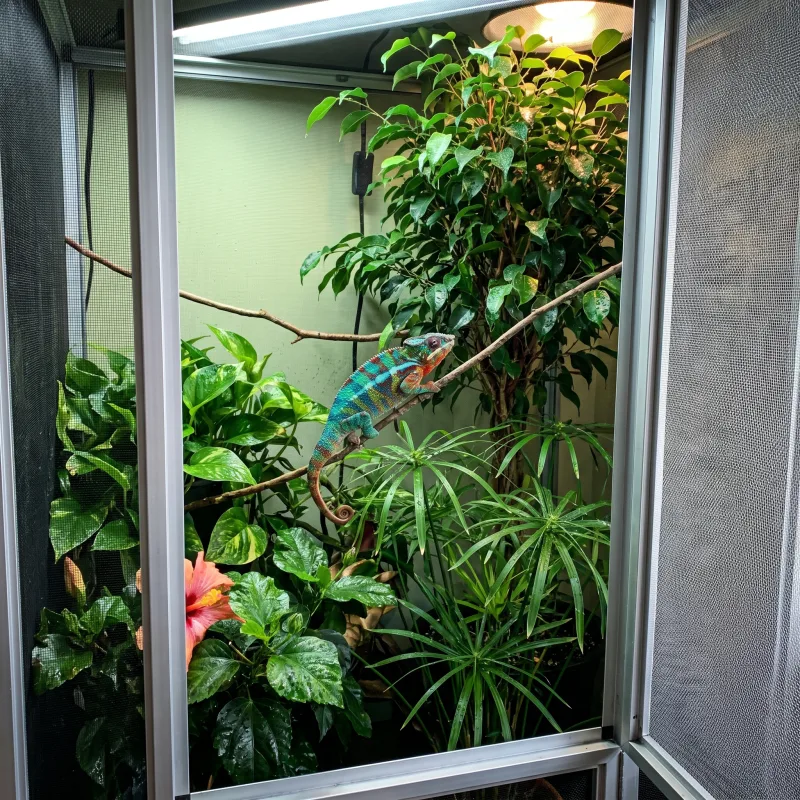
- House one panther chameleon alone in a tall, well-ventilated screen enclosure of at least 48 x 24 x 48 in120 x 60 x 120 cm for an adult male, densely planted with live foliage and crossed with horizontal branches at several heights.
- Females are smaller and can manage slightly less height, but the same cage is better, and more space is always an improvement.
- Glass boxes trap stale humid air and invite respiratory infection, so mesh or hybrid enclosures with strong airflow are the standard.
Show 6 more
- Coming from humid coastal forest rather than the arid Arabian scrub of the veiled chameleon, panthers want a moderate basking spot of around 85°F29°C, comfortably under the roughly 90°F32°C ceiling where overheating and dehydration begin, with ambient temperatures of 72-80°F22-27°C and a night drop into the low-to-mid 60s°F16-18°C, which they actively benefit from.
- Provide a linear T5 HO UVB tube of around 5-6 percent output on a 12-hour cycle, positioned to give a proper basking-branch gradient, and replace it on schedule, because an expired tube still glows while doing nothing.
- Hydration should follow Madagascar's rhythm rather than a constantly damp cage.
- Keep daytime humidity moderate, roughly 40-60 percent, and let the foliage dry out between mistings, because perpetually wet air is what drives the respiratory infections that kill so many chameleons.
- Run long, gentle mistings at dawn and after lights-out, then push the real humidity spike (up toward 80-100 percent) overnight with a fogger during the cool early-morning hours, mimicking the fog and heavy dew of their coastal range; some specialists think panthers take in much of their water at that time, but the dawn and evening mistings stay part of the water supply.
- Chameleons do not drink from bowls, so standing water is useless to them and a hygiene risk; every drop must arrive as droplets on leaves.
Supplies
Setup
- Enclosure, 4 x 2 x 4 ft120 x 60 x 120 cm
- Heating and thermostat
- UVB fixture and bulb
- Thermometers and hygrometer
- Substrate and decor
Ongoing
- Live crickets, dubia roaches, silkworms and black soldier fly larvae
- Hornworms for hydration and variety
- Plain calcium powder without D3
- Calcium with D3 and a reptile multivitamin
- Feeder gut-load and ventilated feeder tubs
Show 3 more
- Automatic mister or fogger
- Cup-feeder that hangs in the branches
- Feeding tongs
Safe substrate: Topsoil and coco fibre mix · Leaf litter over a soil base · Cypress mulch or orchid bark
Care routine
Daily
- Check it dries out between mistings
- Check temperatures and humidity
- Check the dripper or misting nozzles are working
- Look the animal over
- Mist several times a day
- Spot-clean waste and uneaten food
Show 8 more
Every few days
- Gut-loaded, dusted insects (juveniles daily)every 2 days
- Check eyes and uratesevery 3 days
Every few weeks
- Check the lay boxevery 2 weeks
- Weigh-inevery 2 weeks
Monthly
- Deep-clean decor, glass and bowls
- Test thermostats, lamps and guards
Less often
- Refresh the substrateevery 3 months
- Check the UVB lamp's age and replace it if due (if one is fitted)every 6 months
Vet: Annual exam with hydration and bone check, every 12 months (every 6 months from 3 years old)
Tools
Care in depth
Diet
Strict insectivore (gut-loaded live insects)
- Panther chameleons are strict insectivores, and unlike veiled chameleons they take essentially no plant matter, so variety in the live-insect rotation carries the entire diet.
- Build the staple list from gut-loaded crickets, dubia roaches, silkworms, hornworms and black soldier fly larvae, keeping fatty items like waxworms and superworms as occasional treats.
- Gut-load feeders on fresh produce and a quality dry load for 24 to 48 hours before offering them.
- Dust insects with plain calcium (no D3) at most feedings, and with a calcium-plus-D3 supplement and a multivitamin roughly twice a month each, because both under- and over-supplementing cause real harm.
- Adults do well on five to eight appropriately sized insects every other day, while growing juveniles eat daily.
- Obesity is a genuinely common failure in adult males, whose begging at the screen is persuasive, and a fat chameleon is a short-lived chameleon.
- All drinking water arrives as misted droplets on leaves and the fogger's condensation, which makes the hydration schedule part of the diet, not an extra.
Health
Signs of good health, and the common problems
- The dominant killers are the classic chameleon trio of metabolic bone disease from weak or expired UVB and calcium errors, chronic dehydration and kidney damage from too little water, and respiratory infection from stagnant humid air.
- Thermal burns from basking too close to an unguarded lamp and tongue or eye problems from poor supplementation also appear regularly in veterinary caseloads.
- A healthy panther grips firmly, tracks movement with round, alert turret eyes, and holds bright relaxed colour.
- Sunken or closed eyes, dark drab colouration, a weak grip or an animal sitting low in the cage are all reasons to see an exotics vet promptly, and that vet should be located before the chameleon is purchased.
- Females can produce infertile clutches without ever meeting a male, and without a lay bin holding at least 8 in20 cm of moist, diggable sand-soil mix they risk fatal egg-binding.
- Repeated clutching is why breeding females often live only two to four years, and it is a large part of why males dominate the pet trade.
Is this urgent?
3 warning signs and how fast to act, 2 of them right away
Chameleons decline quietly and are usually presented late. Watch the eyes and the grip.
Go now
Today
Chameleons need no visual contact with other chameleons. Even seeing one another through glass is a chronic stressor.
This is general guidance for a healthy adult, not a diagnosis. An exotics vet who knows your animal always overrides it, and the time to find one is before you need one.
Bedding and substrate
5 safe, 3 with a caveat, 4 to avoid
Substrate choice follows the animal's natural humidity, not the look of the vivarium. Get that pairing right and most substrate arguments disappear.
Safe
With a caveat
Never
This is our general list for reptiles. We have not built one specific to Chameleons yet.
Impaction is far more often a temperature problem than a substrate problem: an animal that cannot reach its digestive temperature will not pass what it swallows, whatever it is standing on.
Top resources for more info
Independent creators and organisations we would send a friend to. We have no affiliation with any of them, and nothing here is sponsored. Links checked 2026-10-22.
YouTubers
Sites
Chameleons, side by side
Same axes, same care guides: the honest way to choose between types.