Red-eared Slider
Trachemys scripta elegans
Common aquatic turtle needing a large tankAdvanced
- Lifespan
- 20-30+ years
- Size
- 6-12 in15-30 cm (females largest)
- Social needs
- Can live singly; not dependent on company
- Time
- Medium-High; daily feed, heavy filtration
- Cost
- High
- Diet
- Omnivore (pellets, greens, some protein)
Overview
What is this animal?
- The red-eared slider is one of the most widely kept aquatic turtles, recognised by the red stripe behind each eye.
- Hatchlings look like a cheap pet for a small bowl, but they grow into large, messy, long-lived turtles that need a substantial aquatic setup and decades of care.
- Underestimating their size, mess and lifespan leads to many being released, where they become a damaging invasive species in many countries.
Show 3 more
- In the EU and UK sliders have been listed as invasive since 2016: they may not be sold, bred, exchanged or released, though existing pets may be kept for life.
- In the US, turtles under 4 in10 cm may not legally be sold as pets (an FDA rule since 1975).
- Acquire one only with the space, filtration budget and 20-to-30-year-plus commitment they genuinely require.
Temperament
- Red-eared sliders are active, alert, strong swimmers that quickly learn to beg at feeding time, which many owners enjoy.
- They are not affectionate and generally dislike handling, which can stress them, and larger turtles can deliver a painful bite if mishandled.
Show 3 more
- They do not need company and are often best kept singly, as multiple turtles increase waste, competition and aggression, and adult males may harass tank-mates.
- If kept together, they need much more space and careful monitoring.
- For most keepers, one well-housed turtle is the simplest and kindest choice.
A good fit for
- Keepers with ground-floor room for a 265-gallon1,000-litre tank or indoor pond
- People who enjoy watching rather than handling
- Owners ready for heavy filtration and water changes
- Those committed to 20-30+ years of care
Common mistakes to avoid
- Tiny tanks and bowls for a growing turtle
- Weak filtration causing chronic poor water quality
- Releasing an unwanted slider outdoors, where it becomes invasive
- Missing UVB and basking heat
Enclosure
Minimum 265 gallons1,000 litres
Fine alone or with company. Can live singly; not dependent on company
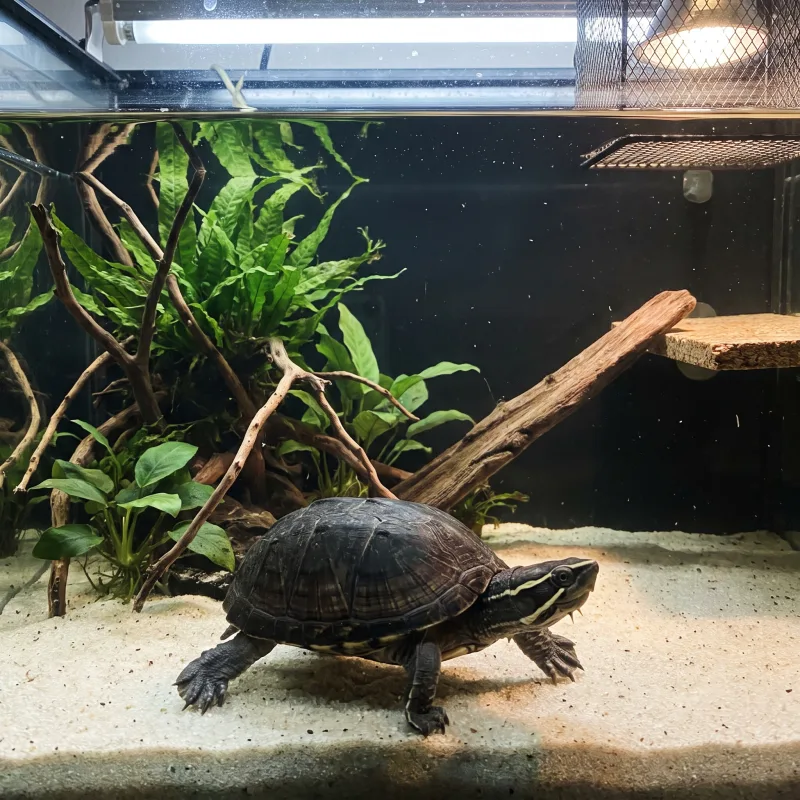
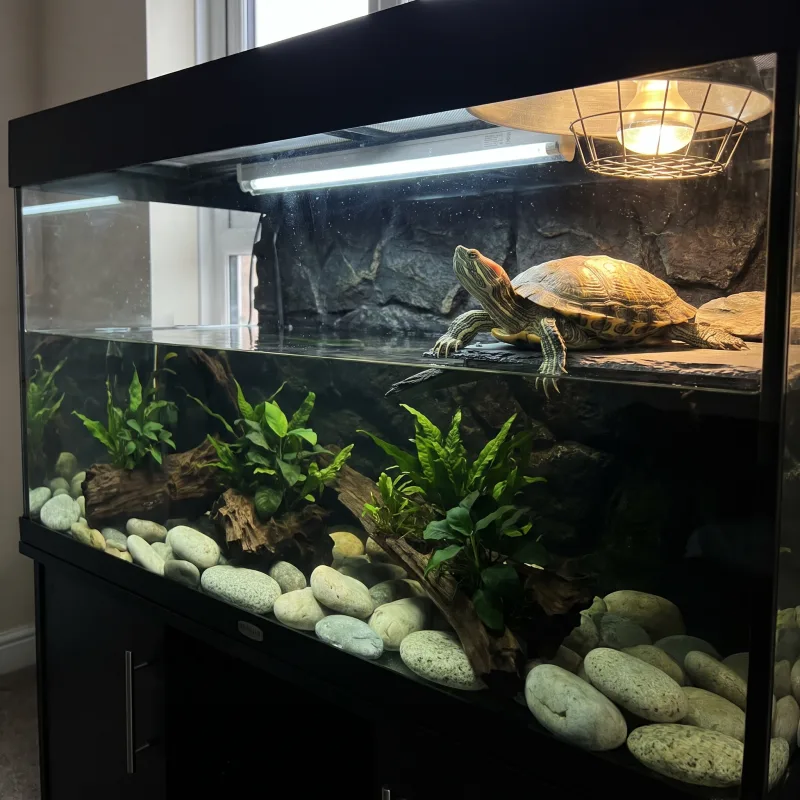
- An adult needs a stock tank, indoor pond or aquarium of at least 265 US gallons1,000 litres for one turtle, such as a 300-gallon1,136-litre stock tank.
- Give it a water area at least five times as long and three times as wide as its shell, water at least twice its shell length deep, and a dry land or basking area of at least 3.2 sq ft0.3 m² (about 22 x 22 in55 x 55 cm), more for a large female.
- A full setup weighs more than a tonne, so it belongs on a ground floor, and a second turtle needs at least half as much water again.
Show 4 more
- The basking area should reach 88-95°F31-35°C under a heat lamp, with water held around 75-79°F24-26°C by a submersible heater; keep juveniles and sick turtles warmer.
- They produce heavy waste, so a powerful external or canister filter rated well above the tank volume is essential, along with regular water changes.
- A UVB lamp over the basking dock is required for shell and bone health.
- Keep the basking zone genuinely dry so the turtle can fully warm and dry off.
Supplies
Setup
- Stock tank, indoor pond or aquarium of 265 US gal1,000 L or more
- Pond or canister filtration rated at two to three times the water volume
- Two guarded submersible heaters, about 600 W in all
- Dry land or basking area, about 22 x 22 in55 x 55 cm (3.2 square feet0.3 square metres) or larger
- Basking lamp, UVB fixture and tube
Show 2 more
- Water conditioner and liquid test kit
- Water thermometer, and a temperature gun for the basking area
Ongoing
- Quality aquatic turtle pellets (carnivorous formula for musk turtles)
- Frozen or live earthworms, shrimp and snails
- Leafy aquatic greens or romaine for the omnivores
- Floating cuttlebone
- Separate feeding tub
Show 3 more
- Fine net for removing uneaten food
- Feeding tongs
- Kitchen scale for tracking growth
Safe substrate: Bare bottom · Smooth river stones or slate larger than the turtle's head
Care routine
Daily
- Check water and basking-dock temperatures
- Look the animal over
- Spot-clean waste and uneaten food
- Top up evaporated water with dechlorinated water
Every few days
- Feed to the species' scheduleevery 2 days
Show 10 more
Weekly
- Check the basking dock
- Check the tank and its kit are kept away from food areas
- Test the water
- Water change and debris vacuum
Every few weeks
- Weigh-inevery 2 weeks
Monthly
- Deep-clean decor, glass and bowls
- Rinse the filter media
- Siphon under rocks and decor
- Test thermostats, lamps and guards
Less often
- Check the UVB lamp's age and replace it if due (if one is fitted)every 6 months
Vet: Annual exam and faecal check, every 12 months
Tools
Care in depth
Diet
Omnivore (pellets, greens, some protein)
- Red-eared sliders are omnivores whose diet shifts with age.
- Hatchlings and juveniles are more carnivorous, while adults eat increasingly plant matter.
- Feed a quality commercial aquatic turtle pellet as a base, plus leafy aquatic greens, and offer protein such as appropriately sized insects for younger turtles.
- Feed juveniles daily and adults every two to three days, removing uneaten food to protect water quality.
- Provide calcium via a cuttlebone.
- Over-feeding, especially fatty protein and processed treats, plus low-calcium or low-UVB conditions, drives obesity, fatty liver, shell deformity and metabolic bone disease.
Health
Signs of good health, and the common problems
- A healthy slider has a hard, smooth shell, clear eyes, a strong swim and a good appetite.
- Common problems include shell rot and soft shell from poor water quality or insufficient UVB and calcium, respiratory infection (gaping, listing in the water, bubbling) from cold water, and swollen eyes linked to vitamin A deficiency.
- Poor water quality underlies most illness, so filtration and water changes are central to health.
- Sliders can carry Salmonella, so wash your hands every time after touching the turtle, its water, food or equipment, and supervise children around it.
- Any turtle floating abnormally, refusing food or labouring to breathe should see a reptile-capable exotics vet.
Is this urgent?
3 warning signs and how fast to act, 1 of them right away
For aquatic turtles the water quality is half the medical history.
Go now
Today
Soon
A turtle needs a basking site that gets it fully dry and properly warm. Half the common problems trace back to a dock that does neither.
This is general guidance for a healthy adult, not a diagnosis. An exotics vet who knows your animal always overrides it, and the time to find one is before you need one.
Bedding and substrate
2 safe, 1 with a caveat, 3 to avoid
For an aquatic turtle the substrate is the tank floor, and the rule is that nothing on it fits in the turtle's mouth.
Safe
With a caveat
Never
Keep the basking dock fully dry. A gravid female needs a separate soil-and-sand nesting box, or she may retain her eggs.
Top resources for more info
Independent creators and organisations we would send a friend to. We have no affiliation with any of them, and nothing here is sponsored. Links checked 2026-10-22.
YouTubers
Sites
Turtles, side by side
Same axes, same care guides: the honest way to choose between types.