Common Musk Turtle
Sternotherus odoratus
Tiny bottom-walking stinkpot with a big attitudeIntermediate
- Lifespan
- 30-50 years
- Size
- 3-5 in8-13 cm shell
- Social needs
- Solitary; males fight and harass tank-mates
- Time
- Medium; regular feeds, weekly water changes
- Cost
- Medium
- Diet
- Carnivore (pellets, snails, worms, shrimp)
Overview
What is this animal?
- The common musk turtle, affectionately called the stinkpot, is one of the smallest turtles in North America at just 3-5 inches8-13 cm of shell.
- It earns the nickname from musk glands at the seams of the shell that can release a pungent odour when the turtle feels threatened, though captive-bred animals used to their keeper musk far less over time.
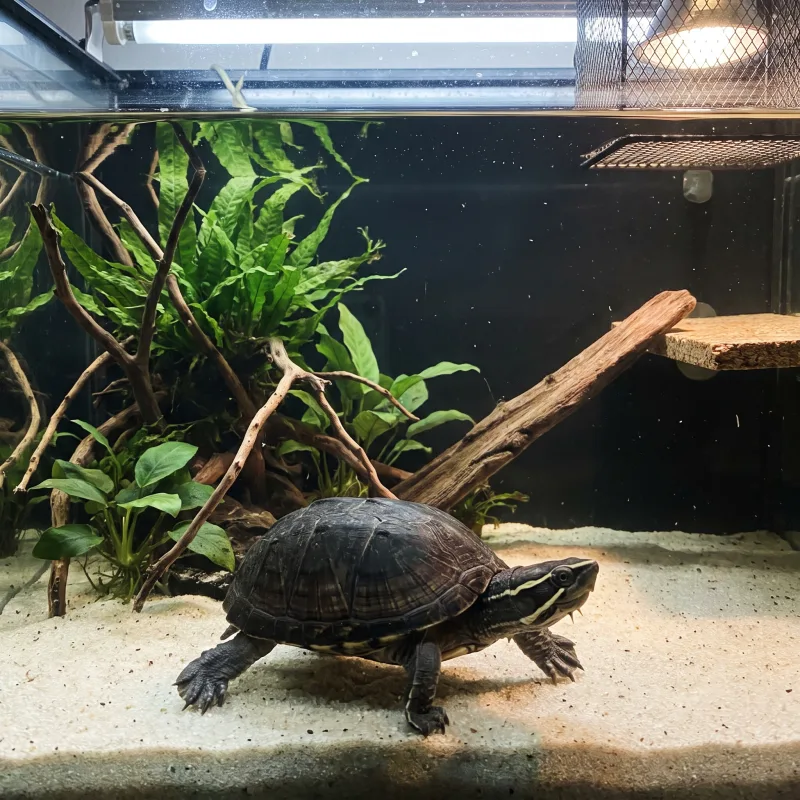
- Two pale stripes run along each side of the face, and fleshy barbels under the chin and throat set it apart from the red-eared slider, the other fully aquatic turtle on this site.
Show 3 more
- Its small adult size makes it the rare aquatic turtle that genuinely fits in an apartment-scale tank, needing a fraction of the space a slider does.
- It is still a 30-to-50-year commitment with real filtration, heating, lighting and UVB costs, so treat it as a manageable turtle rather than an easy one.
- Buy captive-bred only; wild-caught adults are still commonly sold and often adapt poorly, arriving stressed and parasite-laden.
Temperament
- Musk turtles are bold, curious little animals, most active at dawn, dusk and after dark, methodically working the tank floor and investigating anything new.
- They quickly learn to associate their keeper with food and will march to the glass at feeding time.
Show 4 more
- They are watch-not-handle pets: the long, flexible neck can reach back almost to the hind legs, and a startled stinkpot bites hard for its size and may add the trademark musk.
- Keep one turtle per tank.
- Males fight each other, and in typical home aquaria a male will harass a female relentlessly with nowhere for her to escape.
- Fast mid-water fish sometimes coexist, but shrimp, snails and small slow fish are simply food, so a single well-housed turtle is the kind default.
A good fit for
- Keepers wanting an aquatic turtle that needs far less water than a slider
- People who enjoy watching rather than handling
- Evening observers; they are most active at dusk and after dark
- Owners ready for a 30-50 year commitment
- Those willing to over-filter and change the water weekly
Common mistakes to avoid
- Deep bare tanks with no climb routes (drowning risk)
- Skipping the dock and a proper UVB lamp because they rarely bask
- A long-necked bite that reaches surprisingly far back
- Daily feeding of adults; obesity is common
- Wild-caught imports; insist on captive-bred
Enclosure
Minimum 79 gallons300 litres
Must be housed alone. Solitary; males fight and harass tank-mates
- One adult needs an aquarium or turtle tub of at least 80 US gallons300 litres in total capacity, with a long, wide footprint; a 90-gallon341 L tank or a 100-gallon379 L stock tank is the practical way to get there.
- Many care sheets give 20 to 55 gallons75 to 210 litres, but those are floors: the rule of 20 US gallons76 L of tank per inch2.5 cm of shell asks 80 gallons305 litres for a 4-inch10 cm adult and 100 gallons380 litres for a large 5-inch13 cm one, and the water in it is kept wide and shallow rather than deep.
- Floor area matters more than depth, because musk turtles are weak swimmers that walk along the bottom rather than cruising open water.
Show 5 more
- Set the water at least 1.5 times the shell length deep so the turtle can right itself if flipped, which works out to roughly 5-8 inches12-20 cm for an adult and about 1.5-2 inches4-5 cm for a hatchling.
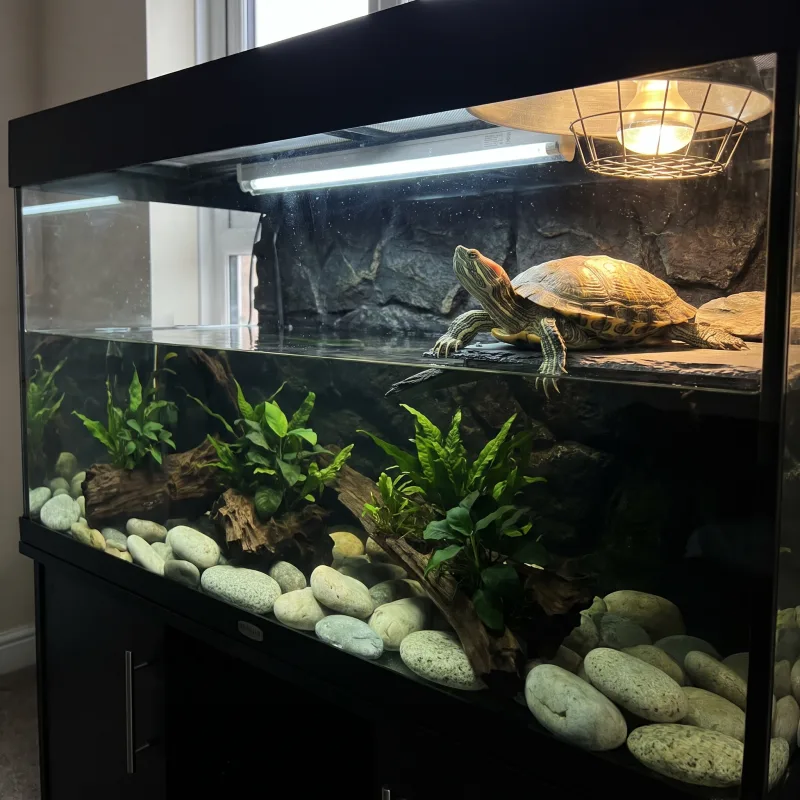
- Adults can use 8-12 inches20-30 cm or more if the tank is densely furnished, so always provide driftwood, rock stacks or thick plants as ladders to the surface; a deep, bare tank is a genuine drowning risk for this species.
- Hold the water at 72-78°F22-26°C with a guarded submersible heater, keep juveniles a touch warmer near 80°F27°C, and provide a dry dock or emergent branch under a basking lamp reaching 85-90°F29-32°C.
- Musk turtles bask far less than sliders and often just rest near the surface, but the dry option must always exist, and a proper UVB lamp over the dock (a 5% / T5 tube or equivalent, replaced yearly) supports shell and bone health.
- Run a canister filter rated for at least double the tank volume and do a partial water change weekly, because a small volume of turtle water fouls much faster than a big one.
Supplies
Setup
- Aquarium or tank, and a stand
- Canister filter rated at two to three times the tank volume
- Submersible heater with a guard
- Basking dock
- Basking lamp, UVB fixture and tube
Show 2 more
- Water conditioner and liquid test kit
- Water thermometer, and a temperature gun for the dock
Ongoing
- Quality aquatic turtle pellets (carnivorous formula for musk turtles)
- Frozen or live earthworms, shrimp and snails
- Leafy aquatic greens or romaine for the omnivores
- Floating cuttlebone
- Separate feeding tub
Show 3 more
- Fine net for removing uneaten food
- Feeding tongs
- Kitchen scale for tracking growth
Safe substrate: Bare bottom · Smooth river stones or slate larger than the turtle's head
Care routine
Daily
- Check water and basking-dock temperatures
- Look the animal over
- Spot-clean waste and uneaten food
- Top up evaporated water with dechlorinated water
Every few days
- Feed to the species' scheduleevery 2 days
Show 10 more
Weekly
- Check the basking dock
- Check the tank and its kit are kept away from food areas
- Test the water
- Water change and debris vacuum
Every few weeks
- Weigh-inevery 2 weeks
Monthly
- Deep-clean decor, glass and bowls
- Rinse the filter media
- Siphon under rocks and decor
- Test thermostats, lamps and guards
Less often
- Check the UVB lamp's age and replace it if due (if one is fitted)every 6 months
Vet: Annual exam and faecal check, every 12 months
Tools
Care in depth
Diet
Carnivore (pellets, snails, worms, shrimp)
- Musk turtles are strongly carnivorous bottom foragers that hunt snails, insects, worms and small crustaceans in the wild.
- Base the captive diet on a quality carnivorous aquatic-turtle pellet, rotated with earthworms, snails, shrimp, crickets and the occasional piece of white fish.
- Most individuals ignore greens, unlike the omnivorous red-eared slider, though offering some aquatic plants does no harm.
- Feed hatchlings daily and adults every other day, with a portion roughly the size of the turtle's head.
- Remove uneaten food promptly, or feed in a separate tub to spare water quality.
- Whole shelled prey such as snails plus a floating cuttlebone cover calcium needs.
- Feeding adults daily is one of the commonest keeper mistakes and quickly produces an obese turtle whose legs bulge from the shell openings.
Health
Signs of good health, and the common problems
- A healthy musk turtle has a firm shell, clear eyes, a strong feeding response and busy bottom-patrolling behaviour.
- The common problems are shell rot and fungal skin infections from dirty water, respiratory infection from chilling or unheated water, swollen eyes linked to vitamin A deficiency, and soft shell in juveniles kept without calcium and UVB.
- Water quality sits behind most illness in this species, so test regularly and treat the filter and water-change schedule as preventive medicine.
- Like all turtles they can carry Salmonella, so wash your hands every time after touching the turtle, its water, food or equipment, and supervise children.
- A musk turtle floating lopsided, bubbling from the nose or refusing food for more than a few days needs a reptile-capable exotics vet, and it is worth confirming access to one before buying an animal that may outlive its keeper's mortgage.
Is this urgent?
3 warning signs and how fast to act, 1 of them right away
For aquatic turtles the water quality is half the medical history.
Go now
Today
Soon
A turtle needs a basking site that gets it fully dry and properly warm. Half the common problems trace back to a dock that does neither.
This is general guidance for a healthy adult, not a diagnosis. An exotics vet who knows your animal always overrides it, and the time to find one is before you need one.
Bedding and substrate
2 safe, 1 with a caveat, 3 to avoid
For an aquatic turtle the substrate is the tank floor, and the rule is that nothing on it fits in the turtle's mouth.
Safe
With a caveat
Never
Keep the basking dock fully dry. A gravid female needs a separate soil-and-sand nesting box, or she may retain her eggs.
Top resources for more info
Independent creators and organisations we would send a friend to. We have no affiliation with any of them, and nothing here is sponsored. Links checked 2026-10-22.
YouTubers
Sites
Turtles, side by side
Same axes, same care guides: the honest way to choose between types.