Blue-tongue Skink
Tiliqua scincoides
Curious, tame, blue-tongued ground lizardIntermediate
- Lifespan
- 15-20 years
- Size
- 18-24 in45-60 cm
- Social needs
- Strictly solitary
- Time
- Medium - daily checks and spot-cleaning; adults fed once or twice a week
- Cost
- High
- Diet
- Omnivore - greens, veg, protein
Overview
What is this animal?
- Blue-tongue skinks are large, robust, ground-dwelling lizards named for the bright blue tongue they flash to startle predators.
- They are curious and often become tame, learning to recognise their keepers.
- Several species and subspecies exist, from Australian to Indonesian types, with differing humidity needs.
- Their interactive nature and manageable size make them rewarding pet lizards, though they need more space and dietary care than many people expect.
Temperament
- Blue-tongue skinks are among the more personable lizards, often becoming calm, confident, and tolerant of regular handling.
- Many tolerate exploring outside their enclosure under supervision.
Show 3 more
- They may huff, flatten, and show their blue tongue when startled, but rarely bite once tame, though their jaws are strong.
- Patient, consistent handling produces a trusting pet.
- They must always be housed alone, as they are not social.
A good fit for
- Keepers wanting an interactive lizard
- Those who can provide a large enclosure
- People able to prepare varied fresh diets
- Intermediate keepers ready for UVB husbandry
Common mistakes to avoid
- Needs UVB - MBD risk if omitted
- Obesity from too much protein or fat
- Must be housed alone, never paired
- Enclosure size often underestimated
Enclosure
Minimum 27 sq ft2.52 m² of floor · 7 x 4 x 3 ft2.1 x 1.2 x 0.9 m
Must be housed alone. Strictly solitary
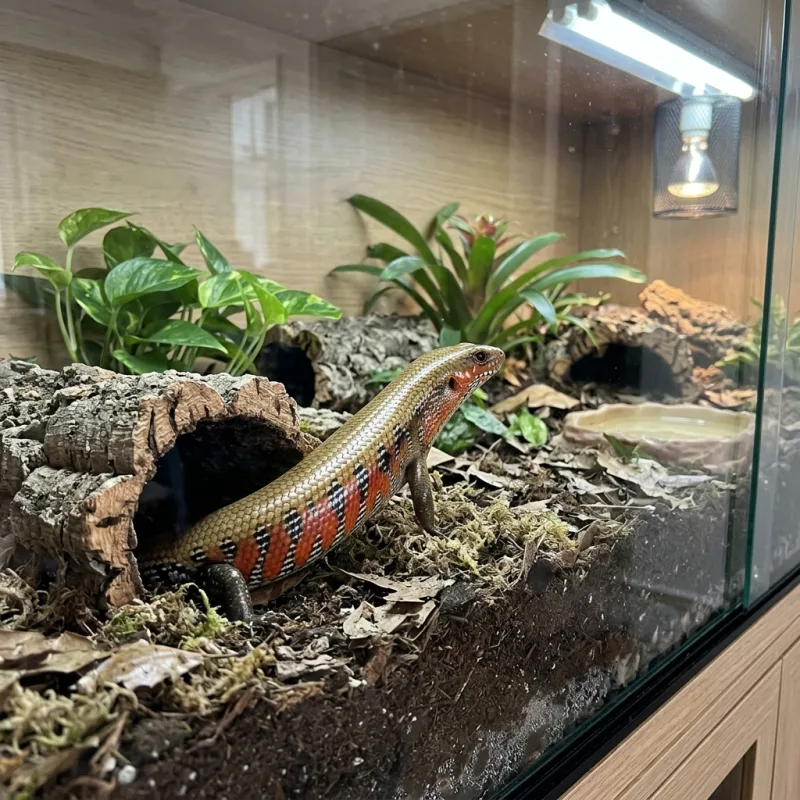
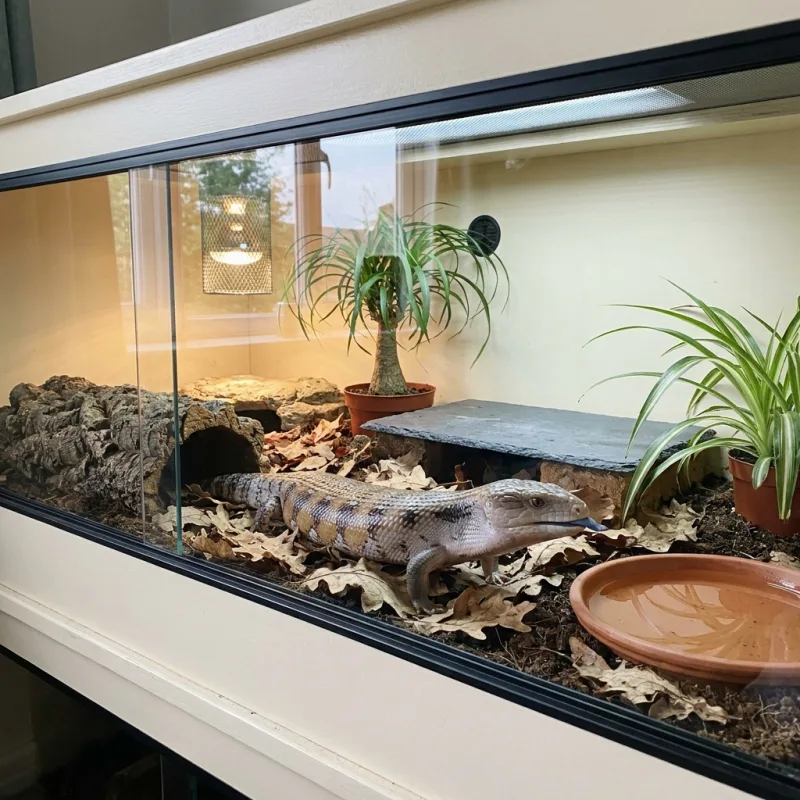
- An adult needs a floor-based enclosure of at least 7 x 4 x 3 ft2.1 x 1.2 x 0.9 m, usually custom-built, with larger being better, as these are active terrestrial walkers.
- Provide a substrate deep enough to burrow into, hides, and sturdy decor.
- They need a basking gradient with a hot spot of 95-104°F35-40°C and a cool side of 72-79°F22-26°C, plus UVB lighting across part of the enclosure for vitamin D3 and calcium metabolism.
- Humidity needs vary by species, so match it to your specific type.
Supplies
Setup
- Enclosure, 7 x 4 x 3 ft2.1 x 1.2 x 0.9 m, usually custom-built
- Heating and thermostat
- UVB fixture and bulb
- Thermometers and hygrometer
- Substrate and decor
Ongoing
- Live crickets, dubia roaches and earthworms
- Dark leafy greens and mixed vegetables (for blue-tongues)
- High-quality wet dog food or plain lean meat (blue-tongues only)
- Plain calcium powder without D3
- Vitamin supplement with D3
Show 3 more
- Feeder gut-load and a ventilated tub
- Shallow food and water dishes
- Blunt-tipped feeding tongs
Safe substrate: Topsoil and coco fibre mix · Leaf litter over a soil base · Cypress mulch or orchid bark
Care routine
Daily
- Check temperatures and humidity
- Fresh water bowl
- Look the animal over
- Spot-clean waste and uneaten food
Every few days
- Short handling sessionevery 3 days
- Feed a measured mixed meal (adults once or twice a week; juveniles about three times a week)every 5 days
Show 7 more
Every few weeks
- Turn and dampen part of the substrateevery 2 weeks
- Weigh-inevery 2 weeks
Monthly
- Check the nails
- Deep-clean decor, glass and bowls
- Test thermostats, lamps and guards
Less often
- Refresh the substrateevery 3 months
- Check the UVB lamp's age and replace it if due (if one is fitted)every 6 months
Vet: Annual exam and weight review, every 12 months (every 6 months from 12 years old)
Tools
Care in depth
Diet
Omnivore - greens, veg, protein
- Blue-tongues are omnivores needing a varied diet of animal protein, greens and vegetables, with fruit kept to no more than a tenth.
- Sources differ on the balance: ReptiFiles feeds adults roughly 50-60% protein and 40-50% greens and vegetables, while veterinary care sheets put greens and vegetables at 45-60% of an adult's diet, so about half and half sits inside both.
- Juveniles need far more protein, about 70-80% by ReptiFiles' figures.
- Offer dark leafy greens, mixed veg, and protein such as insects, lean meat, eggs, or a small amount of high-quality wet dog food, plus occasional fruit.
- Dust food with calcium and use a vitamin supplement as advised.
- Avoid high-fat, all-protein diets that cause obesity and organ stress.
- Babies up to about three months eat daily and juveniles about three times a week; adults eat once or twice a week, adjusted to body condition.
Health
Signs of good health, and the common problems
- Without correct UVB and calcium, blue-tongues readily develop metabolic bone disease, a common and serious husbandry failure.
- Obesity from rich diets and too little space is also frequent, and respiratory infections occur in cold or incorrectly humid setups.
- Provide proper UVB, a thermal gradient, and a balanced diet to prevent these problems.
- Keep nails trimmed and weight in check, and consult a reptile vet for any limb weakness, swelling, or lethargy.
Is this urgent?
8 warning signs and how fast to act, 5 of them right away
Most reptile emergencies are husbandry emergencies first. Before you panic, check the temperatures, but check them with a thermometer, not a hand.
Go now
Today
Soon
Before any non-emergency call, write down the four numbers a vet will ask for: the thermostat probe reading, the warm-end air temperature, the cool-end air temperature, and the hottest accessible surface. Surface temperature can run well above the air above it.
This is general guidance for a healthy adult, not a diagnosis. An exotics vet who knows your animal always overrides it, and the time to find one is before you need one.
Bedding and substrate
5 safe, 3 with a caveat, 4 to avoid
Substrate choice follows the animal's natural humidity, not the look of the vivarium. Get that pairing right and most substrate arguments disappear.
Safe
With a caveat
Never
This is our general list for reptiles. We have not built one specific to Skinks yet.
Impaction is far more often a temperature problem than a substrate problem: an animal that cannot reach its digestive temperature will not pass what it swallows, whatever it is standing on.
Top resources for more info
Independent creators and organisations we would send a friend to. We have no affiliation with any of them, and nothing here is sponsored. Links checked 2026-10-22.
YouTubers
Sites
Skinks, side by side
Same axes, same care guides: the honest way to choose between types.