Fire Skink
Reptiles · Skinks

Fire Skink

Mochlus fernandi

Ember-flanked burrower of the forest floorIntermediate

Lifespan
15-20 years
Size
12-15 in total length
Social needs
Solitary; never house two males
Time
Medium - feeding, misting, spot cleans
Cost
Medium
Diet
Insectivore - gut-loaded insects

Overview

What is this animal?

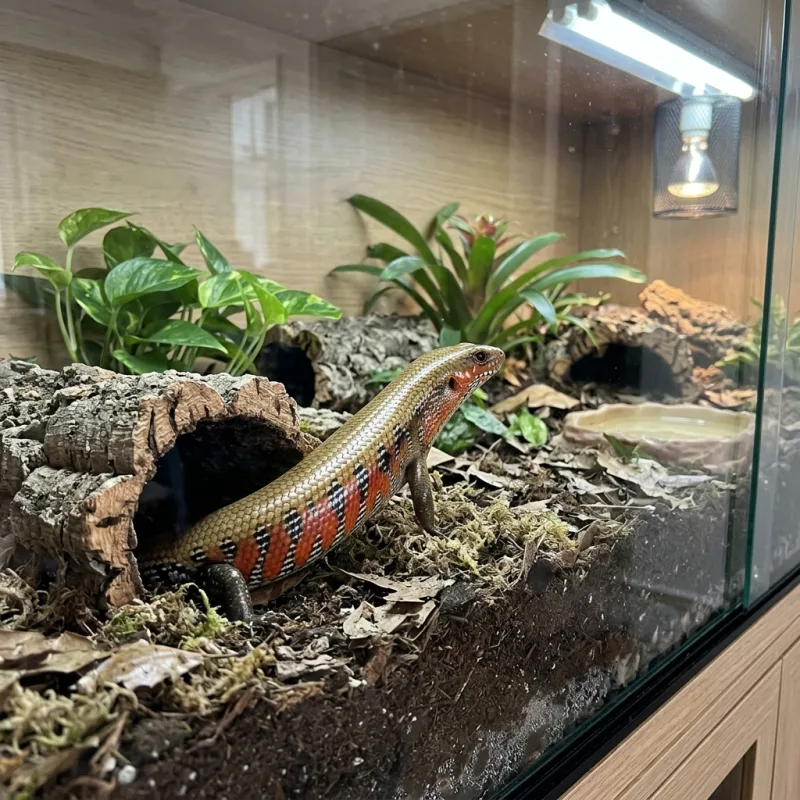
  • Fire skinks are West African forest-floor lizards with brilliant red-and-orange flanks barred in black and white under a golden back, making them one of the most vividly colored skinks in the hobby.
  • Adults reach about 12-15 inches in total length and are smaller, slimmer and far more secretive than the Blue-tongue skink elsewhere on this site.
  • They are semi-fossorial, meaning they spend much of the day tunnelling through deep, damp substrate and leaf litter rather than sitting on display.
Show 3 more
  • A fire skink is best treated as a beautiful occasional-glimpse animal, not a lizard that will lounge in the open.
  • Many fire skinks in shops are still wild-caught imports, which arrive stressed and often carrying parasites.
  • Seek out a captive-bred animal from a breeder, and if you cannot find one, waiting is the better welfare choice.

Temperament

  • Fire skinks are gentle but genuinely shy, and new arrivals may stay buried for days at a time, which is normal rather than a sign of illness.
  • With months of patient tong-feeding many become bold enough to cruise the surface at feeding time and tolerate brief, calm handling.
Show 4 more
  • They almost never bite, preferring to wriggle free and dive into the substrate with surprising speed, and like many skinks they can drop their tail if grabbed, so never restrain one by it.
  • Handle low over the enclosure and keep sessions short.
  • Choose this species for its colour and its busy burrowing behaviour, not for interaction.
  • A keeper who wants a lizard that seeks out contact will be happier with a Blue-tongue skink, while a keeper who enjoys a living vivarium with a jewel inside will love a fire skink.

A good fit for

  • Keepers who enjoy naturalistic bioactive setups
  • People happy with a display-first, handle-little pet
  • Those who can maintain 60-80% humidity reliably
  • Insect-feeding keepers wanting striking colour
  • Patient owners willing to tame with tong-feeding

Common mistakes to avoid

  • Many for sale are wild-caught - insist on captive-bred
  • Hides for days at a time; not a showpiece lizard
  • Needs 4-6 in of damp burrowing substrate, always
  • Two males will fight; house singly by default
  • Tail drops if grabbed or restrained
  • Stuck sheds and scale rot when humidity is wrong

Enclosure

Minimum 6 sq ft of floor · 35 x 24 x 18 in

Must be housed alone. Solitary; never house two males

  • One adult needs a floor-focused enclosure of at least 36 x 24 x 18 in, and a larger one, such as a 4 x 2 ft floor, suits this active forager better still.
  • The non-negotiable feature is 4-6 in of moisture-retentive substrate such as a topsoil and coco-fibre mix capped with leaf litter, because a fire skink that cannot burrow is a chronically stressed fire skink.
  • Provide a basking spot of 92-96°F at one end, a warm ambient of 80-85°F, and a cool side around 75°F.
Show 4 more
  • Nights can safely drop to the low 70s°F.
  • Run a low-output UVB tube over part of the enclosure, since these are shade dwellers that still benefit from modest UV exposure even when dietary D3 is supplied.
  • Keep humidity at 60-80% with the lower substrate layers always slightly damp, misting as needed while the surface stays drier.
  • House them singly as the default, and never place two males together, as they will fight seriously.

Check your enclosure

Supplies

Setup

  • Enclosure
  • Heating and thermostat
  • UVB fixture and bulb
  • Thermometers and hygrometer
  • Substrate and decor

Ongoing

  • Live crickets, dubia roaches and earthworms
  • Dark leafy greens and mixed vegetables (for blue-tongues)
  • High-quality wet dog food or plain lean meat (blue-tongues only)
  • Plain calcium powder without D3
  • Vitamin supplement with D3
Show 3 more
  • Feeder gut-load and a ventilated tub
  • Shallow food and water dishes
  • Blunt-tipped feeding tongs

Safe substrate: Topsoil and coco fibre mix · Leaf litter over a soil base · Cypress mulch or orchid bark

Work out the cost

Care routine

Daily

  • Check temperatures and humidity
  • Fresh water bowl
  • Look the animal over
  • Spot-clean waste and uneaten food

Every few days

  • Feed dusted insects (adults two or three times a week, juveniles daily to every other day)every 3 days

Weekly

  • Optional: brief handling, low over the enclosure, never by the tail
Show 7 more

Every few weeks

  • Turn and dampen part of the substrateevery 2 weeks
  • Weigh-inevery 2 weeks

Monthly

  • Check the nails
  • Deep-clean decor, glass and bowls
  • Test thermostats, lamps and guards

Less often

  • Refresh the substrateevery 3 months
  • Check the UVB lamp's age and replace it if due (if one is fitted)every 6 months

Vet: Annual exam and weight review, every 12 months (every 6 months from 12 years old)

Tools

Care in depth

Diet

Insectivore - gut-loaded insects
  • Fire skinks are insectivores that take crickets, dubia roaches, earthworms, and black soldier fly larvae with enthusiasm, and earthworms are a particularly natural staple for this species.
  • Offer appropriately sized prey two or three times a week for adults and daily to every other day for growing juveniles.
  • Dust insects with calcium at most feedings and add a vitamin supplement with D3 once or twice a week, adjusted to your UVB provision.
  • Gut-load feeder insects for 24-48 hours before offering them, because the insect's diet is what actually feeds your skink.
  • Use waxworms only as a rare treat, as fire skinks put on fat easily in a small enclosure.
  • Tong-feeding is also the single best way to tame this shy species and check that a hidden animal is still eating.

Health

Signs of good health, and the common problems
  • A captive-bred fire skink kept correctly is a hardy lizard, but wild-caught imports frequently carry internal parasites, so a faecal test with a reptile vet in the first weeks is money well spent.
  • Weigh the animal every two weeks, since a secretive burrower can decline for a long time before you notice.
  • The classic husbandry failure is substrate that is too shallow or too dry, which leads to stuck sheds around the toes and tail, dehydration, and constant hiding driven by stress rather than habit.
  • The opposite error, a soggy enclosure with no dry surface layer, causes scale rot and bacterial skin infections.
  • As with all insect-eating lizards, inadequate calcium and UVB can produce metabolic bone disease, showing as a soft jaw, kinked tail, or trembling limbs.
  • Any of those signs, or wheezing and bubbly breathing from cool damp conditions, warrants a prompt exotic-vet visit.

Is this urgent?

8 warning signs and how fast to act, 5 of them right away

Most reptile emergencies are husbandry emergencies first. Before you panic, check the temperatures, but check them with a thermometer, not a hand.

Go now

Gasping or open-mouth breathing away from the basking spot, or bubbles and mucus at the nose or mouth (a mouth held open while basking is normal cooling behaviour in many lizards)Go now. Raise the warm end to the top of the species range in transit. Respiratory infection in a reptile is usually already established by the time it is visible, and it advances fast at the wrong temperature.
Now
Prolapse: any tissue protruding from the ventGo now. Keep the tissue moist with clean lukewarm water. Do not push it back in. Exposed tissue dries and dies quickly, and the window for a simple repair is short.
Now
Unable to right itself when gently turned overGo now. Loss of the righting reflex signals a neurological or metabolic crisis.
Now
A burn, or a blackened patch on the belly or sideGo now, and unplug the heat source before you leave. Contact burns from an unregulated mat or an unguarded lamp are among the most common injuries in captive reptiles.
Now
Tremors, twitching, jerky limbs, or a rubbery jawGo now. Note your UVB bulb type and when it was last replaced. Almost always a calcium and D3 problem, and almost always a UVB problem underneath that.
Now

Today

Retained shed over the eyes, or a ring of stuck shed on the tail or a toeRaise humidity and offer a damp hide, then call if it is not clear within a day. A constricting ring cuts off circulation and the digit or tail tip is lost.
Today
Sudden weight loss, or a visibly sunken or triangular body shapeCall today, with the weight history. A reptile that has lost condition has usually been unwell for a while.
Today

Soon

Refusing food beyond the species' normal fastCheck what a normal fast looks like for this species before worrying: for several snakes it is weeks, not days. Then log it and book if the fast is unusual for this animal. Feeding anxiety drives more unnecessary vet visits than any other reptile question, and also masks the fasts that genuinely matter.
Check the guide first

Before any non-emergency call, write down the four numbers a vet will ask for: the thermostat probe reading, the warm-end air temperature, the cool-end air temperature, and the hottest accessible surface. Surface temperature can run well above the air above it.

This is general guidance for a healthy adult, not a diagnosis. An exotics vet who knows your animal always overrides it, and the time to find one is before you need one.

Bedding and substrate

5 safe, 3 with a caveat, 4 to avoid

Substrate choice follows the animal's natural humidity, not the look of the vivarium. Get that pairing right and most substrate arguments disappear.

Safe

Topsoil and coco fibre mixThe usual bioactive-ready base for lizards from humid habitats. Plain topsoil with no fertiliser, no perlite and no wetting agents; keep the lower layers slightly damp. Coco fibre on its own also holds humidity, but rinse it and do not let it go bone dry, which makes it dusty.
safe
Leaf litter over a soil baseCover, humidity and invertebrate habitat in one. Sterilised, from a known source.
safe
Cypress mulch or orchid barkLong-lasting, holds humidity and resists compaction. Cypress specifically, not general 'wood mulch'.
safe
Topsoil and play sand mix, for species from dry habitatsPacks firm and holds a burrow. Plain topsoil with no fertiliser, no perlite and no wetting agents.
safe
Paper towel or newspaperNot attractive, but correct for quarantine, for a new arrival, and for any animal being monitored for output.
safe

With a caveat

Reptile carpetSnags claws and traps bacteria in the fibres. If used, it needs replacing rather than washing, often.
with a caveat
Sand alone for desert speciesReal desert is packed substrate, not loose play sand. Mix it with soil so it holds a burrow.
with a caveat
Bioactive setupsExcellent when established, but the clean-up crew needs weeks to establish before the animal goes in.
with a caveat

Never

Calcium sand and 'digestible' sandsMarketed as safe to eat, which encourages eating it. Implicated in impaction.
never
Crushed walnut shellSharp fragments, frequently implicated in impaction, with no advantage over soil.
never
Pine and cedarThe same aromatic oils that make them unsafe in small-mammal bedding. They have hardly been studied in reptiles, so leave them out.
never
Uncovered heat mats and unguarded ceramic emittersNot a substrate, but the most common cause of contact burns. Every heat source needs a thermostat, and every emitter needs a guard.
never

This is our general list for reptiles. We have not built one specific to Skinks yet.

Impaction is far more often a temperature problem than a substrate problem: an animal that cannot reach its digestive temperature will not pass what it swallows, whatever it is standing on.

Top resources for more info

Independent creators and organisations we would send a friend to. We have no affiliation with any of them, and nothing here is sponsored. Links checked 2026-10-22.

YouTubers

Sites

Keep going

Skinks, side by side

Same axes, same care guides: the honest way to choose between types.
More Reptiles guides

Is your enclosure big enough?

These are the smallest sizes that give good conditions, not legal minimums. More room is always better.

Minimum 6 sq ft of floor · 35 x 24 x 18 in

Every figure, and where it comes from
Minimum floor area6 sq ft of continuous, unbroken floor
As dimensions35 x 24 x 18 in
CompanyMust be housed alone. Solitary; never house two males
The recognised standards do not agree on this one
ReptiFiles: At least 36 x 18 x 18 in for one, larger strongly recommended; two of the three enclosures it recommends are 36 x 24 in. The figure this site uses is that larger size, 36 x 24 x 18 in. Checked 2026-10-23.
Federation of British Herpetologists (FBH), code of practice on minimum enclosure sizes (2022): 6 x 4 x 3 head-body lengths of width, depth and height for one adult, fire skinks included: 35 x 24 x 18 in at a 6-inch head-body length. Its recommended minimum. It agrees with the figure used here for a skink of 6 in head-body length; a large one of 6.5 in needs about 40 x 27 x 20 in. Checked 2026-10-23.
The Bio Dude: At least 36 x 18 x 18 in for one, and larger is always better. A minimum, below the figure used here. Checked 2026-10-23.

What it really costs

Setup, monthly, first year and across a whole life, itemised and with the electricity worked out from the actual wattage. Published figures for the same animal disagree by a factor of four, so the calculator shows ranges rather than picking one.

Can a Fire Skink eat that?

Fire skinks are insectivores: crickets, roaches, black soldier fly larvae and, above all, earthworms.

The full list: 27 foods

Never (17)

AlcoholNo safe amount at any body weight on this site.
never
AvocadoPersin. Toxic to birds and many mammals; it has not been studied in reptiles, so treat it as unsafe.
never
CaffeineCoffee, tea and energy drinks. Cardiac and neurological toxicity at tiny doses for an animal this size.
never
ChocolateTheobromine and caffeine. Small mammals and reptiles cannot clear either.
never
CitrusAcidic enough to upset the gut, and sugary. Not worth the risk.
never
Dog or cat foodFormulated for a mammal, and not food for an insect-eater.
never
FirefliesLucibufagins. A single firefly has killed adult lizards. This is the most dangerous item on any reptile list and it is the one keepers do not know about.
never
FruitSugar an insect-eater has no use for, and it fills the animal up in place of insects.
never
GarlicSame allium toxicity as onion, and more concentrated by weight.
never
Insects larger than the gap between the eyesOversized prey risks impaction and is often refused. Size the feeder to the animal, every time.
never
Leafy greensNot food for an insect-eater: it will not eat it, and it does it no good. Use greens to gut-load its feeders instead.
never
LeekAllium family. Same mechanism as onion and garlic.
never
OnionOrganosulphur compounds damage red blood cells. The whole allium family is out.
never
RhubarbOxalate load high enough to cause acute kidney injury.
never
Salty or seasoned human foodSalt, oil and seasoning. Crisps, chips, seasoned leftovers and processed meat are all out.
never
VegetablesNot food for an insect-eater: it will not eat it, and it does it no good. Use greens to gut-load its feeders instead.
never
Wild-caught insectsPesticide residue and parasites, and the identification risk. Captive-bred feeders only.
never

Rare treats (2)

SuperwormsFatty. An occasional extra for a larger lizard, not part of the rotation. One or two, rarely.
rare treat
WaxwormsVery fatty. Useful for an underweight animal or for medicating, addictive otherwise. One or two, rarely.
rare treat

Occasional (2)

HornwormsHigh in water; useful for hydration and variety. One or two, in rotation.
occasional
MealwormsHard chitin shell and a poor calcium ratio. Fine as part of a varied feed, poor as the whole diet. A few, alongside better feeders.
occasional

Everyday foods (6)

Black soldier fly larvaeUnusually high in calcium; one of the few feeders that does not need dusting. Several per feed.
everyday food
CricketsA standard feeder. Gut-load them for 24 hours before offering, or you are feeding an empty shell. Sized no wider than the space between the animal's eyes.
everyday food
Dubia roachesBetter calcium ratio and more meat per insect than crickets, and they cannot climb glass. Sized to the animal.
everyday food
EarthwormsA particularly natural staple for fire skinks. A few per feed, in rotation.
everyday food
LocustsA meaty feeder that climbs and draws a strong hunting response. Sized no wider than the space between the animal's eyes.
everyday food
SilkwormsSoft-bodied, lower in fat than most worms, and readily taken. A few per feed, in rotation.
everyday food

That food is not on our list. An insect-eater's diet is live, gut-loaded insects, so if it is not a captive-bred feeder of the right size, leave it out and check the species guide.

Dust feeders with plain calcium at most feedings and with D3 and a multivitamin on the schedule in the species guide; too little and too much both cause harm.