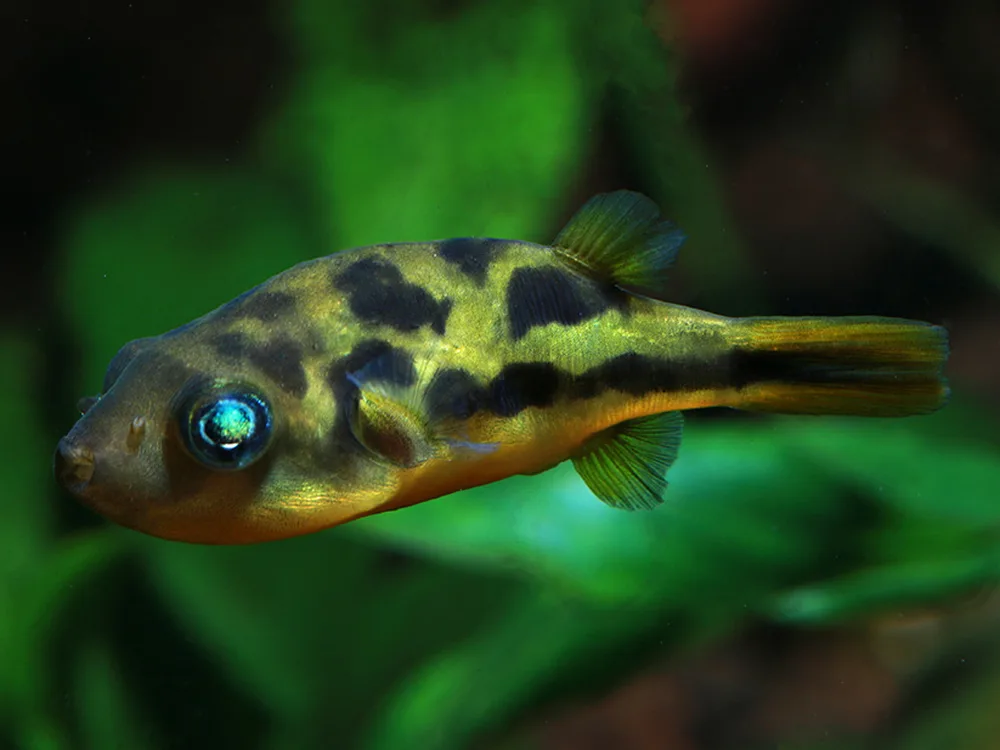
Beta Mahatvaraj · CC BY-SA 4.0 · Wikimedia Commons (cropped)
Pea Puffer
Carinotetraodon travancoricus
World's smallest puffer, with a big attitudeIntermediate
- Lifespan
- 4-5 years
- Size
- 1-1.4 in2.5-3.5 cm
- Social needs
- Solo, or one male with two or more females; species-only tank
- Time
- 15-20 min daily; weekly water change; snail culture upkeep
- Cost
- Moderate
- Diet
- Micropredator (live/frozen foods and snails; refuses dry food)
Overview
What is this animal?
- The pea puffer is the smallest pufferfish in the world, a fully grown adult rarely exceeding 1.4 inches3.5 cm and often closer to 1 inch2.5 cm.
- It is endemic to the rivers and backwaters of Kerala and neighbouring Karnataka in southwest India, and unlike the figure-eight and green spotted puffers often sold beside it, it is a true freshwater species that never needs salt.
- Wild populations face heavy collection pressure for the aquarium trade, so seek out captive-bred stock rather than wild-caught imports.
Show 5 more
- What wins keepers over is the personality packed into that inch2.5 centimetres of fish.
- Pea puffers hover like tiny helicopters, swivel each eye independently, inspect everything in the tank, and quickly learn to beg at the glass when their keeper approaches.
- They are genuinely interactive in a way few nano fish are.
- They are rated Intermediate not because they are fragile, but because of their demands: a fully cycled tank, a live-and-frozen-only diet, a species-only setup, and careful management of their aggression.
- A keeper who wants an easy community centrepiece should look elsewhere; a keeper who wants a single-species project fish will be rewarded.
Temperament
- Do not let the size fool you: pea puffers are bold, territorial, and equipped with a beak.
- They are confirmed fin-nippers and will harass slow or long-finned tankmates, so the honest recommendation is a species-only tank rather than gambling on the community setups often suggested online.
Show 5 more
- Even commonly proposed companions like otocinclus are a risk, not a guarantee.
- Within their own kind, males fight each other and persistently chase females, which is why the safe structures are a single fish or a one-male harem in heavy cover.
- Aggression that seems to appear from nowhere at around six months is usually a second male maturing.
- Toward their keeper they are curious and fearless, watching activity in the room and swimming to the glass at feeding time.
- Many owners describe them as the closest a fish gets to a puppy, which is exactly why a dedicated 15-gallon57-litre planted tank for one tiny fish feels like a fair trade.
A good fit for
- Keepers wanting a single-species project tank
- People charmed by an interactive, intelligent fish
- Planted-tank enthusiasts with dense aquascapes
- Anyone happy to culture snails and feed frozen food
- Freshwater keepers wanting a puffer without brackish water
Common mistakes to avoid
- Adding them to a community tank, where they nip fins
- Keeping two males together without heavy planting and space
- Expecting them to accept flake or pellet food
- Buying wild-caught stock carrying internal parasites
- Undersized tanks fouling fast on a meaty diet
- Confusing them with brackish figure-eight or green spotted puffers
Enclosure
Minimum 14 gallons54 litres
Fine alone or with company. Solo, or one male with two or more females; species-only tank
- Provide at least 14 US gallons (54 litres (a standard 15-gallon57-litre tank qualifies) for a single pea puffer, adding roughly 5 gallons19 litres for each additional fish.
- Despite the tiny adult size, small tanks concentrate both their waste-heavy carnivore diet and their aggression, and cramped, undersized setups are the single most common way this species is failed.
- Keep the water at 75-80°F24-27°C, neutral to slightly alkaline (about pH 7.0-8.0, soft to moderately hard), with a gentle, fully cycled filter, ammonia and nitrite at zero, and nitrate under 20ppm.
Show 5 more
- Dense planting is not decoration for this species, it is a welfare requirement.
- Thickets of stem plants, Java moss, and hardscape break lines of sight so that females can escape a male's attention and rivals can hold separate territories.
- In a bare tank the same group that thrives in a jungle will nip each other ragged.
- Stock either a single puffer or one male with two or more females, never two males in an ordinary home tank.
- Males develop a dark keel stripe down the belly and iridescent wrinkle lines behind the eyes, while females stay rounder and spottier, though juveniles are difficult to sex when purchased.
Supplies
Setup
- Tank and stand
- Filter
- Heater and thermometer
- Substrate, plants and decor
- Liquid test kit
- Dechlorinator and starter supplies
Ongoing
- Frozen bloodworm blister packs
- Frozen brine shrimp and daphnia
- Live or frozen blackworms
- Live bladder or ramshorn snails (or a starter culture)
- A jar or small tank to culture snails
Show 3 more
- Pipette or turkey baster for target-feeding
- Small thawing cup
- Fine net for removing leftovers
Safe substrate: Fine, smooth sand · Smooth, rounded fine gravel (not for loaches or sand-sifting cichlids; sand is better for corydoras) · Bare bottom (quarantine and grow-out only)
Care routine
Daily
- Check temperature and equipment
- Feed meaty food; offer small snails
- Head-count and look everyone over
Every few days
- Top up evaporationevery 3 days
Show 8 more
Weekly
- Check belly and waste
- Partial water change
- Test the water
- Wipe the front glass only
Every few weeks
- Trim and thin the plantsevery 2 weeks
Monthly
- Check supplies and reagent dates
- Replace or recharge chemical media, if you use any (skip it in a blackwater tank)
- Rinse the filter media
Health review: Quarterly parasite and beak review, every 3 months
Tools
Care in depth
Diet
Micropredator (live/frozen foods and snails; refuses dry food)
- Pea puffers are micropredators and almost universally refuse flake and pellet food.
- The staple diet is frozen or live bloodworms, brine shrimp, daphnia, and blackworms, thawed and offered once or twice daily in amounts cleared within a few minutes.
- A new keeper must accept before purchase that this fish will need frozen food in the freezer for its whole life.
- Small live snails such as bladder and ramshorn snails are an excellent regular food that triggers natural hunting behaviour, and many keepers run a separate snail-breeding jar or tank as a live-food culture.
- Unlike large puffer species, the pea puffer's small beak rarely overgrows enough to need trimming, but like all puffers its teeth grow continuously, so offering hard-shelled snails regularly helps keep them worn down as well as providing food and enrichment.
- They are enthusiastic beggars and easily overfed, which fouls the water in a small tank and leads to bloated, lethargic fish.
- Feed deliberately, remove uneaten frozen food, and let their round-but-not-swollen belly profile guide portions.
Health
Signs of good health, and the common problems
- The biggest health issue enters the tank with the fish: wild-caught pea puffers very commonly carry internal parasites and arrive thin.
- Buy captive-bred where possible, quarantine every new arrival, and watch for a fish that eats greedily yet stays hollow-bellied or produces white stringy faeces, which usually indicates worms needing a targeted dewormer.
- Like all puffers they are scaleless and have only reduced gill covers, which makes them unusually sensitive to ammonia, nitrite, medications, and salt.
- Never add them to an uncycled tank, dose treatments cautiously at reduced strength when required, and keep up weekly partial water changes because their meaty diet pollutes water faster than an equivalent community fish.
- A healthy pea puffer is constantly patrolling with bright eyes and a smoothly rounded body.
- Clamped fins, a pinched belly, darkened colour, or hanging listlessly in one spot are early warning signs, most often traceable to water quality or parasites rather than mystery disease.
Is this urgent?
6 warning signs and how fast to act, 3 of them right away
In a fish tank the patient is usually the water. Test before you treat: dosing a healthy tank for a disease it does not have makes things worse.
Go now
Today
Soon
Never add a new fish to a tank that is not fully cycled, and never treat blind. A test kit is cheaper than the fish.
This is general guidance for a healthy adult, not a diagnosis. An exotics vet who knows your animal always overrides it, and the time to find one is before you need one.
Bedding and substrate
3 safe, 4 with a caveat, 2 to avoid
Substrate in an aquarium is a filter as much as a floor. Most of the biology lives in and on it.
Safe
With a caveat
Never
This is our general list for freshwater fish. We have not built one specific to Pufferfish yet.
Top resources for more info
Independent creators and organisations we would send a friend to. We have no affiliation with any of them, and nothing here is sponsored. Links checked 2026-10-22.
YouTubers
Sites
Other Freshwater Fish worth knowing
Same axes, same care guides: the honest way to compare them.