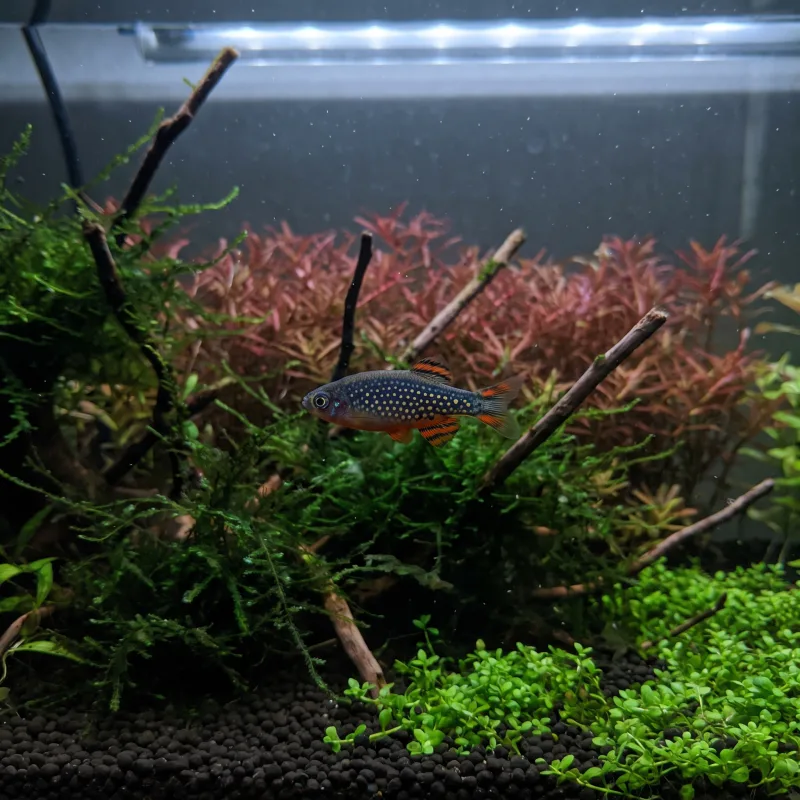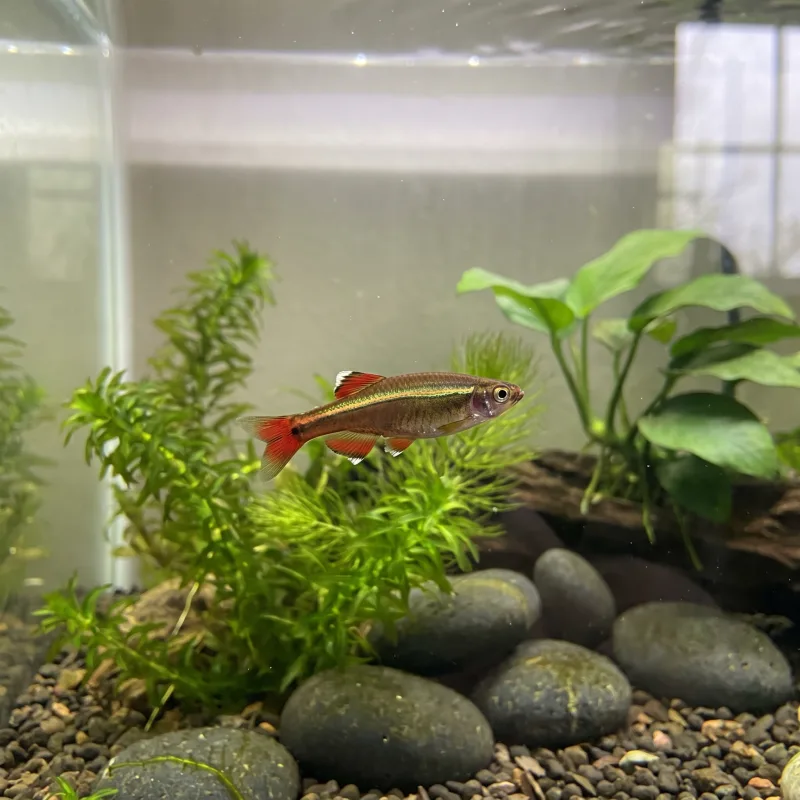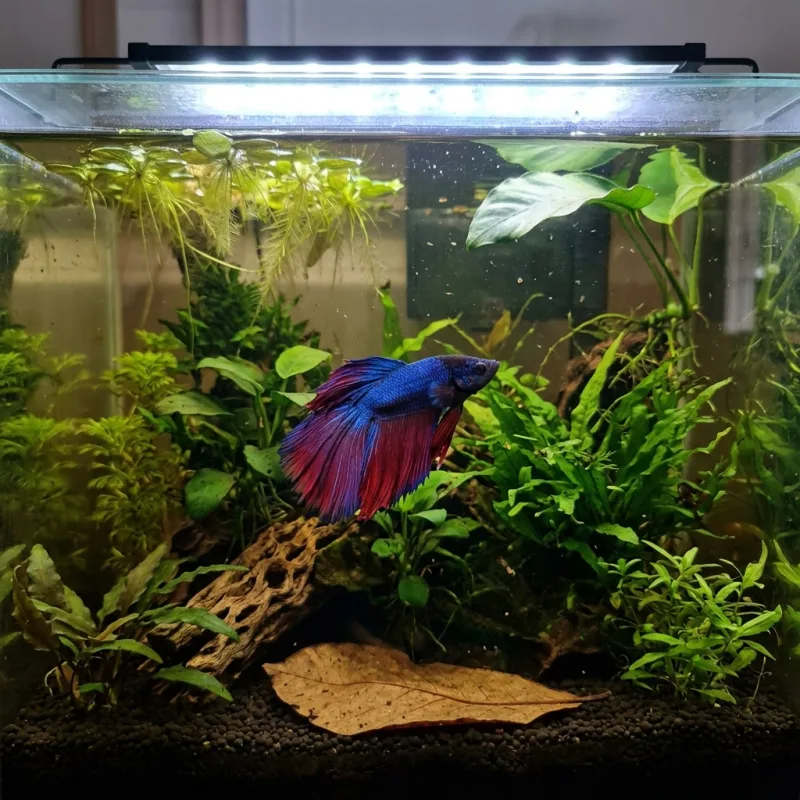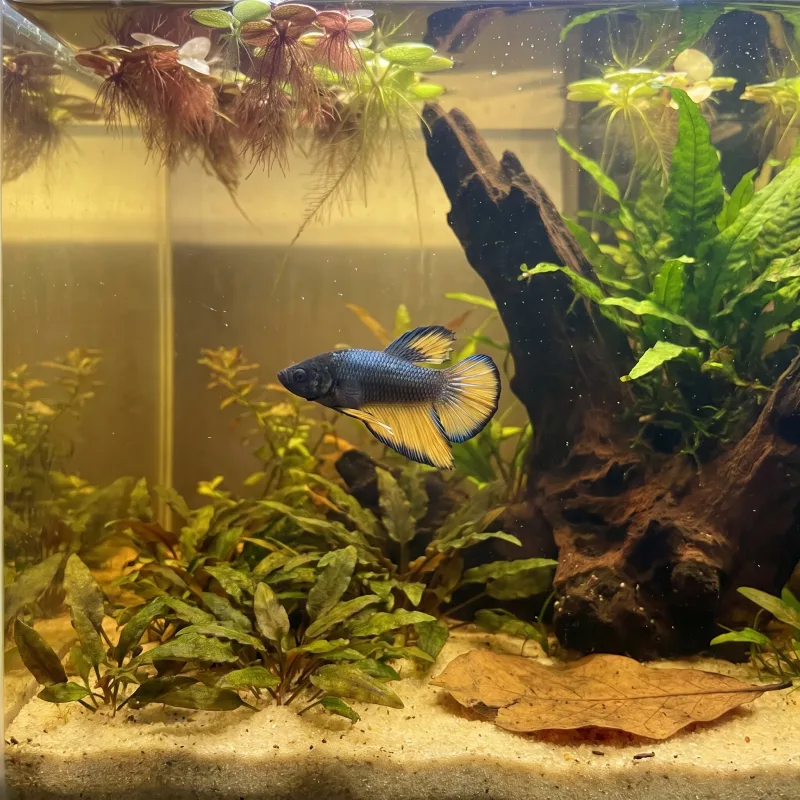
Zebra Danio
Danio rerio
Tireless striped swimmer for cooler tanksBeginner
- Lifespan
- 3-5 years
- Size
- 1.5-2 in4-5 cm
- Social needs
- Shoaler; keep 10+ together
- Time
- Low; daily feeding, weekly water change
- Cost
- Low
- Diet
- Omnivore; flakes, micro pellets, frozen foods
Overview
What is this animal?
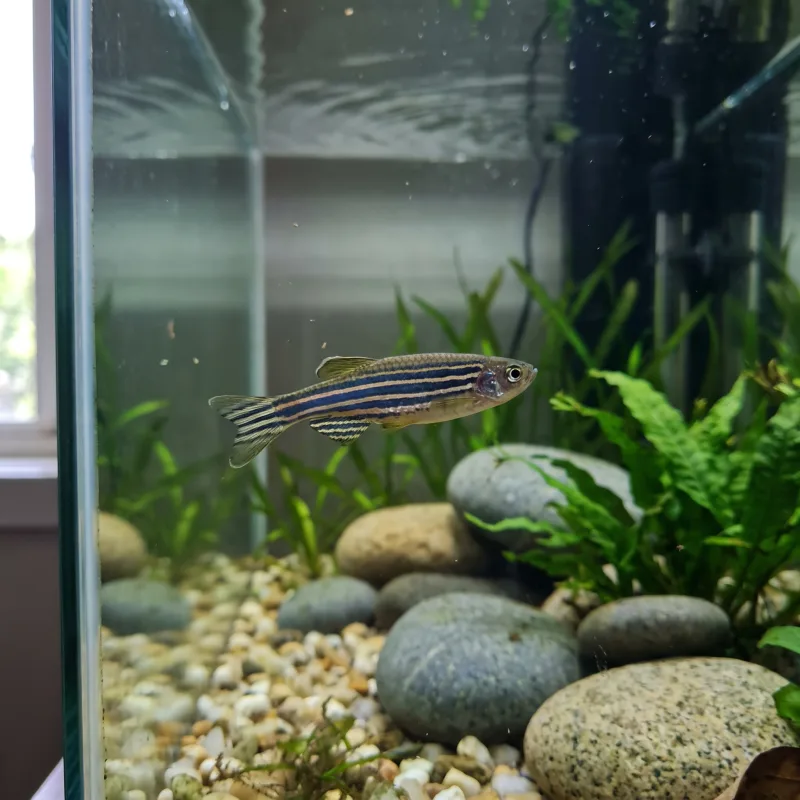
- The zebra danio is a small, fast minnow from the streams and floodplains of South Asia, marked with horizontal blue-gold stripes.
- Widely used as a laboratory model organism, it is one of the hardiest and most adaptable aquarium fish available.
- It is an excellent beginner species, tolerant of a wide temperature range including cooler rooms.
- Avoid dyed or hybrid colour variants where possible, and never keep it in a tiny tank, as its constant activity demands swimming space.
Temperament
- Active, peaceful and confident, zebra danios shoal loosely and dash around the upper levels of the tank.
- Their speed and constant motion can unsettle very timid or slow species in a community.
Show 2 more
- They can nip long, flowing fins when understocked, so keep ten or more to channel that energy within the group.
- Pair them with similarly active, sturdy fish rather than delicate or long-finned tankmates such as bettas or fancy guppies.
A good fit for
- Beginners wanting a tough, lively first fish
- Unheated, room-temperature aquariums
- Active community tanks with sturdy species
- Keepers who enjoy constant movement
Common mistakes to avoid
- Cramped tanks restricting their fast swimming
- Keeping them too warm, shortening lifespan
- Fin-nipping when kept in too-small groups
- Open tanks they readily jump out of
Enclosure
Minimum 21 gallons79 litres, for a group of 10
Cannot be kept alone. The minimum is 10, and the space above is for that group.
- Keep a shoal of at least ten in a tank at least 36 in90 cm long holding 21 US gallons81 litres or more, well filtered.
- Seriously Fish gives that length even for a small group, and the smallest standard US tank that long is a 30-gallon115-litre (36 x 12 x 16 in90 x 30 x 41 cm).
- They thrive at 64-75°F18-24°C and do not strictly need a heater in a stable, room-temperature home, which suits unheated setups in temperate climates.
Show 2 more
- These are powerful, restless swimmers that need length rather than height for laps along the tank.
- They tolerate a wide range of water chemistry and appreciate some current and a secure lid, as they are accomplished jumpers.
Supplies
Setup
- Tank and stand
- Filter
- Thermometer, plus a heater only if the room runs below the species' range
- Substrate, plants and decor
- Liquid test kit
- Dechlorinator and starter supplies
Ongoing
- Quality tropical flake or micro-pellet
- Frozen daphnia
- Frozen brine shrimp
- Frozen or freeze-dried bloodworm (chopped fine; whole bloodworm is too large for celestial pearl danios)
- Frozen cyclops or baby brine shrimp (for celestial pearl danios)
Show 3 more
- Spirulina or vegetable flake
- Small feeding spoon for measured pinches
- Fine net for removing leftovers
Safe substrate: Fine, smooth sand · Smooth, rounded fine gravel (not for loaches or sand-sifting cichlids; sand is better for corydoras) · Bare bottom (quarantine and grow-out only)
Care routine
Daily
- Check temperature and equipment
- Feed
- Head-count and look everyone over
Every few days
- Top up evaporationevery 3 days
Show 8 more
Weekly
- Check the lid
- Test the water
- Water change and gravel vacuum
- Wipe the front glass only
Every few weeks
- Trim and thin the plantsevery 2 weeks
Monthly
- Check supplies and reagent dates
- Replace or recharge chemical media, if you use any (skip it in a blackwater tank)
- Rinse the filter media
Health review: Quarterly temperature and stocking review, every 3 months
Tools
Care in depth
Diet
Omnivore; flakes, micro pellets, frozen foods
- Zebra danios are opportunistic omnivores that feed at the surface and in midwater.
- A quality flake or micro-pellet works as the staple, supplemented with frozen or live daphnia, brine shrimp and bloodworm for variety.
- Feed small amounts once or twice daily, only what is taken in a minute or two.
- Their fast metabolism and constant activity mean they rarely refuse food, so portion carefully to avoid overfeeding and fouling the water.
Health
Signs of good health, and the common problems
- Danios are robust and disease-resistant, with most ailments arising from overcrowding, poor water quality or excessive heat rather than the fish themselves.
- Ich and fin rot are the usual concerns: mild fin rot usually clears once water quality is corrected, but ich (white spot) is a parasite that needs prompt treatment as soon as the spots appear.
- Keeping them too warm for long periods can shorten their lifespan, so avoid over-heating the tank.
- Quarantine new arrivals, maintain weekly partial water changes, and fit a tight lid, since stress can prompt jumping.
Is this urgent?
6 warning signs and how fast to act, 3 of them right away
In a fish tank the patient is usually the water. Test before you treat: dosing a healthy tank for a disease it does not have makes things worse.
Go now
Today
Soon
Never add a new fish to a tank that is not fully cycled, and never treat blind. A test kit is cheaper than the fish.
This is general guidance for a healthy adult, not a diagnosis. An exotics vet who knows your animal always overrides it, and the time to find one is before you need one.
Bedding and substrate
3 safe, 4 with a caveat, 2 to avoid
Substrate in an aquarium is a filter as much as a floor. Most of the biology lives in and on it.
Safe
With a caveat
Never
This is our general list for freshwater fish. We have not built one specific to Danios & Minnows yet.
Top resources for more info
Independent creators and organisations we would send a friend to. We have no affiliation with any of them, and nothing here is sponsored. Links checked 2026-10-22.
YouTubers
Sites
Danios & Minnows, side by side
Same axes, same care guides: the honest way to choose between types.