Bolivian Ram
Mikrogeophagus altispinosus
The forgiving ram for calm community tanksBeginner
- Lifespan
- 4-6 years, sometimes longer
- Size
- 3 in7-8 cm; males larger than females
- Social needs
- Bonded pair or mixed-sex group of 6+; community-safe
- Time
- 10-15 min daily; weekly water change
- Cost
- Medium
- Diet
- Omnivore / substrate-sifter (sinking micro-pellets, frozen foods)
Overview
What is this animal?
- The Bolivian ram is the hardy cousin of the German blue ram, hailing from the cooler Mamore and Guapore river systems of Bolivia and western Brazil rather than the hot Orinoco.
- It is the dwarf cichlid most often recommended as a first cichlid, because it accepts ordinary tropical temperatures and moderate water chemistry.
- It still needs a mature tank with very clean water and calm tankmates, because it competes poorly at feeding time.
Show 4 more
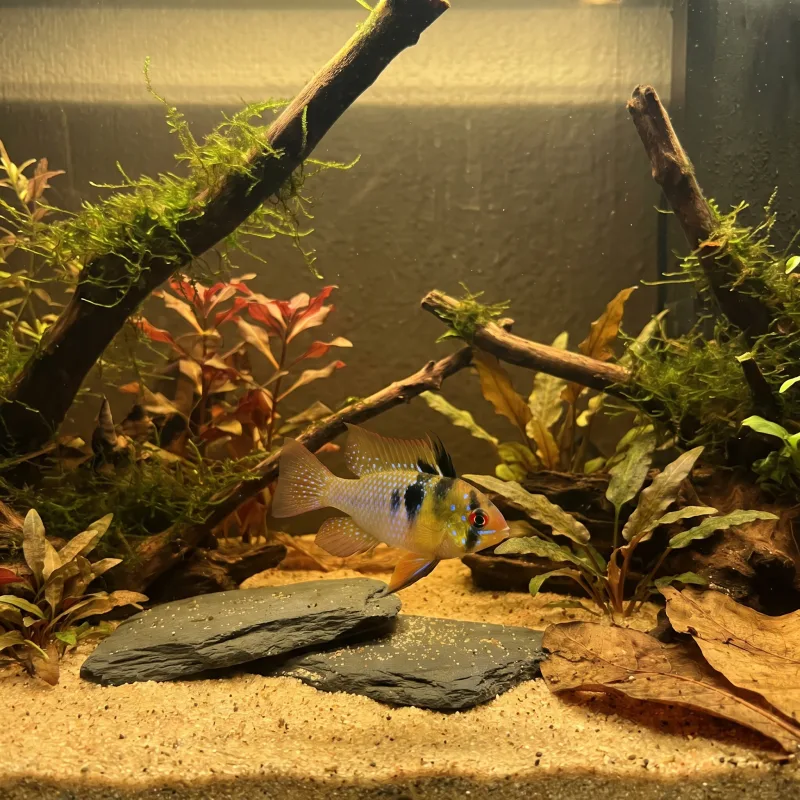
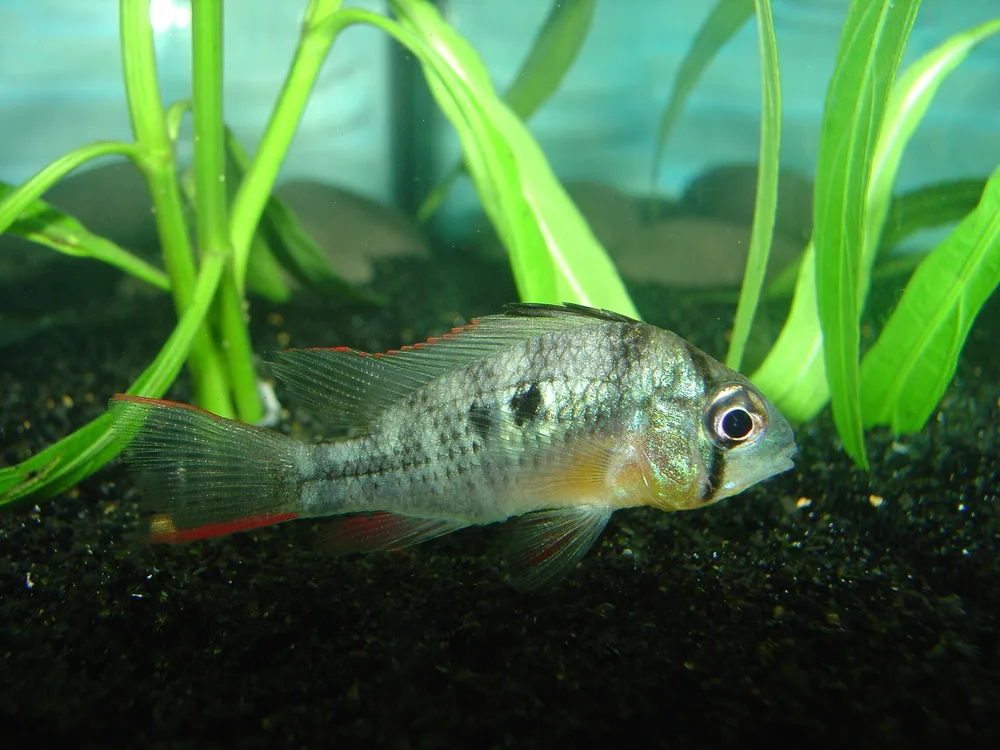
- Its colours are subtler than the blue ram's: an olive-gold body with a black eye bar, a dark flank blotch, red-edged fins and the tall front dorsal spines that give it the name altispinosus.
- What it lacks in neon it repays in personality, with a distinctive stop-and-go hopping swim and a lifespan of four to six years, roughly double what most German blue rams manage.
- It grows noticeably larger than the blue ram, reaching a standard length of about 3 in7-8 cm, with males the larger, more intensely coloured and slightly longer-finned sex.
- Treat it as a genuine long-term community centrepiece rather than a disposable splash of colour.
Temperament
- Bolivian rams are peaceful and community-safe, mixing well with small tetras, rasboras and corydoras, and they show only mild territoriality around a spawning site.
- They are not fin-nippers and are more likely to be bullied than to bully.
Show 5 more
- Juveniles are very difficult to sex, so buy a group of six young fish and let a pair form naturally rather than trusting a shop-picked 'pair'.
- Once a pair bonds, be ready to give the extras more space or rehome them if squabbling starts in a smaller tank.
- A bonded pair are biparental substrate spawners that clean a flat stone, guard the eggs together and shepherd their cloud of fry around the tank: one of the best brood-care displays available to a beginner.
- Avoid stocking them alongside other bottom-territorial cichlids in tanks under about 53 gallons200 litres.
- Seriously Fish also accepts a single Bolivian ram in a calm community tank; this guide asks for a bonded pair.
A good fit for
- First-time cichlid keepers with a cycled, mature tank
- Calm community tanks at 75-79°F24-26°C
- Aquarists who found German blue rams too fragile
- Watching genuine pair-bonding and biparental brood care
- Sand-bottomed planted aquariums
Common mistakes to avoid
- Adding to a new, uncycled aquarium
- Gravel-only tanks with no sand to sift
- Undersizing a pair (under 48 gal180 L on a 35 x 18 in90 x 45 cm base) or a group (under 47 in120 cm long)
- Fast, greedy tankmates outcompeting them at feeding time
- Buying a shop-guessed 'pair' instead of a juvenile group
- Confusing its needs with the much warmer German blue ram
Enclosure
Minimum 48 gallons180 litres, for the pair · 35 x 18 in90 x 45 cm
Cannot be kept alone. The minimum is 2, and the space above is for that group.
- A pair needs a tank with a base of at least 36 x 18 in90 x 45 cm, about 48 US gallons180 litres, the size Seriously Fish recommends for one fish or a bonded pair; a 50-gallon190-litre tank of that base qualifies, while a 40-gallon breeder150-litre breeder has the base but not the volume.
- A long, wide footprint beats a tall one because floor area matters far more to this bottom-cruising fish than height, and the old advice of a 20-gallon long76-litre long tank is far too small for a cichlid that reaches 3 in8 cm and patrols the substrate all day.
- A mixed-sex group of six or more wants a tank at least 47 in120 cm long and roughly 53 US gallons (200 litres (a standard 55-gallon210-litre tank qualifies) so subordinate fish can escape a courting pair.
Show 4 more
- Keep the water at 75-79°F24-26°C with a pH of 6.0-7.5 and soft to moderately hard water (up to about 180 ppm / 10 dGH): normal tropical community conditions, and the single biggest difference from the German blue ram, which wants roughly 82-86°F28-30°C to thrive.
- Fine sand substrate is essential, not optional, because these are benthophagic earth-eaters that feed by sifting mouthfuls of sand and spitting it back out.
- Furnish with driftwood, plants and a few flat stones or a slate as potential spawning sites, and break up sightlines so a pair can hold a modest territory without stress.
- The tank must be fully cycled and mature with low nitrate; adding rams to a freshly set-up aquarium is the classic beginner mistake.
Supplies
Setup
- Tank and stand
- Filter
- Heater and thermometer
- Substrate, plants and decor
- Liquid test kit
- Dechlorinator and starter supplies
Ongoing
- Quality cichlid pellet sized to your species
- Tropical flake as a secondary staple
- Frozen bloodworm, brine shrimp and daphnia
- Spirulina or vegetable flake
- Live blackworms for conditioning (optional)
Show 3 more
- Small thawing cup
- Turkey baster for target-feeding shy fish
- Fine net for removing leftovers
Safe substrate: Fine, smooth sand · Smooth, rounded fine gravel (not for loaches or sand-sifting cichlids; sand is better for corydoras) · Bare bottom (quarantine and grow-out only)
Care routine
Daily
- Check temperature and equipment
- Feed
- Head-count and look everyone over
Every few days
- Top up evaporationevery 3 days
Show 8 more
Weekly
- Check territories and pairing
- Partial water change, 25-30% weekly (discus: several changes a week)
- Test the water
- Wipe the front glass only
Every few weeks
- Trim and thin the plantsevery 2 weeks
Monthly
- Check supplies and reagent dates
- Replace or recharge chemical media, if you use any (skip it in a blackwater tank)
- Rinse the filter media
Health review: Quarterly water and territory review, every 3 months
Tools
Care in depth
Diet
Omnivore / substrate-sifter (sinking micro-pellets, frozen foods)
- Bolivian rams are omnivores that feed by taking in mouthfuls of sand and blowing the substrate back out through the mouth and gills, keeping the edible bits.
- Offer quality sinking micro-pellets as the staple, alongside frozen or live bloodworm, brine shrimp and daphnia for colour and conditioning.
- They are slow, deliberate feeders and are easily beaten to food by fast tankmates like danios or barbs.
- Drop food near their patch of the tank and watch that they actually eat, rather than assuming flakes at the surface will reach them.
- Feed small amounts once or twice daily and let them graze the substrate between meals.
- Floating-only foods are a poor match for a fish built to feed off the bottom.
Health
Signs of good health, and the common problems
- This is a genuinely robust dwarf cichlid, largely free of the hormone-dosed farm fragility that plagues German blue rams, and most stock is tank-bred.
- Kept properly, sudden unexplained deaths are rare rather than expected.
- The common failure modes are slow ones: nitrate creeping upward between skipped water changes, an immature tank, or temperatures allowed to drift below about 72°F22°C, which invites ich.
- Watch for clamped fins, faded body colour, hiding, and a hollow belly or white stringy faeces suggesting internal parasites.
- Weekly water changes of 25-30 percent and a stable heater are most of the health plan.
- Quarantine new arrivals for a few weeks before adding them to the display tank.
Is this urgent?
6 warning signs and how fast to act, 3 of them right away
In a fish tank the patient is usually the water. Test before you treat: dosing a healthy tank for a disease it does not have makes things worse.
Go now
Today
Soon
Never add a new fish to a tank that is not fully cycled, and never treat blind. A test kit is cheaper than the fish.
This is general guidance for a healthy adult, not a diagnosis. An exotics vet who knows your animal always overrides it, and the time to find one is before you need one.
Bedding and substrate
3 safe, 4 with a caveat, 2 to avoid
Substrate in an aquarium is a filter as much as a floor. Most of the biology lives in and on it.
Safe
With a caveat
Never
This is our general list for freshwater fish. We have not built one specific to Cichlids yet.
Top resources for more info
Independent creators and organisations we would send a friend to. We have no affiliation with any of them, and nothing here is sponsored. Links checked 2026-10-22.
YouTubers
Sites
Cichlids, side by side
Same axes, same care guides: the honest way to choose between types.