Electric Blue Acara
Andinoacara pulcher
The mild-mannered cichlid in electric blueBeginner
- Lifespan
- 8-10 years
- Size
- 5-6 in12-15 cm
- Social needs
- Singly or as a bonded pair; community-safe with medium fish
- Time
- Moderate
- Cost
- Medium
- Diet
- Omnivore (cichlid pellets, frozen and live foods)
Overview
What is this animal?
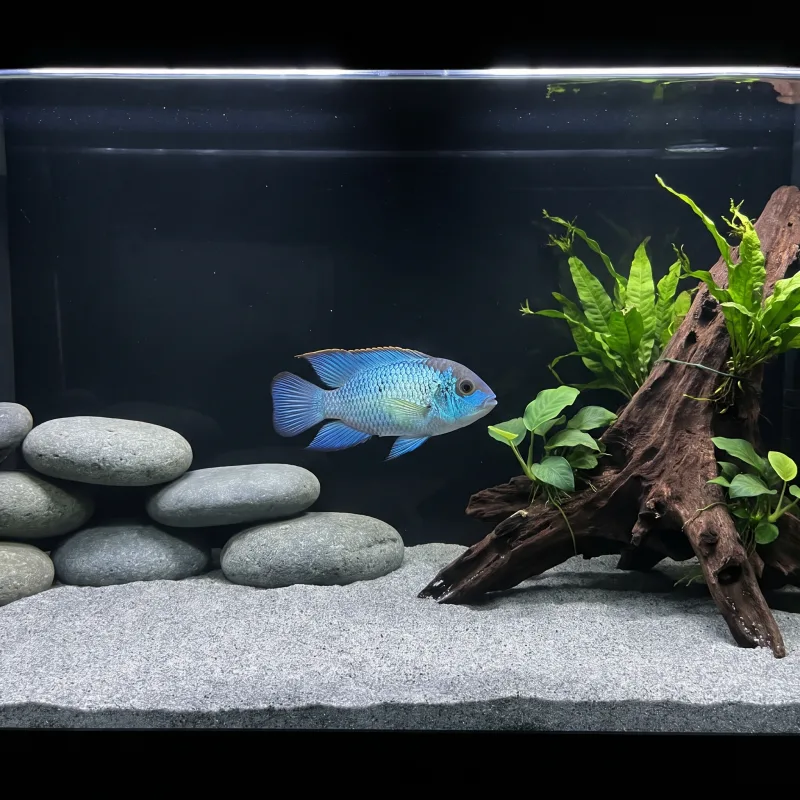
- The electric blue acara is a captive-bred colour form of the blue acara, a sturdy cichlid whose wild ancestors come from Trinidad and coastal Venezuela.
- Its defining trait is an all-over iridescent powder-blue shimmer that the wild-type fish only hints at, usually paired with a dusky forehead and a yellow-orange edge along the dorsal fin.
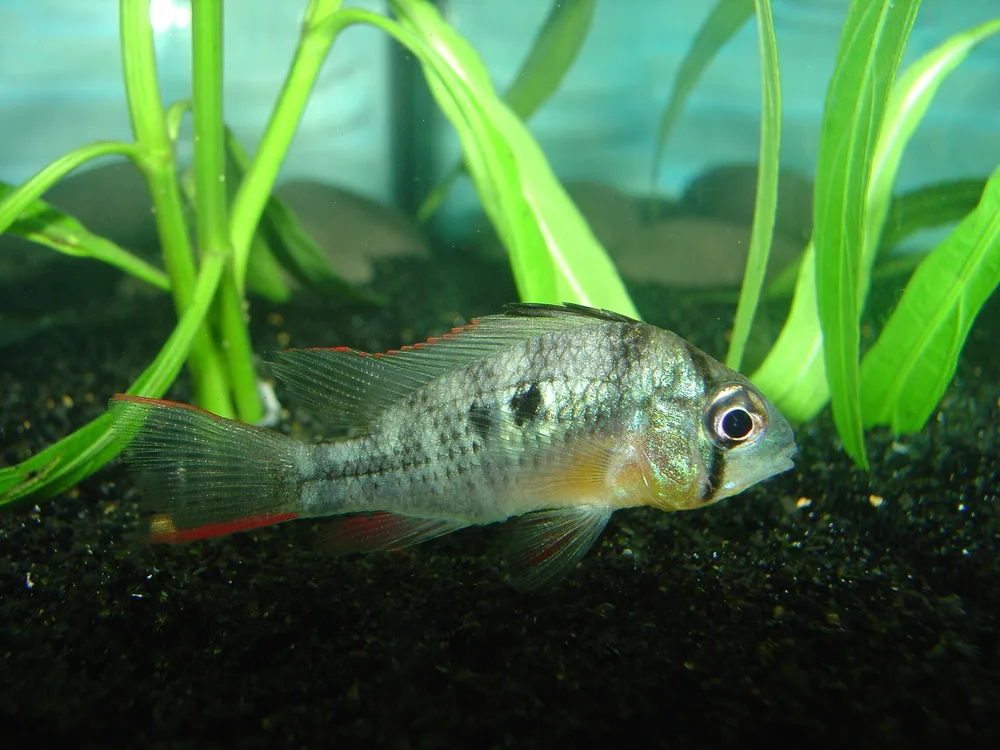
- The morph exists only in the aquarium trade, and its exact ancestry is debated but has never been proven, with many breeders believing ram genes were crossed in early on.
Show 3 more
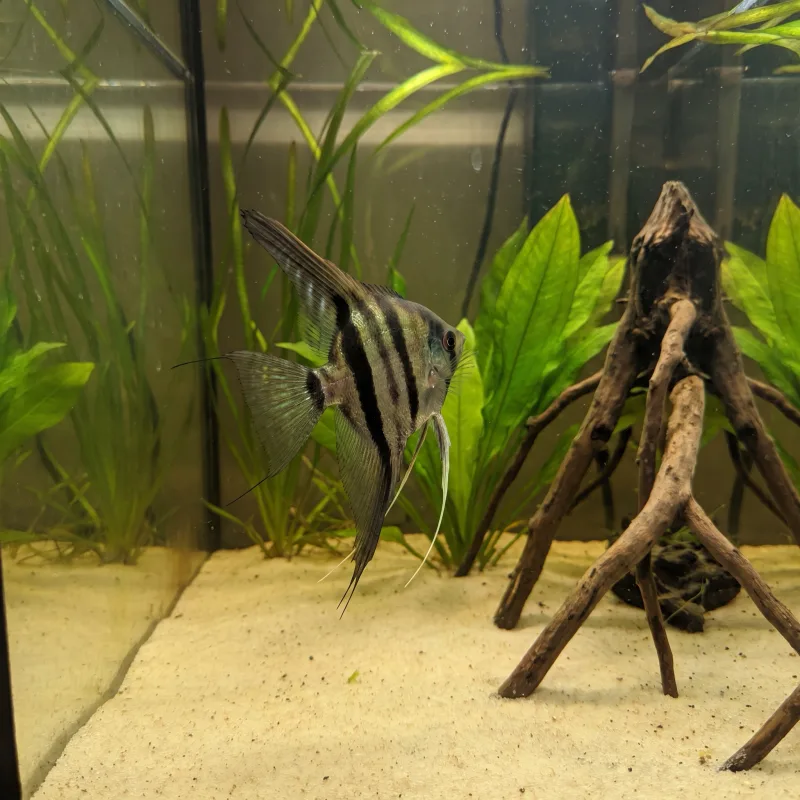
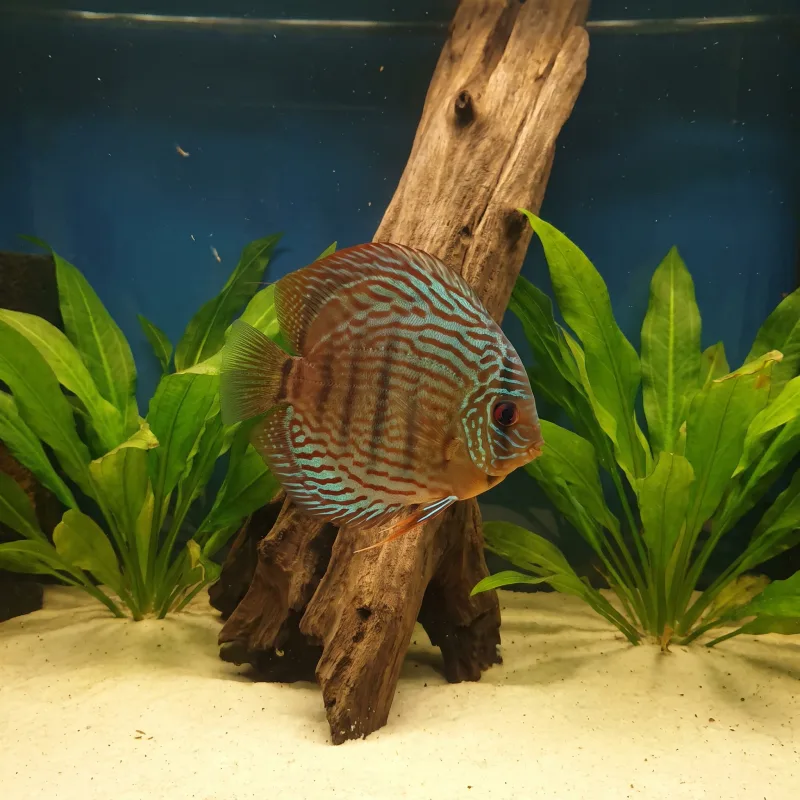
- At 4.5-6 in12-15 cm it towers over this guide's dwarf cichlids and roughly matches a discus in body length, yet it is comfortably the easiest cichlid here.
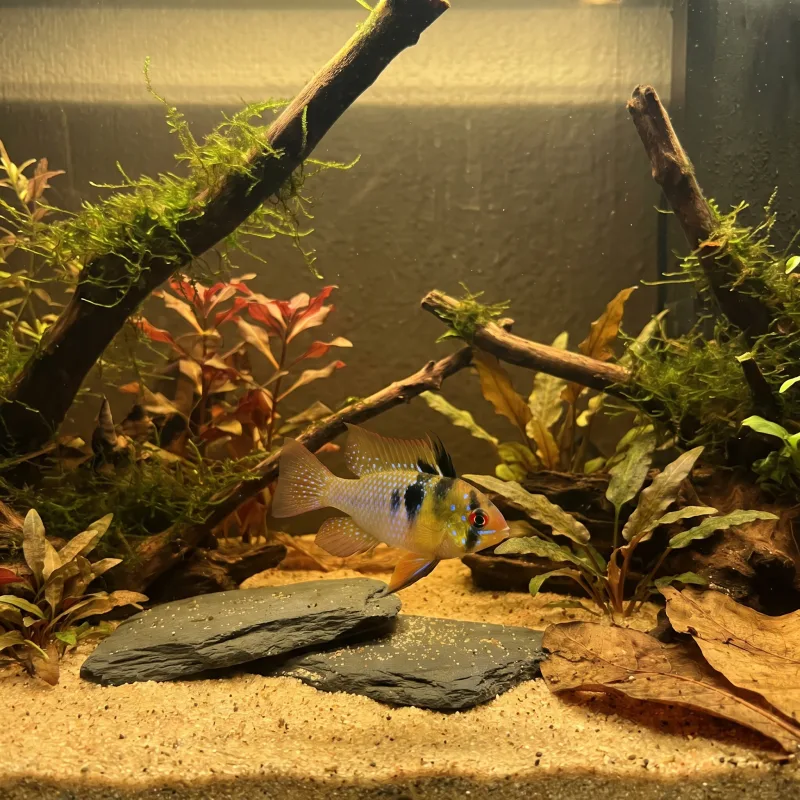
- It tolerates the ordinary temperatures and moderately hard tap water that would slowly kill a German blue ram, and it lacks the spawning-season temper of an angelfish.
- Expect 8-10 years from a well-kept fish, so treat it as a long-term commitment rather than an impulse buy.
Temperament
- This is the gentle exception among mid-sized cichlids, and that is exactly why it earns a beginner rating where the angelfish does not.
- An electric blue acara mostly ignores anything it cannot swallow, and even a pair guarding eggs only firmly pushes other fish away from its corner rather than hunting them down.
Show 4 more
- It spends its day cruising and bulldozing sand rather than picking fights.
- Peaceful does not mean harmless, and the mouth is the measure.
- Neon-sized tetras and dwarf shrimp will eventually be eaten, so choose tankmates like black skirt tetras, larger rasboras, bronze corydoras, bristlenose plecos and medium rainbowfish.
- Keep one fish, or a proven pair, rather than several loose adults, because two unpaired acaras in a 55-gallon210-litre tank may bicker over the same patch of floor.
A good fit for
- First-time cichlid keepers with a 4 ft120 cm tank
- Community tanks built around medium-sized fish
- Keepers who found rams or discus too fragile
- Aquarists wanting easy pair-and-spawn behaviour
- Anyone wanting cichlid personality without the temper
Common mistakes to avoid
- Tanks under 53 gallons200 L
- Housing with neon-sized fish or dwarf shrimp
- Cheap line-bred stock with bent spines or short gill plates
- Hole-in-the-head from old water and monotonous food
- Rooted plants constantly dug up
- Two unpaired adults feuding over territory
Enclosure
Minimum 53 gallons200 litres
Fine alone or with company. Singly or as a bonded pair; community-safe with medium fish
- Easy care does not mean a small tank, and this is where new keepers most often get it wrong.
- Provide at least 53 US gallons (200 L (a standard 55-gallon210-litre tank qualifies) with a 4 ft120 cm footprint for one fish or a pair, because acaras are active swimmers that patrol the whole bottom half of the aquarium.
- Keep water at 72-81°F22-27°C with pH 6.5-8.0 and hardness anywhere up to about 18 dGH, and note that unlike rams or discus they genuinely do not need soft, acidic or very warm water.
Show 5 more
- Use a sand substrate, because acaras dig constantly, taking mouthfuls and re-landscaping the floor, and coarse gravel can scrape their mouths.
- Anchor plants to wood and rock or keep them potted, since rooted stems will be dug up sooner or later.
- Add driftwood, a cave or two, and a few flat stones that a pair can adopt as spawning sites.
- Filter generously, as a meaty-fed 6 in15 cm cichlid produces far more waste than a shoal of tetras.
- The tank must be fully cycled before the fish arrives, with ammonia and nitrite at zero, and a 25-30% water change every week keeps nitrate down.
Supplies
Setup
- Tank and stand
- Filter
- Heater and thermometer
- Substrate, plants and decor
- Liquid test kit
- Dechlorinator and starter supplies
Ongoing
- Quality cichlid pellet sized to your species
- Tropical flake as a secondary staple
- Frozen bloodworm, brine shrimp and daphnia
- Spirulina or vegetable flake
- Live blackworms for conditioning (optional)
Show 3 more
- Small thawing cup
- Turkey baster for target-feeding shy fish
- Fine net for removing leftovers
Safe substrate: Fine, smooth sand · Smooth, rounded fine gravel (not for loaches or sand-sifting cichlids; sand is better for corydoras) · Bare bottom (quarantine and grow-out only)
Care routine
Daily
- Check temperature and equipment
- Feed
- Head-count and look everyone over
Every few days
- Top up evaporationevery 3 days
Show 8 more
Weekly
- Check territories and pairing
- Partial water change, 25-30% weekly (discus: several changes a week)
- Test the water
- Wipe the front glass only
Every few weeks
- Trim and thin the plantsevery 2 weeks
Monthly
- Check supplies and reagent dates
- Replace or recharge chemical media, if you use any (skip it in a blackwater tank)
- Rinse the filter media
Health review: Quarterly water and territory review, every 3 months
Tools
Care in depth
Diet
Omnivore (cichlid pellets, frozen and live foods)
- Electric blue acaras are omnivores with a strong lean toward meaty foods.
- Build the diet around a quality sinking cichlid pellet, then rotate in frozen or live bloodworm, brine shrimp, krill and chopped earthworm two or three times a week.
- A little spirulina or blanched vegetable matter now and then rounds out the menu.
- Feed once or twice daily only what is eaten within a couple of minutes.
- They are enthusiastic, messy eaters that will beg convincingly, and overfeeding is the fastest route to fouled water in a cichlid tank.
- Varied, protein-rich feeding is also what keeps the electric blue shimmer bright rather than washed out.
Health
Signs of good health, and the common problems
- The underlying blue acara is one of the toughest cichlids in the hobby, but the electric blue line is heavily line-bred and quality varies sharply between sources.
- Cheap batches can show bent spines, short gill covers and generally weaker constitutions, so inspect fish before buying and favour a breeder or shop that can say where its stock comes from.
- The main acquired problems are ich after stress or chilling, and hole-in-the-head disease, which in this species is strongly tied to old, nitrate-rich water and a monotonous diet, with the Hexamita parasite often implicated.
- Watch for pitting around the face and lateral line, faded colour, clamped fins and refusal of food.
- Quarantine newcomers for three to four weeks before adding them to the display.
- With clean water, varied food and honest tank space, a good-quality fish should sail past its fifth birthday without ever seeing medication.
Is this urgent?
6 warning signs and how fast to act, 3 of them right away
In a fish tank the patient is usually the water. Test before you treat: dosing a healthy tank for a disease it does not have makes things worse.
Go now
Today
Soon
Never add a new fish to a tank that is not fully cycled, and never treat blind. A test kit is cheaper than the fish.
This is general guidance for a healthy adult, not a diagnosis. An exotics vet who knows your animal always overrides it, and the time to find one is before you need one.
Bedding and substrate
3 safe, 4 with a caveat, 2 to avoid
Substrate in an aquarium is a filter as much as a floor. Most of the biology lives in and on it.
Safe
With a caveat
Never
This is our general list for freshwater fish. We have not built one specific to Cichlids yet.
Top resources for more info
Independent creators and organisations we would send a friend to. We have no affiliation with any of them, and nothing here is sponsored. Links checked 2026-10-22.
YouTubers
Sites
Cichlids, side by side
Same axes, same care guides: the honest way to choose between types.