Firefish Goby
Nemateleotris magnifica
Slender dartfish with a flicking dorsal flagBeginner
- Lifespan
- 3-5 years
- Size
- 3 in7-8 cm
- Social needs
- Singly or bonded pair; nervous in groups
- Time
- Daily feeding; weekly testing/changes
- Cost
- High
- Diet
- Carnivore (mysis, brine, zooplankton, pellets)
Overview
What is this animal?
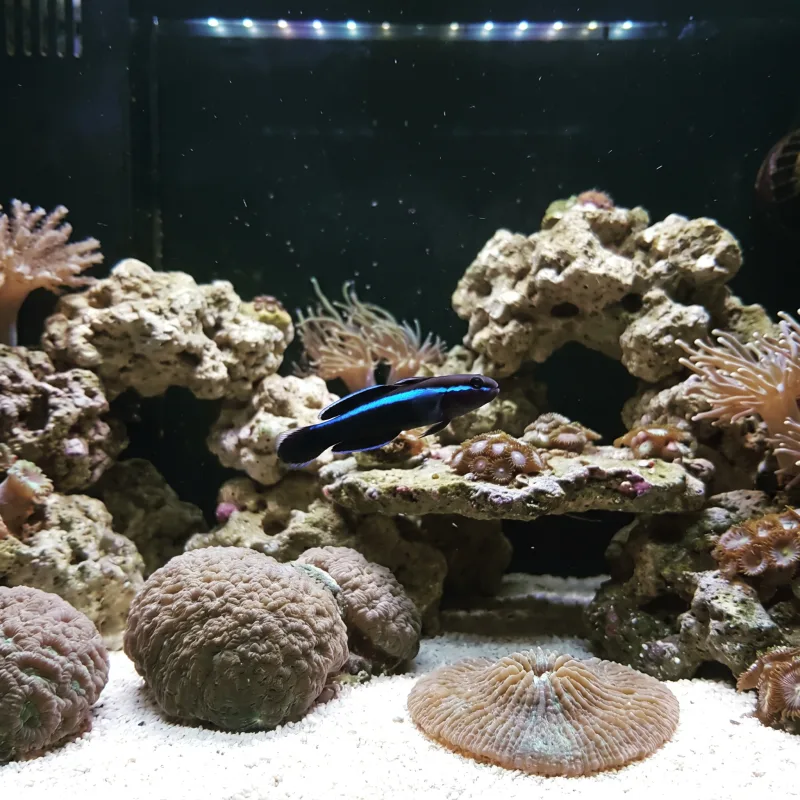
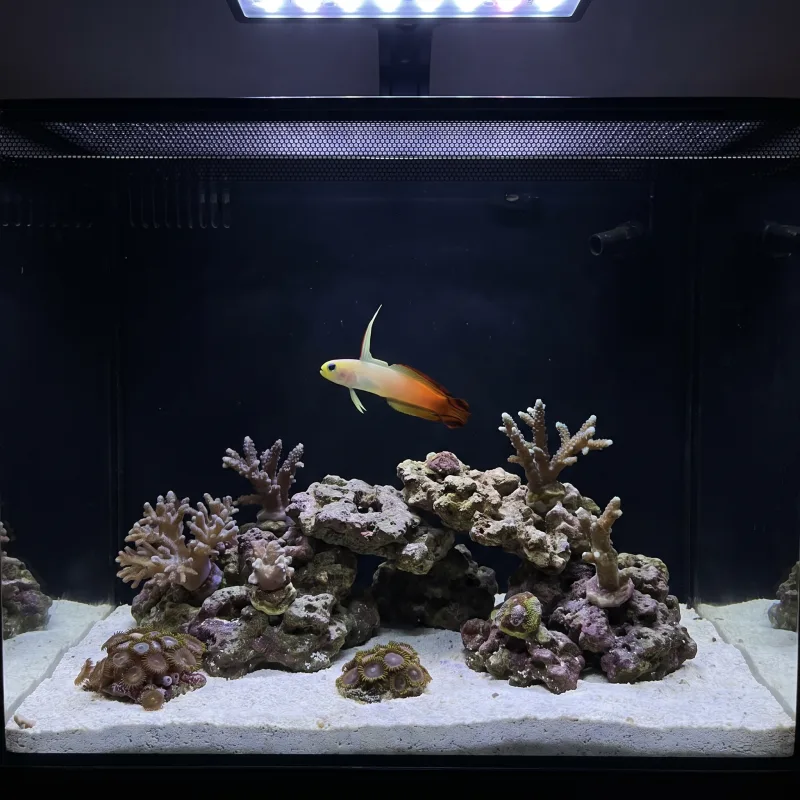
- The Firefish is a slender dartfish, pale at the front fading to fiery orange-red at the tail, with a tall first dorsal fin it flicks like a flag.
- Despite the common name it is a dartfish rather than a true goby.
- Peaceful, reef-safe, and hardy, it is a good beginner fish.
Show 2 more
- It is timid and easily startled, hovering above the rockwork and darting into a burrow at any threat.
- Given calm tankmates and secure hiding holes, it becomes a graceful, ever-present swimmer that adds movement to the mid-water zone.
Temperament
- Peaceful, shy, and reef-safe, the Firefish hovers above the rocks and dives for cover when startled.
- It poses no threat to corals or invertebrates and is easily intimidated by pushier fish.
Show 2 more
- Keep one per tank or a known bonded pair, as two unbonded individuals usually fight.
- It does best with equally gentle tankmates such as small gobies and cardinalfish, where it gains confidence and stays out in open water.
A good fit for
- Beginners wanting graceful movement
- Peaceful community reefs
- Reef-safe stocking plans
- Keepers with a securely covered tank
Common mistakes to avoid
- Any open gap in the lid - they jump out
- Housing with aggressive tankmates
- Keeping two unbonded individuals (fighting)
- No burrows leaves them stressed and hidden
Enclosure
Minimum 79 gallons300 litres
Fine alone or with company. Singly or bonded pair; nervous in groups
- A cycled tank of at least 80 gal300 L with rockwork providing several burrow-like crevices suits a single fish or a known bonded pair.
- Keep salinity 1.024-1.026, temperature 74-79°F23-26°C, pH 8.1-8.4, and nitrate low.
- A tight, gap-free lid is essential because Firefish are accomplished jumpers.
Show 2 more
- Provide multiple crevices so it always has a refuge within reach, which helps it feel secure and stay visible.
- House it only with peaceful tankmates, as boisterous fish keep a Firefish permanently hidden, stressed, and reluctant to feed.
Supplies
Setup
- Tank, stand and sump, about 80-90 US gallons300-340 litres
- Return pump and powerheads
- Protein skimmer
- Reef lighting
- Rock and sand
Show 2 more
- Salt mix, refractometer and test kits
- Quarantine tank
Ongoing
- Frozen mysis shrimp
- Frozen enriched brine shrimp
- Frozen cyclops
- Micro marine pellets
- Copepod bottle or refugium culture
Show 2 more
- Turkey baster or pipette for target-feeding
- Small thawing cup and fine strainer
Safe substrate: Aragonite sand · Dry or cured live rock
Care routine
Daily
- Check salinity, temperature and flow
- Check the lid and every gap
- Feed
- Head-count and look everyone over
- Top up evaporation with fresh water
Every few days
- Service the skimmer and filter socksevery 3 days
Show 7 more
Weekly
- Clean the glass
- Test the water
- Water change
Monthly
- Calibrate the refractometer
- Check salt, RO/DI and reagents
Less often
- Deep-clean pumps and powerheadsevery 3 months
- Replace RO/DI filter mediaevery 6 months
Health review: Quarterly review with a lid check, every 3 months
Tools
Care in depth
Diet
Carnivore (mysis, brine, zooplankton, pellets)
- The Firefish is a micro-carnivore that picks zooplankton from the water column.
- Offer frozen mysis, brine shrimp, finely chopped seafood, and small marine pellets, fed once or twice daily in modest amounts.
- Most accept prepared foods quickly once settled, though shy individuals feed better when tankmates are calm.
- Small, frequent feedings suit its natural picking behaviour.
- A varied diet maintains its tail colour and overall condition.
Health
Signs of good health, and the common problems
- Firefish are generally hardy but sensitive to stress and poor water quality.
- The leading cause of death is jumping out of the tank, not disease, so a sealed lid is the single most important health measure.
- They can develop marine ich or bacterial infections if stressed by aggressive tankmates or unstable conditions.
- Quarantine new fish, keep nitrate low, and provide a calm environment.
- A secure, peaceful tank lets a Firefish reach its full lifespan.
Is this urgent?
6 warning signs and how fast to act, 3 of them right away
In a reef, stability matters more than any single target number. A parameter moving fast does more damage than a parameter sitting slightly off.
Go now
Today
Quarantine every new animal, including corals and inverts. It is the single practice that separates a reef that lasts from a reef that restarts.
This is general guidance for a healthy adult, not a diagnosis. An exotics vet who knows your animal always overrides it, and the time to find one is before you need one.
Bedding and substrate
2 safe, 3 with a caveat, 2 to avoid
In a marine system the rock and the sand are life support, and how you start them decides the first six months.
Safe
With a caveat
Never
This is our general list for saltwater fish. We have not built one specific to Gobies yet.
Top resources for more info
Independent creators and organisations we would send a friend to. We have no affiliation with any of them, and nothing here is sponsored. Links checked 2026-10-22.
YouTubers
Sites
Gobies, side by side
Same axes, same care guides: the honest way to choose between types.