Royal Gramma
Gramma loreto
Purple-and-gold peaceful reef bassletBeginner
- Lifespan
- 5-7 years
- Size
- 3 in8 cm
- Social needs
- Best kept singly; territorial with own kind
- Time
- Daily feeding; weekly testing/changes
- Cost
- Medium
- Diet
- Carnivore (mysis, brine, marine pellets)
Overview
What is this animal?
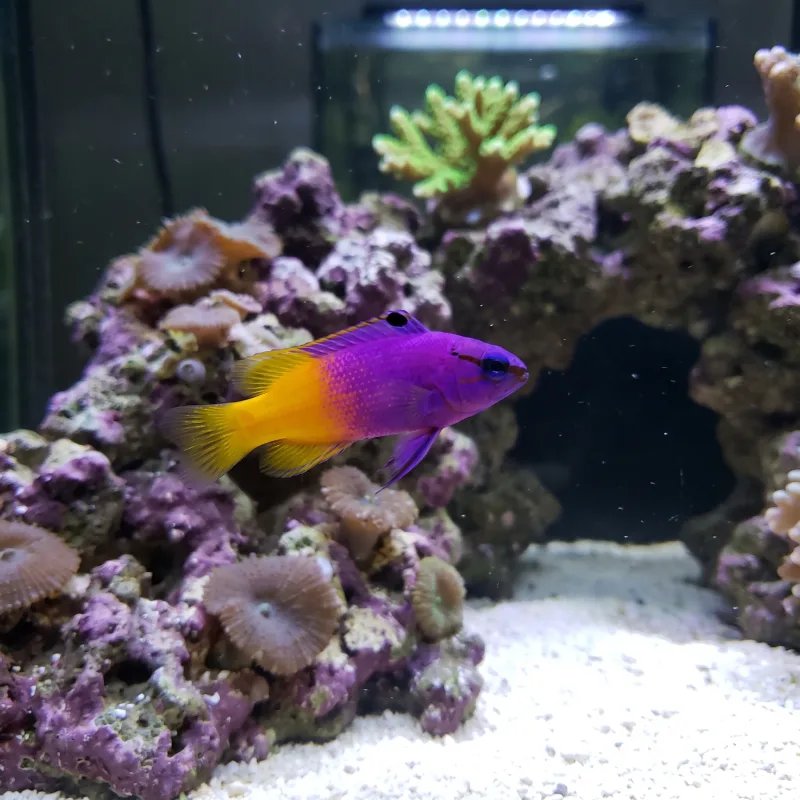
- The Royal Gramma is a small basslet split vividly into magenta-purple at the front and golden-yellow at the rear.
- Hardy, peaceful toward unrelated fish, and reef-safe, it is a good colourful beginner marine fish.
- It darts among rockwork and often hangs upside-down beneath ledges.
Show 2 more
- It comes from Caribbean reef caves and appreciates plenty of hiding spots.
- A well-fed Royal Gramma is shy at first but soon becomes confident, claiming a favourite cave and defending it with mostly harmless bluster against passing tankmates.
Temperament
- Peaceful toward unrelated species, the Royal Gramma is territorial mainly around its chosen cave, where it bluffs and posts largely harmless threats.
- It is reef-safe and ignores corals and invertebrates.
Show 2 more
- Keep one per tank unless the system is very large with widely separated territories, as they fight their own kind and the similar-looking Royal Dottyback.
- With peaceful tankmates and good cover it is a confident, characterful resident.
A good fit for
- Beginners wanting vivid colour
- Peaceful community reef tanks
- Reefs at the smaller end, from 53 gal200 L
- Keepers who enjoy cave-dwelling behaviour
Common mistakes to avoid
- Keeping multiples in small tanks (fighting)
- Confusing it with the aggressive Dottyback
- No caves or hiding spots causes stress
- Open-top tank leads to jumping
Enclosure
Minimum 53 gallons200 litres
One of its kind per tank; other compatible species can share it. Best kept singly; territorial with own kind
- A cycled tank of at least 53 gal200 L with abundant live rock, caves, and overhangs lets it feel secure.
- Maintain salinity 1.024-1.026, temperature 75-80°F24-27°C, pH 8.1-8.4, and nitrate under 20 ppm.
- A lid is essential, as they readily jump from open tanks.
Show 2 more
- Provide line-of-sight breaks with rock so it can establish a home base without stress.
- The more caves and crevices available, the bolder and more visible it becomes, since it always wants an escape route close at hand.
Supplies
Setup
- Tank, stand and sump
- Return pump and powerheads
- Protein skimmer
- Reef lighting
- Rock and sand
Show 2 more
- Salt mix, refractometer and test kits
- Quarantine tank
Ongoing
- Frozen mysis shrimp
- Frozen enriched brine shrimp
- Small sinking marine pellet
- Frozen chopped seafood blend
- Vitamin or HUFA soaking supplement
Show 2 more
- Turkey baster for target-feeding near rockwork
- Small thawing cup and strainer
Safe substrate: Aragonite sand · Dry or cured live rock
Care routine
Daily
- Check salinity, temperature and flow
- Check the lid
- Feed
- Head-count and look everyone over
- Top up evaporation with fresh water
Every few days
- Service the skimmer and filter socksevery 3 days
Show 8 more
Weekly
- Check each fish still has a cave
- Clean the glass
- Test the water
- Water change
Monthly
- Calibrate the refractometer
- Check salt, RO/DI and reagents
Less often
- Deep-clean pumps and powerheadsevery 3 months
- Replace RO/DI filter mediaevery 6 months
Health review: Quarterly review with a territory check, every 3 months
Tools
Care in depth
Diet
Carnivore (mysis, brine, marine pellets)
- The Royal Gramma is a carnivore that in the wild eats zooplankton and small crustaceans.
- In the aquarium offer frozen mysis and brine shrimp, finely chopped seafood, and a sinking marine pellet, fed once or twice daily.
- Most specimens feed readily within days of settling in.
- A varied meaty diet keeps the purple and gold colours strong.
- Feed modest amounts to avoid fouling the water, and make sure faster tankmates do not take all the food first.
Health
Signs of good health, and the common problems
- Royal Grammas are hardy and relatively disease-resistant in stable water.
- The main risks are marine ich and bacterial infections following stress, poor water quality, or aggression from tankmates or a rival Dottyback.
- Quarantine new arrivals and keep nitrate low and parameters steady.
- Watch for hiding, refusing food, or white spots as early warning signs.
- A secure, cave-rich tank reduces stress and keeps this basslet healthy for years.
Is this urgent?
6 warning signs and how fast to act, 3 of them right away
In a reef, stability matters more than any single target number. A parameter moving fast does more damage than a parameter sitting slightly off.
Go now
Today
Quarantine every new animal, including corals and inverts. It is the single practice that separates a reef that lasts from a reef that restarts.
This is general guidance for a healthy adult, not a diagnosis. An exotics vet who knows your animal always overrides it, and the time to find one is before you need one.
Bedding and substrate
2 safe, 3 with a caveat, 2 to avoid
In a marine system the rock and the sand are life support, and how you start them decides the first six months.
Safe
With a caveat
Never
This is our general list for saltwater fish. We have not built one specific to Basslets yet.
Top resources for more info
Independent creators and organisations we would send a friend to. We have no affiliation with any of them, and nothing here is sponsored. Links checked 2026-10-22.
YouTubers
Sites
Other Saltwater Fish worth knowing
Same axes, same care guides: the honest way to compare them.