Green Chromis
Chromis viridis
Active blue-green shoaler for a peaceful reefBeginner
- Lifespan
- 8-15 years
- Size
- 3-4 in8-10 cm
- Social needs
- Shoaling; keep 6+ together, added at the same time
- Time
- Daily feeding; weekly testing/changes
- Cost
- High
- Diet
- Omnivore (mysis, brine, marine flake/pellet)
Overview
What is this animal?
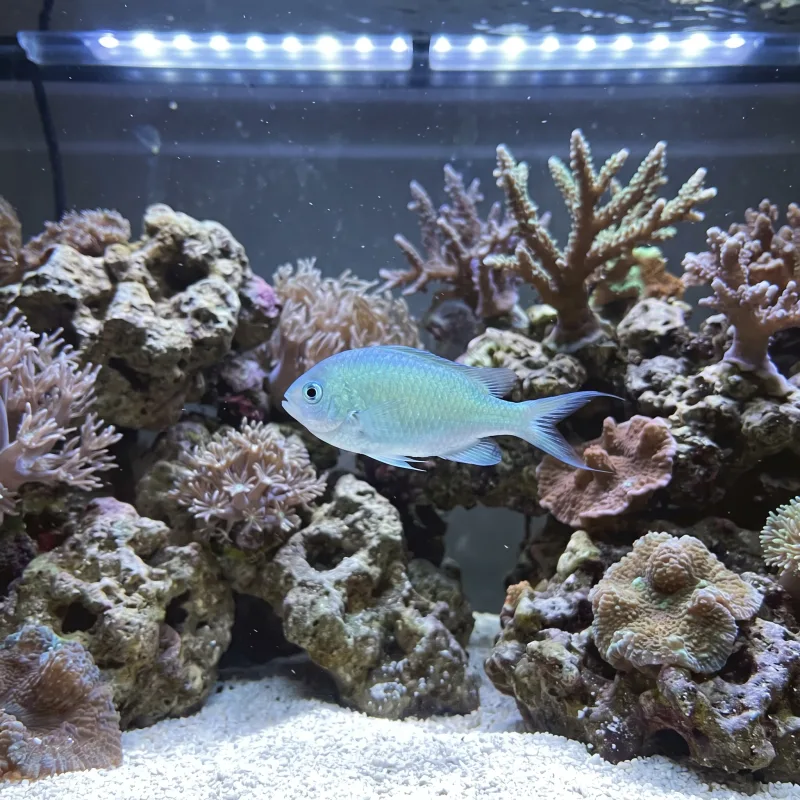
- The Green Chromis is an iridescent blue-green damselfish that schools in the open water of a reef.
- Hardy, inexpensive, and active, it adds constant movement, and unlike most damsels it is relatively peaceful, which makes it a reasonable beginner shoaling species.
- They are among the tougher marine fish available and tolerate minor beginner mistakes within a cycled tank.
- A well-fed group moving in unison across the tank is a striking display.
Temperament
- Peaceful by damselfish standards and reef-safe, Green Chromis school together in open water and ignore corals.
- However, as they mature a hierarchy forms and dominant fish often pick off subordinates one by one until only one or two remain.
Show 2 more
- Counter this by stocking a group of six or more at once in a roomy tank.
- They mix well with other peaceful community fish and add coordinated open-water movement.
A good fit for
- Beginners wanting an active group
- Larger reef and FOWLR tanks
- Keepers on a tighter livestock budget
- Adding open-water movement
Common mistakes to avoid
- Buying too few - they cull down to one
- Adding them piecemeal instead of together
- Undersized tank for an active school
- Aggression as the group matures
Enclosure
Minimum 79 gallons300 litres, for a group of 6
Cannot be kept alone. The minimum is 6, and the space above is for that group.
- Keep a group of six or more in a cycled tank of at least 80 gal300 L, so the school has swimming room and the weaker fish have space to get away.
- Maintain salinity 1.024-1.026, temperature 75-80°F24-27°C, pH 8.1-8.4, and nitrate low, with the moderate-to-strong flow they prefer.
- Provide open swimming space plus live rock for refuge.
- A larger tank and bigger group help spread out the aggression that develops as they mature and keep the schooling behaviour intact over the long term.
Supplies
Setup
- Tank, stand and sump, about 80-90 US gallons300-340 litres
- Return pump and powerheads
- Protein skimmer
- Reef lighting
- Rock and sand
Show 2 more
- Salt mix, refractometer and test kits
- Quarantine tank
Ongoing
- Marine flake or small pellet
- Frozen mysis shrimp
- Frozen brine shrimp
- Frozen cyclops or copepods
- Algae-based marine food
Show 2 more
- Small thawing cup and strainer
- Turkey baster for spreading food in the current
Safe substrate: Aragonite sand · Dry or cured live rock
Care routine
Daily
- Check salinity, temperature and flow
- Feed
- Head-count and look everyone over
- Top up evaporation with fresh water
Every few days
- Service the skimmer and filter socksevery 3 days
Show 8 more
Weekly
- Clean the glass
- Count the group
- Test the water
- Water change
Monthly
- Calibrate the refractometer
- Check salt, RO/DI and reagents
Less often
- Deep-clean pumps and powerheadsevery 3 months
- Replace RO/DI filter mediaevery 6 months
Health review: Quarterly group and aggression review, every 3 months
Tools
Care in depth
Diet
Omnivore (mysis, brine, marine flake/pellet)
- Green Chromis are omnivores.
- Offer a marine flake or pellet staple plus frozen mysis and brine shrimp, fed once or twice daily.
- In the wild they pick zooplankton from the water column, so they appreciate small foods that drift in the current.
- They feed eagerly and rarely need coaxing, which makes them easy to keep well-fed in a busy tank.
- A varied diet maintains their blue-green sheen and supports the group's condition and activity.
Health
Signs of good health, and the common problems
- Chromis are hardy and disease-resistant, tolerating minor parameter swings better than most marine fish.
- The main issue is stress-driven aggression within the group, which can lead to injuries, bacterial infections, and a dwindling school.
- Quarantine new fish and keep nitrate low; marine ich is the usual risk after poor quarantine.
- Watch for nipped fins and isolated, hiding individuals as signs of in-group bullying.
- A large enough group and tank keeps stress and disease low.
Is this urgent?
6 warning signs and how fast to act, 3 of them right away
In a reef, stability matters more than any single target number. A parameter moving fast does more damage than a parameter sitting slightly off.
Go now
Today
Quarantine every new animal, including corals and inverts. It is the single practice that separates a reef that lasts from a reef that restarts.
This is general guidance for a healthy adult, not a diagnosis. An exotics vet who knows your animal always overrides it, and the time to find one is before you need one.
Bedding and substrate
2 safe, 3 with a caveat, 2 to avoid
In a marine system the rock and the sand are life support, and how you start them decides the first six months.
Safe
With a caveat
Never
This is our general list for saltwater fish. We have not built one specific to Damselfish yet.
Top resources for more info
Independent creators and organisations we would send a friend to. We have no affiliation with any of them, and nothing here is sponsored. Links checked 2026-10-22.
YouTubers
Sites
Other Saltwater Fish worth knowing
Same axes, same care guides: the honest way to compare them.