Pajama Cardinalfish
Sphaeramia nematoptera
Peaceful nocturnal cardinalfish that lives in groupsBeginner
- Lifespan
- 4-5 years
- Size
- 3 in8 cm
- Social needs
- Shoaling; keep in a small group
- Time
- Daily feeding; weekly testing/changes
- Cost
- High
- Diet
- Carnivore (mysis, brine, frozen, pellets)
Overview
What is this animal?
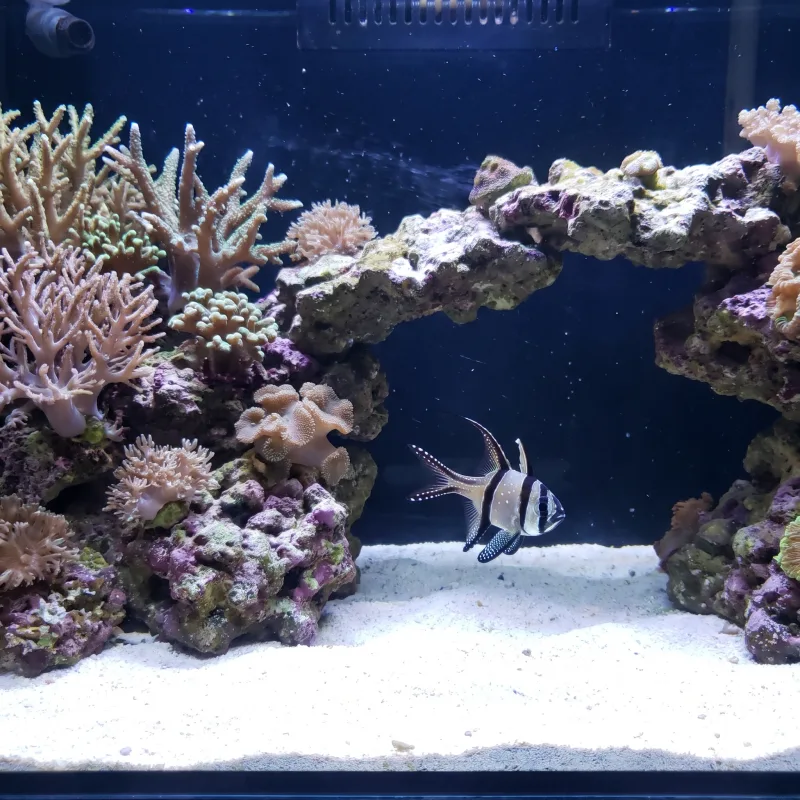
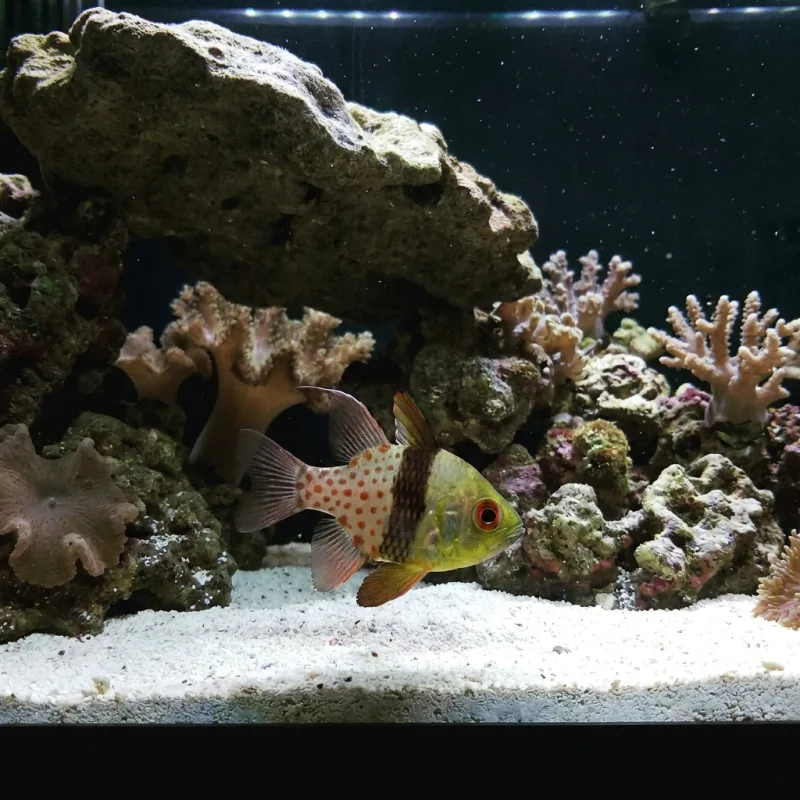
- The Pajama Cardinalfish has a silver-yellow face, a dark band across the body, and a polka-dotted rear, giving it a mismatched "pyjama" look.
- It is peaceful, hardy, and reef-safe, and like most cardinalfish it lives in groups, hovering together near branching cover during the day.
- Naturally nocturnal, it becomes most active at dusk but adapts to feed during the day in aquariums.
- Its slow, gentle drifting makes it a distinctive addition that contrasts with more active swimmers.
Temperament
- Peaceful, slow-moving, and reef-safe, the Pajama Cardinalfish is harmless to corals and most invertebrates, though very small shrimp may be eaten.
- It does best kept in a small group rather than alone.
Show 2 more
- Lone fish tend to be reclusive, while a group of three or more drifts confidently in the open.
- Pair them only with calm tankmates, as fin-nippers and aggressive fish will keep them hidden and stressed.
A good fit for
- Beginners wanting a peaceful group
- Reef community tanks
- Keepers who like calm, hovering groups
- Dusk-active display tanks
Common mistakes to avoid
- Keeping just one (becomes reclusive)
- Fast tankmates stealing their food
- Pairing with aggressive or fin-nipping fish
- Insufficient hiding cover causing stress
Enclosure
Minimum 160 gallons600 litres, for a group of 3
Cannot be kept alone. The minimum is 3, and the space above is for that group.
- A cycled tank of at least 159 gal600 L lets you keep a small group of three or more among live rock and branching coral cover.
- Maintain salinity 1.024-1.026, temperature 75-80°F24-27°C, pH 8.1-8.4, and nitrate low.
- Moderate flow and a covered top are best.
Show 2 more
- Provide overhangs and branching structure where the group can rest and feel secure.
- Stable, clean water and ample cover keep these gentle fish confident and out in view during daylight hours.
Supplies
Setup
- Tank, stand and sump, about 80-90 US gallons300-340 litres
- Return pump and powerheads
- Protein skimmer
- Reef lighting
- Rock and sand
Show 2 more
- Salt mix, refractometer and test kits
- Quarantine tank
Ongoing
- Frozen mysis shrimp
- Frozen enriched brine shrimp
- Frozen or live copepods
- Small marine pellets
- Vitamin or HUFA soaking supplement
Show 2 more
- Turkey baster for target-feeding
- Small thawing cup and strainer
Safe substrate: Aragonite sand · Dry or cured live rock
Care routine
Daily
- Check salinity, temperature and flow
- Head-count and look everyone over
- Small feeds once or twice a day, and watch each fish eat
- Top up evaporation with fresh water
Every few days
- Service the skimmer and filter socksevery 3 days
Show 7 more
Weekly
- Clean the glass
- Test the water
- Water change
Monthly
- Calibrate the refractometer
- Check salt, RO/DI and reagents
Less often
- Deep-clean pumps and powerheadsevery 3 months
- Replace RO/DI filter mediaevery 6 months
Health review: Quarterly condition review, every 3 months
Tools
Care in depth
Diet
Carnivore (mysis, brine, frozen, pellets)
- The Pajama Cardinalfish is a carnivore.
- Offer frozen mysis and brine shrimp, finely chopped seafood, and small marine pellets, fed once or twice daily.
- Being naturally nocturnal, some appreciate a feeding near dusk.
- They can be timid eaters, so make sure boisterous tankmates do not take all the food first.
- Target-feeding shy individuals helps them keep weight.
- A varied meaty diet maintains their condition and gentle, hovering activity.
Health
Signs of good health, and the common problems
- Pajama Cardinalfish are hardy and disease-resistant in stable water.
- The main risks are stress from aggressive tankmates, underfeeding when outcompeted, and marine ich following poor quarantine or unstable parameters.
- Quarantine new fish, keep nitrate low, and watch for thin bellies or hiding, which suggest a fish is not eating enough.
- A peaceful tank with good cover and reliable feeding keeps these fish in good health.
Is this urgent?
6 warning signs and how fast to act, 3 of them right away
In a reef, stability matters more than any single target number. A parameter moving fast does more damage than a parameter sitting slightly off.
Go now
Today
Quarantine every new animal, including corals and inverts. It is the single practice that separates a reef that lasts from a reef that restarts.
This is general guidance for a healthy adult, not a diagnosis. An exotics vet who knows your animal always overrides it, and the time to find one is before you need one.
Bedding and substrate
2 safe, 3 with a caveat, 2 to avoid
In a marine system the rock and the sand are life support, and how you start them decides the first six months.
Safe
With a caveat
Never
This is our general list for saltwater fish. We have not built one specific to Cardinalfish yet.
Top resources for more info
Independent creators and organisations we would send a friend to. We have no affiliation with any of them, and nothing here is sponsored. Links checked 2026-10-22.
YouTubers
Sites
Cardinalfish, side by side
Same axes, same care guides: the honest way to choose between types.