Banggai Cardinalfish
Pterapogon kauderni
Striped cardinalfish best bought captive-bredIntermediate
- Lifespan
- 4-5 years
- Size
- 3 in8 cm
- Social needs
- Singly or as an established male-female pair; a group only in a large tank
- Time
- Daily feeding; weekly testing/changes
- Cost
- High
- Diet
- Carnivore (mysis, brine, copepods, frozen)
Overview
What is this animal?
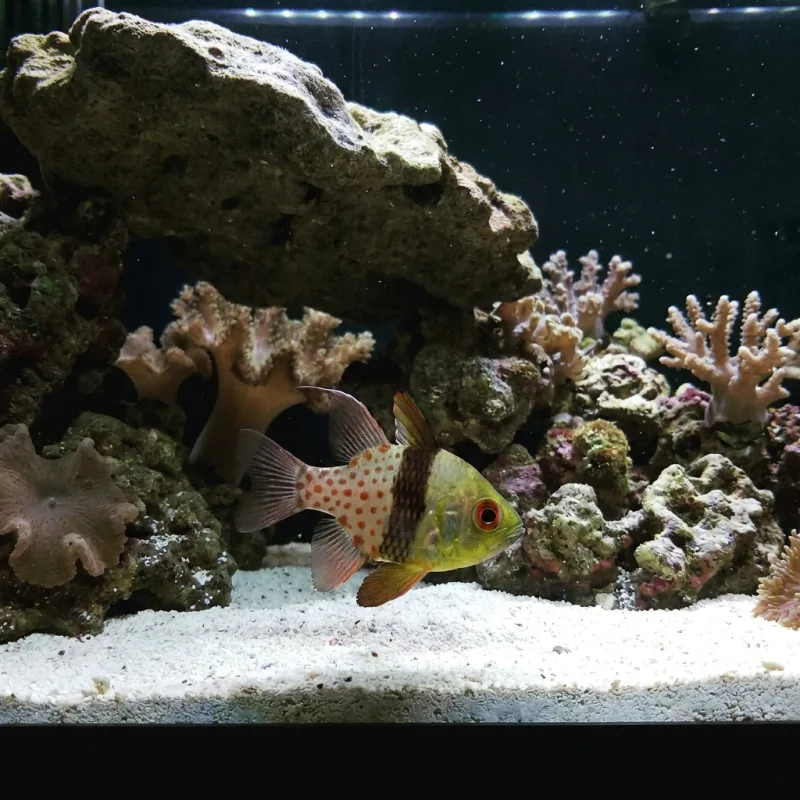
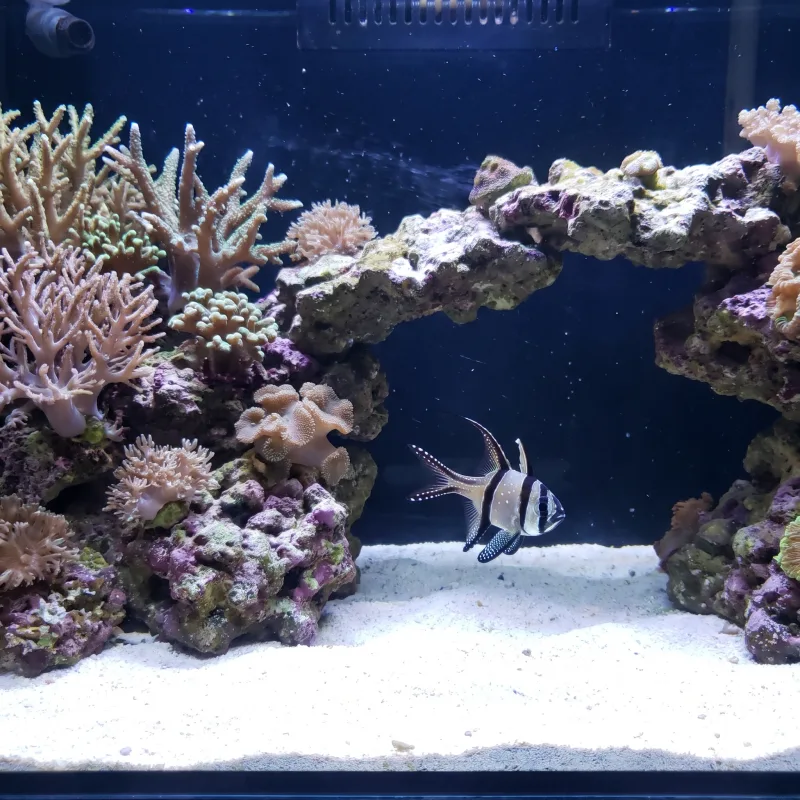
- The Banggai Cardinalfish is a silver fish with bold black bars and white-spotted fins.
- Endemic to a small range in Indonesia, wild populations are threatened by overcollection, so buying captive-bred stock is the more ethical and hardier choice.
- Captive-bred fish adapt readily and ship far better than wild ones.
Show 2 more
- These are mouthbrooders: the male incubates eggs and fry in his mouth, making them one of the more readily bred marine fish at home.
- Slow-moving and peaceful, they hover in the open and add contrast to a reef.
Temperament
- Banggai are peaceful and reef-safe toward other species but can be aggressive among themselves.
- As juveniles mature in a group they pair off and harass the remaining fish, so keep a single individual or an established male-female pair.
Show 2 more
- They hover slowly in the open, often near branching cover, and pose no threat to corals or most invertebrates.
- With careful stocking they are calm fish whose unusual breeding behaviour rewards attentive keepers.
A good fit for
- Keepers wanting to breed marine fish
- Ethical buyers choosing captive-bred
- Peaceful reef community tanks
- Aquarists who enjoy calm, hovering fish
Common mistakes to avoid
- Buying wild-caught (threatened, poor survival)
- Crowding juveniles - they bully as they pair
- Slow feeders outcompeted by fast tankmates
- Too-small tank causing aggression
Enclosure
Minimum 130 gallons500 litres
Fine alone or with company. A single fish, or a male-female pair that has already formed. Adults in a small group pair off and drive the rest away, so do not buy two unsexed fish and hope.
- A cycled tank of at least 133 gal500 L suits a single fish or an established male-female pair; a group needs a far larger tank and many sight-line breaks to prevent bullying.
- Keep salinity 1.024-1.026, temperature 74-80°F23-27°C, pH 8.1-8.4, and nitrate low.
- Long-spined urchins or branching corals give fry natural shelter.
Show 2 more
- A tight lid is advisable.
- Stable water and ample structure reduce in-group aggression and give this slow, deliberate fish the calm environment it prefers in order to thrive and even breed.
Supplies
Setup
- Tank, stand and sump, about 80-90 US gallons300-340 litres
- Return pump and powerheads
- Protein skimmer
- Reef lighting
- Rock and sand
Show 2 more
- Salt mix, refractometer and test kits
- Quarantine tank
Ongoing
- Frozen mysis shrimp
- Frozen enriched brine shrimp
- Frozen or live copepods
- Small marine pellets
- Vitamin or HUFA soaking supplement
Show 2 more
- Turkey baster for target-feeding
- Small thawing cup and strainer
Safe substrate: Aragonite sand · Dry or cured live rock
Care routine
Daily
- Check salinity, temperature and flow
- Head-count and look everyone over
- Small feeds once or twice a day, and watch each fish eat
- Top up evaporation with fresh water
Every few days
- Service the skimmer and filter socksevery 3 days
Show 7 more
Weekly
- Clean the glass
- Test the water
- Water change
Monthly
- Calibrate the refractometer
- Check salt, RO/DI and reagents
Less often
- Deep-clean pumps and powerheadsevery 3 months
- Replace RO/DI filter mediaevery 6 months
Health review: Quarterly condition review, every 3 months
Tools
Care in depth
Diet
Carnivore (mysis, brine, copepods, frozen)
- The Banggai is a carnivore that can be a slow, picky eater.
- Offer enriched frozen mysis and brine shrimp, copepods, and small marine pellets, fed once or twice daily.
- Vitamin-soaked foods improve condition and breeding success.
- Because they feed deliberately, make sure faster tankmates do not strip the food before they eat.
- Target-feeding shy individuals helps.
- A varied meaty diet keeps them in good weight, which is important for successful mouthbrooding.
Health
Signs of good health, and the common problems
- Captive-bred Banggai are reasonably hardy, but the species is prone to a specific Iridovirus and to stress-related disease, especially in poorly acclimated wild fish.
- Buying captive-bred and quarantining new arrivals greatly reduces risk.
- Watch for slow feeding, emaciation, rapid breathing, or white spots.
- Keep nitrate low and parameters stable, and avoid crowding, which causes chronic stress.
- Well-fed, uncrowded fish in clean water generally stay healthy through their lifespan.
Is this urgent?
6 warning signs and how fast to act, 3 of them right away
In a reef, stability matters more than any single target number. A parameter moving fast does more damage than a parameter sitting slightly off.
Go now
Today
Quarantine every new animal, including corals and inverts. It is the single practice that separates a reef that lasts from a reef that restarts.
This is general guidance for a healthy adult, not a diagnosis. An exotics vet who knows your animal always overrides it, and the time to find one is before you need one.
Bedding and substrate
2 safe, 3 with a caveat, 2 to avoid
In a marine system the rock and the sand are life support, and how you start them decides the first six months.
Safe
With a caveat
Never
This is our general list for saltwater fish. We have not built one specific to Cardinalfish yet.
Top resources for more info
Independent creators and organisations we would send a friend to. We have no affiliation with any of them, and nothing here is sponsored. Links checked 2026-10-22.
YouTubers
Sites
Cardinalfish, side by side
Same axes, same care guides: the honest way to choose between types.