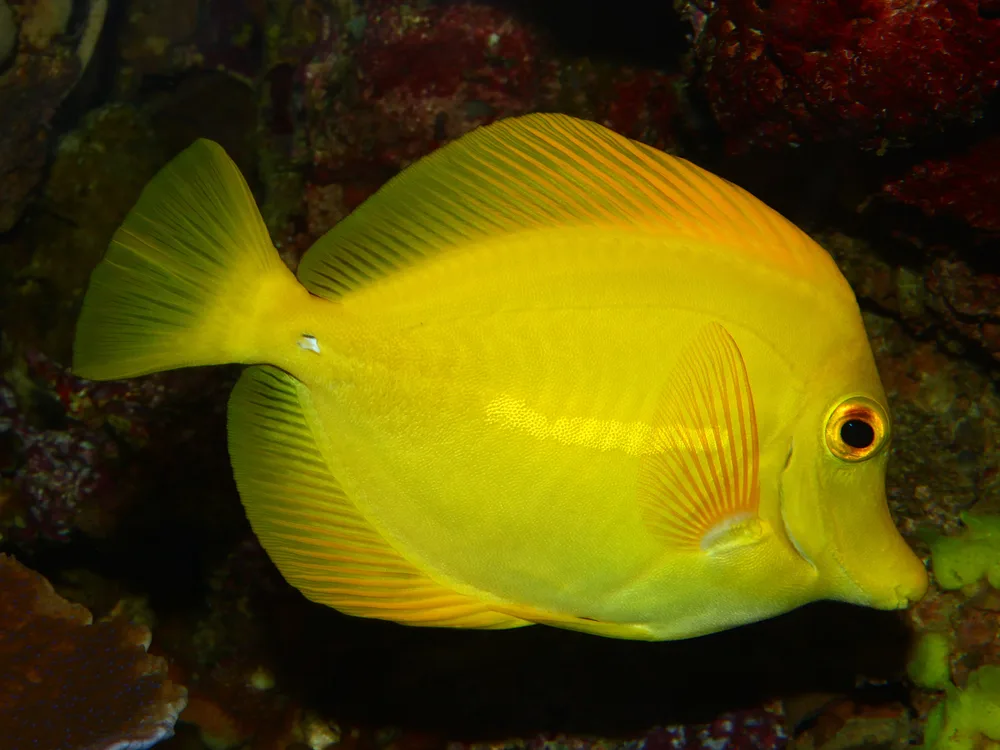
Yellow Tang
Zebrasoma flavescens
Yellow algae-grazer needing serious swimming spaceIntermediate
- Lifespan
- 15-30 years
- Size
- 8 in20 cm
- Social needs
- Best kept singly; territorial with tangs
- Time
- Daily feeding; weekly testing/changes
- Cost
- High
- Diet
- Herbivore (marine algae, nori, seaweed, veg)
Overview
What is this animal?
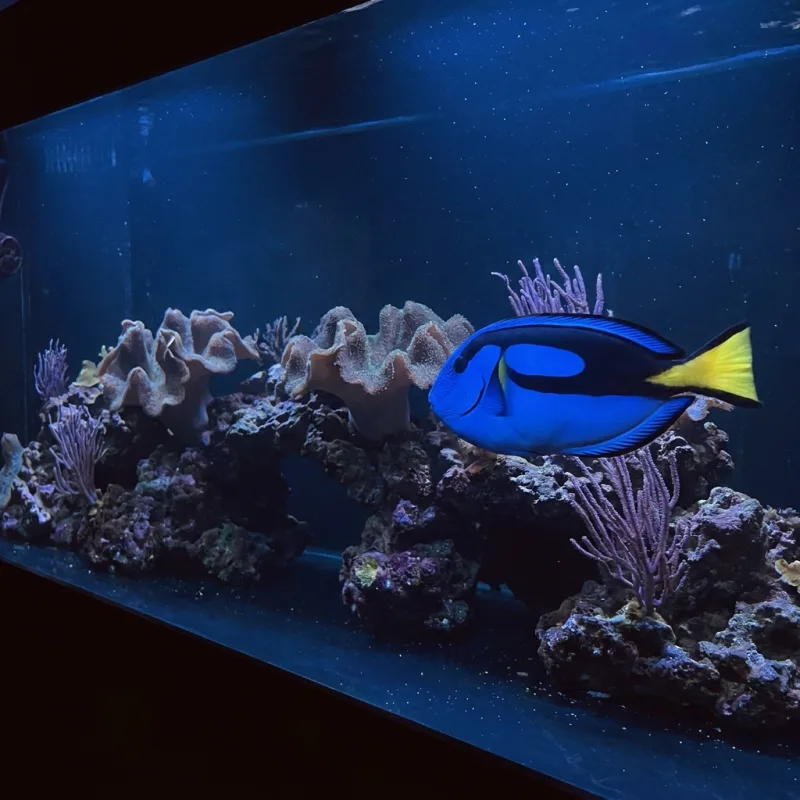
- The Yellow Tang is a lemon-yellow surgeonfish and one of the more recognisable marine fish.
- Captive-bred stock now exists and is the more responsible choice.
- Although hardy once settled, it is not a beginner fish: it needs a large tank, grows substantially, and is prone to disease when stressed.
Show 2 more
- It is an active, all-day swimmer that grazes algae constantly and can live for many years.
- The name "surgeonfish" comes from a sharp scalpel-like spine at the tail base, which it can use defensively, so handle it with care during maintenance.
Temperament
- Active and generally peaceful toward unrelated fish, the Yellow Tang is territorial toward other tangs and similar-shaped fish.
- It is reef-safe and helps control nuisance algae among corals.
Show 3 more
- Keep only one tang per tank unless the system is very large with several added together.
- Its tail spine can injure tankmates and careless hands, so respect it during maintenance.
- Given space, it is a bold, ever-moving centrepiece.
A good fit for
- Intermediate keepers with a large tank
- Reef tanks needing natural algae control
- Long-term committed aquarists
- Ethical buyers choosing captive-bred
Common mistakes to avoid
- Tanks too small for its swimming needs
- Skipping quarantine - prone to marine ich
- Insufficient algae/veg in the diet
- Housing multiple tangs that fight
Enclosure
Minimum 265 gallons1,000 litres
One of its kind per tank; other compatible species can share it. Best kept singly; territorial with tangs
- Provide a long tank of at least 265 gal1,000 L and at least 6 ft1.8 m long for an adult, and larger if you can; tank length matters more than volume for this fast swimmer.
- Care references give 90-180 gal341-681 L for an adult, and a captive breeder of yellow tangs advises 125 gal473 L or more.
- This guide asks for more because good conditions are never less than a law requires, and Austria's law asks 265 gal1,000 L for a tang this size.
Show 4 more
- The 75 gal284 L still quoted in older guides suits only a young fish, and only for a short time.
- Keep salinity 1.024-1.026, temperature 75-80°F24-27°C, pH 8.1-8.4, and nitrate low, with strong flow and good oxygenation.
- Give plenty of rockwork for grazing and refuge.
- Add it last to an established tank, since territorial tangs claim space, and quarantine all new fish to keep marine ich out of the system.
Supplies
Setup
- Tank, stand and sump
- Return pump and powerheads
- Protein skimmer
- Reef lighting
- Rock and sand
Show 2 more
- Salt mix, refractometer and test kits
- Quarantine tank
Ongoing
- Dried marine algae (nori) sheets in bulk
- Magnetic or suction veg clip
- Algae or herbivore pellets
- Herbivore frozen food blend
- Frozen mysis and other meaty marine foods (a small share for the yellow tang, a daily staple for the regal blue tang)
Show 2 more
- Vitamin or HUFA soaking supplement
- Second clip so nori can be offered in two places
Safe substrate: Aragonite sand · Dry or cured live rock
Care routine
Daily
- Check salinity, temperature and flow
- Clip on dried algae
- Feed
- Head-count and look everyone over
- Top up evaporation with fresh water
Every few days
- Service the skimmer and filter socksevery 3 days
Show 8 more
Weekly
- Check head, lateral line and flanks
- Clean the glass
- Test the water
- Water change
Monthly
- Calibrate the refractometer
- Check salt, RO/DI and reagents
Less often
- Deep-clean pumps and powerheadsevery 3 months
- Replace RO/DI filter mediaevery 6 months
Health review: Quarterly review with an HLLE check, every 3 months
Tools
Care in depth
Diet
Herbivore (marine algae, nori, seaweed, veg)
- The Yellow Tang is primarily a herbivore.
- Its diet must be algae-based: offer dried marine algae (nori) clipped in the tank daily, plus algae pellets and herbivore frozen foods.
- Grazing on natural algae growth supplements this.
- A diet too high in meaty foods causes poor health and dull colour, so keep it green.
- Frequent small feedings suit its constant grazing.
- Vitamin-enriched algae sheets help maintain colour and support the immune system.
Health
Signs of good health, and the common problems
- Yellow Tangs are notably susceptible to marine ich (Cryptocaryon) and to head-and-lateral-line erosion (HLLE), which is linked to stress, poor water quality, and inadequate diet.
- Strict quarantine of all new arrivals is essential to keep ich out.
- Maintain clean water, strong oxygenation, and an algae-rich diet to help prevent HLLE.
- Watch for white spots, scratching, faded colour, or pitting along the head and lateral line.
- Good husbandry lets this fish live for many years.
Is this urgent?
6 warning signs and how fast to act, 3 of them right away
In a reef, stability matters more than any single target number. A parameter moving fast does more damage than a parameter sitting slightly off.
Go now
Today
Quarantine every new animal, including corals and inverts. It is the single practice that separates a reef that lasts from a reef that restarts.
This is general guidance for a healthy adult, not a diagnosis. An exotics vet who knows your animal always overrides it, and the time to find one is before you need one.
Bedding and substrate
2 safe, 3 with a caveat, 2 to avoid
In a marine system the rock and the sand are life support, and how you start them decides the first six months.
Safe
With a caveat
Never
This is our general list for saltwater fish. We have not built one specific to Tangs yet.
Top resources for more info
Independent creators and organisations we would send a friend to. We have no affiliation with any of them, and nothing here is sponsored. Links checked 2026-10-22.
YouTubers
Sites
Tangs, side by side
Same axes, same care guides: the honest way to choose between types.