Coral Beauty Angelfish
Saltwater Fish · Dwarf Angelfish

Coral Beauty Angelfish

Centropyge bispinosa

Hardy, colourful dwarf angel for reef tanksIntermediate

Lifespan
5-10 years
Size
3-4.5 in
Social needs
Usually one dwarf angel per tank
Time
Medium
Cost
High
Diet
Omnivore, algae and meaty foods

Overview

What is this animal?

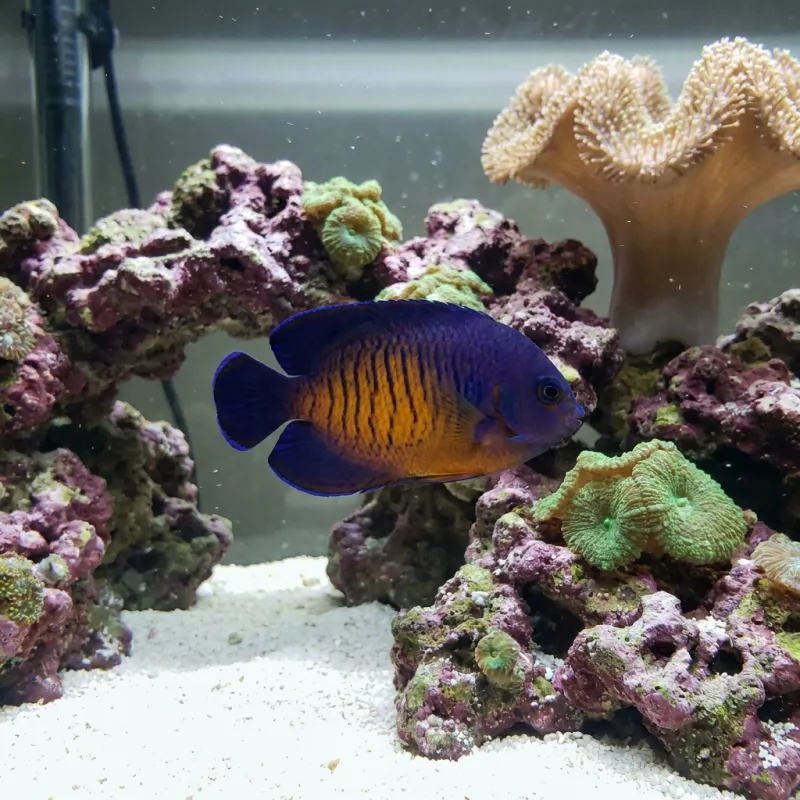
  • The Coral Beauty is one of the hardier and more popular dwarf angelfish, known for its deep blue and orange colouring.
  • It stays small at around 4 in, making it suitable for reef tanks far smaller than the large angels need.
  • It is a good intermediate species: forgiving of minor mistakes but still needing a mature system with plenty of live rock for grazing and stable marine chemistry.

Temperament

  • Reef-safe with caution: most individuals leave corals alone, but some nip at LPS, SPS, or clam mantles, and behaviour varies between specimens.
  • It is semi-aggressive and territorial toward other dwarf angels.
Show 2 more
  • Keep only one Centropyge per tank unless the system is large.
  • It generally coexists peacefully with most community reef fish once established and given its own territory.

A good fit for

  • Reef keepers wanting a hardy dwarf angel
  • Reefs too small for the large angelfish
  • Aquarists with mature, algae-rich rock
  • Intermediate hobbyists building experience

Common mistakes to avoid

  • May nip corals and clam mantles
  • Added to immature tanks with little algae
  • Keeping multiple dwarf angels together
  • Skipping quarantine and risking ich

Enclosure

Minimum 145 gallons

One of its kind per tank; other compatible species can share it. Usually one dwarf angel per tank

  • House in an established reef of at least 146 gallons and 4 ft long, with abundant live rock that provides algae growth, grazing surfaces, and hiding caves.
  • Care references give 70-75 gallons and call about 40 gallons a bare minimum, but this is an active, boisterous grazer that patrols a territory all day, and a German reef encyclopedia asks at least 145 gal, above the 130 gal Austria's law asks for a dwarf angel.
  • A mature tank with natural microfauna and algae film suits it best.
Show 2 more
  • Maintain temperature 75-81°F, salinity 1.024-1.026, pH 8.1-8.4, and ammonia and nitrite at zero.
  • Good filtration and stable parameters keep this fish thriving.

Check your enclosure

Supplies

Setup

  • Tank, stand and sump
  • Return pump and powerheads
  • Protein skimmer
  • Reef lighting
  • Rock and sand
Show 2 more
  • Salt mix, refractometer and test kits
  • Quarantine tank

Ongoing

  • Spirulina-based marine flake
  • Quality marine pellet
  • Dried marine algae (nori) sheets
  • Veg clip
  • Frozen mysis and brine shrimp
Show 2 more
  • Vitamin or HUFA soaking supplement
  • Small thawing cup and strainer

Safe substrate: Aragonite sand · Dry or cured live rock

Work out the cost

Care routine

Daily

  • Check salinity, temperature and flow
  • Feed a varied, algae-rich diet
  • Head-count and look everyone over
  • Top up evaporation with fresh water

Every few days

  • Service the skimmer and filter socksevery 3 days
Show 8 more

Weekly

  • Check corals and clam mantles
  • Clean the glass
  • Test the water
  • Water change

Monthly

  • Calibrate the refractometer
  • Check salt, RO/DI and reagents

Less often

  • Deep-clean pumps and powerheadsevery 3 months
  • Replace RO/DI filter mediaevery 6 months

Health review: Quarterly review with a diet and coral check, every 3 months

Tools

Care in depth

Diet

Omnivore, algae and meaty foods
  • An omnivore, the Coral Beauty grazes on algae, diatoms, and microfauna among the rocks.
  • Supplement with spirulina-based flakes, marine pellets, dried nori, and frozen mysis or brine shrimp several times daily.
  • A varied diet rich in vegetable matter keeps colour vivid and reduces nipping at corals.
  • Well-fed angels are less likely to sample coral polyps or clam mantles.

Health

Signs of good health, and the common problems
  • Generally robust, but like all marine fish it is susceptible to ich and velvet, so quarantine new arrivals.
  • Stable water and a varied diet support a strong immune system and good colour.
  • Watch for hiding, reduced appetite, white spots, or rapid gilling.
  • Most health issues trace to poor water quality or stress from an immature tank or aggressive tankmates.

Is this urgent?

6 warning signs and how fast to act, 3 of them right away

In a reef, stability matters more than any single target number. A parameter moving fast does more damage than a parameter sitting slightly off.

Go now

Any detectable ammonia or nitriteWater change now with matched, mixed and aerated saltwater. Stop feeding. Ammonia is directly toxic, and at reef pH more of it is in the toxic form, so a marine system has less margin than a freshwater one. Nitrite is far less toxic in seawater, but any reading in a stocked tank means the biological filter is not keeping up.
Now
Temperature or salinity has moved sharplyCorrect slowly, over hours, not minutes. Check the heater and the top-off. The speed of the change does the damage. Correcting fast repeats the injury in the other direction.
Now
Rapid gilling, or a fish hanging in the flow breathing hardIncrease aeration and check temperature and salinity. Warm water holds less oxygen, and a heater failure shows up here first.
Now

Today

White spots, or a fine dusting like icing sugarIdentify which parasite before treating. Most reef tanks cannot be treated in place. The two common parasites look similar and need different handling; velvet can kill a tank in days.
Today
Corals closed for more than a day, or receding tissueTest alkalinity first, and compare it against the last reading rather than a target. Unstable alkalinity is the most commonly cited coral killer, and a swing shows up in the trend, never in a single point.
Today
A new fish added without quarantine now looks unwellRemove it to a separate system today if you can. Nearly every wipeout in a reef tank traces back to a skipped quarantine.
Today

Quarantine every new animal, including corals and inverts. It is the single practice that separates a reef that lasts from a reef that restarts.

This is general guidance for a healthy adult, not a diagnosis. An exotics vet who knows your animal always overrides it, and the time to find one is before you need one.

Bedding and substrate

2 safe, 3 with a caveat, 2 to avoid

In a marine system the rock and the sand are life support, and how you start them decides the first six months.

Safe

Aragonite sandThe standard marine substrate, and it hosts the biology. It does not meaningfully hold pH or alkalinity at normal reef pH, so test and dose for those regardless.
safe
Dry or cured live rockDry rock avoids importing pests but takes longer to mature. Cured rock is faster and riskier.
safe

With a caveat

Deep sand bedsPowerful nutrient processing when they work and a sulphide release when they are disturbed. Choose shallow or deep deliberately, not by accident. A sand-sifting or burrowing goby needs a fine bed about 2 to 3 in deep that it turns over itself. That is a different thing from a denitrifying deep sand bed (4 in or more, left undisturbed), and the two do not mix: a sifting goby disturbs the layers a deep sand bed depends on and eats the life in it.
with a caveat
Uncured live rockIt will cycle the tank for you, and it will also bring in whatever was living in it.
with a caveat
Bare bottomWorkable in high-flow systems for fish that neither sift nor burrow, but it removes a large part of the biological buffer. Wrong for watchman gobies and other gobies that burrow or sift, which need a fine sand bed at least 2 in deep to dig and feed in, and for mandarins and other copepod-eaters, which need sand as well as mature rock for their food to breed in.
with a caveat

Never

Silica play sandNot the marine standard, and commonly blamed for feeding diatom blooms in a new tank.
never
Any rock or decor of unknown originMetals and phosphate leach for months and are almost impossible to trace once the tank is running.
never

This is our general list for saltwater fish. We have not built one specific to Dwarf Angelfish yet.

Top resources for more info

Independent creators and organisations we would send a friend to. We have no affiliation with any of them, and nothing here is sponsored. Links checked 2026-10-22.

YouTubers

Sites

Keep going

Dwarf Angelfish, side by side

Same axes, same care guides: the honest way to choose between types.
More Saltwater Fish guides

Is your enclosure big enough?

These are the smallest sizes that give good conditions, not legal minimums. More room is always better.

Minimum 145 gallons

Every figure, and where it comes from

For one fish. Quality Marine and WetWebMedia give 75 US gal, and Practical Fishkeeping a tank 4 ft long. Meerwasser-Lexikon asks at least 145 gal, above Austria's legal minimum of 130 gal for dwarf angels, and this site uses it, because good conditions are never less than a law requires.

Minimum volume145 gallons
Swimming length47 in minimum. A tall tank of the right volume is still the wrong shape.
CompanyOne of its kind per tank; other compatible species can share it. Usually one dwarf angel per tank
The recognised standards do not agree on this one
Meerwasser-Lexikon (German reef encyclopedia): At least 145 gal. The volume this site uses. Checked 2026-10-23.
Austria, 2. Tierhaltungsverordnung, Anlage 5 (legal minimum): At least 130 gal of water for dwarf angelfish (Centropyge), kept singly or in pairs; at least 53 gal for any marine fish. A legal minimum, below the volume used here. Checked 2026-10-23.
Practical Fishkeeping (UK): 63 gal and 4 ft long, and upwards, for dwarf angels other than the smallest species. The swimming length this site uses. Checked 2026-10-23.
Quality Marine (US livestock importer), care article: 75 US gal or more; 40 US gal is an absolute minimum for one fish. Below the volume used here. Checked 2026-10-23.
WetWebMedia (Bob Fenner): At least 75 US gal, uncrowded, and larger is better. Below the volume used here. Checked 2026-10-23.
LiveAquaria (US livestock retailer): 70 US gal or more. A care-listing minimum, below the volume used here. Checked 2026-10-23.

What it really costs

Setup, monthly, first year and across a whole life, itemised and with the electricity worked out from the actual wattage. Published figures for the same animal disagree by a factor of four, so the calculator shows ranges rather than picking one.

My kit says 0.25 ppm. Is that dangerous?

A liquid kit measures total ammonia, but only the un-ionised fraction is really toxic, and that fraction is governed by pH and temperature. Each whole pH unit multiplies it roughly tenfold. So the same reading can be nearly harmless in one tank and lethal in another; this works out which one you are in.