Neon Goby
Elacatinus oceanops
Electric-blue cleaner fish in a two-inch5-centimetre packageBeginner
- Lifespan
- 1-2 years (occasionally 3)
- Size
- 2 in4-5 cm
- Social needs
- Singly or a mated pair; fights other cleaner gobies
- Time
- Daily feeding; weekly testing/changes
- Cost
- High
- Diet
- Micro-carnivore (mysis, enriched brine, cyclops, micro pellets)
Overview
What is this animal?
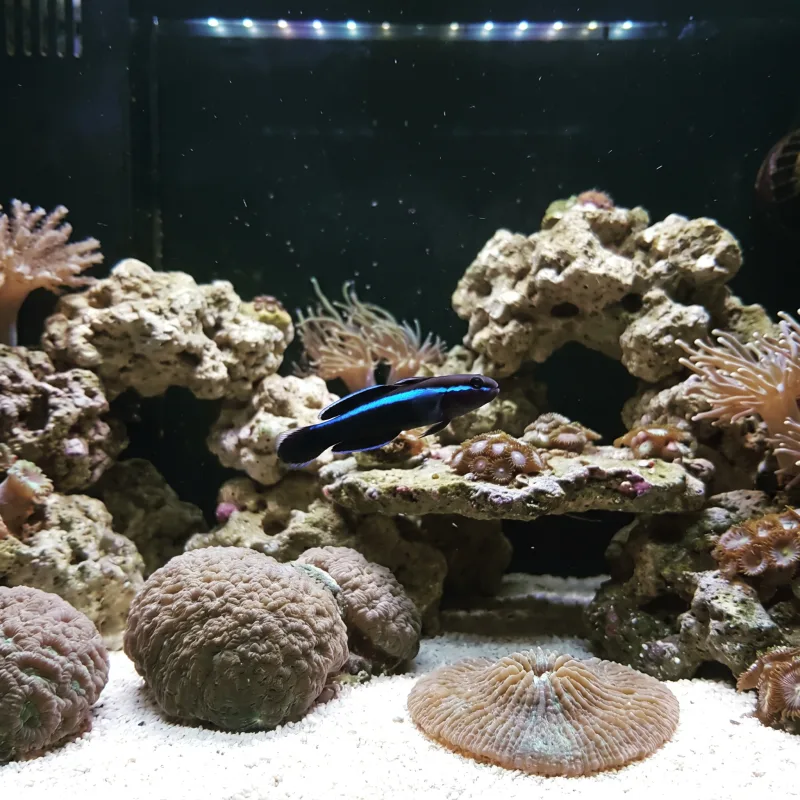
- The Neon Goby is a Western Atlantic cleaner fish, jet black with an electric-blue stripe running from snout to tail on each side.
- At barely 2 in5 cm it is one of the smallest fish commonly kept in the marine hobby, yet it is bold and constantly visible, perching in the open on rock and glass with its fused, suction-cup pelvic fins.
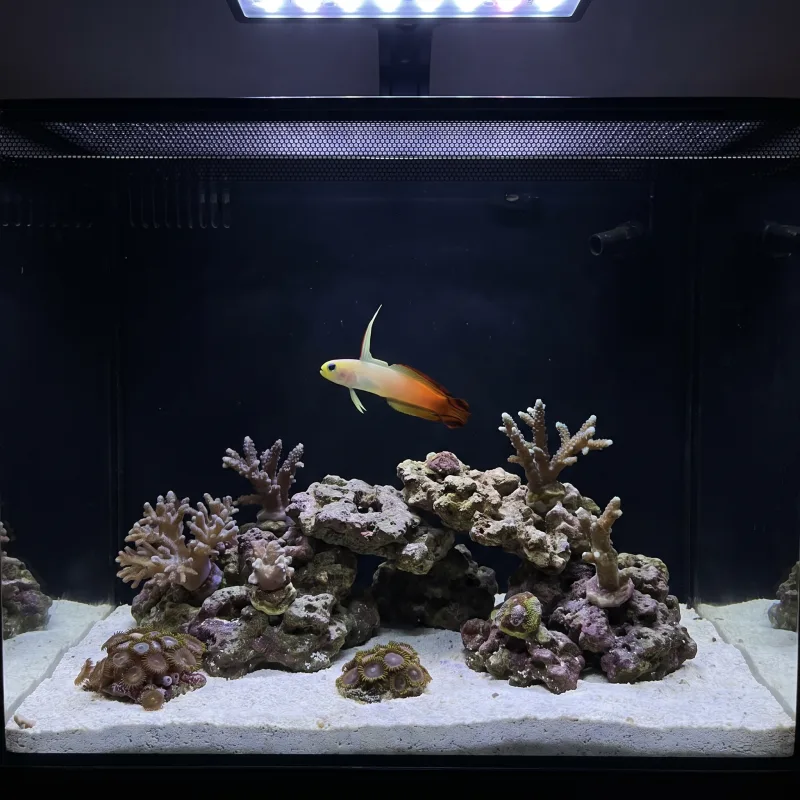
- Unlike the site's watchman gobies it does not burrow, and unlike the hovering Firefish it is a true goby that sits rather than swims.
Show 4 more
- Its defining behaviour is cleaning, since in the wild it runs cleaning stations where larger reef fish queue to have parasites and dead skin picked off.
- Many aquarium specimens keep the habit and will hop onto the flanks of tangs and angelfish, which most tankmates tolerate and even solicit.
- It holds a special place in the hobby as one of the first marine fish ever bred commercially, back in the early 1970s.
- Nearly every Neon Goby sold today is captive-bred, making it one of the most sustainable and hardy saltwater purchases a beginner can make.
Temperament
- This is one of the most peaceful fish in the marine hobby, and its cleaner status grants it unusual safe passage, since most larger fish recognise and tolerate it rather than eat it.
- That immunity has limits, because lionfish, frogfish, scorpionfish, and other ambush predators will swallow a cleaner goby without hesitation.
Show 6 more
- It suits calm communities and peaceful reef tanks alongside cardinalfish, clownfish, and small blennies.
- The one aggression it shows is toward its own kind and other cleaner gobies, so keep a single fish or a true pair in smaller tanks.
- Neon gobies are not known to change sex, so two juveniles raised together pair up only if they turn out to be a male and a female; two of the same sex will fight.
- Buying a proven pair from a breeder is the reliable route.
- Bonded pairs spawn readily every couple of weeks, laying eggs inside a shell or a short piece of PVC pipe that the male guards.
- This makes the Neon Goby the classic first marine breeding project, though raising the tiny larvae still demands rotifer culture and a dedicated rearing tank.
A good fit for
- First-time saltwater keepers
- Fully reef-safe stocking plans
- Buyers who want captive-bred, sustainable fish
- A first marine breeding project
- Peaceful communities needing a bold perching fish
Common mistakes to avoid
- Naturally short lifespan - often just 1-2 years
- It cannot cure ich; quarantine is still essential
- Two unpaired neons will fight in small tanks
- Lionfish and frogfish will eat cleaner gobies
- Easily outcompeted at feeding - target-feed it
- Small body is sensitive to medication dosing
Enclosure
Minimum 79 gallons300 litres
Fine alone or with company. Singly or a mated pair; fights other cleaner gobies
- A cycled, mature tank of at least 80 gal300 L suits one fish or a pair, and it also thrives in much larger community reefs.
- Keep temperature 72-79°F22-26°C, salinity 1.023-1.026, and pH 8.1-8.4, with nitrate kept low through weekly partial water changes.
- Provide rockwork with prominent perch points, because this species claims a visible ledge and works from it rather than hiding.
Show 4 more
- A tight-fitting lid is sensible, as even this rock-hugging goby can jump when startled.
- It is fully reef-safe and will not touch corals, clams, or ornamental shrimp.
- Keep one individual or a bonded pair per tank, because unpaired Neon Gobies and other Elacatinus cleaner gobies fight over territory in close quarters.
- Small groups are only realistic in much larger tanks with widely spaced rock structures.
Supplies
Setup
- Tank, stand and sump, about 80-90 US gallons300-340 litres
- Return pump and powerheads
- Protein skimmer
- Reef lighting
- Rock and sand
Show 2 more
- Salt mix, refractometer and test kits
- Quarantine tank
Ongoing
- Frozen mysis shrimp
- Frozen enriched brine shrimp
- Frozen cyclops
- Micro marine pellets
- Copepod bottle or refugium culture
Show 2 more
- Turkey baster or pipette for target-feeding
- Small thawing cup and fine strainer
Safe substrate: Aragonite sand · Dry or cured live rock
Care routine
Daily
- Check salinity, temperature and flow
- Check the lid and every gap
- Feed
- Head-count and look everyone over
- Top up evaporation with fresh water
Every few days
- Service the skimmer and filter socksevery 3 days
Show 7 more
Weekly
- Clean the glass
- Test the water
- Water change
Monthly
- Calibrate the refractometer
- Check salt, RO/DI and reagents
Less often
- Deep-clean pumps and powerheadsevery 3 months
- Replace RO/DI filter mediaevery 6 months
Health review: Quarterly review with a lid check, every 3 months
Tools
Care in depth
Diet
Micro-carnivore (mysis, enriched brine, cyclops, micro pellets)
- Despite its cleaning trade, a Neon Goby cannot live on parasites and must be fed properly every day.
- It is a micro-carnivore with a tiny mouth, so offer frozen mysis, enriched brine shrimp, cyclops, and crushed or micro marine pellets in one or two small feedings daily.
- Its perching habit puts it at a disadvantage against fast midwater feeders, and slow starvation in busy tanks is a common, quiet killer.
- Target-feed near its perch with a pipette or turkey baster if quicker tankmates strip the water column first.
- Captive-bred stock accepts prepared foods immediately, which is another reason to insist on it.
- A varied diet keeps the blue stripe vivid and supports the frequent spawning of bonded pairs.
Health
Signs of good health, and the common problems
- Captive-bred Neon Gobies are genuinely hardy and rarely bring disease into a tank.
- Be honest with yourself about lifespan before buying, because this is a naturally short-lived species that typically lives only 1 to 2 years, occasionally reaching 3 even in excellent care.
- A Neon Goby dying at a year or two old is biology, not necessarily a husbandry failure.
- The biggest health myth is that it will cure ich, since a single 2-inch5-centimetre cleaner picks at some parasites but cannot control an outbreak in a closed tank.
- Quarantine every new fish properly rather than buying a Neon Goby as a treatment.
- Its small body mass makes it sensitive to medication dosing errors and sudden swings in temperature or salinity, so drip-acclimate slowly and dose any treatment with care.
- Keep the lid secure, as jumping remains a real if modest risk.
Is this urgent?
6 warning signs and how fast to act, 3 of them right away
In a reef, stability matters more than any single target number. A parameter moving fast does more damage than a parameter sitting slightly off.
Go now
Today
Quarantine every new animal, including corals and inverts. It is the single practice that separates a reef that lasts from a reef that restarts.
This is general guidance for a healthy adult, not a diagnosis. An exotics vet who knows your animal always overrides it, and the time to find one is before you need one.
Bedding and substrate
2 safe, 3 with a caveat, 2 to avoid
In a marine system the rock and the sand are life support, and how you start them decides the first six months.
Safe
With a caveat
Never
This is our general list for saltwater fish. We have not built one specific to Gobies yet.
Top resources for more info
Independent creators and organisations we would send a friend to. We have no affiliation with any of them, and nothing here is sponsored. Links checked 2026-10-22.
YouTubers
Sites
Gobies, side by side
Same axes, same care guides: the honest way to choose between types.