Green Anole
Anolis carolinensis
Small active lizard, a hands-off display petIntermediate
- Lifespan
- 4-8 years, up to 10 with excellent care
- Size
- 4.5-8 in12-20 cm (incl. tail)
- Social needs
- Best kept singly; never two males
- Time
- Medium; daily misting and feeding
- Cost
- Low-Medium
- Diet
- Insectivore (small live insects)
Overview
What is this animal?
- The green anole is a small, agile, diurnal lizard native to the southeastern United States, able to shift between green and brown and known for the male's pink throat fan, or dewlap.
- It is inexpensive and widely available, but its small size belies genuine husbandry needs.
- Anoles are fast, fragile and easily stressed, with a tail that drops when grabbed, so they are best treated as a watch-don't-touch species.
Show 2 more
- Well kept, they live four to eight years and sometimes longer, but they are often kept poorly in bare tanks.
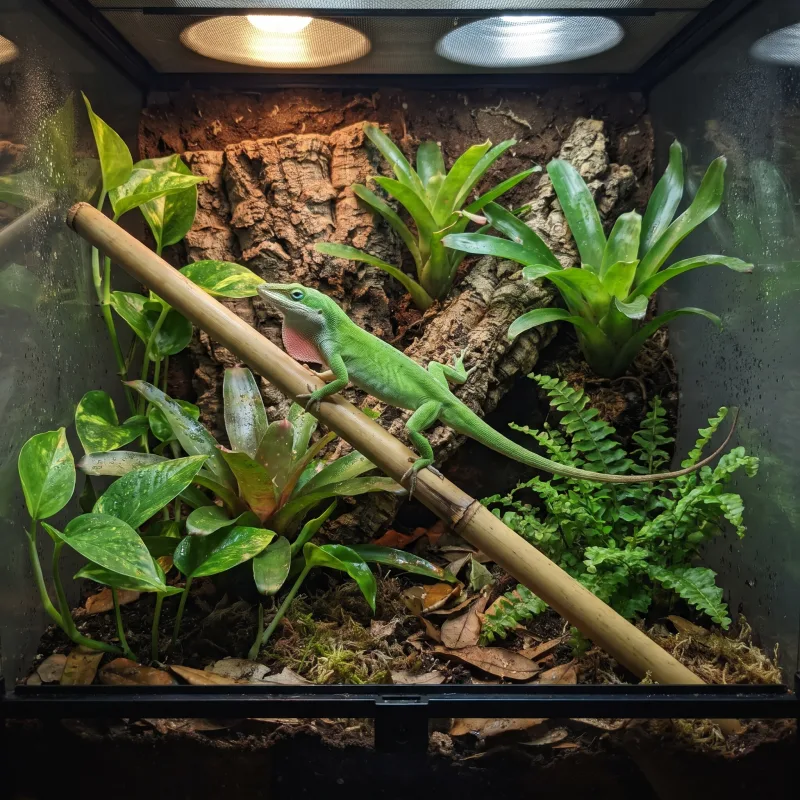
- A well-planted, correctly lit vivarium lets their natural behaviour show.
Temperament
- Green anoles are quick, alert and entertaining to watch, with males displaying dewlaps and territorial push-ups.
- They are not handling pets; they are easily stressed, dart rapidly and can drop their tails, so interaction should be limited to maintenance and observation.
Show 2 more
- Socially, males are strongly territorial and must never be housed together, as they fight and display constantly.
- Groups of one male with females, or of females only, are sometimes kept in much larger, densely planted enclosures with several basking and hiding spots, but bullying is common and housing singly is the safer default.
A good fit for
- Keepers wanting an active, affordable display lizard
- People happy to watch rather than handle
- Naturalistic, planted-vivarium enthusiasts
- Those wanting a small diurnal insectivore
Common mistakes to avoid
- Housing two males together (constant fighting)
- Bare tanks without plants and climbing cover
- Missing UVB, causing metabolic bone disease
- Relying on a water bowl instead of misting
Enclosure
Minimum 4 sq ft0.36 m² of floor · 24 x 24 x 24 in60 x 60 x 60 cm
Usually kept alone. Best kept singly; never two males
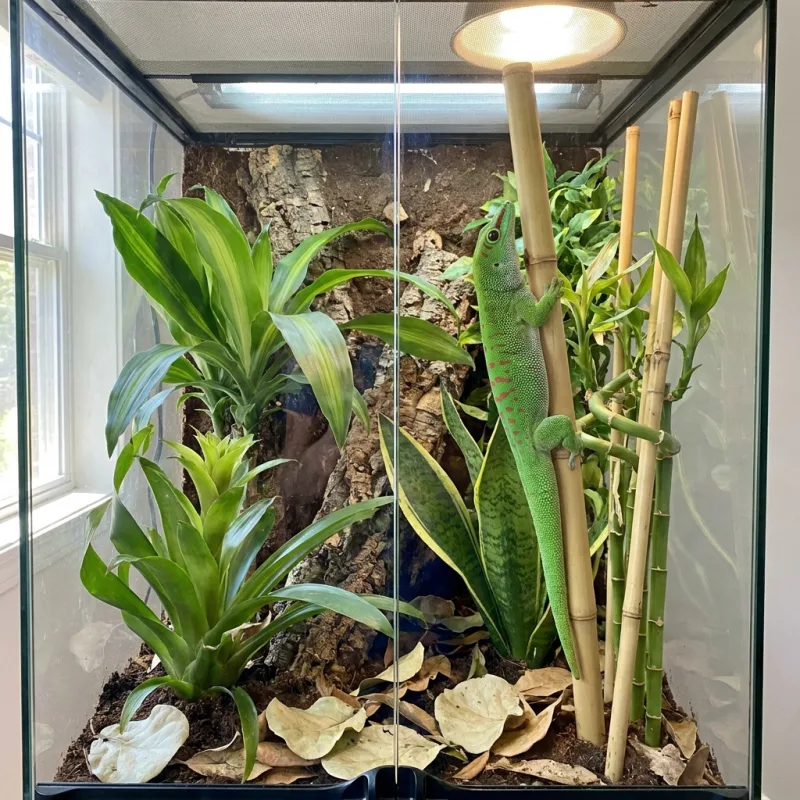
- House a green anole in a tall, well-ventilated, heavily planted vivarium of at least 24 x 24 x 24 in60 x 60 x 60 cm for one animal, and far larger for any group, with abundant branches, vines and foliage for climbing, basking and hiding.
- Vertical space and dense cover reduce stress in this arboreal species.
- Provide a basking spot of about 82-90°F28-32°C under a heat lamp with a cooler gradient below, and a UVB source, as anoles are diurnal and need it for calcium metabolism and to prevent metabolic bone disease.
- Maintain humidity around 60-70% by misting once or twice daily; they drink droplets from leaves rather than from a standing bowl.
Supplies
Setup
- Enclosure
- Heating and thermostat
- UVB fixture and bulb
- Thermometers and hygrometer
- Substrate and decor
Ongoing
- Flightless fruit flies, and crickets sized to the anole (pinheads for hatchlings, about 1/4 inch6.5 millimetres for adults)
- Small dubia roaches or black soldier fly larvae
- Plain calcium powder without D3
- Vitamin and D3 supplement
- Feeder gut-load and a small ventilated tub
Show 2 more
- Hand mister or automatic misting system
- Shallow water dish (as a backup, not the main supply)
Safe substrate: Topsoil and coco fibre mix · Leaf litter over a soil base · Cypress mulch or orchid bark
Care routine
Daily
- Check temperatures and humidity
- Look the animal over
- Mist the enclosure
- Refresh the backup water dish (misting is the real water supply)
- Spot-clean waste and uneaten food
Every few days
- Small dusted insectsevery 2 days
Every few weeks
- Weigh on a fine scaleevery 2 weeks
Show 4 more
Monthly
- Deep-clean decor, glass and bowls
- Test thermostats, lamps and guards
Less often
- Refresh the substrateevery 3 months
- Check the UVB lamp's age and replace it if due (if one is fitted)every 6 months
Vet: Annual exam, every 12 months (every 6 months from 4 years old)
Tools
Care in depth
Diet
Insectivore (small live insects)
- Green anoles are insectivores that eat a variety of small, gut-loaded live insects such as appropriately sized crickets, fruit flies, small roaches and black soldier fly larvae.
- Prey should be no wider than the space between the eyes, and active hunting is part of their enrichment.
- Dust insects with calcium regularly and with a vitamin/D3 supplement on a measured schedule to prevent both deficiency and excess.
- Feed juveniles daily and adults every other day, adjusting for body condition.
- Mist surfaces so they can drink, since dehydration is common when keepers assume a water bowl is enough for this droplet-drinking species.
Health
Signs of good health, and the common problems
- A healthy anole is alert, brightly coloured when relaxed, well-muscled and active during the day.
- Metabolic bone disease from inadequate UVB or calcium is the most common serious problem, alongside dehydration, stuck shed from low humidity, and stress-related colour darkening and hiding.
- Because they are small and secretive, weight loss and illness can be missed, so observe appetite and body condition closely.
- A dropped tail regrows imperfectly; it usually means the anole was grabbed, bitten by a cagemate or caught on something, and the cause needs finding.
- Persistent dark colour, lethargy, sunken eyes or a soft jaw should prompt a visit to an exotics vet familiar with small lizards.
Is this urgent?
8 warning signs and how fast to act, 5 of them right away
Most reptile emergencies are husbandry emergencies first. Before you panic, check the temperatures, but check them with a thermometer, not a hand.
Go now
Today
Soon
Before any non-emergency call, write down the four numbers a vet will ask for: the thermostat probe reading, the warm-end air temperature, the cool-end air temperature, and the hottest accessible surface. Surface temperature can run well above the air above it.
This is general guidance for a healthy adult, not a diagnosis. An exotics vet who knows your animal always overrides it, and the time to find one is before you need one.
Bedding and substrate
5 safe, 3 with a caveat, 4 to avoid
Substrate choice follows the animal's natural humidity, not the look of the vivarium. Get that pairing right and most substrate arguments disappear.
Safe
With a caveat
Never
This is our general list for reptiles. We have not built one specific to Anoles yet.
Impaction is far more often a temperature problem than a substrate problem: an animal that cannot reach its digestive temperature will not pass what it swallows, whatever it is standing on.
Top resources for more info
Independent creators and organisations we would send a friend to. We have no affiliation with any of them, and nothing here is sponsored. Links checked 2026-10-22.
YouTubers
Sites
Other Reptiles worth knowing
Same axes, same care guides: the honest way to compare them.