Mali Uromastyx
Uromastyx dispar maliensis
Herbivorous desert lizard that worships heatIntermediate
- Lifespan
- 15-20+ years
- Size
- 12-15 in30-38 cm
- Social needs
- Solitary; house singly
- Time
- Medium (daily feed, long-term)
- Cost
- Medium-High
- Diet
- Herbivore: greens, dried seeds and lentils
Overview
What is this animal?
- The Mali uromastyx is a stocky, spiny-tailed lizard from the southern Sahara that runs almost entirely on leafy greens and seeds.
- Males often develop striking yellow-and-black patterning.
- They are placid, diurnal, and long-lived, and their plant-based diet sidesteps the insect-keeping that puts some people off lizards.
- The catch is heat: few commonly kept reptiles need basking temperatures this extreme.
Temperament
- Uromastyx are calm and tolerate brief, confident handling better than most lizards once settled, though they would always rather bask than be held.
- A startled animal retreats to its burrow and wedges in with its spiked tail.
Show 2 more
- House them singly: males fight, and even pairs stress each other in ordinary-sized enclosures.
- They show plenty of personality through glass: head bobs, basking sprawls, and salad enthusiasm.
A good fit for
- Keepers who want a lizard without feeder insects
- Fans of bold, diurnal display reptiles
- Households able to fund serious heat and UVB
- People ready for a 15-20 year commitment
Common mistakes to avoid
- Basking spots that are merely warm, not hot
- Humid rooms or substrates causing tail rot
- Fruit- and lettuce-heavy diets with no fibre
- Cohabiting: males injure each other
Enclosure
Minimum 12 sq ft1.08 m² of floor · 47 x 35 x 24 in120 x 90 x 60 cm
Must be housed alone. Solitary; house singly
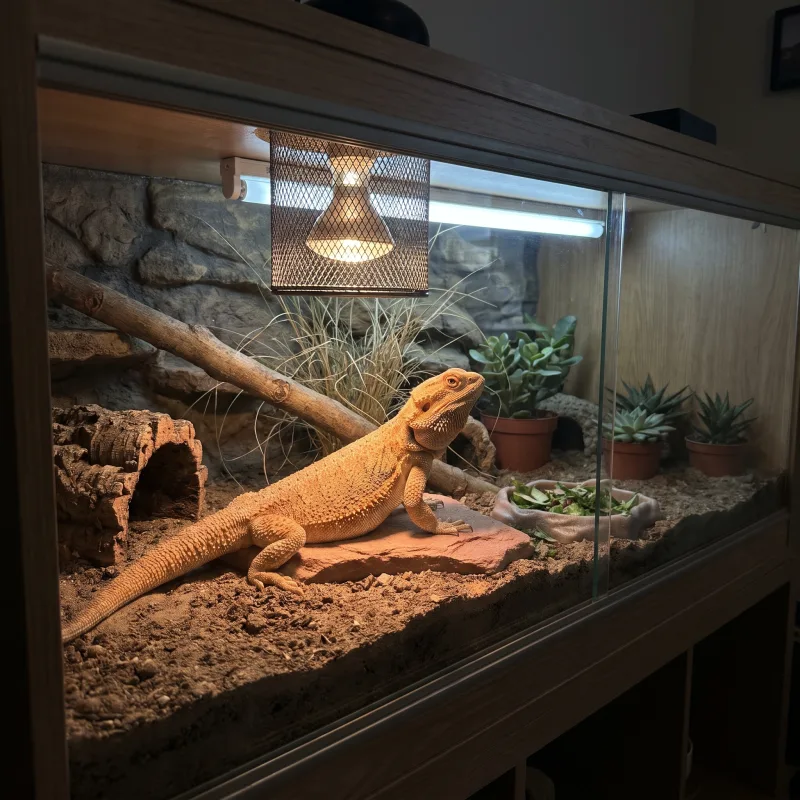
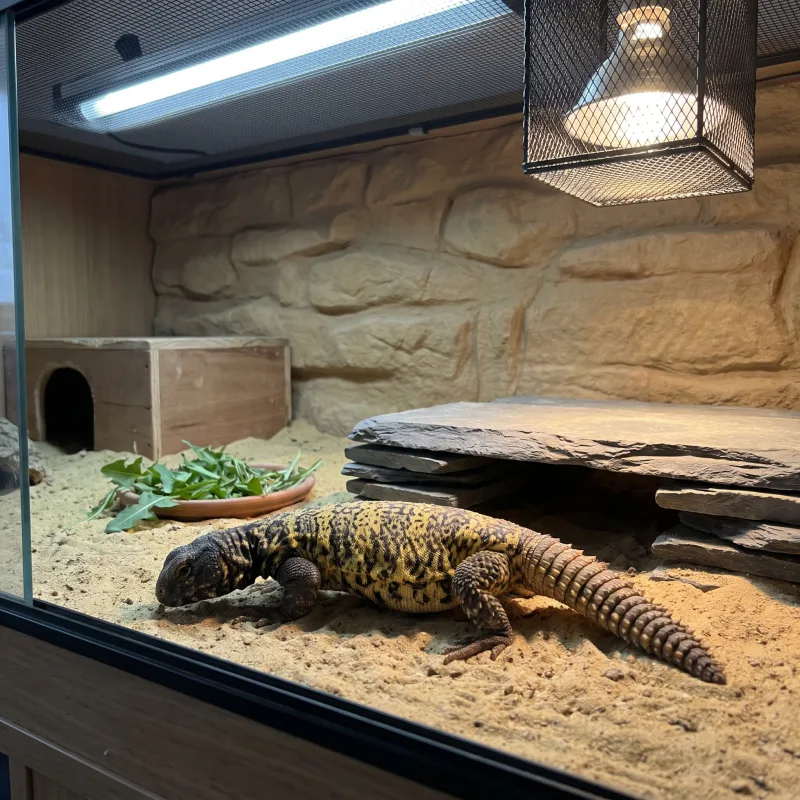
- Provide a floor space of at least 4 x 3 ft120 x 90 cm, with 2 ft60 cm of height, for an adult, with a deep, diggable substrate layer or a burrow box, plenty of flat rock, and low hides.
- These are ground-dwelling diggers rather than climbers.
- The basking surface should reach roughly 120-131°F49-55°C under a halogen flood, with a cool end in the low 80s°Fthe high 20s°C and an overnight drop.
Show 2 more
- Strong UVB is essential and humidity should stay low (around 20-30%).
- Uromastyx take most of their water from fresh greens, but keep a small, shallow bowl of fresh water available on the cool side; in a well-ventilated enclosure it will not push humidity to a harmful level.
Supplies
Setup
- Enclosure, 4 x 3 x 2 ft120 x 90 x 60 cm or larger
- Heating and thermostat
- UVB fixture and bulb
- Thermometers and hygrometer
- Substrate and decor
Ongoing
- Endive, escarole, chicory and dandelion greens
- Dried lentils and split peas
- Small bird-type seed or millet
- Dried edible flowers (hibiscus, dandelion)
- Calcium powder for dusting
Show 3 more
- Balanced reptile multivitamin
- Two shallow dishes: one for salad, one for the seed and lentil portion
- Shallow water dish
Safe substrate: Topsoil and play sand mix · Slate or unpolished stone tile · Paper towel or newspaper
Care routine
Daily
- Check heat and keep it dry
- Fresh greens (seeds and lentils in small portions only)
- Fresh water bowl
- Look the animal over
- Spot-clean waste and uneaten food
Show 7 more
Every few weeks
- Brief, infrequent handling onlyevery 2 weeks
- Check the burrow or dig layerevery 2 weeks
- Weigh-inevery 2 weeks
Monthly
- Deep-clean decor, glass and bowls
- Test thermostats, lamps and guards
Less often
- Refresh the substrateevery 3 months
- Check the UVB lamp's age and replace it if due (if one is fitted)every 6 months
Vet: Annual exam and faecal check, every 12 months (every 6 months from 12 years old)
Tools
Care in depth
Diet
Herbivore: greens, dried seeds and lentils
- Feed a daily salad of dark leafy greens such as endive, escarole, chicory, dandelion, and squash, dusted regularly with calcium.
- Spring mix works as a base but should be cut with coarser, calcium-rich greens.
- Offer a small portion of dried lentils, split peas and small seed such as millet as a regular part of the diet.
- Advice differs on how often: some specialist sources say a small amount no more than once a week, while some keepers leave a dry dish out permanently.
- Either way these are rich in protein and fat, so keep portions small and watch body condition.
- Adults need no insects; sugary fruit should stay an occasional treat at most.
Health
Signs of good health, and the common problems
- Most health problems trace to insufficient heat or UVB: poor digestion, lethargy, and metabolic bone disease top the list.
- A cool uromastyx simply cannot process its food.
- High humidity causes respiratory and tail-rot problems, so keep the enclosure dry and ventilated.
- Find an exotics vet before you need one; a 20-year lifespan means you eventually will.
Is this urgent?
8 warning signs and how fast to act, 5 of them right away
Most reptile emergencies are husbandry emergencies first. Before you panic, check the temperatures, but check them with a thermometer, not a hand.
Go now
Today
Soon
Before any non-emergency call, write down the four numbers a vet will ask for: the thermostat probe reading, the warm-end air temperature, the cool-end air temperature, and the hottest accessible surface. Surface temperature can run well above the air above it.
This is general guidance for a healthy adult, not a diagnosis. An exotics vet who knows your animal always overrides it, and the time to find one is before you need one.
Bedding and substrate
3 safe, 1 with a caveat, 5 to avoid
For a desert lizard the floor should be dry on top and firm enough to hold a burrow; anything chosen to hold humidity is the wrong material.
Safe
With a caveat
Never
Impaction is far more often a temperature problem than a substrate problem: an animal that cannot reach its digestive temperature will not pass what it swallows, whatever it is standing on.
Top resources for more info
Independent creators and organisations we would send a friend to. We have no affiliation with any of them, and nothing here is sponsored. Links checked 2026-10-22.
YouTubers
Sites
Other Reptiles worth knowing
Same axes, same care guides: the honest way to compare them.