Mandarin Dragonet
Synchiropus splendidus
Strikingly coloured fish needing a copepod-rich tankAdvanced
- Lifespan
- 5-10 years
- Size
- 2.5-3 in6-8 cm
- Social needs
- One male per tank; a female may be added
- Time
- High
- Cost
- High
- Diet
- Carnivore, live copepods primarily
Overview
What is this animal?
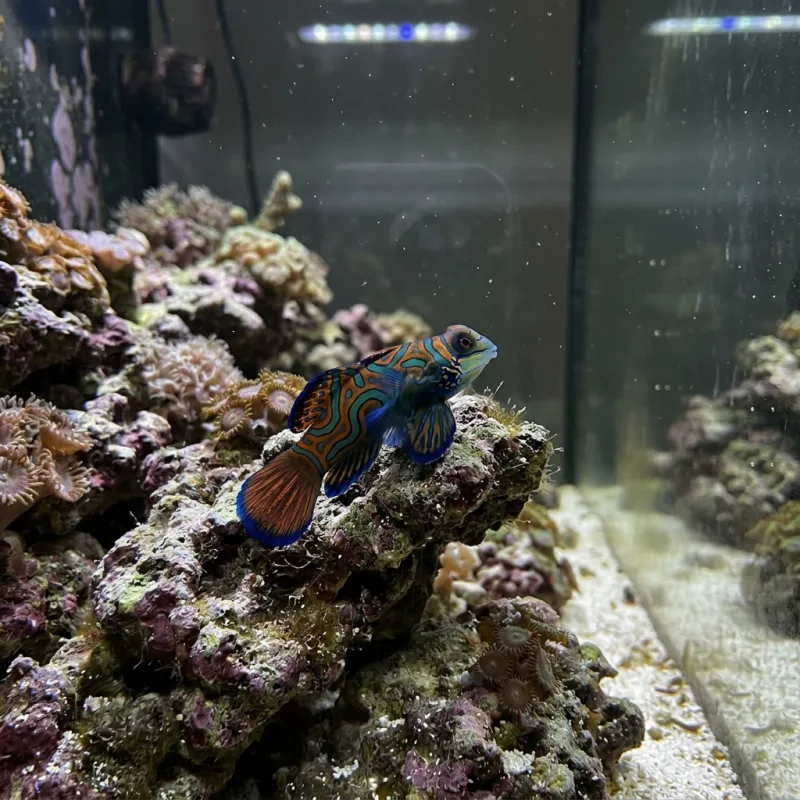
- The Mandarin Dragonet is a strikingly coloured fish, swirled in green, orange, and blue.
- Despite its calm, slow-moving charm, it is an advanced fish because of its specialised diet of small live invertebrates, mainly copepods.
- Most mandarins die slowly of starvation in tanks that cannot sustain a copepod population.
- Success needs a large, mature reef, ideally with a refugium, and patience to establish a thriving food supply.
Temperament
- Peaceful, slow, and shy, it spends the day methodically hopping across rock and sand hunting pods.
- It is reef-safe and harmless to corals and invertebrates, making a calm community fish.
Show 2 more
- Males are territorial toward other males, so keep only one male per tank; a male and female can coexist in a large system.
- Avoid fast, greedy tankmates that outcompete it for food.
A good fit for
- Experienced keepers with mature reefs
- Tanks with a refugium and pod culture
- Aquarists who choose captive-bred, feeding stock
- Patient hobbyists with peaceful communities
Common mistakes to avoid
- Starves without an established copepod supply
- Sold for immature tanks that cannot feed it
- Watch for a pinched, hollow belly
- Greedy tankmates outcompete this slow feeder
Enclosure
Minimum 100 gallons379 litres
Fine alone or with company. One male per tank; a female may be added
- Provide a well-established reef of at least 100 gallons379 L with abundant live rock and a sandbed that hosts copepods: a mature live-rock tank of about that size supports one mandarin, provided nothing else competes for the pods.
- A refugium or pod-culturing system on top of that is strongly recommended to replenish the food supply, and a pair, or a tank with other pod-eaters, needs more.
- A 53 gallon200 L tank is a minimum, and below that size the pods have to be cultured outside the tank, possibly for the fish's whole life.
Show 2 more
- Keep temperature 75-81°F24-27°C, salinity 1.024-1.026, pH 8.1-8.4, and ammonia and nitrite at zero.
- The tank must be biologically mature, never new, before a mandarin is introduced.
Supplies
Setup
- Tank, stand and sump
- Return pump and powerheads
- Protein skimmer
- Reef lighting
- Rock and sand
Show 2 more
- Salt mix, refractometer and test kits
- Quarantine tank
Ongoing
- Live copepod bottles for regular top-ups
- Refugium or pod-culture setup
- Refugium macroalgae or pod hotel media
- Frozen cyclops and baby brine shrimp (for trained individuals)
- Small marine pellets (for trained individuals)
Show 2 more
- Turkey baster for target-feeding near the rockwork
- Small thawing cup
Safe substrate: Aragonite sand · Dry or cured live rock
Care routine
Daily
- Check salinity, temperature and flow
- Head-count and look everyone over
- Target-feed a trained fish; otherwise check the pods
- Top up evaporation with fresh water
Every few days
- Service the skimmer and filter socksevery 3 days
Show 9 more
Weekly
- Check the copepod population
- Clean the glass
- Test the water
- Water change
Monthly
- Calibrate the refractometer
- Check salt, RO/DI and reagents
- Harvest and refresh the refugium
Less often
- Deep-clean pumps and powerheadsevery 3 months
- Replace RO/DI filter mediaevery 6 months
Health review: Monthly pod and belly-profile check, every month
Tools
Care in depth
Diet
Carnivore, live copepods primarily
- A specialised carnivore that grazes copepods and amphipods picked from rock and sand throughout the day.
- A single fish can quickly exhaust a tank's pod population, so a refugium and regular pod top-ups are important.
- Many individuals never accept prepared food, though some can be trained onto frozen cyclops, baby brine, or pellets, and captive-bred mandarins take prepared diets more readily.
- Choose feeding specimens whenever possible.
Health
Signs of good health, and the common problems
- When properly fed, mandarins are reasonably hardy and resistant to ich thanks to a thick protective slime coat.
- The main health risk is slow starvation, visible as a pinched belly and hollow stomach over weeks.
- Quarantine and stable water remain important, but the single best safeguard is confirming the fish eats and maintaining a robust food supply.
- A plump, rounded belly indicates a thriving mandarin.
Is this urgent?
6 warning signs and how fast to act, 3 of them right away
In a reef, stability matters more than any single target number. A parameter moving fast does more damage than a parameter sitting slightly off.
Go now
Today
Quarantine every new animal, including corals and inverts. It is the single practice that separates a reef that lasts from a reef that restarts.
This is general guidance for a healthy adult, not a diagnosis. An exotics vet who knows your animal always overrides it, and the time to find one is before you need one.
Bedding and substrate
2 safe, 3 with a caveat, 2 to avoid
In a marine system the rock and the sand are life support, and how you start them decides the first six months.
Safe
With a caveat
Never
This is our general list for saltwater fish. We have not built one specific to Dragonets yet.
Top resources for more info
Independent creators and organisations we would send a friend to. We have no affiliation with any of them, and nothing here is sponsored. Links checked 2026-10-22.
YouTubers
Sites
Other Saltwater Fish worth knowing
Same axes, same care guides: the honest way to compare them.