Sixline Wrasse
Pseudocheilinus hexataenia
Active, jewel-toned hunter of reef pestsBeginner
- Lifespan
- 4-7 years
- Size
- 3-4 in7-10 cm
- Social needs
- One per tank in most systems
- Time
- Low
- Cost
- High
- Diet
- Carnivore, micro-invertebrates
Overview
What is this animal?
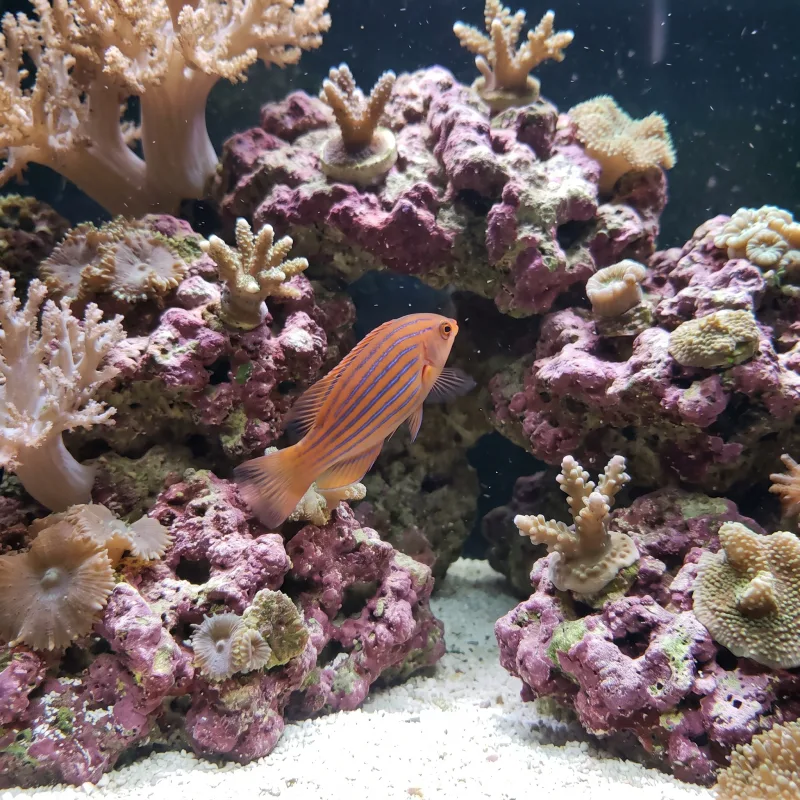
- The Sixline Wrasse is a small, fast, jewel-toned fish striped orange and blue, popular for its hardiness and appetite for reef pests.
- It is constantly active, darting through rockwork in search of food.
- It is reef-safe and helps control pyramidellid snails and some flatworms.
- Easy to keep, it suits beginners, though its bold temperament can grow more aggressive as it matures.
Temperament
- Active and bold, it becomes increasingly territorial and aggressive with age, sometimes harassing newly added or timid fish.
- Add it last to a community so existing fish are established, and keep only one per tank.
Show 2 more
- Reef-safe with corals, but not with every invertebrate: small shrimp (cleaner and peppermint shrimp included, especially while moulting), tiny snails and small hermit crabs can be picked off, particularly by a large, established adult.
- Its assertive nature means careful tankmate selection in smaller or peaceful systems.
A good fit for
- Beginners wanting a hardy, active fish
- Reef tanks needing pest control
- Mature tanks with healthy pod populations
- Keepers wanting colour and movement
Common mistakes to avoid
- Grows territorial and aggressive with age
- Add last so it cannot dominate
- Known jumper; needs a secure lid
- May bully timid or newly added fish
Enclosure
Minimum 130 gallons500 litres
One of its kind per tank; other compatible species can share it. One per tank in most systems
- House in an established reef of at least 133 gallons500 L with abundant live rock full of crevices to hunt and shelter in.
- It can be kept in 30 gallons115 litres, and care references give 55-60 gallons208-227 L, but this is a constantly foraging fish that grows more territorial with age.
- This guide asks for more because good conditions are never less than a law requires, and Austria's law asks 130 gal500 L for a wrasse this size.
Show 3 more
- A mature tank with a good population of micro-invertebrates provides natural foraging.
- Keep temperature 75-81°F24-27°C, salinity 1.024-1.026, pH 8.1-8.4, and ammonia and nitrite at zero.
- Plenty of rockwork lets this active fish exercise its natural hunting behaviour.
Supplies
Setup
- Tank, stand and sump
- Return pump and powerheads
- Protein skimmer
- Reef lighting
- Rock and sand
Show 2 more
- Salt mix, refractometer and test kits
- Quarantine tank
Ongoing
- Frozen mysis shrimp
- Frozen enriched brine shrimp
- Marine flake or small pellet
- Copepod bottle for periodic top-ups
- Refugium media or a pod hotel (optional)
Show 2 more
- Vitamin or HUFA soaking supplement
- Small thawing cup and strainer
Safe substrate: Aragonite sand · Dry or cured live rock
Care routine
Daily
- Check salinity, temperature and flow
- Check the lid
- Feed
- Head-count and look everyone over
- Top up evaporation with fresh water
Every few days
- Service the skimmer and filter socksevery 3 days
Show 7 more
Weekly
- Clean the glass
- Test the water
- Water change
Monthly
- Calibrate the refractometer
- Check salt, RO/DI and reagents
Less often
- Deep-clean pumps and powerheadsevery 3 months
- Replace RO/DI filter mediaevery 6 months
Health review: Quarterly review with lid and rockwork check, every 3 months
Tools
Care in depth
Diet
Carnivore, micro-invertebrates
- A carnivore that hunts copepods, amphipods, small worms, and other micro-invertebrates among the rocks.
- Supplement with frozen mysis and brine shrimp, marine flakes, and pellets once or twice daily.
- A mature tank with a healthy pod population supports natural grazing between feedings.
- It readily accepts prepared foods, making it simple to keep well-fed and active.
Health
Signs of good health, and the common problems
- Hardy and disease-resistant, one of the more forgiving marine fish, though quarantine remains best practice.
- Stable water and a varied diet keep it healthy and well coloured.
- Watch for hiding, faded colour, or reduced appetite as signs of stress or poor conditions.
- It can also jump, so a secure lid prevents the most common cause of accidental loss.
Is this urgent?
6 warning signs and how fast to act, 3 of them right away
In a reef, stability matters more than any single target number. A parameter moving fast does more damage than a parameter sitting slightly off.
Go now
Today
Quarantine every new animal, including corals and inverts. It is the single practice that separates a reef that lasts from a reef that restarts.
This is general guidance for a healthy adult, not a diagnosis. An exotics vet who knows your animal always overrides it, and the time to find one is before you need one.
Bedding and substrate
2 safe, 3 with a caveat, 2 to avoid
In a marine system the rock and the sand are life support, and how you start them decides the first six months.
Safe
With a caveat
Never
This is our general list for saltwater fish. We have not built one specific to Wrasses yet.
Top resources for more info
Independent creators and organisations we would send a friend to. We have no affiliation with any of them, and nothing here is sponsored. Links checked 2026-10-22.
YouTubers
Sites
Other Saltwater Fish worth knowing
Same axes, same care guides: the honest way to compare them.