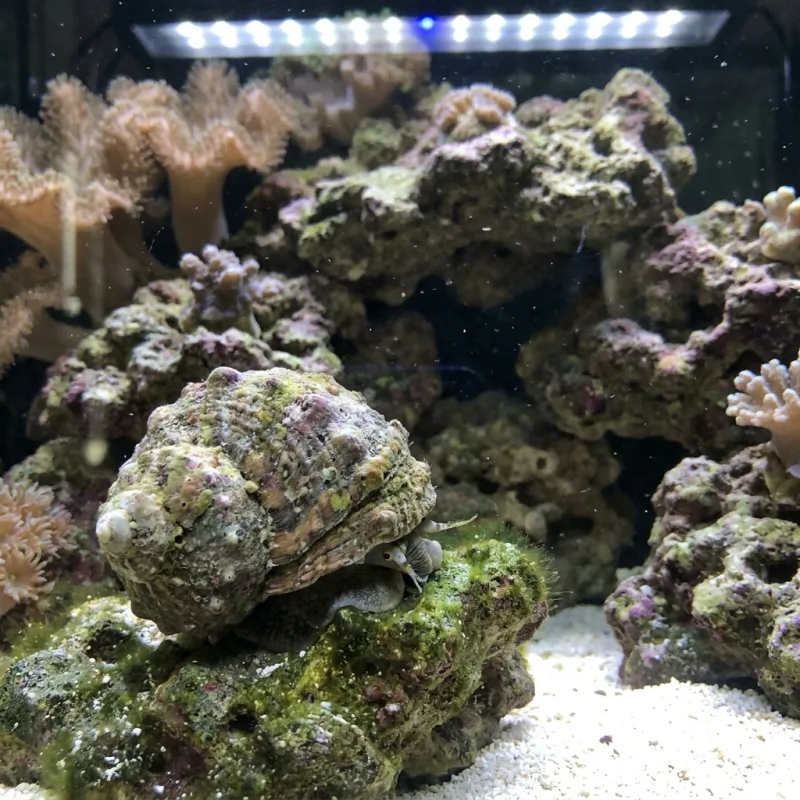
Mexican Turbo Snail
Turbo fluctuosus
The clean-up crew's algae-mowing bulldozerBeginner
- Lifespan
- Often only 1-2 years in aquariums; up to 3-5 years in the wild
- Size
- Up to ~2.5 in6 cm shell (often 1.5-2 in4-5 cm)
- Social needs
- No social needs; stock about one per 29-50 gal110-190 L
- Time
- Low, but must supplement nori once algae is gone
- Cost
- Low
- Diet
- Herbivore (film/hair algae, diatoms, nori)
Overview
What is this animal?
- The Mexican turbo snail is the heavyweight of the marine clean-up crew, a thick, turban-shelled grazer from the Gulf of California that mows down hair algae faster than any other snail commonly sold in the hobby.
- A single adult reaches roughly 2-2.5 in5-6 cm and clears algae at a pace smaller snails cannot match.
- Two things set it apart from the lookalike Astraea and Trochus snails.
Show 6 more
- Like the Trochus, and unlike the flat, top-shaped Astraea, it can usually right itself after a tumble.
- More importantly, it out-eats almost every tank it goes into, so a full-grown turbo that isn't fed will strip the glass bare and then slowly starve.
- Most traded turbos are collected in the Gulf of California, where shallow water runs from below 68°F20°C in winter to around 86°F30°C in late summer.
- Many keepers find they last longer a little cooler than a typical reef, so 72-77°F22-25°C is a sensible target if the rest of your livestock allows it.
- Treat it as a large herbivore with real needs, not a disposable algae tool.
- Bought by the handful for a small tank, most are dead within months.
Temperament
- It is completely peaceful and fully reef-safe in intent, ignoring fish, corals, shrimp, and other snails entirely.
- Any damage it causes is mechanical: an unglued frag ploughed off a ledge, never a bite.
Show 3 more
- The risk runs the other way: large hermit crabs kill turbo snails for their shells, and snail-eating wrasses, triggerfish, and pufferfish treat it as food, so vet the stocking list both ways.
- Offer plenty of spare empty shells if hermits share the tank, though big hermits and turbos remain a risky mix.
- Expect a slow, methodical grazer, most active through the evening and night, that leaves clean tracked lanes through the algae by morning.
A good fit for
- Tanks with a genuine hair-algae problem
- Established, mature systems with algae to spare
- Cooler-run reefs and FOWLR tanks (72-77°F22-25°C)
- Keepers who stock clean-up crews sparingly
Common mistakes to avoid
- Starvation once the algae runs out, the number-one killer
- Bulldozing unglued frags and loose rockwork
- Running it at reef temperatures of 79°F26°C or more, which many keepers find shortens its life
- Copper medication is lethal at any dose
- Large hermit crabs that kill it for its shell
- Rushed acclimation: drip for at least an hour
Enclosure
Minimum 29 gallons110 litres
Fine alone or with company. No social needs; stock about one per 29-50 gal110-190 L
- Give one snail a mature tank of at least 29 gallons110 litres with plenty of live rock and glass carrying a genuine algae film.
- Stock sparsely: roughly one turbo per 29-50 gallons110-190 litres is a realistic ceiling, not the six-packs sold in clean-up-crew bundles; this species eats far more than a small tank can grow.
- This is a bulldozer.
Show 3 more
- It shoulders through rockwork and ploughs unattached frags off ledges, so glue or epoxy every coral and stack rock securely on the bottom glass rather than balancing it on the sand.
- Keep salinity stable at 1.023-1.026 and temperature ideally at 72-77°F22-25°C; keepers commonly report longer lives in that range than at the sustained 79°F26°C or more that most tropical reef tanks run at.
- Unlike Astraea snails it can normally flip itself back over, but still scan the sand for stranded snails after falls, and keep a tight-fitting lid: it grazes right to the waterline and occasionally climbs above it.
Supplies
Setup
- Tank, stand and sump
- Return pump and powerheads
- Protein skimmer
- Reef lighting
- Rock and sand
Show 2 more
- Salt mix, refractometer and test kits
- Quarantine tank
Ongoing
- Dried marine algae (nori) sheets
- Veg clip or rubber bands for anchoring nori to rock
- Alkalinity and calcium test reagents
- Turkey baster for placing food near the snail
- Algae scraper (to clean selectively, not completely)
Safe substrate: Aragonite sand · Dry or cured live rock
Care routine
Daily
- Check salinity, temperature and flow
- Head-count and look everyone over
- Remove any dead snails
- Top up evaporation with fresh water
- Turn over stranded snails
Every few days
- Check the algae, and offer nori if it is grazed bareevery 2 days
- Service the skimmer and filter socksevery 3 days
Show 8 more
Weekly
- Check alkalinity and calcium
- Clean the glass
- Test the water
- Water change
Monthly
- Calibrate the refractometer
- Check salt, RO/DI and reagents
Less often
- Deep-clean pumps and powerheadsevery 3 months
- Replace RO/DI filter mediaevery 6 months
Health review: Quarterly shell and clean-up crew review, every 3 months
Tools
Care in depth
Diet
Herbivore (film/hair algae, diatoms, nori)
- This is a strict herbivore that files film algae, diatoms, and nuisance hair algae off rock and glass with its rasping radula.
- It is one of the few clean-up snails that tackles established hair-algae turf rather than only fresh film.
- Its appetite is the trap: a full-grown turbo eats more algae per day than most modest tanks grow, and starvation is the species' number-one killer.
- Once the visible algae is gone, feed dried seaweed (nori) clipped or rubber-banded to a rock several times a week, and add more snails only if the tank can actually feed them.
- It will not solve cyanobacteria, bubble algae, or dinoflagellate outbreaks; buying extra snails to fight those problems just adds more mouths to starve.
Health
Signs of good health, and the common problems
- Acclimation is the critical moment: drip-acclimate over at least an hour, ideally two, because turbo snails tolerate salinity and pH swings poorly and often die in the first week from rushed transfers.
- Never expose them to copper-based medications: copper is lethal to snails and other invertebrates at any treatment dose.
- Never pull a gripping snail off the glass; the foot tears and the wound is usually fatal, so nudge it sideways until it releases on its own.
- Keep nitrates modest (under roughly 20 ppm) and alkalinity stable for healthy shell growth.
- Chronic poor water shows as a snail that stops moving and hangs loose in its shell.
- Check on any snail motionless for more than a day: a live one clamps its operculum (trapdoor) shut when touched, while a dead one gapes open and smells unmistakable.
- Remove dead snails immediately: a decomposing adult turbo can spike ammonia in a small tank within hours.
Is this urgent?
6 warning signs and how fast to act, 3 of them right away
In a reef, stability matters more than any single target number. A parameter moving fast does more damage than a parameter sitting slightly off.
Go now
Today
Quarantine every new animal, including corals and inverts. It is the single practice that separates a reef that lasts from a reef that restarts.
This is general guidance for a healthy adult, not a diagnosis. An exotics vet who knows your animal always overrides it, and the time to find one is before you need one.
Bedding and substrate
2 safe, 3 with a caveat, 2 to avoid
In a marine system the rock and the sand are life support, and how you start them decides the first six months.
Safe
With a caveat
Never
This is our general list for saltwater fish. We have not built one specific to Snails yet.
Top resources for more info
Independent creators and organisations we would send a friend to. We have no affiliation with any of them, and nothing here is sponsored. Links checked 2026-10-22.
YouTubers
Sites
Other Saltwater Fish worth knowing
Same axes, same care guides: the honest way to compare them.