Chinchilla
Small Pets

Chinchilla

Chinchilla lanigera

A long-lived, heat-sensitive, crepuscular acrobatAdvanced

Lifespan
10-15 years
Size
10-14 in body, plus tail
Social needs
Social; keep compatible same-sex pairs
Time
Daily; long-term, plus careful temperature control
Cost
High
Diet
Unlimited grass hay plus measured plain pellets

Overview

What is this animal?

  • The chinchilla is a long-lived Andean rodent with very dense, soft fur and an energetic, acrobatic nature.
  • They commonly live 10 to 15 years, and sometimes longer, making them one of the longer-lived small pets and a serious commitment.
  • Crepuscular to nocturnal, agile and sensitive to heat, chinchillas need specialised care and are not ideal for young children or casual owners.
  • Their longevity and specific needs place them in the advanced category.

Temperament

  • Chinchillas are lively, intelligent and curious, but also quick and easily startled, preferring to explore on their own terms rather than be cuddled.
  • With gentle, patient handling many become tame and interactive.
Show 2 more
  • They are social and generally happier in compatible same-sex pairs, provided introductions are careful.
  • Their crepuscular and nocturnal activity means they are liveliest in the evening, suiting keepers with matching routines.

A good fit for

  • Experienced keepers wanting a long-lived pet
  • Owners able to keep rooms cool
  • Those with evening-active routines
  • Keepers committed for well over a decade

Common mistakes to avoid

  • Overheating; needs cool, low-humidity rooms
  • Inadequate hay causing dental disease
  • Sugary or fatty treats upsetting digestion
  • Underestimating the long lifespan commitment

Enclosure

Minimum 22 sq ft of floor, for the pair · 6.5 x 3.3 x 5 ft

Cannot be kept alone. The minimum is 2, and the space above is for that group.

  • Give a pair a tall enclosure of at least 105 cubic feet and at least 59 in high, for example 6.5 x 3.3 x 4.9 ft, and add at least 18 cubic feet for each further adult.
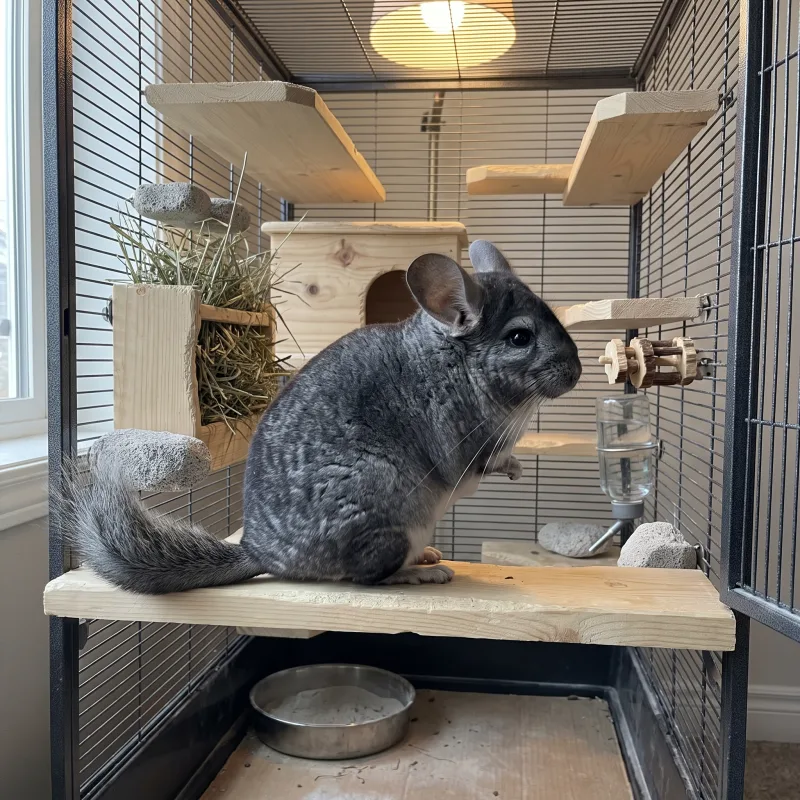
  • Fit solid shelves on at least three levels that they reach by jumping, leave plenty of climbing and jumping space, and close off two adjoining sides so they can retreat from view.
  • Use safe, non-toxic wooden ledges and avoid wire flooring, which harms their feet.
Show 3 more
  • Most chinchilla cages sold in shops are far smaller than this.
  • Chinchillas overheat easily: keep them below about 77°F at all times, and ideally cool, at the 50-64°F the RSPCA advises, with low humidity; heatstroke is a real risk.
  • Offer a dust bath every day for about 10 to 15 minutes, as the RSPCA, VCA and Merck advise and Austrian law requires, then take it out so it stays clean and does not irritate the eyes.

Check your enclosure

Supplies

Setup

  • Enclosure, 6.5 x 3.3 x 4.9 ft or larger
  • Water bottles, bowls, hides and enrichment
  • Carrier and travel box
  • Digital kitchen scale

Ongoing

  • Grass hay in bulk (Timothy or orchard)
  • Plain chinchilla pellets, no added seeds or fruit
  • Dried rose hips or plain herbal treats
  • Untreated apple or willow chew sticks
  • Water bottle plus a bottle brush
Show 3 more
  • Hay rack
  • Measuring spoon for the daily pellet ration
  • Airtight bin for pellets; store hay dry, off the floor and with airflow (its box, a paper sack or a ventilated bin)

Safe substrate: Kiln-dried aspen · Dust-extracted paper bedding · Chinchilla bathing dust or fine chinchilla bathing sand, offered for 10 to 15 minutes at a time

Work out the cost

Care routine

Daily

  • Check the room temperature
  • Company and time out
  • Feed and clear yesterday's leftovers
  • Fresh water
  • Offer a dust bath
  • Spot-clean the enclosure
  • Top up unlimited hay
  • Watch them while they are awake
Show 7 more

Weekly

  • Deep-clean and change bedding
  • Hands-on health check
  • Rotate enrichment
  • Weigh-in

Every few weeks

  • Replace chews and pumiceevery 2 weeks

Monthly

  • Check nails and teeth
  • Check supplies and dates

Vet: Annual exam and dental check, every 12 months (every 6 months from 8 years old)

Tools

Care in depth

Diet

Unlimited grass hay plus measured plain pellets
  • The diet centres on unlimited high-quality grass hay, which is essential for the continuously growing teeth and sensitive digestion, plus a measured portion of plain chinchilla pellets.
  • Hay should always dominate.
  • Provide constant fresh water.
  • Avoid fatty, sugary or moist treats, including most fruit and nuts, which cause digestive upset, bloat and dental problems.
  • Adjust foods slowly, as sudden diet changes can trigger gut problems.

Health

Signs of good health, and the common problems
  • Dental disease from inadequate hay is a leading problem, alongside heatstroke, stress-related fur chewing, and gut disturbances such as bloat and constipation.
  • The dense coat makes overheating especially dangerous.
  • Watch for drooling, reduced appetite, soft stools and lethargy, all of which warrant prompt veterinary care.
  • Their long lifespan demands a sustained commitment to a chinchilla-experienced exotics vet and careful environmental control.

Is this urgent?

11 warning signs and how fast to act, 7 of them right away

Small mammals are prey animals. They mask pain and illness by instinct, so by the time something is obvious it is usually already advanced.

Go now

Not eating, or eating far less than normalCall an exotics vet. Bring a recent weight if you have one. Loss of appetite is serious in every small mammal. In hindgut fermenters such as chinchillas and degus the gut slows and then stops when food stops moving through it, which makes this one of the most common emergencies in those species. In a hedgehog, appetite loss is often the first visible sign of illness, and a hedgehog that stops eating can quickly develop fatty liver.
8 hours
No droppings, or droppings suddenly tiny, misshapen or scarceCall an exotics vet now. Take a photo of the litter tray. Output is the most reliable read on gut movement there is, and it fails before the animal looks unwell.
8-12 hours
Sitting hunched, pressed to the floor, unwilling to moveGo now. A hunched, still posture in a prey animal is a pain posture.
Now
Audible teeth grinding or crunchingGo now. Loud, slow grinding is a pain signal.
Now
Hard, bloated or drum-tight abdomenGo now. Do not offer food or attempt to massage the abdomen. Gas or an obstruction can become fatal within hours and needs imaging, not home care.
Now
Laboured breathing, open-mouth breathing, or clickingGo now. Keep the animal quiet and undisturbed in transit, at its usual temperature: never chilled, never overheated. Most small mammals are obligate nose breathers; open-mouth breathing means they are already struggling.
Now
Maggots or fly eggs anywhere on the animal, especially the rearGo now. Do not attempt to wash them off first. Flystrike can kill within a day. Risk rises sharply in warm weather and in any animal with a dirty or damp rear.
Now

Today

Head tilted persistently to one side, or circlingBook today. Several causes, most of which respond far better to early treatment.
Today
Weight down 5 percent or more since the last weighingCall today, and bring the weight history. Weight falls before appetite visibly changes. This is why weekly weighing is worth the two minutes.
Today
Drooling, wet chin, or dropping food while trying to eatBook a dental check today. Dropping food means eating less. In rodents, continuously growing teeth can overgrow into the tongue or cheek long before the animal stops trying to eat; chinchillas and degus have this in every tooth, mice and gerbils in the incisors. In hedgehogs, whose teeth do not keep growing, the usual cause is gum disease, tartar, an abscess or a growth in the mouth.
Today

Soon

Scratching hard enough to break skin, or bald patches spreadingBook an appointment. Mites and fungal infections spread, and some transfer to other animals in the household.
A few days

Have the number of an exotics-competent practice saved before you need it. Most general small-animal clinics do not treat rabbits or rodents out of hours, and finding one at 11pm is not realistic.

This is general guidance for a healthy adult, not a diagnosis. An exotics vet who knows your animal always overrides it, and the time to find one is before you need one.

Bedding and substrate

3 safe, 1 with a caveat, 2 to avoid

Chinchillas must stay dry. Their coat is dense enough that damp against the skin causes fungal problems.

Safe

Kiln-dried aspenAbsorbent and dry.
safe
Dust-extracted paper beddingWorks well; change promptly.
safe
Chinchilla bathing dust or fine chinchilla bathing sand, offered for 10 to 15 minutes at a timeA fine product made for chinchillas, never play or builder's sand or general-purpose dusts. Take it out after 10 to 15 minutes: left in, it becomes a litter tray and irritates the eyes.
safe

With a caveat

Fleece linersFine over absorbency, but a chinchilla on damp fleece is a fungal infection waiting to happen.
with a caveat

Never

Pine and cedarAromatic oils that irritate the airway.
never
Water bathsNever bathe a chinchilla in water. The coat does not dry through.
never

Top resources for more info

Independent creators and organisations we would send a friend to. We have no affiliation with any of them, and nothing here is sponsored. Links checked 2026-10-22.

Sites

Keep going

Other Small Pets worth knowing

Same axes, same care guides: the honest way to compare them.
More Small Pets guides

Is your enclosure big enough?

These are the smallest sizes that give good conditions, not legal minimums. More room is always better.

Minimum 22 sq ft of floor, for the pair · 6.5 x 3.3 x 5 ft

Every figure, and where it comes from

TVT, the German Federal Chamber of Veterinarians and the charity bmt set the same standard for a pair: at least 105 cu ft of enclosure and at least 59 in of height, plus at least 18 cu ft for each further adult. At 59 in high that is 22 sq ft of floor, for example 6.5 x 3.3 x 5 ft, which is what this checker tests. They measure it as volume, so a taller enclosure of 105 cu ft on a little less floor also meets their standard, though this checker will mark its floor short. Solid shelves on at least three levels, reached by jumping, go inside it and do not count toward the floor. Swiss Animal Protection STS recommends more: a room of their own, or at least 6.5 x 6.5 x 6.5 ft.

Minimum floor area22 sq ft of continuous, unbroken floor
As dimensions6.5 x 3.3 x 5 ft
Height59 in minimum. This species climbs, so height is not optional.
CompanyCannot be kept alone. The minimum is 2, and the space above is for that group.
The recognised standards do not agree on this one
TVT, the German veterinary association for animal welfare (Merkblatt 153, Chinchillas): At least 105 cu ft for two, at least 20 in wide and 59 in high, plus at least 18 cu ft for each further adult, with shelves on at least three levels. The figure this site uses, tested as 22 sq ft of floor at 59 in high. Checked 2026-10-23.
German Federal Chamber of Veterinarians (Bundestierärztekammer): At least 105 cu ft for two, at least 59 in high and 39 in wide, and more for each further animal. The same standard. Checked 2026-10-23.
bmt (Bund gegen Missbrauch der Tiere), a German animal-protection charity: At least 105 cu ft for two, plus at least 18 cu ft for each further animal, and daily time out as well if the enclosure is only that size. The same standard. Checked 2026-10-23.
Swiss Animal Protection STS: Ideally a room of their own; otherwise an enclosure at least 6.5 ft long, 6.5 ft wide and 6.5 ft high. A higher recommendation. Checked 2026-10-23.
Switzerland, Tierschutzverordnung (Anhang 2, Tabelle 1): 5.5 sq ft of floor and 26 cu ft for two, at least 47 in high, plus 2.2 sq ft for each further animal. A legal minimum, recorded for context. Checked 2026-10-23.
Austria, 2. Tierhaltungsverordnung: 47 x 31 x 39 in for a pair, plus 20 percent of the floor for each further adult. A legal minimum, recorded for context. Checked 2026-10-23.
VCA Animal Hospitals: 3 x 2 x 5 ft for a pair. A veterinary hospital's minimum. Checked 2026-10-22.

What it really costs

Setup, monthly, first year and across a whole life, itemised and with the electricity worked out from the actual wattage. Published figures for the same animal disagree by a factor of four, so the calculator shows ranges rather than picking one.

Can a Chinchilla eat that?

Chinchillas evolved on dry, fibrous forage: unlimited hay, a measured plain pellet, a pinch of dried herbs, and very little fresh food, because sudden moisture and sugar upset the gut.

The full list: 34 foods

Never (28)

AlcoholNo safe amount at any body weight on this site.
never
AvocadoPersin, concentrated in the leaves, skin and stone. It damages the heart in birds and in many mammals, rabbits and rodents among them; it has not been studied in reptiles, so treat it as unsafe for them too.
never
Bread and baked goodsRefined starch ferments in the hindgut and causes gas and stasis. No nutritional case for it either.
never
CaffeineCoffee, tea and energy drinks. Cardiac and neurological toxicity at tiny doses for an animal this size.
never
CarrotThe root is sugary. Merck says to give it only rarely, and this guide leaves it out. The leafy tops are a different food.
never
ChocolateTheobromine and caffeine. Small mammals and reptiles cannot clear either.
never
DairyAdults are lactose intolerant and the gut flora cannot handle it.
never
Dried fruitRaisins, banana chips and other sugary dried fruit pack sugar several times over, and Merck advises avoiding dried fruit. The dried rose hip is the one exception this guide makes.
never
Fresh fruitNot toxic, but this guide keeps sugar and moisture out of a chinchilla's diet, and the dried rose hip is the treat. Merck's owner guide is looser and allows an occasional slice of apple or pear.
never
GarlicSame allium toxicity as onion, and more concentrated by weight.
never
Gassy vegetablesLafeberVet lists cabbage, peas and corn among the foods to avoid for chinchillas; broccoli, sprouts and cauliflower are gas-formers of the same family.
never
High-calcium and high-oxalate greensMerck advises avoiding high-calcium vegetables such as kale, parsley and dandelion greens, which can cause bladder stones in chinchillas, and LafeberVet lists spinach among foods to avoid. Dried dandelion leaf in a herb mix is a different food: a pinch is fine.
never
Iceberg lettuceAlmost all water, with negligible nutrition.
never
LeekAllium family. Same mechanism as onion and garlic.
never
MeatA hindgut fermenter has no way to process animal protein. It disrupts the gut flora the animal depends on.
never
Muesli-style mixLets a chinchilla pick out the seeds and dried fruit and leave the fibre.
never
MushroomsNot part of any of these animals' natural diet, and the risk from misidentified varieties is not worth the zero upside.
never
NutsFat and phosphorus loads a herbivore is not built for, and a choking risk.
never
OnionOrganosulphur compounds damage red blood cells. The whole allium family is out.
never
PeasStarchy, and LafeberVet lists them among the foods to avoid.
never
PotatoSolanine in the skin and any green part, plus a starch load the hindgut cannot handle.
never
Raw beansLectins. Also a gas producer in a species that cannot vomit or belch.
never
RhubarbVery high in soluble oxalate, high enough to cause acute kidney injury. The leaves are worse than the stalks.
never
Salty or seasoned human foodSalt, oil and seasoning. Crisps, chips, seasoned leftovers and processed meat are all out.
never
SeedsFatty, and Merck says seeds and nuts upset a chinchilla's stomach.
never
SweetcornStarchy, and LafeberVet lists corn among the foods to avoid.
never
Watery vegetablesCucumber, courgette, tomato and watermelon are mostly water, which loosens a gut built for dry forage.
never
Yogurt dropsDairy plus sugar, sold for chinchillas and suitable for none.
never

Rare treats (1)

Fresh low-calcium leavesChinchillas evolved on dry forage, and fresh food in quantity, or introduced suddenly, causes diarrhoea and bloat. Vets differ here: Merck's owner guide allows a daily handful of romaine, bell pepper and carrot tops, and LafeberVet keeps produce and treats under a tenth of the diet; this guide takes the cautious line. A single small leaf or strip a few times a week at most, introduced slowly. Stop if droppings soften.
rare treat

Occasional (3)

Dried herbsNettle, plantain and dried dandelion leaf add variety without sugar or moisture. A pinch.
occasional
Dried rose hipDry and fibrous, which suits a chinchilla's gut in a way fresh fruit does not. The usual chinchilla treat. One a day at most: the day's whole treat.
occasional
Plain rolled oatsMerck advises against grains; a single flake as the day's treat is as far as this guide goes. A single oat flake, instead of the rose hip, never a handful.
occasional

Everyday foods (2)

Grass hayThe foundation of the diet: it wears the continuously growing teeth and keeps a sensitive gut moving. Hay should always dominate. Unlimited, always.
everyday food
Plain chinchilla pelletsGrass-based and uniform, never a mix with seeds or dried fruit. 1 to 2 tablespoons a day.
everyday food

That food is not on our list. Leave it out: a chinchilla's gut copes badly with anything new, and nothing beyond hay, pellets and dried herbs is needed. Check with an exotics vet.

Change anything slowly, over a week or more. Soft or small droppings are the first sign that a food did not suit.