Ferret
Small Pets

Ferret

Mustela furo

Playful obligate-carnivore escape artistsAdvanced

Lifespan
6-10 years
Size
13-20 in including tail
Weight
1.5-4.5 lb
Social needs
Social; happiest in pairs or small groups
Time
High; 4+ hours supervised play daily
Cost
High
Diet
Obligate carnivore; high-protein meat-based

Overview

What is this animal?

  • Ferrets are domesticated mustelids, not rodents, and are obligate carnivores with the curiosity and athleticism of a small predator.
  • They sleep 14-18 hours a day but are intensely energetic when awake, often performing a bouncing "weasel war dance." They bond with people and other ferrets and learn routines and litter habits.
  • Mammal checklists now usually give the ferret's scientific name as Mustela furo; many veterinary sources still write Mustela putorius furo, treating the ferret as a domesticated form of the European polecat.
Show 3 more
  • They suit dedicated, experienced keepers.
  • Their high needs, frequent veterinary issues, and musky odor make them a poor impulse purchase.
  • In some regions they are restricted or banned, so check local law before committing.

Temperament

  • Ferrets are mischievous, intelligent, and affectionate, forming clear bonds with their humans and cage-mates.
  • They communicate with chirps, hisses, and "dooking" chuckles, and most enjoy gentle handling, tunnels, and interactive games.
Show 4 more
  • Kits nip while learning bite inhibition and need patient, consistent training.
  • They are not ideal for very young children or hands-off owners.
  • Without enough stimulation they become bored, destructive, or withdrawn.
  • A compatible companion ferret plus rich daily enrichment keeps them mentally healthy.

A good fit for

  • Experienced, very hands-on owners
  • Households able to give hours of daily play
  • Keepers wanting a dog-like interactive small pet
  • Homes that can be fully escape-proofed

Common mistakes to avoid

  • Feeding dog food, fruit, or carbohydrate-heavy diets
  • Skipping distemper vaccination
  • Soft rubber/foam toys causing fatal blockages
  • Heatstroke above roughly 82-86°F

Enclosure

Minimum 65 sq ft of floor, for the pair

Cannot be kept alone. The minimum is 2, and the space above is for that group.

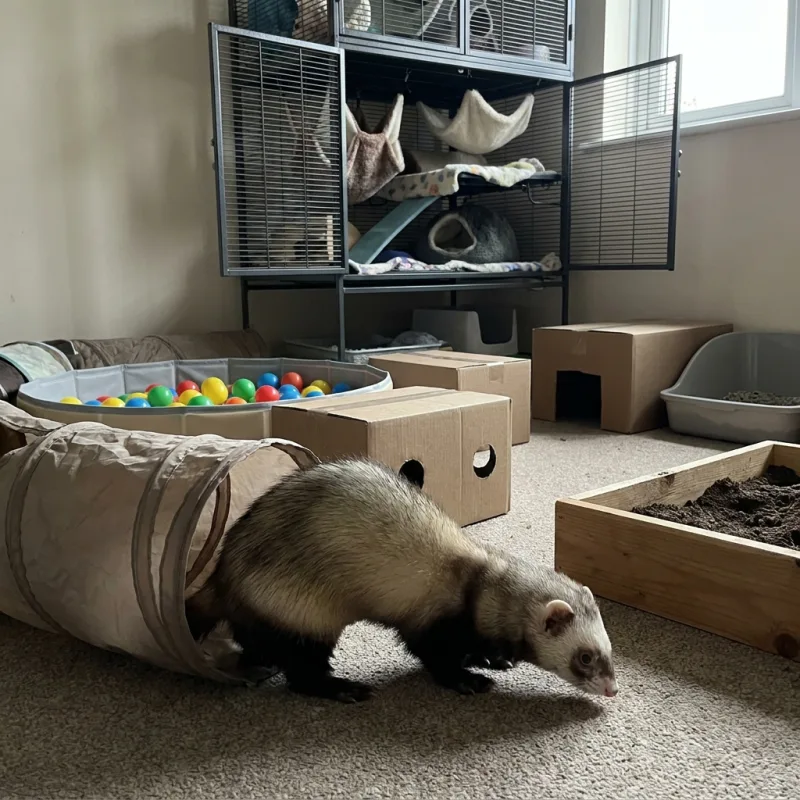
  • Give a pair a ferret-proofed room or a secure enclosure with at least 65 sq ft of ground floor and at least 59 in of height, and add 11 square feet for each further ferret.
  • Levels, ramps, tunnels and hammocks go on top of that floor, not in place of it, with a closed sleeping box for each ferret and a litter tray in the corners they choose.
  • Ferrets also need several hours of supervised free-roaming exercise every day in a thoroughly ferret-proofed space.
Show 3 more
  • They are skilled escape artists who squeeze through gaps as small as 1 in and chew or dig at anything.
  • Block all holes, secure cupboards, and remove soft foam and rubber, which can cause fatal intestinal blockages.
  • Keep them cool; they risk heatstroke above about 82-86°F.

Check your enclosure

Supplies

Setup

  • Ferret room or enclosure with 65 sq ft of floor or more
  • Water bottles, bowls, hides and enrichment
  • Carrier and travel box
  • Digital kitchen scale

Ongoing

  • High-protein ferret kibble (32-38% protein, 18-20% fat)
  • Frozen whole prey or raw meaty pieces if feeding raw
  • Freeze-dried plain meat treats
  • Heavy ceramic food bowl plus a water bowl
  • Water bottle as a backup supply
Show 2 more
  • Airtight kibble bin to stop fats going rancid
  • Kitchen scale for weekly weigh-ins

Safe substrate: Recycled-paper or paper-pellet litter in the tray · Washable fleece, towels or old blankets in the sleeping areas · Hammocks and sleep sacks

Work out the cost

Care routine

Daily

  • Clean the litter boxes
  • Fresh water
  • Keep food available and clear old raw food
  • Out-of-cage play
  • Spot-clean the enclosure
  • Sweep the play space before letting them out
  • Watch them while they are awake
Show 9 more

Weekly

  • Clean the teeth
  • Deep-clean and change bedding
  • Hands-on health check
  • Rotate enrichment
  • Wash hammocks and bedding
  • Weigh-in

Every few weeks

  • Nails and earsevery 2 weeks

Monthly

  • Check nails and teeth
  • Check supplies and dates

Vet: Annual exam and vaccinations, every 12 months (every 6 months from 3 years old)

Tools

Care in depth

Diet

Obligate carnivore; high-protein meat-based
  • As obligate carnivores, ferrets need a diet very high in animal protein and fat with little carbohydrate or fibre.
  • Feed a quality ferret kibble, or a balanced raw or whole-prey diet, with roughly 32-38% animal protein and 18-20% fat.
  • Avoid dog food, fruit, vegetables, and sugary treats.
  • Their gut transit is only about 3-4 hours, so food should be available frequently or free-fed, with constant fresh water.
  • Sugary or carbohydrate-heavy diets are linked to insulinoma, a common ferret cancer.

Health

Signs of good health, and the common problems
  • Ferrets are prone to several serious conditions: adrenal gland disease, insulinoma (pancreatic tumors causing low blood sugar), lymphoma, and dental disease.
  • Early-neutered animals from large breeding mills are especially predisposed to adrenal disease.
  • Annual checks, moving to twice-yearly with age, are advised with an exotic vet.
  • They require core vaccination, typically against canine distemper, which is almost always fatal in ferrets, and against rabies where mandated.
  • Keep them away from infected dogs.
  • Sudden weakness, drooling, or hind-leg collapse can signal an insulinoma crisis needing urgent care.

Is this urgent?

4 warning signs and how fast to act, 2 of them right away

Ferrets hide illness less well than rodents, but they deteriorate faster. Weekly weighing still catches the most.

Go now

Repeated vomiting, pawing at the mouth, or straining with nothing producedGo now. Ferrets swallow things. A blockage is a surgical emergency and they cannot wait it out.
Now
Sudden hind-leg weakness or collapseGo now. Rub a little honey or syrup on the gums on the way if the ferret can swallow. Often a blood-sugar crash, which is treatable if caught quickly.
Now

Today

Steady weight loss over several weeksCall with the weight log. Weekly weigh-ins catch most ferret problems earliest.
Today

Soon

Symmetrical hair loss starting at the tail, or a swollen vulva in a spayed femaleBook an appointment. A well-recognised hormonal condition that responds far better to early treatment. In a male, straining to urinate with this condition is an emergency: go now.
This week

This is general guidance for a healthy adult, not a diagnosis. An exotics vet who knows your animal always overrides it, and the time to find one is before you need one.

Bedding and substrate

3 safe, 3 to avoid

Ferrets do not tunnel through their bedding the way rodents do. The cage needs a litter tray they will use and soft, washable bedding to sleep in.

Safe

Recycled-paper or paper-pellet litter in the trayLow dust, and harmless if a little is swallowed. Ferrets back into corners to toilet, so put a high-backed tray in the corner they choose.
safe
Washable fleece, towels or old blankets in the sleeping areasFerrets burrow under soft fabric to sleep. Wash weekly: ferret odour lives in the bedding rather than in the animal.
safe
Hammocks and sleep sacksUsed constantly. Check for chewed holes and loose threads at every wash.
safe

Never

Clumping clay cat litterDusty, and it clumps if it is swallowed or packs into the nose.
never
Pine and cedar shavingsAromatic oils that irritate the airway.
never
SawdustDust plus, usually, softwood.
never

Top resources for more info

Independent creators and organisations we would send a friend to. We have no affiliation with any of them, and nothing here is sponsored. Links checked 2026-10-22.

Sites

Keep going

Other Small Pets worth knowing

Same axes, same care guides: the honest way to compare them.
More Small Pets guides

Is your enclosure big enough?

These are the smallest sizes that give good conditions, not legal minimums. More room is always better.

Minimum 65 sq ft of floor, for the pair

Every figure, and where it comes from

TVT asks for at least 65 sq ft of ground floor for a pair, at least 59 in high, plus 11 sq ft for each further ferret, with several hours of free-roaming a day as well. This checker tests that ground floor. Levels, ramps, tubes and hammocks belong in the enclosure, but they go on top of the 65 sq ft and do not count toward it. A ferret-proofed room that is theirs at all times meets this as well as an enclosure does. The legal minimums for ferrets that also get daily free-roaming are far smaller: Austria allows 22 sq ft spread over levels, and Switzerland asks for 43 sq ft of ground floor. Ferrets that live in an enclosure all the time, with no free-roaming, need much more: Austria's law asks for 108 sq ft outdoors for one or two and Switzerland's 161 sq ft, and Four Paws accepts only an outdoor enclosure of at least 86 sq ft for two.

Minimum floor area65 sq ft of continuous, unbroken floor
Height59 in minimum. This species climbs, so height is not optional.
CompanyCannot be kept alone. The minimum is 2, and the space above is for that group.
The recognised standards do not agree on this one
TVT, the German veterinary association for animal welfare (Merkblatt 155, Ferrets): At least 65 sq ft of ground floor for a pair and at least 59 in of height, plus 11 sq ft for each further ferret, with several levels; several hours of free-roaming a day recommended. The figure this site uses. Checked 2026-10-23.
Wood Green, The Animals Charity (UK): 8 x 6.5 x 6.5 ft for a pair outdoors, which is 52 sq ft of floor; indoors, round-the-clock access to a secure, ferret-safe room. A little less floor, with more height. Checked 2026-10-23.
Four Paws (Vier Pfoten): Only an outdoor enclosure of at least 86 sq ft for two is acceptable; ferrets already kept without one need daily free-roaming. A larger figure, for outdoor keeping. Checked 2026-10-23.
Switzerland, Tierschutzverordnung and the Federal Food Safety and Veterinary Office (BLV): 43 sq ft of ground floor for two, even with extra levels, plus 5.5 sq ft for each further ferret, and only with several hours of free-roaming a day; 161 sq ft outdoors for ferrets kept without it; keeping ferrets needs a permit. A legal minimum, recorded for context. BLV calls it the absolute minimum. Checked 2026-10-23.
Austria, 2. Tierhaltungsverordnung: Indoors, 22 sq ft of usable floor for one or two ferrets, spread over two or three levels at least 24 in high each, plus 5.5 sq ft for each further ferret, and several hours of free-roaming a day; kept permanently outdoors, 108 sq ft for one or two, plus 27 sq ft for each further ferret. A legal minimum, recorded for context. Checked 2026-10-23.
DEFRA licensing guidance for selling animals as pets (England): 6.5 sq ft for one adult ferret, plus 6.5 sq ft for each extra. For temporary holding in a pet shop, not a home. Checked 2026-10-22.
Merck Veterinary Manual: About 3 x 3 x 2 ft for one ferret. A veterinary figure for a single ferret. Checked 2026-10-22.

What it really costs

Setup, monthly, first year and across a whole life, itemised and with the electricity worked out from the actual wattage. Published figures for the same animal disagree by a factor of four, so the calculator shows ranges rather than picking one.

Can a Ferret eat that?

An obligate carnivore with no caecum: animal protein and fat, almost no carbohydrate or fibre. Food clears the gut in three to four hours, so it should be there all day.

The full list: 21 foods

Never (17)

AlcoholNo safe amount at any body weight on this site.
never
AvocadoPersin, concentrated in the leaves, skin and stone. It damages the heart in birds and in many mammals, rabbits and rodents among them; it has not been studied in reptiles, so treat it as unsafe for them too.
never
CaffeineCoffee, tea and energy drinks. Cardiac and neurological toxicity at tiny doses for an animal this size.
never
ChocolateTheobromine and caffeine. Small mammals and reptiles cannot clear either.
never
Cooked bonesCooked bone splinters and can pierce or block the gut. Bone is only ever fed raw, as part of a raw diet.
never
DairyMerck says not to feed milk or other dairy products. Adult ferrets digest lactose poorly, and dairy causes diarrhoea.
never
Dog foodToo low in animal protein and too high in plant matter for an obligate carnivore.
never
FruitFerrets have no caecum and no use for fruit sugar or fibre. Fruit causes digestive upset and swings in blood sugar, and sugary diets are linked to insulinoma, a common ferret cancer.
never
GarlicSame allium toxicity as onion, and more concentrated by weight.
never
Grains, bread and cerealStarch an obligate carnivore has no use for. Carbohydrate-heavy diets are linked to insulinoma.
never
HayHay is a herbivore's food. A ferret cannot digest it and gets nothing from it.
never
LeekAllium family. Same mechanism as onion and garlic.
never
OnionOrganosulphur compounds damage red blood cells. The whole allium family is out.
never
RhubarbVery high in soluble oxalate, high enough to cause acute kidney injury. The leaves are worse than the stalks.
never
Salty or seasoned human foodSalt, oil and seasoning. Crisps, chips, seasoned leftovers and processed meat are all out.
never
Sugary treatsSugar is linked to insulinoma. No sweet pastes, honey, yoghurt drops or cereal-based treats. (Honey rubbed on the gums is first aid for a blood-sugar crash on the way to the vet, not food.)
never
Vegetables and leafy greensAn obligate carnivore cannot digest plant fibre. It passes through at best, and pieces can cause a blockage.
never

Occasional (2)

Plain cooked eggGood animal protein and a common ferret treat. Cooked, never raw. A small piece, once or twice a week.
occasional
Plain meat treatsThe only kind of treat a ferret should have: a scrap of plain meat or a freeze-dried meat treat. Keep treats small: Merck says under 5 percent of the day's calories, RSPCA Australia under 10. A small piece, as a reward.
occasional

Everyday foods (2)

Complete ferret kibbleA complete, formulated ferret food is the basis of most ferret diets. Check that the first several ingredients are animal-derived, with roughly 32 to 38 percent animal protein and 18 to 20 percent fat. Available all day; ferrets eat many small meals.
everyday food
Raw meat, bone and whole preyA balanced raw diet (muscle meat with raw bone and organ) or whole prey such as thawed mice, rats or day-old chicks is a complete alternative to kibble. Plain muscle meat on its own is not: it is low in calcium and causes bone disease, especially in kits. Fresh or just thawed. Lift anything uneaten within a few hours rather than the next morning.
everyday food

That food is not on our list. If it is not meat, a ferret almost certainly does not need it. Leave it out and check with an exotics vet.

Food and fresh water should be available at all times. Change a ferret's food gradually, mixing the new into the old over a week or two.