Flame Hawkfish
Neocirrhites armatus
Scarlet coral-percher with black bandit eyesIntermediate
- Lifespan
- 5-10 years
- Size
- 3.5 in9 cm
- Social needs
- One per tank (bonded pair only in a large system)
- Time
- 15-20 min daily; reef-standard upkeep
- Cost
- High
- Diet
- Carnivore (frozen mysis, brine, krill, chopped seafood)
Overview
What is this animal?
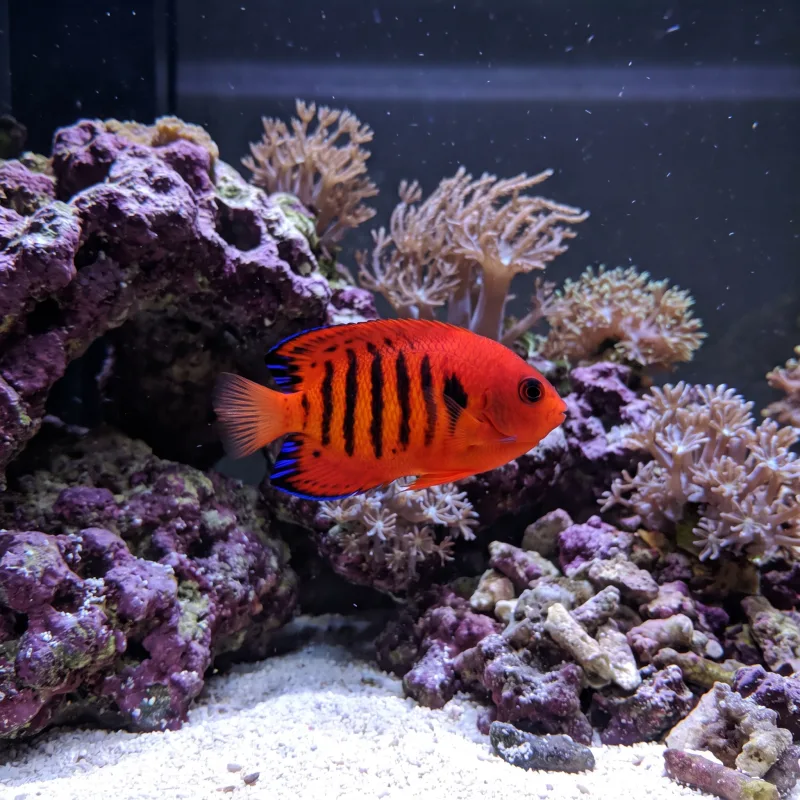
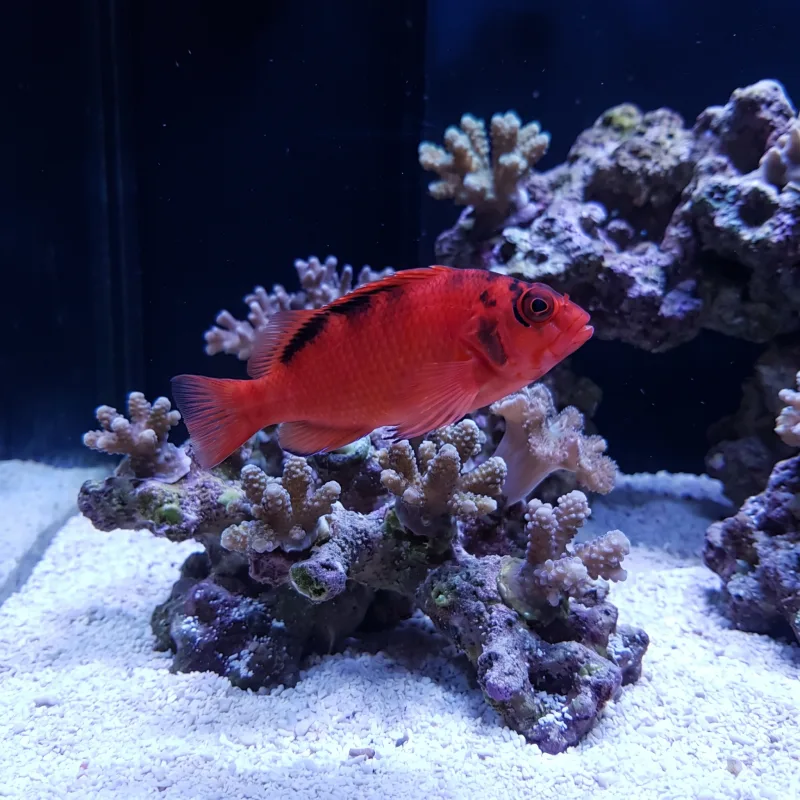
- The flame hawkfish is a small, solid scarlet-red hawkfish marked with black rings around the eyes and a black band running along the base of the dorsal fin.
- At about 3.5 in9 cm it is one of the smaller hawkfish commonly kept, and it comes from western and central Pacific surge zones where it lives wedged inside heads of branching Pocillopora and Stylophora coral.
- Where the longnose hawkfish perches high and surveys the reef, the flame lives low, tucked into branches near the rock, and is noticeably more secretive for its first weeks.
Show 3 more
- It is hardy and full of character once settled, and its bulldog face and pure red colour make it one of the most striking small marine fish.
- Flame hawkfish on sale are wild-caught, mostly from Fiji and nearby Pacific reefs, which keeps prices well above a clownfish.
- A university lab has spawned the species, but as of 2024 no one had reported raising the larvae beyond about two weeks old, so there is no captive-bred stock to wait for; buy from a supplier who can tell you where and how the fish was collected.
Temperament
- A settled flame hawkfish is bold, watchful, and quickly learns to recognise its keeper, but it is a genuine predator of small invertebrates.
- Ornamental shrimp, small hermit crabs, and small snails are at real risk, so build the cleanup crew from larger snails and skip cleaner and sexy shrimp and tiny hermits entirely.
Show 5 more
- It defends its patch of rockwork and can bully small bottom-dwellers such as gobies, blennies, and firefish, especially in smaller tanks.
- Add the hawkfish last, after peaceful fish have established, and give it its own branching territory.
- Keep one hawkfish per tank as a rule.
- Flame hawkfish are protogynous hermaphrodites, so a bonded male-female pair can live together, but only in a large system with plenty of rock; two unpaired fish will fight over the best perch until one is hurt.
- With medium-sized, confident tankmates a single hawkfish causes little trouble and spends its day hopping between lookout points.
A good fit for
- Reef keepers wanting an intense splash of red
- Reefs from 80 gal300 L upward
- Fans of perching, watchful personality fish
- Coral-dominated tanks without prized ornamental shrimp
- Keepers willing to wait for a responsibly collected, already-feeding fish
Common mistakes to avoid
- Shrimp, small hermits, and snails become prey
- Open lids: hawkfish are explosive jumpers
- Two unpaired hawkfish fight; only a bonded pair cohabits, in a large tank
- Adding it before shy bottom-dwellers have settled
- Buying a shipping-stressed fish that never feeds
Enclosure
Minimum 79 gallons300 litres
One of its kind per tank; other compatible species can share it. One per tank (bonded pair only in a large system)
- Provide a cycled reef of at least 80 gallons300 litres with dense branching rockwork or sturdy branching coral set low in the tank, because this hawkfish wedges into structure rather than perching in the open.
- It needs little swimming room, and care references give 30-40 gallons114-151 litres, but the extra volume gives it more lookout points and its smaller tankmates more room to keep away.
- Like all hawkfish it lacks a swim bladder, so it rests on its pectoral fins and moves in short hops instead of cruising.
Show 4 more
- Keep salinity 1.024-1.026, temperature 75-80°F24-27°C, pH 8.1-8.4, ammonia and nitrite at zero, and nitrate below 20 ppm.
- As a surge-zone native it appreciates strong flow and will happily sit in currents that would exhaust more delicate fish.
- A tight-fitting lid is non-negotiable, since startled hawkfish are explosive jumpers and jumping is the most common cause of loss.
- It will not nip corals, though it may irritate a small SPS colony by perching on the same spot day after day.
Supplies
Setup
- Tank, stand and sump
- Return pump and powerheads
- Protein skimmer
- Reef lighting
- Rock and sand
Show 2 more
- Salt mix, refractometer and test kits
- Quarantine tank
Ongoing
- Frozen mysis shrimp
- Frozen krill
- Frozen enriched brine shrimp
- Frozen chopped seafood blend
- Marine carnivore pellets
Show 2 more
- Feeding tongs
- Small thawing cup and strainer
Safe substrate: Aragonite sand · Dry or cured live rock
Care routine
Daily
- Check salinity, temperature and flow
- Check the lid
- Feed
- Head-count and look everyone over
- Top up evaporation with fresh water
Every few days
- Service the skimmer and filter socksevery 3 days
Show 7 more
Weekly
- Clean the glass
- Test the water
- Water change
Monthly
- Calibrate the refractometer
- Check salt, RO/DI and reagents
Less often
- Deep-clean pumps and powerheadsevery 3 months
- Replace RO/DI filter mediaevery 6 months
Health review: Quarterly review with a lid check, every 3 months
Tools
Care in depth
Diet
Carnivore (frozen mysis, brine, krill, chopped seafood)
- Flame hawkfish are carnivores that ambush small crustaceans in the wild.
- Feed frozen mysis, enriched brine shrimp, krill, and finely chopped fresh seafood once or twice daily, and most individuals learn to take a marine carnivore pellet within a few weeks.
- New arrivals often hide and refuse food for the first several days, which is normal, but confirm the fish is eating at the shop before you buy, because shipping-stressed wild-caught specimens sometimes never start.
- Target-feeding near its favourite crevice helps a shy newcomer compete.
- Vary the menu rather than relying on one food, and remove anything uneaten.
- Remember that it will also feed itself on any tank crustacean small enough to crack, so do not count the cleanup crew as part of its diet plan.
Health
Signs of good health, and the common problems
- This is one of the tougher marine fish, with good parasite resistance and a calm response to the minor parameter swings that would stress delicate species.
- Quarantining new arrivals for 3-4 weeks remains best practice all the same.
- Most flame hawkfish losses are not disease at all but jumping through an open lid or starvation in fish that were already failing at import.
- Choose an alert, actively feeding specimen with full body weight behind the head and no pinched belly.
- With stable water and a varied diet a flame hawkfish commonly lives 5-10 years, and well-kept individuals can go longer.
- Watch for the standard marine warning signs of scratching, white spots, or rapid breathing, and treat in a separate hospital tank rather than dosing the reef.
Is this urgent?
6 warning signs and how fast to act, 3 of them right away
In a reef, stability matters more than any single target number. A parameter moving fast does more damage than a parameter sitting slightly off.
Go now
Today
Quarantine every new animal, including corals and inverts. It is the single practice that separates a reef that lasts from a reef that restarts.
This is general guidance for a healthy adult, not a diagnosis. An exotics vet who knows your animal always overrides it, and the time to find one is before you need one.
Bedding and substrate
2 safe, 3 with a caveat, 2 to avoid
In a marine system the rock and the sand are life support, and how you start them decides the first six months.
Safe
With a caveat
Never
This is our general list for saltwater fish. We have not built one specific to Hawkfish yet.
Top resources for more info
Independent creators and organisations we would send a friend to. We have no affiliation with any of them, and nothing here is sponsored. Links checked 2026-10-22.
YouTubers
Sites
Other Saltwater Fish worth knowing
Same axes, same care guides: the honest way to compare them.