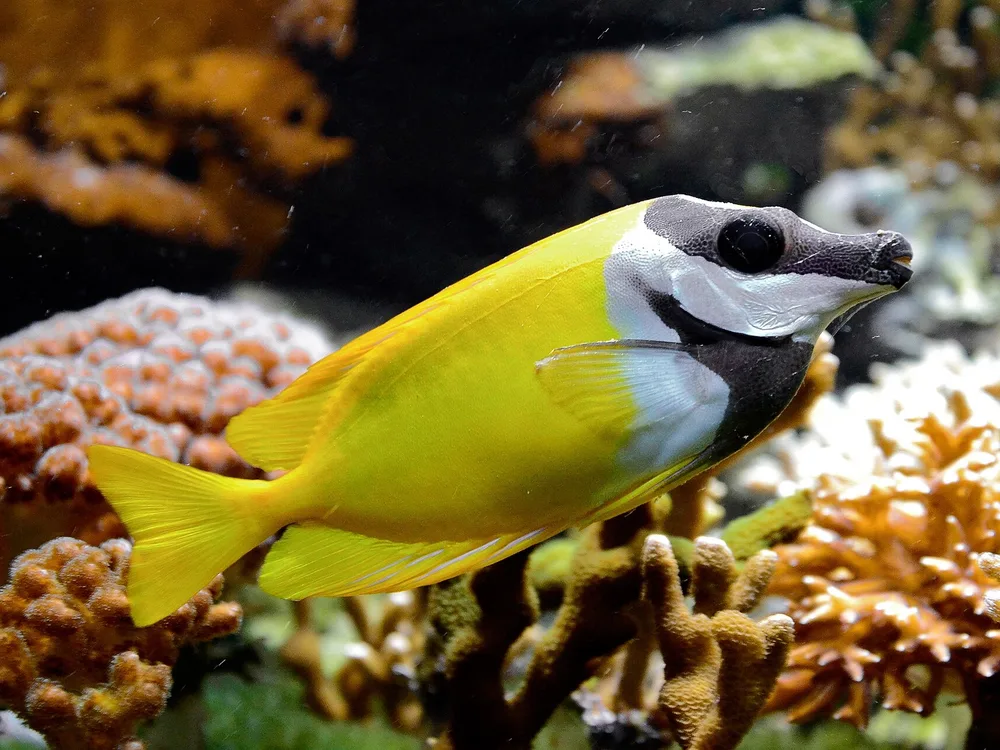
Alexandre Prévot · CC BY-SA 2.0 · Wikimedia Commons (cropped)
Foxface Rabbitfish
Siganus vulpinus
Venom-spined algae mower with a fox's faceIntermediate
- Lifespan
- 8-12 years
- Size
- 9.5 in24 cm
- Social needs
- One per tank; peaceful with dissimilar fish
- Time
- Daily feeding; weekly testing and water changes
- Cost
- High
- Diet
- Herbivore-leaning omnivore (algae, nori, veg)
Overview
What is this animal?
- The Foxface Rabbitfish is a bright yellow grazer with a pointed, fox-like snout and a bold black-and-white banded face.
- It reaches around 9.5 in24 cm as an adult, so it is a genuinely large fish that outgrows midsize tanks.
- Its defining trait is defensive: the 13 dorsal spines, plus the anal and pelvic spines, are venomous, and a sting is sharply painful, so this is a fish you plan handling around.
Show 4 more
- Compared with the tangs it is often bought alongside, the Foxface is hardier, thicker-skinned, and far less territorial, which makes it one of the more forgiving large marine herbivores.
- It is still not a beginner fish: the tank-size requirement is real, and nearly all stock is wild-caught from the Western Pacific because captive breeding is not yet commercially established.
- One quirk catches new keepers out: at night or when stressed it switches to a blotchy brown camouflage pattern.
- That mottling is normal and reversible, not a disease.
Temperament
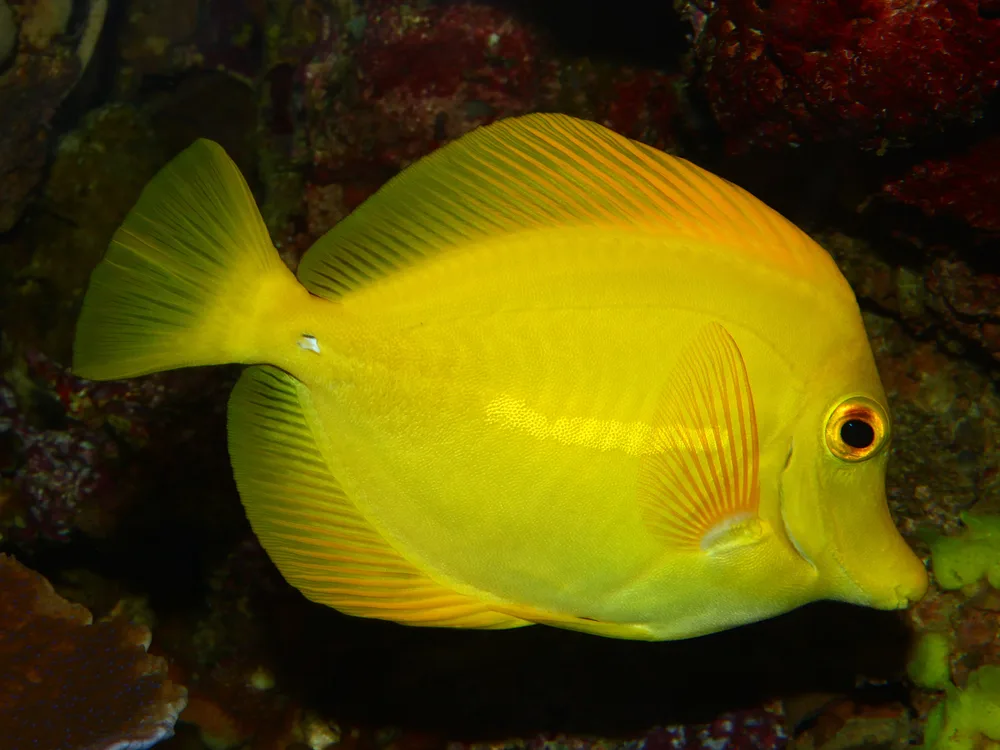
- The Foxface is calm and peaceful toward almost everything it does not resemble, and because it is not a tang it usually coexists with a Yellow Tang or other surgeonfish without the turf wars tangs wage on each other.
- It spends the day openly grazing and cruising, raising its venomous dorsal fin and flashing mottled colour only when it feels threatened.
Show 3 more
- Keep one per tank as the standard rule, since two Foxfaces will squabble unless they arrive as a bonded pair in a very large system.
- It ignores shrimp and small fish, so it fits over communities of gobies, blennies, and cardinalfish without risk.
- Its defence is entirely passive: it never attacks tankmates with its spines, but slow-moving fish that blunder into a raised fin can be stung, and so can a keeper's careless hand during aquascaping.
A good fit for
- Keepers with an established 265-gallon1,000-litre-plus system
- Reef tanks fighting hair or bubble algae
- Communities that already include a tang
- Intermediate marine keepers stepping up in size
- Aquarists wanting a hardier alternative to tangs
Common mistakes to avoid
- Venomous dorsal, anal and pelvic spines - never hand-catch or net carelessly
- Tanks under 265 gal1,000 L or 5 ft1.5 m long
- Underfed individuals nip zoanthids and LPS corals
- Panicking over normal brown night-time mottling
- Nearly all stock is wild-caught - choose suppliers carefully
Enclosure
Minimum 265 gallons1,000 litres
One of its kind per tank; other compatible species can share it. One per tank; peaceful with dissimilar fish
- Provide at least 265 gal1,000 L with a tank length of 5 ft1.5 m or more, because this is an active, open-water grazer that cruises the full run of the aquarium; a 6 ft1.8 m tank suits an adult better long term.
- Care references give 125 gal473 L for an adult.
- This guide asks for more because good conditions are never less than a law requires, and Austria's law asks 265 gal1,000 L for a rabbitfish this size.
Show 6 more
- The 75 gal284 L still quoted in some guides suits only a young fish.
- Keep temperature 75-80°F24-27°C, salinity 1.024-1.026, pH 8.1-8.4, and nitrate low with strong flow and good oxygenation.
- Aquascape with generous rockwork for grazing and a cave it can retreat to, while leaving clear swimming lanes along the front.
- A tight-fitting lid matters, since a startled Foxface can jump.
- Add it to an established tank with some natural algae growth rather than a newly cycled system, and quarantine it like any new marine fish.
- Plan the maintenance routine so you never need to grab it by hand: use a container to guide it rather than a net pressed against venomous spines.
Supplies
Setup
- Tank, stand and sump
- Return pump and powerheads
- Protein skimmer
- Reef lighting
- Rock and sand
Show 2 more
- Salt mix, refractometer and test kits
- Quarantine tank
Ongoing
- Dried marine algae (nori) sheets in bulk
- Magnetic or suction veg clip
- Quality herbivore pellets
- Herbivore frozen food blend
- Second veg clip for a separate grazing station
Show 2 more
- Vitamin or HUFA soaking supplement
- Small thawing cup
Safe substrate: Aragonite sand · Dry or cured live rock
Care routine
Daily
- Check salinity, temperature and flow
- Clip on dried algae
- Feed
- Head-count and look everyone over
- Top up evaporation with fresh water
Every few days
- Service the skimmer and filter socksevery 3 days
Show 8 more
Weekly
- Clean the glass
- Plan hand work around the spines
- Test the water
- Water change
Monthly
- Calibrate the refractometer
- Check salt, RO/DI and reagents
Less often
- Deep-clean pumps and powerheadsevery 3 months
- Replace RO/DI filter mediaevery 6 months
Health review: Quarterly herbivore review, every 3 months
Tools
Care in depth
Diet
Herbivore-leaning omnivore (algae, nori, veg)
- The Foxface is a herbivore-leaning omnivore whose diet must stay green.
- Offer dried marine algae (nori) on a clip daily, alongside quality herbivore pellets and occasional herbivore frozen foods.
- It grazes constantly and famously mows down hair algae, and many individuals will even pick at bubble algae that other fish ignore.
- Underfeeding is the classic mistake with this species.
- A hungry Foxface is the one that starts nipping zoanthids and fleshy LPS corals, which is why it is rated reef-safe only with caution.
- Keep it well fed with several small algae-based feedings and it generally leaves corals alone.
- A meaty, protein-heavy diet is the other error: it dulls colour and undermines long-term health, exactly as it does in tangs.
Health
Signs of good health, and the common problems
- The Foxface has a thick slime coat and is noticeably more resistant to marine ich than the tangs on this site, but resistant is not immune, so quarantine every new arrival.
- Watch newly imported fish for a pinched belly, which signals starvation in the supply chain and calls for immediate, frequent algae feedings.
- As with other marine herbivores, chronic poor diet and water quality can lead to head-and-lateral-line erosion, so keep nitrate low and the diet algae-rich.
- Persistent dark mottling during the day, combined with hiding and refusal to eat, is the signal that something is actually wrong, as opposed to the normal night-time colour change.
- Keeper safety is part of the health picture here.
- A sting from any of the fin spines causes intense pain and swelling; immerse the wound in hot (not scalding) water and seek medical advice if symptoms spread or you have any allergic reaction.
Is this urgent?
6 warning signs and how fast to act, 3 of them right away
In a reef, stability matters more than any single target number. A parameter moving fast does more damage than a parameter sitting slightly off.
Go now
Today
Quarantine every new animal, including corals and inverts. It is the single practice that separates a reef that lasts from a reef that restarts.
This is general guidance for a healthy adult, not a diagnosis. An exotics vet who knows your animal always overrides it, and the time to find one is before you need one.
Bedding and substrate
2 safe, 3 with a caveat, 2 to avoid
In a marine system the rock and the sand are life support, and how you start them decides the first six months.
Safe
With a caveat
Never
This is our general list for saltwater fish. We have not built one specific to Rabbitfish yet.
Top resources for more info
Independent creators and organisations we would send a friend to. We have no affiliation with any of them, and nothing here is sponsored. Links checked 2026-10-22.
YouTubers
Sites
Other Saltwater Fish worth knowing
Same axes, same care guides: the honest way to compare them.